2027 Is an Online Ed.D. in Leadership and Learning in Organizations a Good Fit for Federal Workforce Development Leaders?
Audited and Verified:
Our Editorial and Data Verification Process
Research.com uses government datasets, official education statistics and primary institutional information to support its career and degree guides. Our review process checks factual accuracy, occupational definitions, source dates and the requirements associated with the credentials discussed.
How This Article Was Fact-Checked
Our editorial team verifies salary estimates, employment projections, education requirements and program information against original data providers and official organizations. Salary figures are checked against the relevant occupational definitions and reporting periods. Information about licensure, accreditation and required in-person training is reviewed separately.
Fact-checked and verified on:

Co-Founder and Chief Data Scientist
Federal workforce development leaders must improve how agencies build skills while working within hiring rules, budgets, and public accountability requirements. An online Ed.D. in Leadership and Learning in Organizations may strengthen that work, but its value depends on the responsibilities you already hold and the problems you need to solve.
This guide examines what the degree can prepare you to do, where it may fall short, and how to assess its cost, format, and career relevance before committing to doctoral study.
Key Things You Should Know
- An online Ed.D. is most useful when you lead workforce learning or organizational change and need sustained practice in evaluating and improving those efforts - not simply a credential for promotion. Federal advancement depends on position requirements and demonstrated experience.
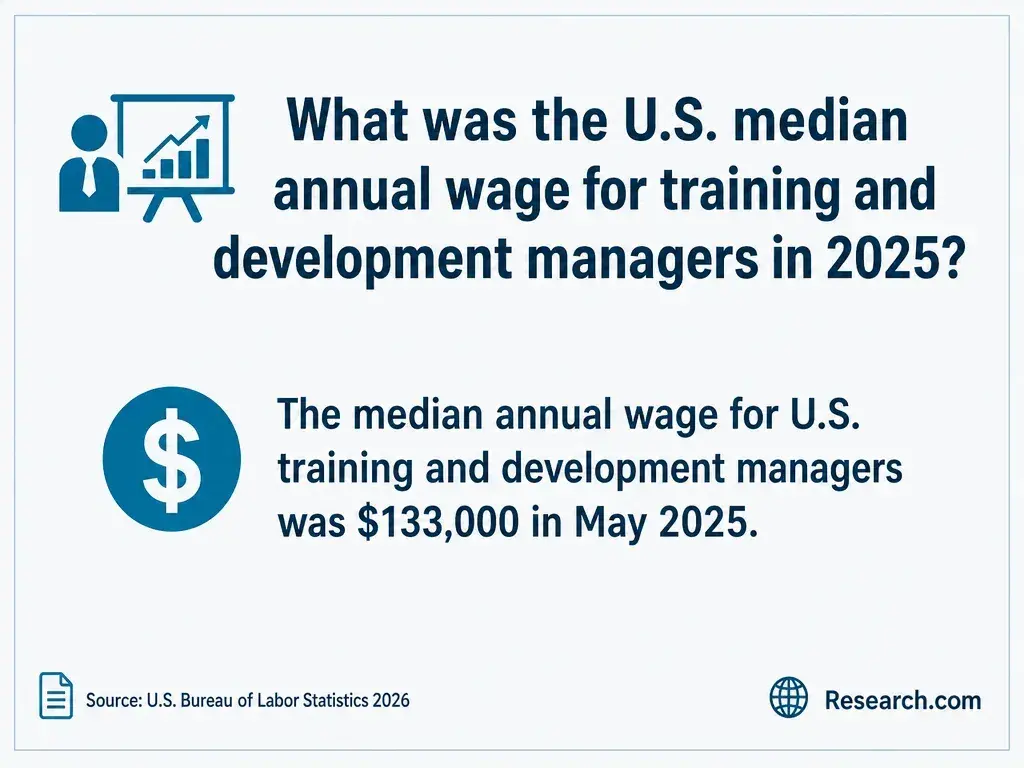
- The $133,000 median annual salary for training and development managers is a national occupational figure, not a federal pay estimate or an Ed.D. outcome.
- Before enrolling, confirm the program's applied-project rules, live attendance and travel requirements, total charges, and whether your agency will authorize the access your proposed work requires.
Is an online Ed.D. in Leadership and Learning in Organizations a good fit for federal workforce development leaders?
It can be a good fit for an established leader who can use doctoral study to improve a consequential workforce-development problem. Examples include evaluating whether supervisor training changes workplace practice, redesigning a reskilling strategy, or improving how learning needs are identified across offices. An Ed.D. is a practice-oriented doctorate; its strongest potential value is connecting leadership, adult learning, and applied inquiry to decisions you are positioned to influence.
That fit weakens if your immediate goal is to meet a specific vacancy's minimum qualifications, learn one technical skill, or obtain a promotion on a predictable schedule. Federal position requirements and selection processes are separate from a university's degree requirements. Agency rotations, supervised improvement projects, an MPA, or focused evaluation training may address a narrower gap sooner.
The comparison below starts with the outcome you need, rather than the prestige of the credential.
| Path | Best fit for a federal workforce leader | Main limitation |
| Leadership and learning Ed.D. | Leading and studying complex learning or organizational improvement in practice | Substantial time and cost; no automatic advancement |
| MPA or focused public-management study | Building broader public administration, budgeting, or governance preparation | May offer less depth in adult learning and applied doctoral inquiry |
| Targeted training or agency leadership development | Closing a defined skill gap or gaining near-term leadership experience | Usually less sustained research and cross-disciplinary study |
| Research-focused PhD | Preparing for a career centered on original scholarly research | May be less aligned with improving a current agency practice |
What does an online Ed.D. in Leadership and Learning in Organizations prepare graduates to do?
A well-matched program can help leaders diagnose learning and performance problems, design development initiatives, evaluate implementation, and communicate evidence to decision-makers. In a federal setting, that could mean separating a training gap from a problem caused by workflow, incentives, staffing, or policy. Training is not an adequate remedy for every performance issue.
Doctoral study may also improve a leader's ability to frame researchable questions and interpret evaluation findings without claiming that a small workplace study proves causation. Those capabilities become valuable when paired with authority to act, agency subject-matter expertise, and cooperation from program owners. The degree alone does not confer those conditions.
What careers can federal workforce development leaders pursue with this Ed.D.?
An experienced federal leader might use the degree in learning and development management, talent or leadership development, organizational improvement, program evaluation, or senior workforce strategy. A move to consulting or another sector is possible, but employers will assess project results, management scope, technical expertise, and sector knowledge alongside education.
For context, the U.S. Bureau of Labor Statistics reports a May 2025 median annual salary of $133,000 for training and development managers. That figure covers an occupation across employers; it is not a forecast of federal pay, a starting salary, or a return on this degree. Compare actual vacancies with your résumé and the applicable federal pay structure instead of using a national median to justify tuition.
If you are already directing substantial initiatives, a doctorate may help you lead more rigorous improvement work. If you have limited responsibility for budgets, staff, or implementation, obtaining that experience may do more for your next application than adding a credential first.
Relevant study may cover adult learning and learning transfer, organizational change, leadership, qualitative and quantitative methods, and program evaluation. For federal leaders, the key curricular question is whether assignments let you examine implementation under real governance and resource constraints - not whether a course title merely includes "leadership." Verify required courses and electives with each program.
Applied doctoral work varies. One institution may require a dissertation in practice; another may use a different capstone or dissertation structure. Comparing Ed.D. dissertation alternatives can clarify the terminology, but the program must confirm its actual deliverable and approval process. Agency data access, employer permission, university review, confidentiality, and publication permission are separate questions; employment at an agency does not settle any of them.
Requirements vary by institution. Programs may assess a prior degree, graduate academic record, professional experience, recommendations, and a statement explaining the leadership or learning problem the applicant hopes to study. Some set specific graduate-credit or experience conditions; others do not. Federal service is relevant evidence when you can describe your decisions, collaborators, and results without disclosing restricted information.
Ask admissions staff to distinguish credits considered for eligibility from credits that would actually apply toward doctoral requirements. A prior specialist degree or unfinished doctoral study does not automatically shorten an Ed.D.; readers considering doctoral progression after an education specialist degree should request a written, program-specific credit evaluation.
Expect a multiyear commitment, but do not rely on a generic completion estimate. Required credits, course sequencing, cohort schedules, research approvals, and the final project can all affect the timeline. Ask for the published degree plan and completion rules for your entry term, including what happens if an assignment, leave, transfer, or agency reorganization disrupts your project.
If you have completed doctoral coursework elsewhere, Ed.D. pathways for students with prior doctoral study are worth examining. An "all but dissertation" history does not itself establish transfer eligibility or remove a new program's coursework and research requirements.
There is no reliable single price without a named institution and enrollment plan. Request a written estimate covering required tuition and fees, possible tuition changes, technology charges, any campus travel and lodging, and charges if the final project extends beyond the planned schedule. Then calculate the amount you would personally owe after confirmed aid or employer support - not after hoped-for reimbursement.
Federal employees should check their agency's education-assistance rules before assuming the degree qualifies. Ask whether approval must precede enrollment, which expenses are covered, what academic or service conditions apply, and whether changing jobs affects reimbursement. Guidance on funding for higher education leadership doctorates can inform the search, but available support and eligibility must be confirmed for this program and your agency.
Online delivery removes a routine commute, not necessarily fixed obligations. Live classes, group meetings, residencies, and workplace research may still require travel or protected time. A campus program may make in-person faculty and peer interaction easier, while an online program may let a federal employee stay in their role and apply coursework locally. Neither format is inherently faster or more rigorous.
When comparing Ed.D. completion timelines, check the sequence of required courses and project milestones rather than the shortest advertised duration. Also confirm attendance rules, meeting times, campus visits, and what support remains available if your duty station or schedule changes.
Federal workforce development leadership does not generally depend on an educator license simply because an applicant holds an Ed.D. A leadership and learning doctorate also does not itself award a professional certification or qualify someone for a regulated school-administrator position. Specific federal vacancies may impose their own education or experience requirements.
If your goal involves a licensed education role, ask the university whether the exact program is approved for that credential and confirm eligibility with the relevant state authority. Do not infer licensure preparation from the university's accreditation or from a leadership course.
How can federal employees evaluate an accredited online Ed.D. program?
Start by verifying the university's institutional accreditation with the accreditor and the U.S. Department of Education's accreditation records. Then examine the specific degree: its required curriculum, faculty guidance, project rules, attendance expectations, charges, and published outcomes, including how any completion figures are defined.
Before applying, put your likely agency problem beside the program's requirements. Ask the program director what kinds of workplace or external projects qualify and who approves a change of project site. Separately, ask the appropriate agency officials what data, staff participation, use of official time, and public sharing could be authorized. A promising program is one you can complete ethically and use in your actual role - not merely one that describes itself as flexible or accredited.
Other Things You Should Know About EdD Leadership
Do not assume so. Ask your supervisor and the office that administers agency training or education assistance whether approved study time is available and get the terms in writing.
Only within your agency's disclosure rules. Use an approved, non-sensitive description of your responsibilities and ask the appropriate security or ethics office before sharing uncertain details.
Enrollment does not override federal ethics or outside-employment rules. Seek any required agency review before accepting work, especially when a client's interests overlap with your official duties.
Ownership and sharing rights depend on university policies, agency rules, your duties, and any project agreement. Resolve those terms before committing an agency-based project or promising to publish its findings.
- Human Capital: Selected Agencies' Experiences and Lessons Learned in Designing Training and Development Programs https://www.govinfo.gov/content/pkg/GAOREPORTS-GAO-04-291/html/GAOREPORTS-GAO-04-291.htm
- Types of Financial Aid: Grants, Work-Study, and Loans | studentaid.gov https://studentaid.gov/understand-aid/types
- General Schedule Qualification Policies | U.S. Office of Personnel Management https://www.opm.gov/policy-data-oversight/classification-qualifications/general-schedule-qualification-policies/
- Cost of Attendance (Budget) | 2025-2026 Federal Student Aid Handbook https://fsapartners.ed.gov/knowledge-center/fsa-handbook/2025-2026/vol3/ch2-cost-attendance-budget
- 5 CFR Part 610 -- Hours of Duty | ecfr.gov https://www.ecfr.gov/current/title-5/chapter-I/subchapter-B/part-610
- Accreditation in the U.S. | ed.gov http://www.ed.gov/laws-and-policy/higher-education-laws-and-policy/college-accreditation/accreditation-in-the-us
- Research & Capstone Projects - PennWest Career Center https://career.pennwest.edu/channels/research-capstone-projects/
- What's the Difference Between Asynchronous and Synchronous Learning? | Ohio State Online https://online.osu.edu/content-hub/blogs/whats-the-difference-between-asynchronous-and-synchronous-learning/