2027 From Dental Assistant to Public Health: Planning a Bachelor's Pathway

Co-Founder and Chief Data Scientist
Dental assisting gives you firsthand experience with prevention, patient communication, and barriers to care. Moving into public health means learning to address those issues across communities rather than one appointment at a time. For dental assistants considering a bachelor's degree, the crucial questions are which credits will count, what new skills employers expect, and whether the investment fits the job you want.
This guide helps you compare degree pathways, prepare for admission, and test the likely time and cost against realistic career options.
Key Things You Should Know
- A public health bachelor's can support entry-level community outreach, program coordination, and health education work; dental assisting experience helps, but the degree alone does not qualify you for every role.
- A bachelor's commonly requires about 120 semester credits. Dental assisting coursework may transfer without satisfying major requirements, so request an official degree audit before estimating your remaining time or cost.
- Compare programs on credits applied to graduation, required fieldwork, scheduling, and institutional accreditation - not the advertised transfer-credit total or online label alone.
What public health careers can dental assistants pursue with a bachelor's degree?
The closest transition is from helping patients navigate oral care to helping a community access prevention and other health services. A public health bachelor's can make a dental assistant more competitive for some entry-level roles, particularly when paired with documented outreach, scheduling, education, or data experience. Job requirements still vary by employer and state.
The roles below differ in what they ask you to do. Use the tasks - not just the title - to decide which courses and practical experience to seek.
| Potential role | Typical work | Preparation to demonstrate |
| Community health worker or outreach worker | Connect people with services, share health information, and document follow-up | Community engagement, communication, and knowledge of local resources; some employers require specific training |
| Public health program assistant or coordinator | Support events, referrals, reporting, and partner communications | Organization, spreadsheets, basic evaluation, and reliable documentation |
| Oral health outreach or prevention staff | Support school, clinic, or community prevention initiatives | Dental knowledge plus population-level education and partnership skills |
| Health education specialist | Develop, deliver, or assess health education activities | Relevant bachelor's preparation and experience suited to the employer's duties |
Dental assisting does not, by itself, provide the analytical preparation for an epidemiologist role or the authority to practice dental hygiene or dentistry. If a target job routinely asks for graduate education, investigate that requirement before committing to a long academic sequence; a public health graduate scholarship eligibility guide is relevant to that later decision, not a reason to enroll in graduate study now.
What bachelor's degree pathway leads from dental assisting to public health?
There is no single dental-assisting-to-public-health bridge. The best route depends on whether you have a certificate, an associate degree designed for transfer, an applied associate degree, or substantial general education already completed. A BA or BS in public health may fit broad population-health goals; a BAS or degree-completion program may be worth comparing if it is designed to accept applied technical coursework. Program names do not establish which credits will count.
These starting points call for different credit checks before you apply.
| Starting point | Main transfer question | Likely planning priority |
| Dental assisting certificate | Is any work transcripted as college credit, and will the university accept it? | General education and introductory major requirements |
| Transfer-oriented associate degree | Which courses satisfy specific bachelor's requirements? | Major prerequisites and upper-division sequencing |
| Applied associate degree | Does the destination program apply occupational credits toward graduation? | Compare BAS and traditional BA or BS degree audits |
| Prior college work without a degree | How do completed courses apply to the current catalog? | Missing requirements, course recency, and residency credits |
Send transcripts from every college attended to each prospective institution. Ask its transfer-credit office to evaluate courses, then ask a public health adviser for a degree audit showing general education, prerequisites, major requirements, electives, and credits that must be earned there. A list of affordable shorter online public health degrees can help you identify programs to investigate, but only the receiving school can determine your remaining coursework.
Which public health bachelor's degree requirements should dental assistants expect?
Separate admission to the university from admission to the public health major and, later, eligibility to graduate. Some programs admit students directly to the major; others require prerequisite courses or a separate application. Published GPA, transfer-credit, and course-grade rules must be checked for the entry term you intend to use.
Many bachelor's pathways include general education, introductory biology or other science, mathematics or statistics, writing, upper-division public health courses, and a capstone or field experience. These are common patterns, not universal dental-assistant prerequisites. Clinical training may strengthen your background while leaving a statistics or writing requirement unmet.
If a college initially awards elective credit for a comparable course, ask about its documented substitution or transfer-appeal process rather than assuming the audit cannot change.
Protect your academic options by checking the sequence before registering: a required statistics course, for example, may need to be completed before an upper-division methods class. If graduate study is a later possibility, strong undergraduate work can matter; advice on strengthening a lower-GPA public health master's application addresses a different admissions decision and should not be mistaken for bachelor's requirements.
Online study may let a working dental assistant avoid a commute, but it does not necessarily make deadlines, group projects, exams, or fieldwork self-paced. Campus-based programs may offer easier access to local faculty, student organizations, and community partners, but fixed class times can conflict with clinic hours. Either format can work if its actual obligations match your schedule.
Before choosing, request a sample course schedule and ask whether lectures are recorded, when required live sessions occur, how often upper-division courses run, and whether an internship can be completed near home.
Compare any mandatory campus visits and field-site hours as carefully as class times. Online public health bachelor's accelerated class options can help identify shorter course formats; a shorter term usually concentrates the work rather than removing it.
Public health courses shift the unit of attention from the individual patient to patterns of health across populations. Expect introductory epidemiology, statistics or biostatistics, social and behavioral health, health policy, environmental health, and program planning or evaluation in many programs. Exact titles, prerequisites, and elective choices differ.
For a dental assistant, the most valuable learning gap may not be another course on oral anatomy. Epidemiology teaches you to interpret patterns of disease; statistics helps you assess claims; program evaluation helps you ask whether an outreach activity reached its intended audience. An oral health education project can connect prior clinical knowledge to these skills, provided the program offers suitable coursework or a supervised placement.
Choose electives by the work you hope to do. Community health and communication suit outreach; stronger quantitative coursework suits later research preparation. A research-focused student may eventually compare a public health PhD affordability guide, but doctoral study is neither a standard continuation of this bachelor's pathway nor necessary for most entry-level outreach jobs.
Describe what you actually did, not just where you worked. Patient education, infection-prevention procedures, appointment follow-up, and coordination with clinicians can demonstrate communication and reliability. If you helped with a school event, referral process, or outreach activity, explain your responsibilities without claiming that you designed or evaluated the whole program.
Connect those examples to a specific reason for studying public health: perhaps you noticed recurring access barriers and want to learn how organizations assess and address them.
Ask a supervisor for a recommendation only if the bachelor's program requests one; an employment reference cannot replace required transcripts or prerequisites. Advice about online public health master's no-letter application paths concerns graduate admissions, whose rules should not be applied to undergraduate applications.
A bachelor's degree often totals about 120 semester credits and is commonly planned as four years of full-time study from the beginning. That benchmark says little about a dental assistant's remaining time: accepted occupational credits might count only as electives, while missing prerequisites, infrequently offered courses, or part-time enrollment can extend completion. A written degree audit is more useful than an advertised "finish in two years" claim.
Compare the full remaining cost, not tuition alone. Include mandatory fees, books, technology, travel or lost work hours for fieldwork, and the number of terms you would actually attend. The public health bachelor's affordability guide can help assemble a shortlist, but use each school's current charges and your own audit to estimate cost.
Ask its financial-aid office how your enrollment level and satisfactory academic progress affect aid; ask your employer whether education assistance is available rather than assuming it is.
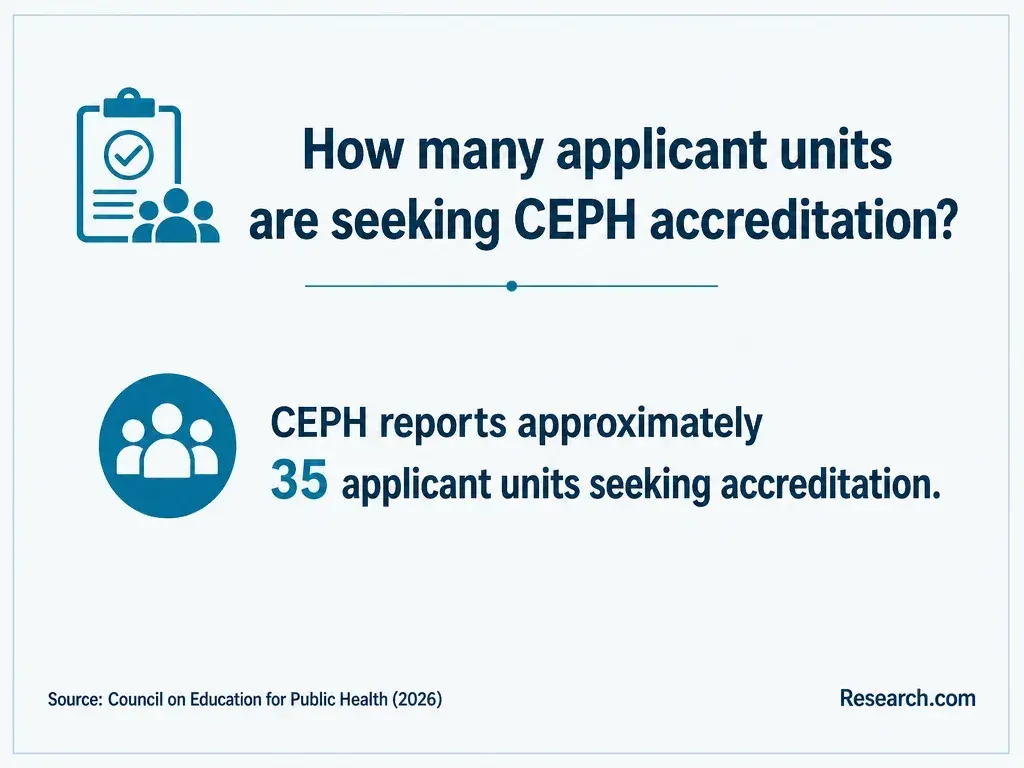
First, confirm that the university holds recognized institutional accreditation. This matters for evaluating the institution and can affect credit transfer and financial-aid eligibility. Then check whether the public health degree has accreditation from the Council on Education for Public Health (CEPH), if that distinction matters to your goals.
CEPH accredits specified public health schools, units, and standalone programs; a university's institutional accreditation does not mean its public health bachelor's is CEPH-accredited. Check the accreditor's listing and the program's description to determine the exact accredited entity and whether your degree is within its scope.
If an MPH is a possible later step, comparing accreditation across online MPH programs is a separate exercise: the status of a future master's program does not establish the status of your bachelor's.
There is no general US license to work in public health. Entry-level program and outreach jobs may require no professional certification, although employers or states can set role-specific training requirements. The Certified in Public Health (CPH) credential and health education credentials such as CHES have separate eligibility and examination rules; a bachelor's diploma does not award them automatically.
If you intend to keep performing regulated dental assisting duties, check your state's dental board requirements. A public health degree does not replace dental assisting permissions, qualify you as a dental hygienist, or confer another clinical license. Nor is doctoral study a certification shortcut: online epidemiology doctorate financial assistance is relevant only if you later pursue advanced research training, not to establish eligibility for entry-level public health work.
What salary and job outlook can public health graduates expect?
There is no reliable single salary for "public health bachelor's graduates." Pay depends on the occupation, employer, location, and experience. As one relevant benchmark, the US Bureau of Labor Statistics reported a $51,030 median annual wage for community health workers in May 2024. That is an occupation-wide figure - not a starting offer, a wage for dental assistants changing careers, or an outcome promised by a degree.
Compare openings against your intended role rather than assuming every public health job shares one outlook. Read local postings to identify required experience, credentials, and pay, then weigh likely entry-level opportunities against tuition and any income you would forgo. Advanced-degree earnings should not be used to justify a bachelor's investment; a public health doctorate financial planning and outcomes comparison addresses a different career stage.
Other Things You Should Know About Public Health
Yes. Ask local health departments, community clinics, or oral health nonprofits about outreach support or supervised volunteer opportunities. Use the experience to test whether you enjoy population-level work, while respecting patient privacy and each organization's training rules.
That can preserve income and keep you connected to oral health, if course and fieldwork schedules permit. Compare reduced-hours and part-time study options before leaving a job; neither arrangement is automatically faster or cheaper.
Possibly, if the program approves the site, supervisor, learning objectives, and work as distinct from routine job duties. Obtain approval before relying on the placement.
It may be useful for outreach, prevention programs, or community partnerships. If your goal is primarily expanded clinical duties, check the specific dental credential or license required first; it may be a more direct route.
- Cost of Attendance (Budget) | 2025-2026 Federal Student Aid Handbook https://fsapartners.ed.gov/knowledge-center/fsa-handbook/2025-2026/vol3/ch2-cost-attendance-budget
- Careers in Public Health - New York State Department of Health https://www.health.ny.gov/prevention/public_health_works/careers/
- Oral Health Workforce, Education, Practice and Integration | nih.gov https://www.ncbi.nlm.nih.gov/books/NBK578298/
- The Dental Public Health Workforce: Employer Expectations and Future Directions - PMC https://pmc.ncbi.nlm.nih.gov/articles/PMC12445252/
- Guidance: Dental Assistant Certificate vs. Certified Dental Assistant | NYS Education Department https://www.acces.nysed.gov/bpss/guidance-dental-assistant-certificate-vs-certified-dental-assistant
- Oral Health Program: Dental Assistant | wisconsin.gov https://www.dhs.wisconsin.gov/oral-health/dental-assistant.htm
- Bachelor of Science in Public Health | charlotte.edu https://ech.charlotte.edu/degrees-and-programs/phs-undergraduate-programs/bachelor-science-public-health-bsph-2/
- Tuition Basics | University of Phoenix https://www.phoenix.edu/tuition-financial-aid.html
- Dental assisting classes | degree | Stark State College, Ohio https://www.starkstate.edu/academics/explore-all-programs/dental-assisting/
- 3 Types of Dental Hygiene Degrees | University of Bridgeport https://www.bridgeport.edu/news/types-of-dental-hygiene-degrees/