2027 Fastest Online Oceanography Degree Programs You Can Finish in Under 2 Years

Co-Founder and Chief Data Scientist
Many students seeking advancement in oceanography face limited time due to work or personal obligations. According to the National Center for Education Statistics, 35% of online science degree students aim to complete their programs within two years or less. This trend reflects growing demand for accelerated, flexible education paths. However, identifying reputable oceanography programs that meet these criteria remains challenging.
This article examines the fastest online oceanography degree programs available in the US, focusing on those that can be completed in under two years. It provides key details to help prospective students make informed decisions quickly and efficiently.
Key Benefits of Online Oceanography Degree Programs You Can Finish in Under 2 Years
- Accelerated online oceanography degrees enable students to enter the workforce up to 40% faster, meeting rising demand as NOAA forecasts a 6% job growth through 2030 in related marine science roles.
- Completing programs online reduces expenses by eliminating commuting and housing costs; studies show accelerated degrees typically cost 20-30% less than traditional timelines.
- Flexible schedules suit working adults balancing jobs or family, with online oceanography enrollment rising 15% annually, reflecting growing acceptance of distance learning quality.
What Features Make an Online Oceanography Program Accelerated?
Accelerated online oceanography degree programs offer an important pathway for students aiming to enter the workforce faster. Completing these programs in under two years can reduce educational costs and speed career advancement in a competitive field. Research shows students in accelerated online science programs, including oceanography, are 30% more likely to finish within two years than those in traditional courses.
- Compressed course terms: Classes typically run 5 to 8 weeks rather than a full semester, enabling students to concentrate on fewer subjects at once and move more quickly through the curriculum.
- Higher course loads: Allowing students to take more credits simultaneously cuts down the total number of terms required to graduate, though it demands strong time management skills.
- Flexible scheduling: Asynchronous formats let learners access lectures and assignments on their own time, helping maintain continuous progress around work or personal commitments.
- Streamlined curricula: These programs focus intensely on core oceanography topics and limit electives, which eliminates unnecessary coursework and saves time.
- Targeted advising: Dedicated academic advisors assist students in planning an efficient degree path that avoids delays and maximizes credit applicability.
For those interested in fast track oceanography courses with easy admissions, this approach balances rigor with flexibility. Students seeking related accelerated opportunities might also explore online doctoral programs in education as another example of speed and accessibility in higher education.
What Are the Online Oceanography Degree Formats You Can Finish in Under 2 Years?
Program format plays a critical role in enabling accelerated online oceanography degree programs to be completed in under two years by shaping the pace and structure of coursework. Choosing the right format can significantly impact how quickly students progress toward graduation. The following outlines common fast track online oceanography degree formats that support accelerated completion:
- Accelerated term-based programs: These condense traditional semesters into shorter sessions, allowing students to complete more courses annually and maintain consistent progress.
- Competency-based education (CBE): This format enables students to advance by demonstrating mastery of skills rather than spending fixed time in class, making it ideal for self-motivated learners seeking speed.
- Full-time intensive tracks: Designed for those who can commit significant weekly hours, these increase course loads to reduce total degree completion time.
- Year-round enrollment models: By eliminating summer breaks, these programs offer continuous course availability, helping students avoid interruptions in their studies.
Career-focused students often find these strategies appealing because research from the U.S. Department of Education indicates degree completion times can be shortened by up to 30%-40% compared to traditional formats. Those interested in related fields may also explore options such as a online counseling degree for complementary skills. The variety of accelerated online oceanography degree programs enables flexible approaches to education, accommodating diverse schedules and learning preferences.
What Are the Admission Requirements for Accelerated Online Oceanography Degrees?
Admission criteria are crucial for students considering accelerated online oceanography degree programs that can be completed in less than two years. These fast-track options demand higher eligibility expectations since the pace is significantly faster than traditional programs. Below are common requirements prospective students should anticipate when evaluating fast-track online oceanography degree enrollment requirements.
- Minimum GPA: Most programs require an undergraduate GPA of around 3.0 or higher to ensure academic readiness for the accelerated curriculum.
- Relevant Coursework: Prior study in foundational sciences such as biology, chemistry, physics, and calculus is generally expected to prepare students for complex subject matter covered quickly.
- Work Experience: Some programs value professional experience in related fields, which can demonstrate practical knowledge beneficial for intensive study.
- Placement Tests or Competency Exams: These assessments verify proficiency in essential topics, helping programs tailor support or confirm a candidate's eligibility before enrollment.
- Time Management and Motivation: Admissions often look for evidence of strong organizational skills and academic resilience through personal statements or recommendations, given the demanding pace of accelerated courses.
Compared to standard timelines, these admission criteria are generally more stringent to accommodate the fast pace and rigor of condensed oceanography programs. Students exploring accelerated pathways should also consider reviewing options like an online masters in psychology to compare admission frameworks and program flexibility. Evaluating the admission criteria for accelerated online oceanography degrees will help prospective learners align their preparation with program expectations and increase chances of successful enrollment.
Breakdown of Public Fully Online Title IV Institutions

Transfer credits play a crucial role for students aiming to shorten their path to an online oceanography degree, often saving both time and money. Nearly 40% of online undergraduates utilize credits from previous coursework, underscoring how these policies can accelerate program completion. Below are key points about how fast online oceanography programs generally handle transfer credits.
- Maximum Transfer Limits: Many programs allow between 30 and 60 semester credits to be transferred, which frequently accounts for half or more of a bachelor's degree. This upper limit ensures students still engage deeply with program-specific courses.
- Course Equivalency Evaluation: Prior courses are reviewed for content similarity and grade standards, commonly requiring at least a "C" grade from accredited institutions. Classes in related sciences like biology, chemistry, physics, and geology tend to transfer more smoothly.
- Required On-Campus or Program Credits: Institutions usually mandate completing 30 to 40 credits within their own curriculum to maintain academic integrity and specialized knowledge acquisition.
- Time Reduction and Graduation Speed: Effectively applied transfer credits can reduce degree timelines significantly, making it possible for students to graduate in fewer than two years if they have substantial prior coursework.
I spoke with a professional who earned his online oceanography degree in under two years to understand the transfer credit experience firsthand. He shared how navigating the credit evaluation process initially felt daunting, involving detailed course descriptions and transcripts. "It was nerve-wracking wondering if my old classes would count, but once they did, it felt like unlocking a fast track." He emphasized the importance of thorough communication with academic advisors and how transfer credits dramatically cut down his study time, allowing him to balance work and education effectively.
Balancing an accelerated online oceanography degree with work or personal responsibilities requires careful planning of course loads. Managing too many classes at once can overwhelm students and hinder success, especially when programs are designed for faster completion. Notably, a majority of accelerated STEM students-68%-choose part-time enrollment to maintain balance, indicating the significance of manageable pacing. Below are key factors influencing how many classes students typically handle concurrently.
- Concurrent classes: Most students enroll in 2 to 4 classes simultaneously, aligning with the intensive nature of accelerated courses while allowing space for other commitments.
- Term length: Accelerated programs often feature shorter sessions lasting 5 to 8 weeks, compared to the traditional 15-week semester. These condensed terms require focused effort over a shorter period, which influences how many classes can be effectively managed at once.
- Course sequencing and pacing: Programs may adopt back-to-back or overlapping term structures. Some students take one or two classes per term consecutively, while others manage overlapping classes with denser weekly workloads, making time management essential for success.
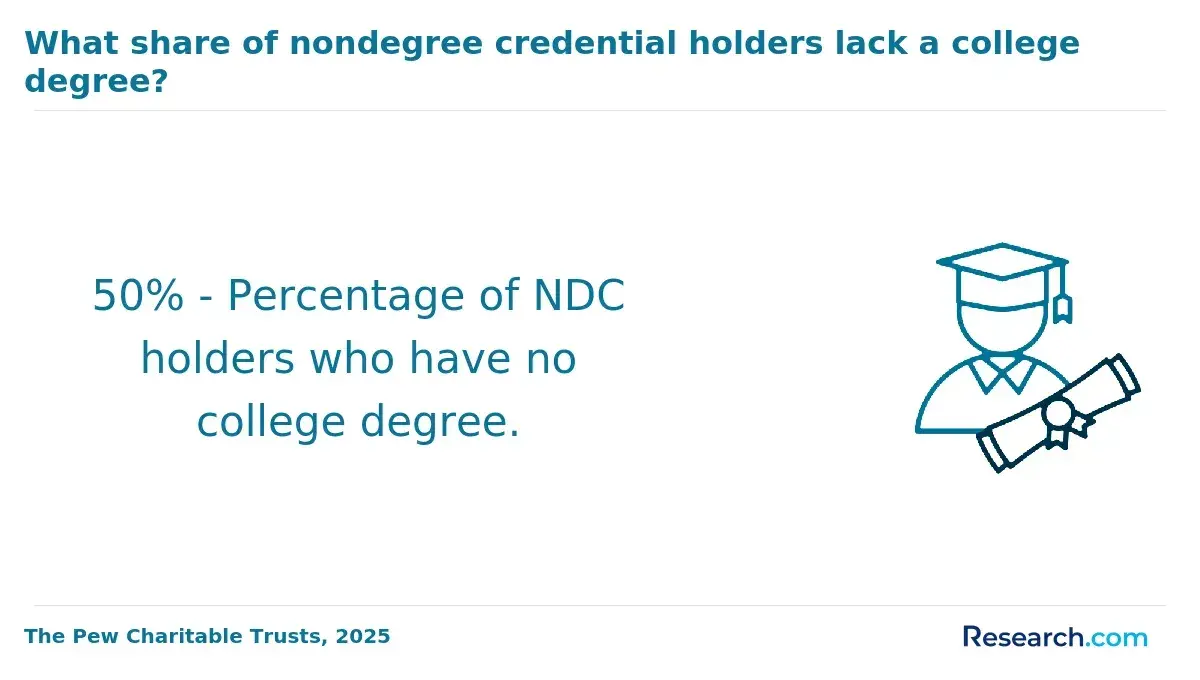
The share of nondegree credential holders with no college degree.
How employers view accelerated online oceanography degrees completed in less than two years significantly impacts students' career opportunities. Positive perceptions can enhance job prospects, while doubts may pose challenges in competitive fields. Recent data shows that more than 60% of employers are increasingly willing to consider candidates with online credentials, assuming the program meets certain quality standards. Key factors employers examine include the following:
- Accreditation: Credentials from accredited institutions carry greater weight, indicating that the program meets established academic and industry benchmarks. This assurance of quality influences employer trust in the candidate's educational background.
- Skills relevance: Employers prioritize degrees that emphasize current scientific techniques, data analysis capabilities, and practical oceanography-related skills. Programs integrating fieldwork or lab components tend to be viewed more favorably.
- Demonstrated experience: Internships, research contributions, or applied projects showcase a student's ability to translate knowledge into real-world settings, which is often more important than the mode or speed of study.
- Program rigor: Even with an accelerated format, employers assess whether the curriculum maintains academic depth and breadth. If the fast pace sacrifices thoroughness, it may raise concerns about preparedness.
In sum, while accelerated online oceanography degrees can gain respect, graduates must ensure their education offers robust content, relevant experience, and verifiable accreditation to maximize employer confidence and career readiness.
Cost plays a critical role for students choosing accelerated online oceanography programs, especially those aiming to finish in less than two years. Because these programs compress traditional coursework into a shorter timeframe, understanding the financial commitment is essential. Several key cost factors shape the overall price. Here is a breakdown to consider:
- Per-credit tuition: Tuition is commonly charged by the credit hour, with many accelerated programs charging between $300 and $800 per credit. Since accelerated paths may allow credit transfers or focus on upper-division courses, the total credit load-and thus total tuition-can be lower than the standard 120 credits.
- Total program cost: Beyond per-credit rates, prospective students should weigh all expenses including mandatory fees and required materials. A holistic view of costs helps estimate the financial commitment for completing the program rapidly.
- Additional fees: Technology access, lab usage, and administrative fees often add several hundred to over a thousand dollars annually. These can vary widely, impacting affordability and should be factored into the budget.
- Cost-saving opportunities: Transfer credits, scholarships, military benefits, and employer tuition assistance frequently reduce the total price. Leveraging these options is especially important for accelerated students aiming to minimize debt while finishing quickly.
When I spoke with a graduate of an accelerated online oceanography degree program completed in under two years, she shared how careful planning helped cut her expenses significantly. She took advantage of transfer credits from previous college courses, which reduced her credit requirements and saved thousands on tuition. Additionally, she secured a scholarship targeted at students in accelerated STEM fields, easing the burden of extra fees. Even though the program's fast pace was demanding, she found that compressing the timeline eliminated semesters of living expenses and financial aid interest accumulation. "It wasn't easy juggling work and classes, but finishing swiftly meant I avoided prolonged costs," she reflected. Her experience highlights how strategic use of available resources can make a fast online oceanography degree more financially accessible.
Career outcomes are a key consideration for students pursuing accelerated online degrees they can complete in under 2 years, as these programs are designed to quickly prepare graduates for the workforce. The U.S. Bureau of Labor Statistics projects a steady 3% growth rate for environmental scientists and specialists, including oceanographers, highlighting ongoing demand in this field. Below are common job roles attainable with fast online oceanography careers and the typical skills and salaries associated with each.
- Marine Technician: Responsible for deploying instruments and collecting oceanographic data, this role requires proficiency in equipment handling and basic data interpretation. Annual salaries generally range between $40,000 and $60,000.
- Oceanographic Data Analyst: These analysts manage and interpret data to support climate studies and marine ecosystem assessments, demanding strong skills in scientific analysis and data management software. Pay typically falls within the $60,000 to $75,000 range.
- Environmental Compliance Specialist: Focused on ensuring marine and coastal projects comply with federal and state regulations, this position blends fieldwork with reporting and requires knowledge of environmental laws and solid communication abilities. Salaries usually vary from $50,000 to $70,000.
Students exploring jobs with accelerated oceanography degree programs should align their education with these market needs and salary expectations. For those interested in the broader landscape of lucrative fields, resources like best bachelor degrees offer valuable insights into high-paying opportunities across disciplines.
Success in accelerated online oceanography programs requires having the right technology to keep up with the fast-paced nature of coursework, especially when aiming to complete the program in under two years. Efficient access to digital tools not only saves time but also helps manage the intense study load. Below are essential tech tools for fast-track oceanography programs that support this demanding educational model.
- Reliable high-speed internet (minimum 25 Mbps) - High-speed internet is critical for smooth participation in live lectures, streaming educational videos, and submitting assignments on time. The Federal Communications Commission recommends at least 25 Mbps to handle video conferencing and multimedia content without lag, ensuring uninterrupted learning in accelerated online settings.
- Access to a robust learning management system - A strong LMS provides centralized access to course materials, progress tracking, and communication with instructors. This platform keeps students organized and on schedule, which is crucial for balancing multiple accelerated classes with tight deadlines.
- Video conferencing applications for live classes and group work - These tools enable real-time interaction and collaboration despite geographic distances. They foster engagement and immediate feedback, both of which are vital for success in fast-paced oceanography courses that rely on dynamic discussions and teamwork.
- Productivity and data analysis software for assignments - Up-to-date software, including word processors, spreadsheets, and specialized data analysis programs, supports lab reports and research tasks. These applications help students efficiently handle the technical demands typical in oceanography coursework.
Integrating these technology requirements for accelerated online oceanography degrees enhances time management, communication, and overall access to vital educational resources. Without them, students risk delays that can impede finishing on schedule. Those interested in exploring the fastest degree to get online may find that ensuring their technology setup meets these standards is a foundational step before enrollment.
Choosing an accelerated online oceanography degree is vital for students who want to join the workforce sooner or minimize tuition expenses. Picking the right program means balancing speed with quality, ensuring you finish in less than two years without sacrificing educational value. Consider these key factors when evaluating options:
- Program length: Verify the entire degree can be completed within two years by reviewing credit hour requirements and whether courses are offered in intensive formats or sessions.
- Curriculum structure: Look for programs that provide year-round classes or condensed schedules to keep academic momentum consistent and shorten time to completion.
- Accreditation: Confirm the program holds regional or national accreditation to guarantee recognized standards, aiding future employment and advanced study.
- Cost: Assess total tuition and fees alongside available financial aid, as accelerated degrees often reduce overall costs by requiring fewer terms.
- Career outcomes: Investigate graduate job placement rates and support services like career counseling to ensure the program prepares you effectively for the workforce.
What Graduates Say About Their Fastest Online Oceanography Degree Programs
- Truett: "Choosing an accelerated online oceanography degree was a game-changer for me. I wanted to dive into marine sciences without spending years on campus, and this program fit perfectly with my busy schedule. The cost was surprisingly affordable too, averaging around $15,000, which made me confident about my investment. Since graduating in under two years, I've landed a role with a coastal research institute, and the fast-paced learning really prepared me for real-world challenges. -"
- Charlie: "After careful consideration, I enrolled in an accelerated online oceanography degree program because I needed a flexible option that didn't compromise quality. Although the total cost was nearly $18,000, the time saved and convenience felt worth every penny. Reflecting on my journey, completing the degree quickly allowed me to transition smoothly into environmental consulting, where I now apply what I learned every day. "
- Katrina: "Enrolling in a fast online oceanography degree program was a strategic move for my career advancement. The program cost just under $16,000, which was a significant factor as I balanced work and studies. Finishing the degree in less than two years enabled me to qualify for a promotion in my marine biology lab, demonstrating how valuable accelerated education can be in professional settings. - Daniel"
Other Things You Should Know About Oceanography Degrees
Yes, many online oceanography degrees are recognized by professional scientific organizations like the American Geophysical Union and the Oceanography Society. Accreditation from recognized bodies ensures that these programs meet industry standards, making graduates eligible for membership and professional opportunities.
Yes, many accelerated online oceanography programs require at least one supervised field experience, lab, or internship, even when most coursework is online. Programs may ask for 120 total credits, with 6 to 12 credits in fieldwork or research completed under faculty or approved site supervision.
Many programs allow transfer of relevant STEM credits, especially in biology, chemistry, physics, and mathematics, to shorten time to completion. Policies vary by institution, so it is essential to verify transfer limits and course equivalencies with admissions counselors. Properly applied transfer credits can make completing an accelerated oceanography degree more efficient.
- Oceanographer - Salary, How to Become, Job Description & Best Schools https://www.onlinedegree.com/careers/life-physical-science/oceanographer/
- Marine Science BS | Florida Gulf Coast University https://www.fgcu.edu/degree/bachelor/marine-science-bs/
- Oceanography Online Courses: Top Colleges, Eligibility, Platforms & Job Opportunities https://www.selectyouruniversity.com/blog/oceanography-online-courses
- Oceanography Degrees https://web.uri.edu/gso/academics/oceanography/
- Are you our new Oceanographer? https://oceanbox.io/
- Master of Oceanography | UWA https://www.uwa.edu.au/study/courses/master-of-oceanography
- Online Course | ESA Advanced Ocean Synergy Training Course 2025 https://oceantrainingcourse2025.esa.int/online-course/
- A New Way of Learning https://tos.org/oceanography/article/a-new-way-of-learning
- F710 BSc Oceanography 4900 (3 years) | University of Southampton https://www.southampton.ac.uk/courses/oceanography-degree-bsc
- Transfer Applicants https://www.maritime.edu/undergraduate-admissions/apply/transfers