2027 Data Science Master's vs. Internal Company Training for an Analytics Promotion

Co-Founder and Chief Data Scientist
A data science master's can broaden your qualifications, while internal company training can help you prove you are ready for a specific analytics promotion.
For employees choosing between them, the deciding factor is usually not which credential sounds stronger, it is what the target role requires, what the employer will recognize, and how quickly each path lets you demonstrate those skills. This guide helps you compare the options before committing time or money.
Key Things You Should Know
- For a near-term promotion at your current employer, start with the role's requirements: internal training paired with a visible analytics project may provide more relevant evidence than a degree alone.
- Consider a master's when the gap is broader: graduate study may be more useful if you need substantial statistical or technical depth, or want options beyond your current employer.
- Do not treat labor-market growth as a promotion forecast: the U.S. Bureau of Labor Statistics projects 35% employment growth for data scientists from 2025 to 2035, but your employer's criteria determine an internal promotion.
Is a data science master's or internal company training better for an analytics promotion?
Internal training is usually the better first move when the promotion is defined, your employer accepts work-based evidence, and you can apply new skills to a consequential project.
A master's is more suitable when the role requires knowledge you cannot develop adequately through available training, or when you also want to compete for roles outside the company. Neither path guarantees promotion.
The comparison below focuses on what each path can demonstrate to the person making the promotion decision:
| Decision factor | Data science master's | Internal company training |
| Primary strength | Structured, broader study with an externally recognizable credential | Direct alignment with company systems, data, and business priorities |
| Evidence for a promotion | Coursework and projects, strongest when connected to the target role | Applied work and results visible to managers and stakeholders |
| Main limitation | A degree may not address the employer's immediate promotion criteria | Training may leave technical gaps or be harder to explain to other employers |
| Best fit | Substantial skill gaps or a longer-term external career goal | A specific internal opportunity with clear performance expectations |
Before choosing, ask the hiring manager or promotion committee what evidence a successful candidate must show. If they expect ownership of forecasting, experimentation, or production models, a short dashboard course will not be enough.
If they chiefly need better reporting and stakeholder leadership, a technically intensive degree may be more education than this promotion requires. A combined path, internal project now, graduate study later if gaps remain, can also be sensible.
What skills do employers expect for data science and analytics promotions?
Expectations depend on the role and employer. An analytics promotion may emphasize SQL, reliable metrics, visualization, and recommendations that influence decisions.
A data science role may add statistical modeling, machine learning, experiment design, and reproducible coding. Senior roles often require both technical judgment and the ability to define problems with stakeholders.
Translate the job description into evidence you can produce. These questions expose gaps that a course title or completion certificate might conceal:
- Can you independently obtain and validate the data used in a business decision?
- Can you explain why a method is appropriate, test its limitations, and communicate uncertainty?
- Can you show an implemented analysis or model, including what changed - or why stakeholders chose not to act?
AI tools may speed up coding and analysis, but they do not remove the need to check data quality, evaluate outputs, and protect company information. Ask whether your employer values those capabilities in the target role; then choose training or coursework that lets you demonstrate them, rather than merely use a tool.
How do master's degrees and company training compare in cost, time, and ROI?
Compare your out-of-pocket cost and time away from promotable work, not just advertised tuition against a free-looking company course. Graduate costs can include mandatory fees, materials, and financing charges; internal training can consume work hours or depend on continued employment. Employer assistance may change the comparison substantially.
A useful ROI test is to estimate the additional compensation you could reasonably expect if promoted, then compare it with your net education cost and the time required to qualify.
This is a scenario, not a predicted return: the promotion may be delayed, awarded to someone else, or attainable without the degree. Compare the master's with a realistic alternative, such as training plus a work project, rather than with doing nothing.
Ask human resources whether tuition assistance covers the proposed program, requires a minimum grade, or must be repaid if you leave. If graduate study remains attractive, explore financial aid for graduate data science degrees while confirming eligibility and current terms directly with schools and aid providers. A common mistake is treating an employer reimbursement cap as money already awarded.
What does a data science master's degree curriculum typically include?
Programs commonly combine programming, statistics, data management, machine learning, and applied projects, but required courses and technical depth vary.
For this decision, the important question is whether the curriculum fills a promotion-relevant gap. Someone seeking an analytics manager role may benefit more from experimentation and communication than from advanced model-building electives; an aspiring data scientist may need deeper modeling and evaluation practice.
Read required-course descriptions and examine project expectations. A passing mention of machine learning is not equivalent to repeated opportunities to build, evaluate, and explain models.
If your employer needs AI-specific skills rather than a broad data science credential, compare relevant courses first; do not assume an AI degree or a list of inexpensive online artificial intelligence programs is automatically a better fit for the promotion.
How do online and campus-based data science master's programs differ?
Online study may make it easier to remain employed and apply coursework immediately; campus study may offer easier in-person access to peers, faculty, and local recruiting.
Neither format establishes program quality on its own. Check whether classes meet live, when team projects happen, and whether exams or required events conflict with your work schedule.
For an internal promotion, the most useful format is one you can complete without sacrificing the performance that makes you promotable.
If you are comparing online data science degrees for in-demand careers, check whether their projects can also help you demonstrate the specific skills your manager expects. Confirm any campus visits and your state's eligibility rules with the institution before enrolling.
What are the admission requirements for a data science master's program?
Requirements vary by institution. Programs may evaluate prior coursework, quantitative preparation, programming experience, transcripts, recommendations, and written statements; some offer ways to address preparation gaps.
Work experience can strengthen an application, but it does not automatically satisfy a stated academic prerequisite.
If applying would delay a near-term promotion, check requirements before investing in test preparation or prerequisite courses. Ask admissions staff whether your prior study meets formal requirements and whether work projects count as evidence of readiness.
Applicants for whom the essay is a particular obstacle can compare machine learning master's programs without an admissions essay, while still verifying each program's current policy and fit for the intended analytics role.
How long do data science master's programs take and how much do they cost?
There is no dependable single duration or price for a data science master's: credit requirements, enrollment pace, tuition policies, fees, and employer support differ.
Obtain each school's current total required credits and tuition schedule, then calculate a comparable estimated total for your intended pace. Ask whether taking fewer courses changes fees or extends the time before you can use a required capstone as promotion evidence.
Set that timeline beside your employer's promotion cycle. A shorter program may help if the credential is explicitly required soon, but fast completion has less value if it prevents you from performing well at work.
If schedule is the main constraint, AI master's options for a shorter study schedule may be worth comparing, but only if their curriculum matches the role. Avoid assuming a program's advertised pace or tuition applies to your enrollment plan.
What analytics roles can you pursue after a master's degree or company training?
Both paths can support movement into analytics roles, but the feasible next role depends on your existing experience and demonstrated work. Internal training may position a reporting analyst to become a senior analyst or analytics lead within the same business unit.
A master's may help someone seek data scientist, machine learning, or more technical analytics positions, particularly when coursework addresses a genuine skills gap. A degree alone does not establish readiness for those jobs.
Identify the role you want before selecting a path. Compare its actual responsibilities with your recent projects, then seek an assignment that closes the most important evidence gap. If you may change employers, document your contribution and methods in a portfolio that does not reveal confidential information.
Programs marketed as preparation for online data science degrees for in-demand careers should likewise be judged by relevant project work and skills, not a career-oriented label alone.
What salaries and job growth can analytics and data science professionals expect?
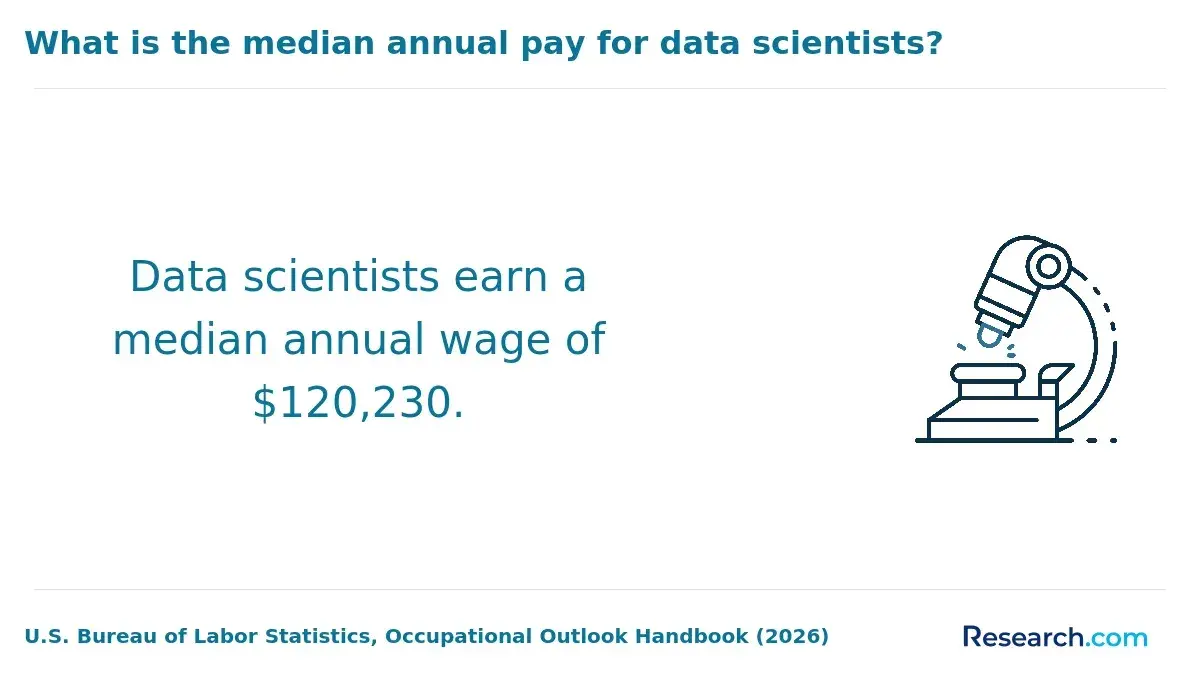
The U.S. Bureau of Labor Statistics reports a $120,230 median annual wage for data scientists in May 2025. That is a national occupation-wide figure, not the salary a newly promoted analyst or master's graduate should expect. Your likely pay depends on the actual position, experience, location, and employer.
BLS projects 35% growth in data scientist employment from 2025 to 2035. This supports considering a broader data science career, but it says little about openings on your company's analytics team.
For the immediate decision, request the target role's compensation range and promotion criteria; compare those with your current pay rather than treating a national median as a projected raise.
Which accreditation and certifications matter for data science career advancement?
For a master's, verify the institution's recognized institutional accreditation and review the program's curriculum and outcomes. Do not assume that an impressive-sounding program title carries a separate, required data science accreditation.
Ask the school what its accreditation covers and confirm current status through the institution and accreditor.
For an internal promotion, a vendor or company certificate is most useful when it verifies skills the employer actually uses. It is not interchangeable with a graduate degree, but a degree is not automatically more persuasive than successful applied work.
Before paying for either credential, ask the promotion decision-maker which qualifications are required, which are preferred, and which examples of performance would carry the most weight.
Other Things You Should Know About Data Science
Only with the appropriate employer permission and safeguards. Check confidentiality, privacy, and intellectual-property rules before sharing data, code, screenshots, or results with instructors or classmates.
Do not assume so. Ask whether training time is paid, whether degree coursework must be done outside working hours, and how either arrangement affects your regular responsibilities.
Ask for written development goals, the work you will be allowed to own, and when your readiness will be reviewed. Treat support as an opportunity to build evidence, not a promotion commitment.
Yes, but you can prepare now. Build relevant project experience and check program prerequisites so you can respond when an opening appears without committing prematurely to graduate tuition.
References
- The Role of Continuing Professional Training or Development in Maintaining Current Employment: A Systematic Review https://pmc.ncbi.nlm.nih.gov/articles/PMC10647344/
- Evaluate Training: Measuring Effectiveness | cdc.gov https://www.cdc.gov/training-development/php/about/evaluate-training-measuring-effectiveness.html
- General Schedule Qualification Policies | U.S. Office of Personnel Management https://www.opm.gov/policy-data-oversight/classification-qualifications/general-schedule-qualification-policies/
- What You Can Do with a Master's in Data Science and Artificial Intelligence | Harvard Extension School https://extension.harvard.edu/blog/what-you-can-do-with-a-masters-in-data-science-and-artificial-intelligence/
- Profiling data scientists in the digital labour market | sciencedirect.com https://www.sciencedirect.com/science/article/pii/S0263237322000810
- What Can I Do With a Degree in Data Science? Career Paths & Skills | Harvard SEAS https://seas.harvard.edu/news/what-can-i-do-degree-data-science-career-paths-skills
- Master of Science in Analytics | Capella University https://www.capella.edu/online-information-technology-degrees/masters-analytics/
- Convincing your employer to pay for your degree | asu.edu https://news.wpcarey.asu.edu/node/16704
- What Can You Do with a Master's Degree in Data Science? | UCLA MSOL Data Science https://www.msol.ucla.edu/data-science-engineering/articles/what-can-you-do-with-masters-degree-data-science/
- Graduate degrees pay - but it's complicated | Brookings https://www.brookings.edu/articles/graduate-degrees-pay-but-its-complicated/