2027 MIDS vs. MSDS: Comparing Information and Data Science Master's Degrees

Co-Founder and Chief Data Scientist
MIDS and MSDS degrees can both prepare students for data science work, but their names do not reliably tell you how much programming, statistics, or applied decision-making a program teaches. If you are comparing master's programs, the useful question is not which acronym sounds stronger. It is which curriculum closes your skill gaps, fits your schedule and budget, and produces evidence of the work you want to do. This guide shows you how to make that comparison.
Key Things You Should Know
- MIDS generally means Master of Information and Data Science; MSDS generally means Master of Science in Data Science. Neither name establishes a standard curriculum or level of technical depth.
- Choose by required courses, electives, projects, and career fit - not the acronym. The U.S. Bureau of Labor Statistics projects 35% growth in data scientist employment from 2025 to 2035, but that outlook does not predict an individual graduate's prospects.
- Compare each school's current tuition and mandatory fees for the full degree, along with scheduling and travel costs. There is no single price or completion time for either credential.
What Are the Differences Between an MIDS and an MSDS?
MIDS commonly stands for Master of Information and Data Science, while MSDS commonly stands for Master of Science in Data Science. The distinction is primarily a naming convention: universities define their own requirements, so an MSDS is not automatically more mathematical, and an MIDS is not automatically more business-focused.
This comparison separates what the labels suggest from what you must verify in a particular program.
| Criterion | MIDS | MSDS |
| Degree title | Emphasizes information and data science in its name | Identifies data science as a Master of Science field |
| Technical depth | Depends on required methods, computing courses, and projects | Depends on required methods, computing courses, and projects |
| Career signal | May need its full name explained to an unfamiliar employer | States "data science" explicitly on the credential |
| Best comparison tool | Published degree requirements and course descriptions | Published degree requirements and course descriptions |
A useful test is to compare programs side by side without looking at their names. If the required coursework and substantial projects serve your target role, the acronym is a secondary consideration.
What Do MIDS and MSDS Programs Teach?
Both types of program may combine statistics, programming, data management, machine learning, communication, and responsible data use. What differs is the required depth. One curriculum might require extensive statistical modeling; another might give students more room to study product decisions, data engineering, or organizational applications.
Read beyond topic lists. A course that mentions machine learning is not equivalent to a sequence that requires students to build models, evaluate them against baselines, and explain limitations. Likewise, a program's emphasis on communication is more meaningful when students repeatedly present findings to nontechnical audiences. For a specialized AI goal, compare the actual AI coursework with options for studying artificial intelligence online rather than assuming either data science degree provides the specialization you want.
Which Degree Is Better for Your Data Science Career Goals?
Neither credential is universally better. Choose the MIDS if a particular MIDS program combines the technical foundation you need with strong opportunities to frame problems, work with stakeholders, and communicate results. Choose the MSDS if a particular MSDS offers more of the statistics, computing, or specialized methods your target work requires. Reverse either choice when the other program has the stronger curriculum: fit matters more than the letters.
Start with the work you want to show an employer. Someone aiming for model development should look for substantial programming, statistical evaluation, and reproducible projects. Someone aiming for analytics leadership may place more weight on experimentation, interpretation, and communicating decisions - but still needs enough technical grounding to assess the work. Explore online data science programs and employment pathways to refine the role you are targeting before paying for a specialization.
A common mistake is treating "more technical" as synonymous with "better." Advanced methods have limited value if a program leaves you unable to apply them to your intended problems; the reverse is also true if your goal requires methods the curriculum barely covers.
What Courses Are Included in MIDS and MSDS Curricula?
Course titles vary, but relevant categories to check include probability and statistical inference, programming, databases, data visualization, machine learning, ethics, and a practicum, thesis, or capstone where offered. A published catalog - not the degree abbreviation - establishes which courses are mandatory and which are electives.
Compare the sequence as well as the subjects. A strong match for a beginner builds from foundations toward independent work; an experienced analyst may benefit more from advanced electives. For each promising program, inspect sample assignments or project descriptions if available. Ask whether students must acquire and clean data, justify a method, test results, and communicate uncertainty. A capstone label alone does not establish that those activities occur.
What Are the Admission Requirements for MIDS and MSDS Programs?
Admissions requirements are set by each institution, not by the MIDS or MSDS designation. Check the current program page for its bachelor's-degree requirement, prerequisite coursework, application materials, testing policy, and any expectations for professional experience. Do not assume that a nontechnical major rules you out - or that work experience replaces a stated mathematics prerequisite.
Before applying, match your transcript and work samples against the required preparation in programming, calculus, linear algebra, and statistics, where applicable. If a gap remains, ask admissions whether a proposed course formally satisfies the requirement. Independent study may improve your readiness without satisfying a documented prerequisite.
How Long Do MIDS and MSDS Degrees Take and Cost?
Neither degree name sets a standard length or price. Required credits, course availability, enrollment pace, and capstone scheduling determine time to completion. Tuition policies and mandatory fees determine the billed cost; books, software, travel, and reduced work hours may add to the amount you ultimately spend.
Request a current, full-program estimate from each school using the same enrollment plan. Separate tuition from mandatory fees, then check whether rates can change before graduation. Comparing one school's per-credit tuition with another school's all-in estimate is an avoidable mistake. If you are weighing a more specialized credential, use the same full-cost approach when examining machine learning master's tuition plus mandatory fees.
To judge affordability, consider employer assistance and aid you are actually eligible to receive, as well as borrowing costs. A future salary should not be treated as a guaranteed return on tuition: prior experience, the job obtained, and location also affect earnings.
Are Online or Campus-Based MIDS and MSDS Programs Better?
Online and campus-based formats can both support rigorous study; the better choice is the one whose requirements you can consistently meet. Campus study may make in-person collaboration easier. Online study may reduce relocation or commuting, but it can still require scheduled classes, group meetings, exams, or travel.
Confirm whether courses are live or self-paced, when required activities occur, and how often each course is offered. Those details matter more than an "online" label if you work full time or live in another time zone. If speed is a priority, examine shorter online data science master's programs, then verify whether their pace leaves enough room to learn and complete worthwhile projects.
How Do You Choose an Accredited MIDS or MSDS Program?
Verify the university's institutional accreditation through the institution and its recognized accreditor. Do not assume that a program must have a separate data-science-specific accreditation, or that institutional accreditation proves a particular curriculum fits your goals. If you will study online from another state, confirm the school can enroll students where you live.
Then assess academic and professional fit using the school's current catalog, course schedule, total-cost information, faculty and project opportunities, and available career support. Ask what access online students actually have to advising, employer events, and alumni. Networking can matter for a career change, but a promised network is more useful when the program explains how students engage with it; master's-level AI programs with alumni networking opportunities offer another point of comparison if AI is your focus.
What Jobs and Salaries Can MIDS and MSDS Graduates Expect?
Depending on their skills and prior experience, graduates may pursue data scientist, data analyst, machine learning, analytics, or data engineering work. Employers evaluate the fit between a candidate and a role; neither degree title alone establishes readiness for every one of these jobs.
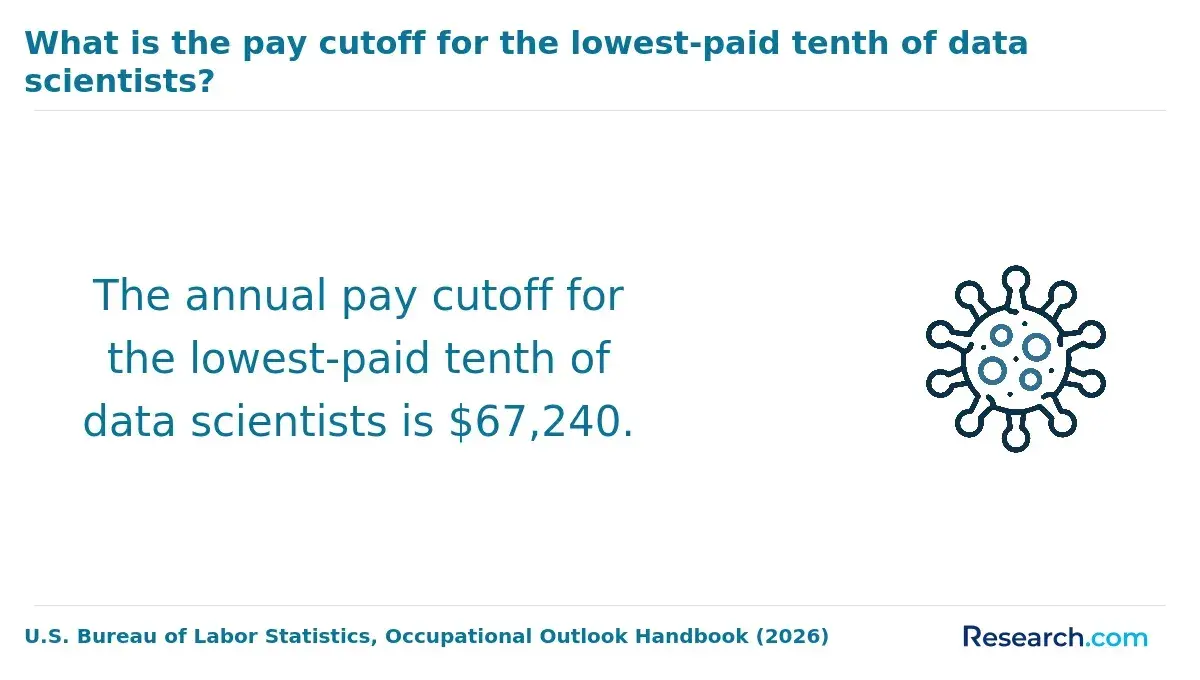
The U.S. Bureau of Labor Statistics reports a $120,230 median annual wage for data scientists in May 2025. That is a wage for workers in the occupation, not a starting salary or an outcome attributable to an MIDS or MSDS. Use it as labor-market context, then examine actual job postings and any program outcome reports for the roles and locations you care about. When a school publishes graduate salaries, check who responded and whether the figure reflects experienced professionals as well as career changers.
Do MIDS or MSDS Graduates Need Licenses or Certifications?
A general data science job does not carry a universal professional license tied to either degree. Employers may value a certification in a particular cloud platform or tool, but it is not a substitute for meeting a role's technical requirements. Requirements can differ in regulated industries or specialized positions, so check the actual job description and applicable rules.
Choose an optional certification only when it closes a recognizable gap for your target role. For most program comparisons, the more important question is whether the degree helps you produce credible evidence of your skills through coursework and projects.
Other Things You Should Know About Data Science
Either may support a future application, but doctoral programs set their own research and prerequisite requirements. If a PhD is a serious goal, look for research opportunities, advanced theory courses, and faculty mentorship rather than relying on the master's title.
Spell out the degree name and identify relevant methods, tools, and projects. That gives an employer more useful information than the acronym alone.
Not without appropriate permission and safeguards. Check your employer's rules and the program's project policies; public or properly de-identified data may be a safer alternative.
Ownership and publication rights depend on university policies and any employer or project-partner agreement. Confirm what you may share in a portfolio before committing sensitive data or proprietary code to a project.
References
- Graduate Degree Fields - COE https://nces.ed.gov/programs/coe/indicator/ctb/graduate-degree-fields
- Master's in Data Science: Curriculum | NYU CDS https://cds.nyu.edu/masters-in-data-science-curriculum/
- Prerequisite Key Topics - UVA School of Data Science https://datascience.virginia.edu/pages/prerequisite-key-topics
- MSDS Curriculum & Courses - College of Information Science https://infosci.arizona.edu/ms-data-science/curriculum-courses
- Online Master's in Data Science (MSDS) | Northwestern University https://sps.northwestern.edu/masters/data-science/
- Curriculum | Master of Science in Data Science | University of Miami https://msdatascience.as.miami.edu/academics/curriculum/index.html
- Tuition & Financial Aid: UW MS in Data Science Program | Trends and Issues in Higher Ed https://www.washington.edu/datasciencemasters/tuitionfinancialaid/
- MS in Data Science | columbia.edu https://datascience.columbia.edu/education/ms-data-science
- Data Science Master's Program - College of LSA https://lsa.umich.edu/stats/masters_students/mastersprograms/data-science-masters-program.html
- Curriculum - MS in Data Science - Pace University Online https://online.pace.edu/graduate-programs/ms-in-data-science/curriculum/