2027 Comparing Nursing Benefits: Health Insurance, Retirement, Paid Leave, and Education Support
Audited and Verified:
Our Editorial and Data Verification Process
Research.com uses government datasets, official education statistics and primary institutional information to support its career and degree guides. Our review process checks factual accuracy, occupational definitions, source dates and the requirements associated with the credentials discussed.
How This Article Was Fact-Checked
Our editorial team verifies salary estimates, employment projections, education requirements and program information against original data providers and official organizations. Salary figures are checked against the relevant occupational definitions and reporting periods. Information about licensure, accreditation and required in-person training is reviewed separately.
Fact-checked and verified on:

Co-Founder and Chief Data Scientist
Two RN offers with similar hourly pay can have very different value once insurance premiums, retirement contributions, usable leave, and education support are included. Those differences matter whether you are choosing a first nursing job, changing employers, or planning further study.
This guide explains what benefits commonly cover, where the important exceptions lie, and how to compare written offers against your household costs and career plans. It also puts education pathways and career outcomes in context, so a promised tuition benefit does not distract from a poor overall fit.
Key Things You Should Know
- Compare the cost of covering your household, not just whether an employer offers insurance: premiums, deductibles, networks, and prescription coverage can change the value of an RN offer substantially.
- For retirement, check the employer's actual contribution and vesting schedule. For leave, compare hours earned with your ability to schedule time off; federal Family and Medical Leave Act protection, when available, is generally unpaid.
- Employer education assistance may qualify for up to $5,250 per calendar year in tax-free treatment under federal rules, but an employer can set a lower limit and impose eligibility, grade, or repayment conditions.
What nursing benefits do employers typically offer registered nurses?
Full-time registered nurses often have access to medical coverage, a retirement plan, paid time off, and professional-development support. Availability and terms vary by employer, employment classification, union agreement, and work location. A job posting that says "comprehensive benefits" is not enough to compare offers.
The table shows useful starting points for comparing employers, not guaranteed packages for every organization in a category.
| Employer setting | Benefits to investigate | Potential trade-off |
| Hospital or health system | Several health-plan choices, retirement contributions, paid leave, specialty training, and degree assistance | Weekend or holiday requirements, benefit waiting periods, and restrictions on scheduling leave |
| Government or public hospital | Health coverage, structured leave rules, and a pension or defined-contribution plan, depending on the employer | Pay scales and pension vesting rules may limit the value of a short stay |
| Outpatient, community, or school setting | Predictable schedules and employer-specific insurance, leave, and retirement options | Smaller organizations may offer less education funding or fewer plan choices |
| Agency, travel, or per diem work | Potentially higher cash compensation or schedule choice | Coverage, paid leave, and retirement contributions may be limited, conditional, or absent |
Compare the complete offer with the job itself: orientation length, staffing support, shifts, and clinical expectations affect whether you can remain in the role long enough to use its benefits. If a hospital advertises degree support, ask whether it covers BSN completion pathways with alternative practice experiences and whether the program's required activities fit your schedule.
How do nursing health insurance benefits compare across employers?
For health insurance, the best comparison is your likely annual household cost, not the monthly premium alone. Review the employee contribution for the coverage tier you need, deductible, out-of-pocket maximum, copays or coinsurance, prescription formulary, and whether your clinicians and preferred facilities are in network. An inexpensive employee-only plan may be costly once a spouse or children are added.
Ask each employer for its current summary of benefits and coverage and rate sheet. Check when coverage begins and what happens if your hours fall below the plan's eligibility threshold. If you regularly use a particular medication or specialist, verify coverage with the plan rather than relying on a recruiter's description.
Education costs and health costs should be separate lines in a household budget. For example, an employer's tuition benefit may make online BSN-to-MSN programs organized by tuition worth examining, but it does not offset a more expensive family health plan unless the numbers work for your circumstances.
What retirement plans and employer contributions are common for nurses?
Nurses commonly encounter a 401(k), 403(b), 457(b), pension, or a combination, depending on the employer. In a defined-contribution plan, distinguish your own payroll deferrals from the employer's match or other contribution. A pension instead promises a benefit determined by its plan rules; its value can depend heavily on years of service.
Request the plan document or summary plan description. Compare when you can participate, how much the employer contributes, whether a contribution requires you to contribute first, and when employer-funded amounts vest - become yours to keep if you leave. Your own contributions are yours; employer contributions may follow a vesting schedule. A generous advertised match can be worth little to someone who leaves before vesting.
This matters if further education may prompt a job change. Before choosing between staying for benefits and comparing accelerated DNP programs, calculate the employer contributions you would forfeit, alongside tuition support and any change in work hours. A DNP is not necessary simply to obtain stronger retirement benefits.
There is no universal number of paid vacation or sick days for US nurses. Employers may provide separate vacation and sick banks or one paid-time-off bank; accrual may depend on hours worked and length of service. Holidays may be paid separately, included in the bank, or worked with premium pay. An offer's stated PTO hours are therefore only the beginning of the comparison.
Ask how leave accrues during orientation, whether unused hours carry over or are paid at separation, how far ahead vacation must be requested, and what happens when several nurses request the same dates. In a continuously staffed unit, a substantial PTO balance is less useful if coverage makes preferred dates difficult to obtain.
Family and medical needs require a separate check. Eligible employees of covered employers may receive up to 12 workweeks of job-protected leave in a 12-month period under the federal Family and Medical Leave Act, but that leave is generally unpaid; eligibility rules apply. State law, an employer's paid parental leave, short-term disability coverage, or accrued paid leave may change the income picture.
If you plan to study while employed, map clinical placements and required live sessions against actual shift and leave rules. Even a faster MSN-PMHNP pathway may require supervised clinical experiences that cannot be scheduled around every work shift.
Hospitals, health systems, government employers, and some outpatient organizations offer tuition reimbursement, direct tuition payment, scholarships, certification support, continuing-education funds, or paid training. The amount and eligible programs vary. Reimbursement usually means paying the school first and receiving money later after meeting the employer's conditions; direct payment can reduce that upfront burden.
Before enrolling, obtain the written policy and confirm which schools and degree levels qualify, whether you must work full-time, when eligibility begins, required grades, annual limits, and whether leaving the employer triggers repayment. Check whether certification exam fees, travel, books, and clinical-placement costs are covered. Under federal tax rules, up to $5,250 per calendar year of qualifying employer educational assistance can generally be excluded from an employee's income; that is a tax-treatment limit, not a promise that your employer pays $5,250.
For an RN considering advanced practice, compare a proposed award against the full cost and scheduling demands of cost-focused nurse practitioner study options. Employer support can reduce expense, but it does not replace required population-focused education, supervised clinical preparation, certification, or state authorization.
If you are not yet an RN, education benefits should influence - but not determine - your route into nursing. Approved prelicensure associate-degree and bachelor's-degree programs, as well as some diploma programs, prepare graduates to seek RN licensure. After completing an eligible program, applicants must meet their state board's requirements and pass the NCLEX-RN; graduation itself does not grant a license.
An ADN or ASN can be a route to initial licensure with less time in school than a traditional BSN, while a BSN may better match employers that prefer or require it. An accelerated BSN serves eligible applicants with prior college study, but prerequisite and clinical schedules can be intensive. An RN-to-BSN program is different: it is for someone who already holds an RN license and is not an initial-licensure route.
Applicants with a non-nursing bachelor's degree can also investigate comparing online MSN entry options for non-nurses. Verify whether a particular program actually provides initial RN preparation, where its required clinical learning takes place, and whether it meets the intended state's eligibility rules. A short advertised timeline is less valuable than a viable path to licensure and employment.
Before relying on an employer's education benefit, confirm that the school and program serve your goal. Institutional accreditation applies to the institution; nursing program accreditation, when applicable, concerns the nursing program; and state board approval or recognition affects the program's standing for licensure purposes in the relevant jurisdiction. These are distinct checks, not interchangeable badges.
For a prelicensure program, ask the intended licensing state's board whether graduates of that exact program and location can apply for RN licensure. Confirm the program's current status directly with the school and relevant accreditor, including the degree and campus or delivery option involved. For later graduate study or employment, ask whether the receiving institution or employer imposes additional accreditation requirements.
Admission flexibility does not resolve these questions. When considering ABSN programs with flexible admission requirements, verify prerequisite equivalencies, clinical-placement eligibility, state approval, and total attendance requirements before accepting an offer or committing tuition funds.
Online delivery can make lectures and assignments easier to combine with shifts, but nursing programs may still require scheduled simulations, skills labs, campus visits, supervised clinical placements, or live classes. Campus-based programs make on-site commitments more visible, though commuting can add time and cost. Neither format automatically offers a lighter workload.
For each program, request a term-by-term schedule showing required in-person days, clinical hours, placement locations, and who secures approved sites or preceptors. A working parent should also ask how much notice is given for placements and what happens if a shift, caregiving obligation, or clinical schedule changes.
Labels can be especially misleading in graduate study. A guide to DNP programs without traditional clinicals may help distinguish direct patient-care rotations from other required practice experiences or projects. Always confirm the exact track's requirements; "online" and "without traditional clinicals" do not mean no supervised, on-site, or scheduled work.
Pay should be compared by occupation, location, hours, and experience, not by degree label alone. The US Bureau of Labor Statistics reports wages for registered nurses as an occupation; its median is not a promised starting salary for an ADN or BSN graduate. An offer may also include differentials for nights, weekends, or on-call work, which should be separated from dependable base pay.
For a sound offer comparison, calculate annual base earnings from guaranteed hours, then add only differentials you reasonably expect to earn. Subtract employee insurance premiums and likely out-of-pocket costs, and add the employer retirement contribution you expect to keep. Treat tuition reimbursement as valuable only if you are eligible, intend to use it, and can meet its conditions. Finally, weigh orientation quality, staffing support, and schedule sustainability - factors that can affect both earnings and retention.
A graduate credential does not guarantee a salary increase. For example, an RN considering lower-cost online PMHNP programs should compare total education costs and foregone work time with actual local offers for the intended role, while confirming certification and state licensure requirements. Do not use an occupation-wide wage figure as a personal return-on-investment forecast.
What job outlook and certifications shape long-term nursing careers?
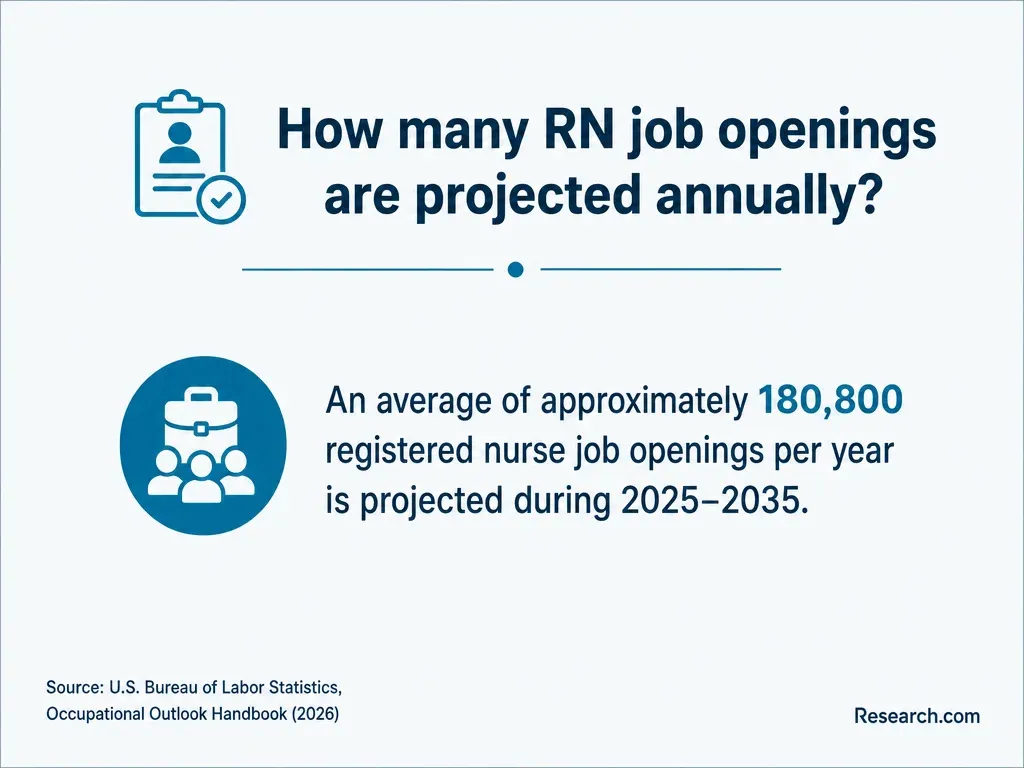
Long-term nursing opportunities depend on more than the number of job postings. Registered nurses work across inpatient, ambulatory, community, and other settings, but each move can require different experience, orientation, and scheduling. Use the latest Bureau of Labor Statistics RN employment projections as national context, then examine local vacancies and employers' stated qualifications for the role you want.
Specialty certification can document experience and knowledge, but it does not replace an active RN license, employer competency checks, or supervised onboarding. An RN planning an advanced-practice transition must make a larger distinction: an NP role requires appropriate graduate population-focused preparation, national certification where required, and state authorization. Experienced nurses evaluating short PMHNP certificate pathways for nurses should verify that their prior graduate education meets the program's entry rules and that the certificate supports the intended certification and licensing pathway.
When comparing employers for the long term, ask what training is funded, whether specialty development occurs on paid time, and whether advancement requires a new degree or can be achieved through experience and targeted training. The best benefits package is the one you can actually use while building competence in a sustainable role.
Other Things You Should Know About Nursing
Not always. A new hire may have a waiting period for insurance or a separate start date for retirement contributions or tuition assistance. Request the effective dates in writing before accepting an offer.
Eligibility varies by employer and hours worked. Some per diem roles offer limited benefits; others offer none. Compare the higher hourly rate, if any, with the value of coverage and leave you would need to obtain elsewhere.
Some do, but terms can change between assignments or depend on maintaining eligibility. Check coverage dates, gaps between contracts, and whether quoted compensation includes taxable wages, stipends, or employer-paid benefits.
No. A collective bargaining agreement can establish enforceable pay and benefit terms, but its value depends on the specific contract. Compare that contract's premiums, contributions, leave rules, and scheduling provisions with the alternative offer.
- Employer-Sponsored Benefits in the United States: The Past, Present, and Future - PMC https://pmc.ncbi.nlm.nih.gov/articles/PMC8689109/
- New York State Benefits Package | Employment Opportunities https://ocfs.ny.gov/main/employment/benefits.php
- Your total costs for health care: Premium, deductible, and out-of-pocket costs https://www.healthcare.gov/choose-a-plan/your-total-costs/
- Fact Sheet #28A: Employee Protections under the Family and Medical Leave Act | U.S. Department of Labor https://www.dol.gov/agencies/whd/fact-sheets/28a-fmla-employee-protections
- California Paid Sick Leave: Frequently Asked Questions | ca.gov https://www.dir.ca.gov/dlse/paid_sick_leave.htm
- Frequently asked questions about educational assistance programs | Internal Revenue Service https://www.irs.gov/newsroom/frequently-asked-questions-about-educational-assistance-programs
- 2025 Employer Health Benefits Survey | KFF https://www.kff.org/health-costs/2025-employer-health-benefits-survey/
- Employer Retirement Plans: Two Basic Types | wiserwomen.org https://wiserwomen.org/resources/retirement-planning-resources/employer-retirement-plans-two-basic-types/
- What Are Premiums, Deductibles, and Copays? Health Insurance Terminology | SHADAC https://www.shadac.org/news/health-insurance-terminology-insurance-premiums-deductibles-copays
- Understanding out-of-pocket limits | uhc.com https://www.uhc.com/understanding-health-insurance/understanding-health-insurance-costs/types-of-health-insurance-costs/out-of-pocket-limits