Careers After an Online MBA in Healthcare Management for Nonbusiness Bachelor’s Graduates

Co-Founder and Chief Data Scientist
A nonbusiness bachelor's degree can be an asset in healthcare management - but it does not, by itself, prepare you to manage a budget, team, or service line. An online MBA in healthcare management can help bridge that gap while you continue working. Your likely career options, however, depend heavily on whether your existing experience is in clinical care, healthcare operations, or another field.
This guide maps those starting points to realistic jobs, explains what the degree can and cannot qualify you to do, and helps you judge whether an MBA is the right next step.
Key Things You Should Know
- A nonbusiness bachelor's degree generally does not rule out a healthcare management MBA; check each school's experience requirements and whether it assigns business foundation courses.
- The most direct moves build on experience you already have: a clinician might pursue service-line operations, while an analyst might pursue healthcare performance or revenue-cycle management.
- The Bureau of Labor Statistics reports a $126,520 median annual wage for all management occupations in May 2025 - not a starting salary or expected payoff for healthcare MBA graduates.
What careers can you pursue with an online MBA in healthcare management?
Healthcare management careers involve directing people, budgets, processes, or strategy in organizations such as hospitals, physician practices, insurers, and health services companies. An MBA can add business skills to disciplinary expertise you already possess. The strongest first move is usually an adjacent transition, rather than a jump into an unfamiliar senior role.
A nurse or allied health professional may be well positioned for clinic operations, quality improvement, or service-line coordination because they understand care delivery. Someone with a public health or science degree might build toward program management after gaining operational experience. A psychology or communications graduate who has managed patient access teams could pursue practice administration. A graduate with no healthcare work history will usually need an entry point - such as an operations, scheduling, or project-support role - before competing for management positions.
If you already work in care delivery, comparisons of MBA programs serving healthcare professionals may help you look for coursework and projects that connect business decisions to clinical operations. Program fit still depends on your intended role, not just your current profession.
Can you earn a healthcare management MBA with a nonbusiness bachelor's degree?
Yes. Many MBA programs consider applicants from a range of undergraduate majors, though admission policies vary by school. A nonbusiness degree is not the same as a lack of preparation: a science graduate may bring quantitative skills, a clinician may understand care workflows, and a social science graduate may have research or communication strengths.
The gap to assess is business readiness. Graduate accounting, finance, economics, and analytics courses may assume comfort with spreadsheets, basic statistics, and financial statements. Some schools require foundation courses; others offer optional refreshers or teach these concepts within the MBA. Ask whether any required preparation adds credits, time, or cost. An online MBA programs for nonbusiness majors program comparison can provide a starting list, but confirm the current requirements directly with each school.
What is an online MBA in healthcare management?
It is a broad graduate business degree delivered primarily online, with healthcare-focused coursework added through a formal concentration, track, or set of electives. The MBA core typically develops management-level skills across finance, operations, strategy, and leadership. Healthcare courses apply those skills to settings where reimbursement, patient safety, regulation, and clinical stakeholders shape decisions.
An online format describes where much of the instruction happens - not how flexible the schedule is. Live classes, group meetings, campus visits, and fixed course sequences may still apply. Likewise, a program with one healthcare elective is not necessarily an MBA with a formally designated healthcare management concentration. If speed matters, examine fast-track MBA options for working adults degree programs alongside their course loads; a shorter calendar can mean less room to manage work and study.
An MBA is best suited to broad business leadership. A master of healthcare administration may offer more concentrated preparation in health-system administration; neither degree replaces a clinical qualification.
An MBA can strengthen an application, but employers hire for demonstrated responsibilities as well as education. The examples below separate plausible next steps from roles that generally require a longer record of management or specialized work.
| Prior experience | Potential next-step roles | What employers may still expect |
| Clinical care or patient services | Clinic operations supervisor; service-line coordinator; quality improvement manager | Staff leadership, workflow improvement, and knowledge of the care setting |
| Billing, scheduling, or insurance operations | Revenue-cycle supervisor; patient access manager; payer operations manager | Knowledge of reimbursement processes, performance measures, and team management |
| Analytics, IT, or project work | Healthcare operations analyst; implementation manager; health-system project manager | Relevant systems knowledge, project results, and stakeholder coordination |
| Little or no healthcare experience | Operations coordinator; practice administrator assistant; project specialist | Evidence of transferable skills and familiarity with healthcare workflows |
Titles vary substantially by employer: one organization's "manager" may lead a team, while another's may manage projects without direct reports. Director, hospital executive, and similar roles usually call for progressively responsible experience. Build that record by seeking ownership of a budget, process improvement, implementation, or team - not by relying on the degree title alone.
The core commonly covers managerial accounting, finance, operations, organizational behavior, analytics, and strategy. Healthcare-focused courses may examine health-system finance, payment and reimbursement, policy, quality, or healthcare operations. Exact offerings and the number of specialized courses vary; inspect the catalog rather than assuming every program teaches the same material.
For a nonbusiness graduate, accounting and finance often provide the most immediate bridge to management decisions: reading a service-line budget is different from understanding a care protocol. Conversely, someone without healthcare experience should look for substantial health-sector coursework and an applied project with a relevant organization. A capstone can provide evidence of skills, but it does not automatically provide clinical access, an internship, or a job lead.
Requirements are school-specific. Applicants commonly submit a bachelor's degree transcript, résumé, and statement of purpose; some programs also request recommendations, an interview, or a GMAT or GRE score. Schools differ on minimum grades, test waivers, and professional experience. Do not assume that a healthcare concentration requires a clinical license - or that every program admits applicants without work experience.
Before applying, check the published policy on prerequisites and describe your transferable work clearly. A lab supervisor might emphasize staffing and resource decisions; a teacher might document team leadership and performance analysis. If your quantitative background is limited, an introductory accounting or statistics course can help you prepare, whether or not the school requires it.
Completion time depends on required credits, course availability, enrollment pace, and any foundation work. Tuition may be charged per credit, course, or term, so a published rate is not necessarily the full program price. Before comparing offers, obtain each school's current tuition schedule and add mandatory fees, materials, possible travel, and any prerequisite courses. Borrowing can add financing costs; employer assistance may reduce what you pay, subject to its eligibility and repayment rules.
For a realistic schedule comparison, check how many courses you must take at once, whether classes meet live, and whether required courses run every term. A guide to online MBA duration and schedule choices MBA programs can help frame the pace question, but confirm the healthcare coursework sequence with the individual school. Finishing sooner is not cheaper if an unmanageable workload forces you to pause or repeat a course.
First verify the institution's accreditation through a recognized accreditor, then check whether the business school holds separate specialized accreditation, such as AACSB, ACBSP, or IACBE. Institutional and business-school accreditation answer different questions; neither establishes that a particular healthcare concentration is available online.
Next, compare the factors most likely to change your career options: the number and content of healthcare courses, access to healthcare-focused projects, support for online students seeking new roles, schedule constraints, and total price. Ask career services whether online students can use the same employer events and coaching as campus students. A resource to compare MBA tuition and fees degree programs can illustrate cost-checking questions, but an information-systems program list is not a healthcare MBA comparison; verify healthcare-specific program prices separately.
A useful final test is whether the program helps you close your gap. A clinician moving into operations may need stronger finance training; an experienced business analyst entering healthcare may need deeper coverage of payment and care delivery.
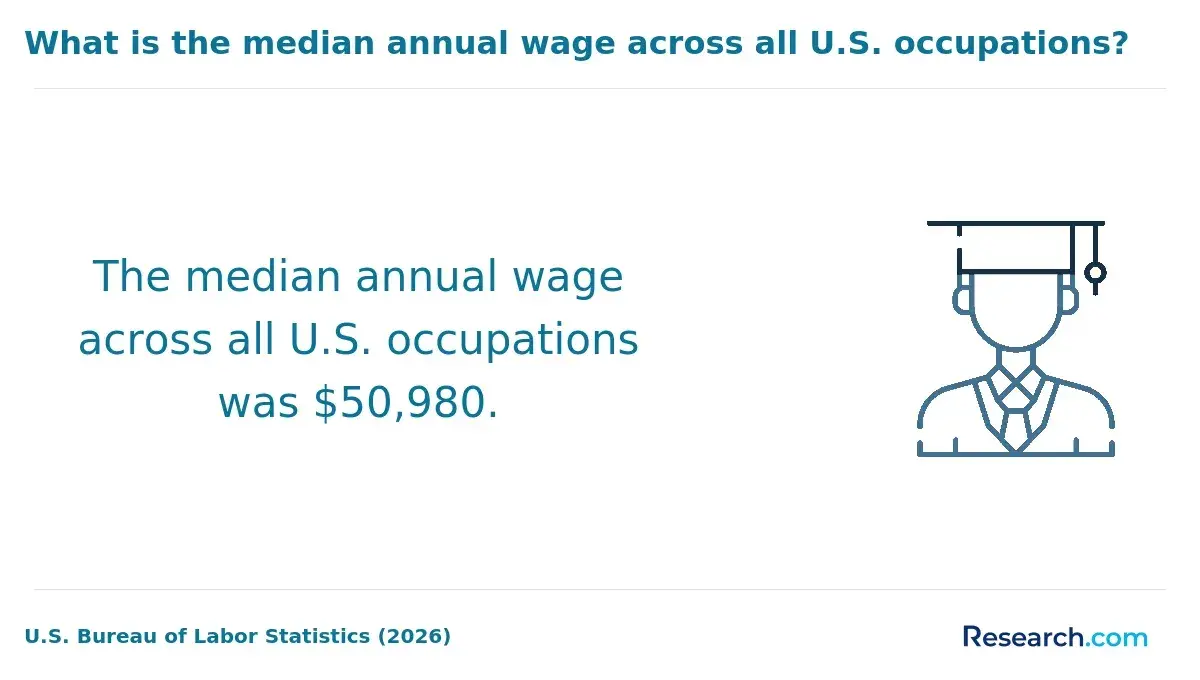
There is no single reliable "healthcare management MBA salary." Pay depends on the occupation, location, employer, responsibilities, and experience before and after the degree. For context, the U.S. Bureau of Labor Statistics reports a $126,520 median annual wage for management occupations in May 2025. That figure covers managers across industries and career stages; it is not a healthcare-specific wage or an MBA graduate earnings measure.
For a decision relevant to you, compare local job postings for the next role you could credibly obtain, not an executive title you hope to hold later. Record their pay ranges and experience requirements, then weigh a plausible compensation change against the MBA's full cost. BLS projects management occupations overall to grow faster than the average for all occupations from 2025 to 2035, but that broad outlook does not predict openings in your preferred healthcare role or location.
Do healthcare management MBA careers require licenses or certifications?
Most general healthcare operations and business management roles do not have a universal MBA-specific license. Requirements depend on the job. Practicing as a nurse, physician, therapist, or other regulated clinician still requires the applicable professional license; an MBA does not confer or replace it. Nursing home administrators, for example, face state-specific licensing requirements that must be checked with the relevant board.
Employers may value credentials in areas such as project management, quality, or health information, but those are distinct from an MBA and may have their own eligibility rules. Review actual postings for your target role before paying for an additional credential. If they consistently require a clinical license or technical experience you lack, another course or certification alone may not solve the eligibility gap.
Other Things You Should Know About MBA
That depends on the school's diploma and transcript policies. Ask the registrar what each document displays before enrolling.
Possibly, with employer approval and appropriate privacy safeguards. Do not put identifiable patient information into class materials or unapproved platforms.
Some fellowships accept MBAs, but eligibility rules vary by program and may include graduation dates or healthcare experience. Check the fellowship's current requirements directly.
Ask which programs and expenses qualify, when reimbursement is paid, and whether leaving your job triggers repayment. Those terms can materially change your out-of-pocket cost.
- Essential Skill and Knowledge Required for Health Data... - PMC https://pmc.ncbi.nlm.nih.gov/articles/PMC11605378/
- Health Science vs. Nursing: Choosing Your Healthcare Path | Northern Kentucky University Online https://onlinedegrees.nku.edu/programs/undergraduate/health-and-human-services/bs-health-science/degree-careers-jobs/
- Discover Career Opportunities With a Healthcare Management MBA Online | Fitchburg State University Online https://online.fitchburgstate.edu/degrees/business/mba/healthcare-management/careers/
- 10 Skills Employers Want for Healthcare Management Jobs | AIU https://www.aiuniv.edu/blog/10-top-skills-for-healthcare-management-jobs
- MHA vs. MHI vs. MBA: Degree Comparison Guide | About the University of Cincinnati https://www.uc.edu/blog/mha-vs-mhi-vs-mba--degree-comparison-guide.html
- Healthcare MBA Curriculum & Skills - Online Programs | Case Western Reserve University MBA https://onlineprograms.case.edu/mba/blog/healthcare-mba-program-online-what-you-learn-and-why/
- Health Sciences vs. Nursing: Which Is Right for You? | Husson University https://www.husson.edu/online/blog/2025/04/health-science-vs-nursing
- MHA vs. MBA: Which Degree Is Best for Your Health Career? | USC Price https://priceschool.usc.edu/price-blog/mha-vs-mba-which-degree-is-best-for-your-health-career/
- Common Careers in Health Sciences: Clinical vs. Nonclinical | Excelsior University https://www.excelsior.edu/article/clinical-vs-nonclinical-health-sciences-careers/