2027 Burn Unit Nurse Orientation: Training, Competency Reviews, and Support to Compare
Audited and Verified:
Our Editorial and Data Verification Process
Research.com uses government datasets, official education statistics and primary institutional information to support its career and degree guides. Our review process checks factual accuracy, occupational definitions, source dates and the requirements associated with the credentials discussed.
How This Article Was Fact-Checked
Our editorial team verifies salary estimates, employment projections, education requirements and program information against original data providers and official organizations. Salary figures are checked against the relevant occupational definitions and reporting periods. Information about licensure, accreditation and required in-person training is reviewed separately.
Fact-checked and verified on:

Co-Founder and Chief Data Scientist
A burn unit offer can be exciting, but the length of orientation alone will not tell you whether you will be ready to care for patients safely. Burn nurses may manage complex wounds, critical illness, pain, rehabilitation needs, and difficult family conversations - often within the same shift.
This guide is for nursing students, new graduates, and RNs moving into burn care. It explains what training and competency reviews should cover, how to compare employer support, and which questions to ask before accepting a position or paying for additional education.
Key Things You Should Know
- Compare three separate safeguards: an active RN license, supervised burn-specific orientation, and documented competency before taking an independent assignment.
- Ask for the actual progression plan - not just a number of orientation weeks - including preceptor continuity, patient assignments, skill sign-offs, and a process for extending support.
- A specialty course or certification can strengthen preparation, but neither replaces observed bedside performance or an employer's authorization to perform a task.
What does burn unit nurse orientation typically include?
Burn unit orientation is an employer-led transition from general RN preparation to the unit's patient population, equipment, protocols, and team workflows. Its length varies with the nurse's experience, the unit's acuity, and whether the role includes intensive care, step-down care, or outpatient treatment. A calendar end date should not substitute for a readiness decision.
A useful orientation moves from observation to supervised care and then to a progressively fuller assignment. The comparison below shows what each stage should accomplish.
| Stage | Typical focus | Evidence to look for |
| Foundations | Unit safety, infection prevention, documentation, equipment, and escalation routes | Access to policies, instruction, and supervised practice |
| Supported assignments | Assessment, wound care, pain management, handoffs, and coordination with the burn team | Direct preceptor feedback across relevant patient situations |
| Readiness review | Prioritization and performance with the expected assignment type | Documented competency, identified gaps, and a support plan |
A nurse transferring from another specialty may need a different plan from a new graduate. An RN completing a guide to RN-to-BSN programs with no clinicals should not mistake academic degree completion for burn-specific bedside orientation.
What education and licensing are required to become a burn unit nurse?
Bedside burn unit RN positions generally require completion of an RN-qualifying nursing program and an active RN license in the state of practice. An ADN, nursing diploma, or BSN may meet the educational starting point; individual employers can set additional hiring preferences. Graduation and NCLEX passage are distinct from the state board's decision to issue a license.
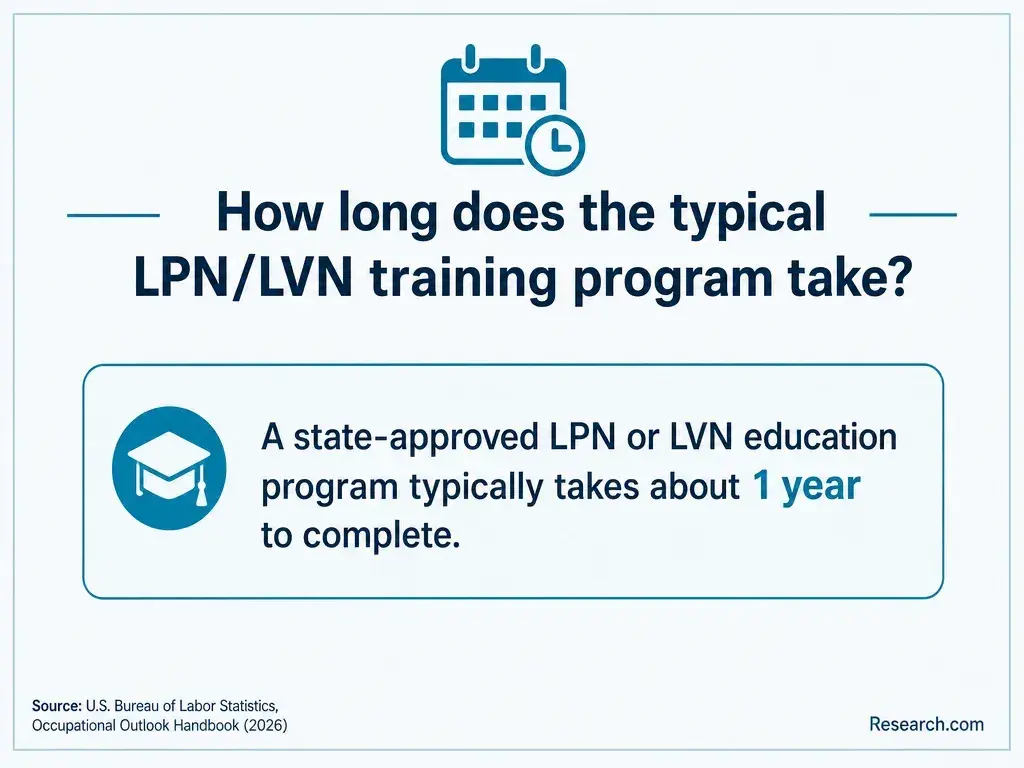
Nursing school teaches assessment, pharmacology, clinical judgment, and supervised patient care, but it does not make a graduate independently competent in burn care. Students interested in the specialty can seek relevant critical care, surgical, emergency, or wound-care exposure without assuming a particular rotation guarantees employment. LPNs or LVNs interested in RN burn roles must first meet RN education and licensure requirements; accelerated RN bridge options for LPNs are a separate decision from choosing a burn unit orientation.
How do burn nurse training programs build clinical competency?
Strong training combines focused instruction, demonstration, simulation where useful, and repeated supervised care with feedback. A preceptor should observe how the nurse assesses a patient, explains concerns, uses current unit protocols, communicates with the team, and recognizes when help is needed. A class attendance record or simulation check-off alone cannot establish readiness for an independent patient assignment.
Ask whether educators and preceptors use the same competency criteria and whether the nurse can encounter the range of cases expected in the eventual role. Low exposure to a skill may call for additional supervised practice, not an automatic sign-off. Nurses who later pursue practice-improvement leadership can compare DNP practice and project requirements, but a DNP project is not a substitute for burn-unit clinical validation.
A meaningful review checks performance in the nurse's assigned role rather than relying on a generic checklist. The reviewer should distinguish skills the nurse can perform independently from those requiring supervision, additional training, or a different credential.
These domains are especially useful when comparing how units define readiness:
- Assessment and escalation: recognizing changes in patient condition, prioritizing concerns, and communicating promptly through unit channels.
- Wound and infection-related care: following approved dressing, specimen, isolation, and documentation processes within the RN's role.
- Medication and symptom safety: assessing pain and other symptoms, administering prescribed therapy safely, and evaluating the response.
- Teamwork and recovery planning: coordinating with providers, rehabilitation staff, patients, and families while protecting privacy and documenting accurately.
For an ICU-based burn role, the review may also include critical-care equipment and monitoring competencies. Ask who performs each sign-off, what happens if an opportunity to demonstrate a skill does not arise, and how competencies are reassessed after orientation. Advanced study - including DNP study options beyond highly selective programs - does not override an employer's bedside competency process.
Start with the job posting and the burn unit's own requirements. Basic Life Support and, for some roles, Advanced Cardiovascular Life Support or pediatric resuscitation training may be required by the employer. Critical-care or wound-care credentials may be valuable for particular assignments, but eligibility and relevance depend on the credentialing organization, the nurse's experience, and the position. Verify the current official eligibility and renewal rules before paying for an exam or course.
Separate certification from an educational completion certificate and from employer competency sign-off. None grants an RN license or automatically expands scope of practice. Psychiatric-mental health NP credentials, including those pursued through faster PMHNP certificate pathways, prepare nurses for a different advanced-practice role; they are not burn nurse qualifications.
Neither delivery format eliminates the need for supervised clinical learning. A prelicensure program may deliver some coursework online, but students still need the labs, simulation, and clinical experiences its program and applicable regulators require. Campus instruction can make hands-on practice easier to schedule, while a hybrid format may reduce commuting for lectures; neither guarantees a burn placement.
For an already-licensed RN, online degree completion may fit around employment, but its courses should be evaluated separately from employer-provided specialty training. Associate-degree RNs considering graduate nursing routes for associate-degree nurses should first ask whether a graduate degree serves their long-term goal. It is not usually the quickest way to become competent on a burn unit.
There is no single universal burn nurse curriculum. Employer orientation and specialty courses commonly connect burn-related pathophysiology with assessment, wound management, infection prevention, pain and symptom care, nutrition, mobility, psychosocial support, and discharge planning. ICU-based programs may add more extensive preparation for critically ill patients. Procedures and treatment decisions must follow the patient's condition, the nurse's scope, current orders, and institutional policy.
Judge a curriculum by whether it prepares the nurse for the unit's actual patient population and then tests learning through supervised performance. A family nurse practitioner pathway - even one listed among family NP programs organized by duration - has different population-focus and clinical requirements. It should not be treated as an alternative burn RN curriculum.
The timeline has two parts: qualifying for and obtaining an RN license, then completing employer-specific burn orientation. The first depends on the nursing program and licensing process; the second depends on experience, unit acuity, scheduling, and demonstrated competence. Ask a prospective employer for its expected orientation schedule and extension policy rather than relying on a typical number of weeks.
Compare the total cost to you, not just a course price. Employer-paid orientation may still affect income if shifts or hours differ during onboarding. Optional courses can add tuition, travel, materials, and exam fees; confirm reimbursement terms before enrolling. If your goal is instead advanced practice, accelerated FNP certificate admissions and requirements involve a different educational and financial decision, not a shortcut into burn bedside practice.
Burn nurses may work in burn centers, hospitals with burn services, or related outpatient settings and may later pursue precepting, education, critical care, rehabilitation coordination, or leadership roles. Actual openings and advancement requirements depend on the employer. The physical demands of wound care and the emotional demands of severe injury and recovery also matter when evaluating fit.
The U.S. Bureau of Labor Statistics reports wages and employment projections for registered nurses, not a separate national burn nurse occupation. Its RN figures are useful as broad labor-market context, but they cannot predict a burn unit offer. Compare written offers by base pay, differentials, benefits, scheduling, staffing, and orientation support. A nurse considering a faster MSN-PMHNP pathway is comparing a different licensed role and should not use NP earnings expectations to evaluate burn RN pay.
How can nurses choose a reputable burn care training program?
For a new or transitioning RN, the most consequential "program" is often the employer's orientation. Look beyond a course brochure to the people, assignments, and decisions that will shape supervised practice. A reputable unit should be willing to explain how it handles gaps in experience without assigning work beyond a nurse's demonstrated readiness.
Before accepting an offer or purchasing training, ask for specific answers to these questions:
- Who are the preceptors and educators, and how consistently will I work with them?
- Which patient types and skills must I demonstrate, and who signs off each competency?
- How are assignments increased, and what happens if I need more supervised time?
- What support is available after orientation for unfamiliar cases, distressing events, and continuing education?
Compare answers across employers, and request the competency framework if it is available. If a separate long-term goal is psychiatric advanced practice, compare affordable psychiatric-mental health NP pathways on their own merits; their price or format does not indicate the quality of a burn unit's orientation.
Other Things You Should Know About Nursing
Yes, if the employer hires new graduates for that role. Ask whether its orientation is designed for new RNs, not only experienced nurses transferring specialties.
Tell your preceptor or manager which assignments or skills concern you and request a documented plan for additional supervised practice. A completed schedule is not proof of readiness for every assignment.
Not automatically. A school must approve and evaluate clinical experiences under its requirements; ordinary paid employment does not become academic credit simply because the work is relevant.
Ask to speak with a recent hire about preceptor access, assignment progression, and help after orientation. Compare that account with the manager's written or stated plan.
- Medical and Surgical Care of Critical Burn Patients - PMC - NIH https://pmc.ncbi.nlm.nih.gov/articles/PMC9754771/
- APRN Practice FAQ - Texas Board of Nursing https://www.bon.texas.gov/faq_practice_aprn.asp.html
- Why We Need Preceptors and the Benefits of Preceptorship | Baylor University Online https://onlinenursing.baylor.edu/news/why-we-need-preceptors-and-benefits-preceptorship
- A cross-sectional survey on nurses in burn departments | sciencedirect.com https://www.sciencedirect.com/science/article/pii/S0305417922002388
- Components of an Effective Nurse Orientation Pathway | American Association of Critical-Care Nurses https://solutions.aacn.org/blog/components-of-an-effective-nurse-orientation-pathway
- Burn Care Excellence: The Certified Burn Registered Nurse | The Board of Certification for Emergency Nursing https://bcen.org/cbrn/program-overview/
- Nursing management of burn injuries | rch.org.au https://www.rch.org.au/rchcpg/hospital_clinical_guideline_index/Nursing_management_of_burn_injuries/
- Nurse Orientation Core Blueprint | lww.com http://links.lww.com/JONA/A968
- BCEN Publishes CBRN Burn Nursing Specialty Certification Exam Content Outline | Society of Trauma Nurses https://traumanurses.org/education/upcoming-webinars/bcen-publishes-cbrn-burn-nursing-specialty-certification-exam-content-outline
- Taking Orientation Back to Basics for New Nurses | childrenshospitals.org https://www.childrenshospitals.org/content/pediatric-learning-solutions/case-study/taking-orientation-back-to-basics-for-new-nurses