
2027 Book Editor Careers: Skills, Education, Salary & Job Outlook

Co-Founder and Chief Data Scientist
Choosing a book editor career means deciding whether you want to build a working life around manuscripts, authors, deadlines, and close attention to language. A bachelor's degree in English, journalism, communications, or a related field is often enough to start, but the field is competitive. Strong writing judgment, practical editing experience, and a portfolio usually matter more than credentials alone.
Pay expectations can also be confusing because editor earnings vary by industry, employer, location, specialization, and whether the role is in-house or freelance. Some references place typical pay around $57,000, with top earners exceeding $120,000; this guide also discusses a median salary of $75,260 and a wider salary range in the earnings section. The key point is that book editing can be financially viable, but it is not a guaranteed high-paying path for every entrant.
This guide explains what book editors do, the skills and training employers look for, how to enter the field, where advancement can happen, and what trade-offs to consider before committing to this career.
Key Things You Should Know About Book Editor Career
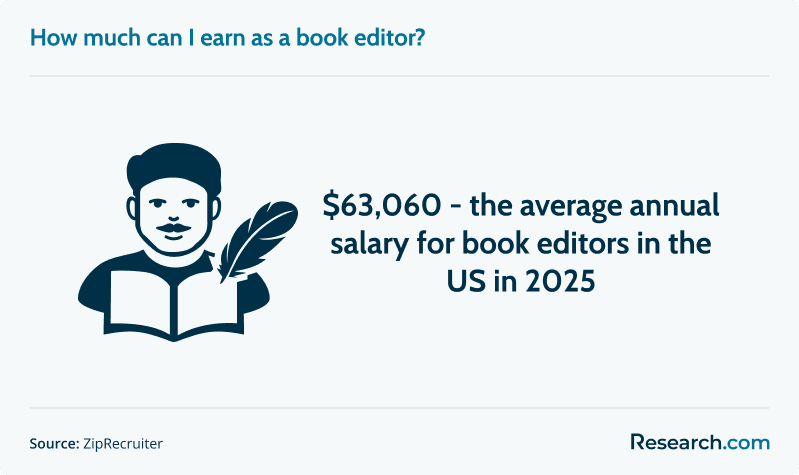
- The typical earning potential for a book editor ranges from about $45,500 to $63,060 annually, though the median salary for editors overall is around $75,260.
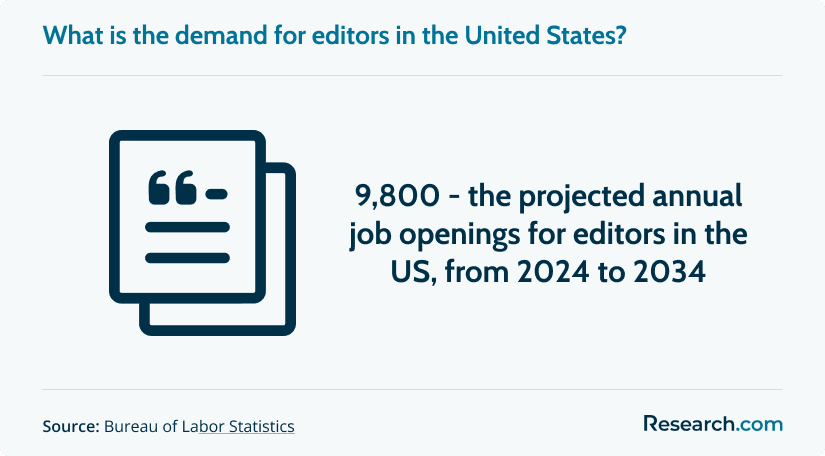
- The field of editing is expected to grow slowly, with employment increasing only about 1 percent from 2024 to 2034, indicating a stable but limited expansion.
- A bachelor's degree in English, communications, or journalism is generally required to begin a career as a book editor.
- Success depends on strong writing and editing skills, sharp attention to detail, excellent organizational abilities, comfort working under deadlines, proficiency in publishing software, and clear communication skills.
- Advancement opportunities include moving into senior editor or editorial director roles, leading larger projects and teams, or transitioning into publishing management and related fields like writing.
What do book editors do?
Book editors help turn drafts into publishable books. They evaluate structure, argument, voice, pacing, grammar, style, accuracy, and reader fit. Their job is not to rewrite a book according to their own taste, but to help the author produce the strongest version of the manuscript for its intended audience and market.
The work can vary widely depending on the type of editing. A developmental editor may focus on plot, organization, argument, character development, or chapter flow. A line editor may refine tone, rhythm, and clarity. A copyeditor checks grammar, consistency, style, and usage. A proofreader reviews the final version for remaining errors before publication.
A day in the life of book editors
A typical day often includes several hours of focused manuscript review, written feedback to authors, meetings with editorial or production teams, and project tracking. Editors may compare a manuscript against a style guide, answer author questions, review revised chapters, check facts, or coordinate with designers and marketers as the book moves toward publication.
The role requires both solitude and collaboration. Editors need quiet time for close reading, but they also need the communication skills to explain suggested changes clearly, tactfully, and persuasively. The final product is a cleaner, stronger manuscript that better serves readers while preserving the author's voice.
What are the key responsibilities of book editors?
Book editors are responsible for improving manuscripts while keeping publication goals, author intent, reader expectations, and production timelines in view. The exact workload depends on the publisher, genre, and level of editing, but most roles combine editorial judgment with project management.
Common responsibilities include:
- Reviewing manuscripts for clarity and quality: Editors identify confusing sections, weak organization, inconsistent tone, grammar issues, and style problems.
- Giving actionable feedback to authors: They explain what needs revision, why it matters, and how the manuscript can improve without overwhelming the author.
- Managing revisions: Editors track changes, review new drafts, resolve author queries, and make sure requested edits are completed.
- Checking accuracy: In nonfiction and academic work, editors may verify dates, names, data, citations, terminology, and claims.
- Applying publisher standards: They use house style, formatting requirements, and production guidelines so the manuscript is ready for design, proofing, and release.
- Coordinating with publishing teams: Editors often work with acquisitions, design, production, marketing, publicity, and sales teams to keep a book aligned with its audience and schedule.
- Managing multiple projects: Many editors handle several manuscripts at once, each with different deadlines, authors, and levels of complexity.
The most challenging vs. the most rewarding tasks
One of the hardest parts of the job is delivering criticism in a way an author can hear and use. Major cuts, structural changes, or factual corrections can be sensitive, especially when the author is deeply attached to the work. Editors need tact, evidence, and patience, particularly when deadlines are tight.
The most rewarding part is seeing a rough or unfinished manuscript become a polished book. Editors often work behind the scenes, but their judgment can shape pacing, readability, credibility, and emotional impact. For readers considering broader credential options that may support career growth, it can also be useful to compare certification programs linked to stronger earning potential.
What are the key skills for book editors?
Book editors need excellent command of language, but grammar knowledge alone is not enough. The strongest editors combine close reading, judgment, research ability, diplomacy, and deadline discipline.
- Written communication: Editors must improve prose and write clear feedback that authors can act on.
- Editorial judgment: They decide what should change, what should stay, and which issues matter most for the reader.
- Style and grammar expertise: Editors apply grammar rules, usage conventions, house style, and genre expectations consistently.
- Content editing software proficiency: They commonly work in Microsoft Word, Adobe InCopy, or specialized publishing platforms, often using tracked changes and comments.
- Fact-checking and research: Editors verify names, dates, statistics, quotations, references, and subject-specific details when accuracy is critical.
- Project management: They manage deadlines, version control, author communication, and multiple manuscripts at different stages.
- Layout and design collaboration: Editors may coordinate with designers or production teams to make sure covers, interior formatting, captions, headings, and other elements meet publisher standards.
- Author relationship management: Editors must build trust while still being honest about problems in the manuscript.
The overlooked skill that separates good editors from great editors
Author relationship management is often underestimated. A technically skilled editor can still struggle if feedback sounds dismissive, vague, or controlling. A great editor knows how to protect the book's quality while keeping the author engaged in the revision process.
For example, an editor may need to recommend cutting a favorite chapter, changing the structure, or clarifying a weak argument. The best editors explain the reader benefit, offer alternatives, and keep the conversation focused on the book's goals. This skill reduces conflict, saves time, and improves the final manuscript.
Strong editing skills can support opportunities in several publishing environments, including the publishing industries (except Internet), which tend to offer the top pay for editors. Readers considering advanced education can compare options such as master's degrees that may be easier to complete while working, but practical editing ability remains essential.
Book Editor Careers: A Step-by-Step Guide to Getting Started
There is no single required route into book editing, but most successful editors build the same foundation: education in writing or communication, direct editing practice, industry exposure, and a portfolio that proves they can improve real manuscripts.
- Build foundational education: Complete higher education in English, journalism, communications, creative writing, publishing, or another writing-intensive field. Use coursework to strengthen analysis, grammar, research, and revision skills.
- Develop core editing and writing skills: Practice editing different types of material, including fiction, nonfiction, academic writing, essays, articles, and long-form manuscripts. Learn style guides and become comfortable using editing software.
- Gain practical industry experience: Look for internships, campus publication roles, literary magazine work, publishing assistant positions, editorial assistant roles, manuscript reader work, or freelance projects.
- Build professional credentials and a portfolio: Save before-and-after samples when permitted, collect testimonials, document project types, and pursue relevant training or certificates when they address a real skill gap.
- Pursue advancement and specialization: As experience grows, focus on stronger niches such as developmental editing, copyediting, academic editing, technical editing, children's books, genre fiction, or nonfiction subject areas.
The best early strategy is to get close to manuscripts as soon as possible. Employers and clients want evidence that you can edit under real constraints, communicate with writers, meet deadlines, and improve work without damaging the author's voice.
What education, training, or certifications are required?
Most book editor positions require a bachelor's degree, commonly a Bachelor of Arts in English, Journalism, Communications, or a related field. These programs help develop the reading, writing, research, and analytical skills editors use every day. However, a degree alone rarely proves job readiness. Employers and clients also want demonstrated editing experience.
Training often begins through internships at publishing houses, magazines, literary agencies, university presses, or media organizations. Entry-level roles such as Editorial Assistant or Manuscript Reader can also provide exposure to acquisitions, author communication, copyediting, permissions, production schedules, and publishing workflows.
Certifications are usually optional, not mandatory. Examples include the Editing Certificate from the Editorial Freelancers Association and the Certified Proofreader designation from the American Society of Professional Editors. These credentials may help freelancers, career changers, or candidates without formal editorial experience signal commitment and basic competence. Before paying for any program, compare cost, curriculum, instructor qualifications, portfolio value, and employer recognition.
Are advanced degrees or niche certifications worth the investment?
Advanced degrees such as a Master of Arts in English or Journalism can be useful for editors who want deeper literary training, stronger research skills, or access to specialized editorial roles. They may also help in academic, scholarly, or subject-focused publishing where advanced knowledge is valued.
Still, most book editing jobs do not require education beyond a bachelor's degree. Direct experience, strong samples, reliable references, and the ability to manage authors and deadlines often carry more weight. If cost is a concern, readers comparing graduate options can review affordable online master's degree programs before committing.
A practical rule is this: choose an advanced degree or certification only if it clearly improves your editing skill, strengthens your portfolio, supports a target niche, or helps you qualify for roles you could not otherwise reach.
What is the earning potential for book editors?
The median salary for book editors is $75,260 per year. This figure can serve as a useful benchmark, but actual earnings vary significantly by employer type, location, experience level, specialization, and whether the editor is salaried or freelance.
The book editor salary range 2025 spans from about $47,090 annually at entry level to $127,180 for senior editors. This wide range is important. New editors may start with modest pay while building experience, while senior editors, executive editors, specialized editors, and professionals in higher-paying industries may earn substantially more.
Several factors can influence earning potential:
- Experience: Editors with a strong record of completed books and author relationships are more competitive for higher-level roles.
- Specialization: Technical, academic, scientific, legal, business, and niche nonfiction editing may command stronger compensation than general entry-level editing.
- Location: Major metropolitan publishing markets may offer higher salaries, though cost of living can offset the advantage.
- Employment model: In-house roles may offer stability and benefits, while freelance editing can offer flexibility but requires client acquisition and income management.
- Project complexity: Developmental editing, substantive editing, and specialized nonfiction work often require more judgment than basic proofreading.
Readers should evaluate salary alongside job stability, benefits, workload, advancement potential, and the realities of competition in publishing.
What is the job outlook for book editors?
Employment of editors, including book editors, is projected to grow by just 1 percent from 2024 to 2034. That is slower than the average growth rate for all occupations and suggests a competitive labor market with limited net job creation.
Most openings are expected to come from replacement needs rather than rapid expansion. In practical terms, aspiring book editors should not rely on degree completion alone. They need targeted experience, strong samples, networking, and adaptability across print, digital, and freelance publishing environments.
The key factors shaping the future outlook
Technology is changing editorial work. Automation and artificial intelligence can assist with spelling, grammar, formatting, and consistency checks, which may reduce demand for some routine editing tasks. However, these tools do not replace higher-level editorial judgment, author management, narrative structure, audience awareness, or subject-matter accuracy.
Traditional publishing sectors such as newspapers and magazines have also faced pressure, while digital media and online content have created different kinds of editorial work. Book editors who can work across formats, understand digital publishing workflows, and show measurable editorial value may be better positioned.
Because job growth is limited, students should be careful about education costs. Comparing options such as low-tuition colleges that accept financial aid can help reduce debt while building the skills needed to compete.
What is the typical work environment for book editors?
The typical book editor work environment is computer-based, deadline-driven, and detail-intensive. Editors spend long stretches reading, commenting, revising, checking facts, answering emails, and reviewing manuscript versions.
Many editors work in publishing offices, university presses, media companies, professional services firms, or home offices. Most professionals in this field work within book, newspaper, and directory publishers (29%), followed by professional, scientific, and technical services (14%), while a notable portion are self-employed (11%). This mix reflects both traditional publishing employment and freelance opportunities.
The work style combines independence and collaboration. Editors often read and edit alone, then communicate with authors, other editors, production staff, designers, marketers, and sometimes agents. The pace can be calm during early review stages and intense near deadlines.
Schedules often follow standard business hours, but editors may exceed 40-hour weeks when a manuscript is behind schedule, proofs are due, or a publication date is fixed. Evening or weekend work can happen, especially for freelancers and editors managing multiple projects. Remote work is increasingly common because manuscripts, comments, proofs, and meetings can often be handled digitally.
What are the pros and cons of book editors careers?
A book editor career can be deeply satisfying for people who love language, ideas, and author collaboration. It can also be demanding, competitive, and less glamorous than many readers imagine. The best fit is someone who enjoys improving other people's work and can handle criticism, repetition, and deadlines without losing attention to detail.
Pros
- Meaningful creative work: Editors help shape books that may educate, entertain, persuade, or influence readers.
- Close collaboration with authors: The role can be rewarding for people who enjoy coaching writers and improving ideas.
- Visible improvement: Editors can often see the direct effect of their work from rough draft to final manuscript.
- Specialization options: Editors can focus on fiction, nonfiction, academic publishing, children's books, technical subjects, or freelance niches.
- Remote and freelance potential: Many editing tasks can be done from anywhere, depending on the employer or client base.
Cons
- Competitive entry: Publishing roles can attract many qualified applicants, especially in desirable markets.
- Tight deadlines: Publication schedules can require long hours and quick turnaround.
- Emotionally sensitive feedback: Authors may resist edits, especially when revisions affect structure, tone, or content they value.
- Repetitive detail work: Copyediting, proofreading, consistency checks, and fact-checking require sustained concentration.
- Commercial pressure: Editors may need to balance literary quality with market positioning, publisher expectations, and production limits.
Before choosing this path, consider whether you prefer working behind the scenes, improving existing material, and negotiating changes diplomatically. If you want to combine editing with another field, reviewing the best dual degree combinations may help you think through broader career options.
What are the opportunities for advancement for book editors?
Book editors can advance by moving into higher editorial roles, specializing in more complex work, managing authors or imprints, or building a strong freelance business. Advancement usually depends on editorial skill, project reliability, market judgment, author relationships, and the ability to deliver publishable work on schedule.
Structured advancement pathways
Book editor career advancement opportunities often follow a progression from support roles to decision-making roles:
- Editorial Assistant / Manuscript Reader: Support senior editors, screen submissions, handle correspondence, prepare materials, and learn publishing workflows.
- Associate Editor / Editor: Edit manuscripts more independently, communicate with authors, coordinate revisions, and manage selected projects.
- Senior Editor / Executive Editor: Lead higher-profile books, guide editorial strategy, mentor junior staff, and sometimes acquire manuscripts.
- Publisher / Editorial Director: Oversee an imprint, list, or editorial program and make broader decisions about acquisitions, positioning, budgets, and publishing direction.
Specialization opportunities and promotion strategies
Learning how to get promoted as a book editor starts with becoming known for dependable judgment. Editors who consistently meet deadlines, improve manuscripts, work well with authors, and understand the market are more likely to receive greater responsibility.
- Developmental editing: Focus on structure, argument, plot, pacing, character, or overall manuscript strategy.
- Copyediting: Specialize in grammar, style, consistency, clarity, and final manuscript polish.
- Technical editing: Work with academic, scientific, medical, engineering, or specialized nonfiction content where accuracy is essential.
- Content editing / genre specialization: Build expertise in fiction, nonfiction, children's books, memoir, textbooks, scholarly publishing, or another defined category.
- Freelance editing: Serve multiple authors, publishers, or organizations while developing a client base and business skills.
Useful promotion strategies include seeking mentorship, volunteering for complex projects, learning production workflows, tracking measurable outcomes, developing subject expertise, and maintaining a portfolio that shows the type and level of editing performed.
What other careers should you consider?
If you like editing but are unsure whether book publishing is the right fit, related careers can help you use similar strengths in different settings. Consider whether you prefer shaping manuscripts, representing authors, producing persuasive copy, explaining technical information, reporting news, or managing publishing decisions.
- Literary Agent: Literary agents evaluate manuscripts, represent authors, negotiate deals, and help position books for publishers. This path may suit people who enjoy editorial judgment but want a more business-facing role.
- Copywriter: Copywriters create persuasive marketing, advertising, web, and brand content. This option fits strong writers who like concise messaging and audience-focused communication.
- Technical Writer: Technical writers explain complex information clearly in manuals, guides, documentation, and instructional materials. This can be a strong fit for detail-oriented editors who enjoy accuracy and structure.
- Journalist: Journalists research, interview, fact-check, and write stories for public audiences. This path may appeal to editors who enjoy deadlines, reporting, and current events.
- Publisher: Publishers oversee broader editorial, production, financial, and market decisions. This route suits professionals who want leadership responsibility beyond line-level editing.
The right choice depends on what kind of work gives you energy: deep manuscript development, language polish, client service, research, business strategy, or public communication.
Here's What Professionals Say About Their Book Editor Careers
- Sofia: "Going from a casual reader to the person helping shape a full book felt unreal. I still remember copyediting my first manuscript and realizing I had found work that matched how my mind operates. Every page brought a new problem to solve, and when the book was finally ready, I felt proud of the care I had put into it."
- Amir: "My first major project came with a very tight deadline, so I planned my days carefully and edited late into the night. It was exhausting, but each finished chapter made me more confident. That project taught me that editing is not only about language skill. It is also about discipline, stamina, and keeping promises."
- Elena: "Meeting a deadline always feels good, but the best part is seeing how the manuscript improves because of the edits. One client told me she could tell I was thinking about the book even away from my desk. That meant a lot because good editing requires real attention to another writer's work."
Key Findings
- Book editors improve manuscripts for clarity, structure, accuracy, style, consistency, and reader impact while preserving the author's voice.
- A bachelor's degree in English, Journalism, Communications, or a related field is common, but practical experience and a strong portfolio are often more important than credentials alone.
- Optional credentials, such as the Editing Certificate from the Editorial Freelancers Association or the Certified Proofreader designation from the American Society of Professional Editors, may help some candidates but are not usually required.
- The median salary for book editors is $75,260 per year, with the book editor salary range 2025 running from about $47,090 to $127,180 depending on experience and role level.
- Employment of editors, including book editors, is projected to grow by just 1 percent from 2024 to 2034, making the field competitive.
- Editors who combine language expertise with author relationship management, deadline discipline, digital workflow skills, and specialization are better positioned for advancement.
- This career is best suited to people who enjoy detailed reading, constructive feedback, long-form projects, and behind-the-scenes creative collaboration.
Other Things You Should Know About Book Editor Careers
In 2027, book editors need advanced skills in digital literacy and AI tool integration to efficiently manage content. Understanding machine learning systems used for editing can enhance workflow. Moreover, strong interpersonal skills remain vital for collaborating effectively with authors and publishing teams amidst technological changes.
In 2027, AI and automation are reshaping book editing by streamlining repetitive tasks such as grammar checks and initial proofreading. This shift allows editors to focus more on creative tasks, enhancing the narrative and refining the author's voice, thereby requiring editors to adapt to new tech tools and workflows.
In 2027, job security challenges for book editors include the rise of AI in content creation and editing, increased reliance on freelancers, and the shift towards digital publishing. Editors must adapt by enhancing their digital skills and staying updated with industry trends to remain competitive.
References
- What does a Book Editor do? Career Overview, Roles, Jobs | SSP https://jobs.sspnet.org/career/book-editor
- Soft Skills Every Aspiring Author Needs https://writingcooperative.com/soft-skills-every-aspiring-author-needs-98e4fc6d199
- How to become a writer or editor https://www.open.edu.au/advice/careers/media-communications/writer-editor
- A Week in the Life of a Book Editor: Your Top 10 Questions Answered https://self-publishingschool.com/book-editor-week-in-the-life/
- Frequently Asked Questions - Bookcareers https://www.bookcareers.com/frequently-asked-questions-faqs/
- What I Wish I'd Known About: Working in Publishing https://www.killyourdarlings.com.au/article/what-i-wish-id-known-about-working-in-publishing/
- 5 Book Editor Job Description Templates and Examples | Himalayas https://himalayas.app/job-descriptions/book-editor
- Purpose Job Board https://www.purpose.jobs/discover/companies/red-ventures/jobs/45582712-audience-development-editor-lonely-planet
- What Working On Your First Book Is Really Like - Edit Republic https://editrepublic.com/blog/what-working-on-your-first-book-really-like/
- A Book Editor’s Work is Never Done • Career Authors https://careerauthors.com/book-editors-work/


