2027 Best Online Bachelor's Degree Programs With Easy Admission Requirements

Co-Founder and Chief Data Scientist
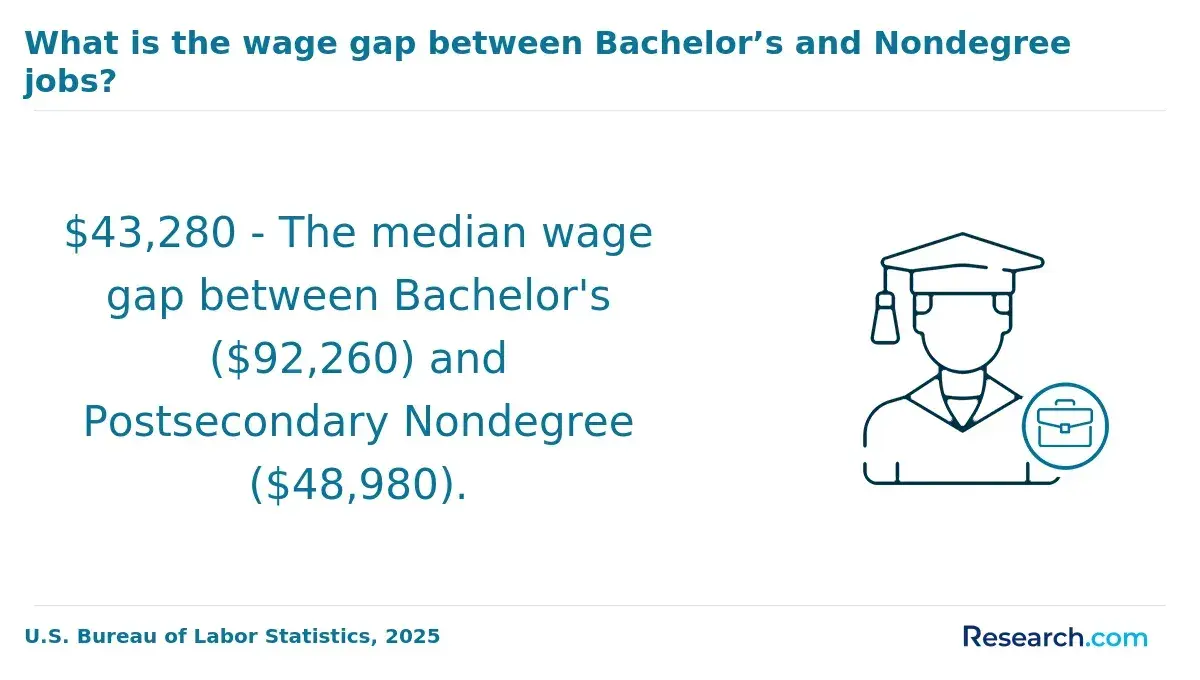
Choosing an online bachelor's program is often a balance between access, cost, credibility, and career payoff. Bureau of Labor Statistics 2024 data show workers age 25 and older with a bachelor's degree had median weekly earnings of $1,543, compared with $930 for those with only a high school diploma.
This guide is for adults, transfer students, first-generation learners, and career changers who want flexible programs with realistic admission requirements. You'll learn which majors are easier to enter, what schools typically require, and how to avoid costly enrollment mistakes.
Key Things You Should Know
- Easy-admission online bachelor's programs commonly use open, rolling, or transfer-friendly admissions, but regional or national institutional accreditation still matters more than a simple application process.
- College Board's 2024 Trends in College Pricing reported average published tuition and fees of $11,610 for in-state public four-year students and $43,350 at private nonprofit four-year institutions, so school type and residency can heavily affect total cost.
- BLS 2024 wage data show computer, IT, healthcare management, engineering, and some business roles generally offer stronger median pay than many general bachelor's-level fields, but licensure and experience can change outcomes.
Top 10 Best Online Bachelor's Degree Programs With Easy Admission Requirements
Business Degrees
Online business degrees are among the most accessible bachelor's options because many programs accept transfer credits, prior college coursework, and broad general education backgrounds. Common majors include business administration, management, accounting, finance, marketing, and human resources.
BLS May 2024 data placed the median wage for business and financial occupations at $80,920, making this a practical choice for students who want flexible career options. Choose accounting or finance for quantitative paths, management for operations roles, and marketing for digital strategy or sales-focused careers.
Healthcare Degrees
Healthcare bachelor's programs with easier entry often include health administration, public health, healthcare management, and health sciences rather than clinical majors. These programs suit students who want to work in hospitals, clinics, insurance, community health, or healthcare operations without becoming licensed clinicians. Medical and health services managers had a May 2024 median wage of $117,960, according to BLS data, but many management roles require experience. Check whether internships, fieldwork, or background checks are required before enrolling.
Information Technology Degrees
Online information technology programs are often transfer-friendly and may accept students without advanced math backgrounds, especially when compared with computer science. Coursework usually covers networking, systems administration, cloud platforms, databases, project management, and cybersecurity basics. BLS May 2024 data reported a median wage of $105,990 for computer and information technology occupations. This degree fits students who want applied technology roles, hands-on troubleshooting, and employer-recognized technical skills rather than theory-heavy computing.
Computer Science Degrees
Computer science can be more selective than general IT because it often requires calculus, discrete math, programming sequences, and structured problem-solving. However, many online programs admit students conditionally or allow prerequisites to be completed after enrollment. The degree is best for students interested in software development, data systems, AI tools, algorithms, or graduate study. BLS May 2024 data listed software developers at a median wage of $133,080, but portfolios, internships, and coding ability strongly influence entry-level competitiveness.
Cybersecurity Degrees
Cybersecurity bachelor's programs often accept beginners, especially at schools that embed networking and operating systems fundamentals into the curriculum. Students study risk management, incident response, digital forensics, secure systems, and compliance. BLS May 2024 data placed information security analysts at a median wage of $124,910. This major is a strong fit for detail-oriented learners who can build labs, pursue certifications, and handle constant technology change. Look for programs aligned with recognized security frameworks and hands-on practice environments.
Psychology Degrees
Psychology is usually one of the easier online bachelor's degrees to enter because it has broad prerequisites and few technical barriers. It helps students build research, communication, behavioral analysis, and human services skills. A bachelor's degree alone does not qualify graduates to become licensed psychologists, so students should view it as a foundation for roles in case management, human resources, social services, market research, or graduate school. It fits learners who want people-focused careers and may later pursue counseling, social work, or clinical training.
Nursing Degrees
Online nursing degrees are not usually easy-entry for first-time college students because clinical requirements, state board rules, and competitive admissions apply. The most accessible online nursing route is often an RN-to-BSN program for licensed registered nurses. BLS May 2024 data reported a median wage of $93,600 for registered nurses, but pay varies by state, setting, shift, and specialty. Before enrolling, confirm that the program is approved for your state and matches your licensure status.
Education Degrees
Online education degrees may be easy to enter at the pre-licensure or non-licensure level, but teacher certification programs must meet state requirements. Common options include elementary education, special education, early childhood education, instructional design, and education studies.
Students planning to teach in public schools should verify student-teaching placement rules, testing requirements, and state authorization. This degree is best for students who want classroom, training, curriculum, or youth development roles and understand that licensure rules vary widely.
Criminal Justice Degrees
Criminal justice programs often have accessible admissions and flexible online formats. Coursework may cover law enforcement, corrections, courts, criminology, ethics, emergency management, and homeland security. The degree can support careers in policing, probation, corrections administration, compliance, victim advocacy, or security management. Some sworn roles require academy training, physical standards, background checks, and local hiring exams rather than only a degree. It fits students who want public service or justice-related work and can meet employer screening requirements.
Engineering Degrees
Engineering is typically not the easiest online bachelor's path because ABET-accredited programs often require advanced math, labs, design projects, and strict course sequencing. Some online options focus on engineering technology, industrial technology, or software-oriented engineering fields, which may be more accessible.
BLS May 2024 data show engineers generally earn above the median for all occupations, but admission standards and workload can be demanding. Choose this route if you are comfortable with calculus, physics, structured problem-solving, and long-term technical study.
What Are the Easiest Online Bachelor's Degrees to Get Into?
The easiest online bachelor's degrees to get into are usually broad, transfer-friendly majors with limited lab, licensure, or advanced math requirements. "Easy to get into" does not mean low quality; it usually means the school has flexible admission policies, multiple start dates, generous transfer rules, or conditional admission for students who do not meet standard criteria.
The table below compares common easy-entry majors by admission flexibility and career direction. Use it to narrow your search before comparing individual schools.
| Degree area | Why admission may be easier | Best fit | Watch out for |
| Business administration | Broad prerequisites and high online availability | Students seeking flexible corporate, nonprofit, or entrepreneurial roles | Overly general programs without career tracks |
| Psychology | Few technical prerequisites at the bachelor's level | Students interested in people-focused work or graduate study | Assuming it leads directly to licensed therapist roles |
| Criminal justice | Accessible curriculum and multiple public-service pathways | Students interested in law enforcement, courts, corrections, or security | Ignoring background checks or agency hiring rules |
| Health administration | Often non-clinical and open to new healthcare learners | Students interested in healthcare operations | Confusing it with clinical nursing or allied health licensure |
| Information technology | Applied curriculum and multiple beginner-friendly tracks | Students who want practical tech skills | Choosing a program without labs, projects, or current tools |
If you want to test your readiness before committing to a full degree, reviewing easy online college courses can help you identify subjects that match your strengths and schedule.
What Admission Requirements Do Easy-Entry Online Bachelor's Programs Need?
Easy-entry online bachelor's programs usually reduce barriers, but they still require proof that you can do college-level work. Requirements vary by institution, degree level, transfer status, and whether the program leads to licensure.
The table below summarizes typical requirements and what they mean for applicants. It can help you prepare documents before speaking with admissions.
| Requirement | Common expectation | Why it matters |
| High school diploma or GED | Required for first-time bachelor's students | Confirms basic eligibility for undergraduate admission |
| College transcripts | Required for transfer students | Determines transfer credits, GPA standing, and class placement |
| Minimum GPA | Often flexible, conditional, or waived at open-admission schools | Affects admission status and sometimes scholarship eligibility |
| Standardized tests | Often optional or not required for adult online students | Can reduce barriers for applicants returning to school |
| Placement or prerequisite courses | Common in math, writing, science, nursing, engineering, and computing | May lengthen your timeline if not completed before enrollment |
| State authorization or licensure review | Required for regulated programs | Confirms whether the school can enroll you and support your career goal |
Before applying, gather documents and ask the admissions team direct questions. The fastest path is usually the one that accepts the most legitimate credits without sacrificing accreditation or career alignment.
- Request unofficial transcript reviews from more than one school before paying enrollment deposits.
- Ask whether admission is full, provisional, conditional, or limited to pre-major status.
- Confirm whether credits from military training, professional certifications, AP, CLEP, or prior learning assessments are accepted.
- Check whether the program has separate admission requirements after general university admission.
How Do You Choose an Accredited Online Bachelor's Program?
Accreditation is the quality-control checkpoint that protects your transfer credits, financial aid eligibility, graduate school options, and employer recognition. An easy application process is only useful if the credential is accepted by the people and institutions that matter for your goals.
Use this comparison to understand which accreditation signals are most relevant. Institutional accreditation is the baseline; programmatic accreditation matters most in regulated or highly technical fields.
| Accreditation type | What it evaluates | When it matters most |
| Institutional accreditation | The overall college or university | Financial aid, credit transfer, employer recognition, and graduate admission |
| Programmatic accreditation | A specific degree or professional program | Nursing, education, engineering, business, counseling, and other regulated fields |
| State approval | Whether a program meets state rules | Teacher licensure, nursing licensure, clinical placements, and distance education authorization |
| Industry alignment | Whether coursework maps to employer tools or certifications | IT, cybersecurity, project management, healthcare administration, and analytics |
Red flags deserve attention because they can limit your options after graduation. Before enrolling, take these steps to reduce risk.
- Verify the school's accreditation through recognized accreditor listings rather than relying only on marketing pages.
- Ask whether your state allows residents to enroll in the program and complete any required field experiences.
- Confirm whether programmatic accreditation is required for your target license, certification, graduate program, or employer.
- Avoid schools that pressure you to enroll immediately, refuse to provide total cost estimates, or make guaranteed job claims.
How Do Online Bachelor's Degrees Compare With Campus Programs?
Online bachelor's degrees and campus programs can lead to the same credential when they come from the same accredited institution, but the learning experience is different. The right format depends on your schedule, learning style, access to campus resources, and need for structure.
The table below highlights the practical trade-offs students should compare. Focus on fit rather than assuming one format is automatically better.
| Factor | Online bachelor's program | Campus bachelor's program |
| Schedule | Often asynchronous or evening-friendly | Usually tied to fixed class times |
| Best for | Working adults, caregivers, military students, and transfers | Students who want face-to-face structure and campus life |
| Costs | May reduce commuting, housing, and relocation expenses | May include housing, transportation, and campus fees |
| Support | Depends heavily on virtual advising, tutoring, and tech support | Often easier to access in-person offices and peer networks |
| Hands-on requirements | May require local placements, intensives, labs, or simulations | Often easier for lab, studio, clinical, or field-based work |
| Employer view | Generally strongest when accredited and skill-based | Generally strongest when paired with internships and networking |
Choose online if flexibility is essential and you can manage deadlines independently. Choose campus if you need daily structure, in-person labs, or a residential college experience.
Which Online Bachelor's Degrees Lead to the Best Careers?
The best career-leading online bachelor's degrees are usually those connected to growing industries, measurable skills, licensure pathways, or clear occupational ladders. Salary should matter, but it should not be the only measure of value; completion cost, debt, location, experience, and employer demand also affect return on investment.
The table below summarizes degree areas that often provide strong career alignment. Use it as a starting point, then compare programs by outcomes, internships, projects, and employer partnerships.
| Degree area | Common career direction | Why it can be valuable |
| Information technology | Systems, cloud, support, networking, and IT operations | Builds applied skills that employers can test through projects and certifications |
| Computer science | Software development, data systems, AI tools, and technical product roles | Supports high-skill technical roles when paired with coding portfolios |
| Cybersecurity | Security analysis, risk, compliance, incident response, and digital forensics | Connects to employer demand for risk reduction and secure infrastructure |
| Nursing | Registered nursing advancement, leadership, and specialty preparation | Can support advancement for licensed RNs when state requirements are met |
| Healthcare administration | Clinic, hospital, insurance, and health services operations | Fits a large healthcare labor market without requiring clinical licensure |
| Accounting or finance | Accounting, audit, banking, budgeting, and analyst roles | Provides structured quantitative skills and professional credential pathways |
| Engineering or engineering technology | Technical operations, design support, manufacturing, systems, and quality | Can lead to specialized technical roles, especially when accreditation aligns |
Students who want faster career validation before or during a degree can also compare online certifications that pay well, especially in IT, project management, business analytics, and cybersecurity.
What Jobs Can You Get With an Online Bachelor's Degree?
An online bachelor's degree can qualify you for entry-level roles, help you advance from an associate degree, or meet the education requirement for management tracks. The exact job depends on the major, internships, certifications, location, and whether the role is regulated.
This table connects popular online bachelor's majors with realistic job directions. It does not guarantee eligibility, but it can help you match a degree to a target career.
| Major | Possible roles | What strengthens your application |
| Business administration | Operations coordinator, account manager, project coordinator, management trainee | Internships, Excel skills, analytics tools, leadership experience |
| Accounting | Staff accountant, audit associate, tax associate, payroll analyst | CPA eligibility planning, accounting software, strong GPA in major courses |
| Healthcare administration | Clinic coordinator, medical office manager, healthcare analyst, patient services supervisor | Healthcare experience, compliance knowledge, internship or practicum |
| Information technology | IT support specialist, systems analyst, network technician, cloud support associate | Labs, certifications, help desk experience, scripting basics |
| Cybersecurity | Security operations analyst, compliance analyst, junior incident response analyst | Home labs, security certifications, networking knowledge, clear background checks |
| Psychology | Case manager, HR assistant, research assistant, behavioral health technician | Human services experience, statistics skills, graduate school planning |
| Criminal justice | Probation aide, corrections officer, security manager, victim advocate | Background eligibility, communication skills, public agency requirements |
The biggest mistake is choosing a major first and researching jobs later. Start with three target roles, read actual job postings, and then choose the degree that appears most often in employer requirements.
How Much Do Online Bachelor's Degree Programs Cost?
Online bachelor's degree costs vary widely because schools price tuition by residency, credit hour, program type, transfer credits, fees, books, technology, and whether you attend full time. Published tuition is not the same as net price after grants, scholarships, employer assistance, or military benefits.
College Board's 2024 Trends in College Pricing provides useful national benchmarks for four-year undergraduate costs. These figures are published tuition and fees, not the total price every online student will pay.
- Average published in-state tuition and fees at public four-year institutions: $11,610.
- Average published out-of-state tuition and fees at public four-year institutions: $30,780.
- Average published tuition and fees at private nonprofit four-year institutions: $43,350.
The table below explains the main cost variables you should compare before enrolling. A low per-credit price can still become expensive if few credits transfer or if mandatory fees are high.
| Cost factor | How it affects total cost | What to ask |
| Transfer credits | More accepted credits can reduce time and tuition | How many credits will apply to my specific degree plan? |
| Residency pricing | Some public universities charge different online rates by state | Is there a separate online tuition rate? |
| Fees | Technology, course, graduation, and proctoring fees can add up | Can I see a full cost sheet before enrolling? |
| Books and materials | Open educational resources can reduce recurring costs | Are textbooks included or separately billed? |
| Pace | Accelerated terms can reduce calendar time but increase weekly workload | What happens financially if I drop or repeat a course? |
| Financial aid | Grants and scholarships reduce net price, while loans increase future repayment | What is my estimated net price after aid? |
If a bachelor's degree is currently too expensive, comparing 12-month certificate programs that pay well may help you build income and experience before returning to complete the degree.
How Long Does an Online Bachelor's Degree Take?
A traditional bachelor's degree usually requires about 120 semester credits, but online students rarely follow one identical timeline. Completion speed depends on transfer credits, course load, term length, prerequisite sequencing, financial aid rules, and whether the program is self-paced or cohort-based.
The table below shows common completion scenarios. Use it to estimate your timeline before choosing between affordable, accelerated, and part-time options.
| Student situation | Typical path | Key trade-off |
| First-time full-time student | About four academic years | Faster completion but heavier weekly workload |
| Part-time working adult | Often five or more years | More manageable schedule but longer time to credential |
| Associate degree transfer student | Often about two years if credits apply cleanly | Depends heavily on articulation agreements and major fit |
| Adult student with mixed credits | Varies after transcript evaluation | Some credits may transfer as electives rather than major requirements |
| Accelerated online student | Shorter calendar time through condensed terms | Requires strong time management and fewer interruptions |
Accelerated programs are useful when you already have credits and a stable schedule. If you need a shorter credential first, quick certifications that pay well can be a lower-commitment way to build job skills while planning a bachelor's pathway.
Which Online Degrees Require Licensure or Certification?
Some online bachelor's degrees are academic credentials, while others are tied to state licensure, board approval, professional certification, or supervised fieldwork. This distinction matters because graduating from an online program does not automatically make you eligible for every regulated job in every state.
The table below identifies fields where you should verify licensure or certification requirements before enrolling. Requirements can change, so confirm directly with the state board or licensing agency that governs your target occupation.
| Degree field | Licensure or certification issue | What to verify before enrolling |
| Nursing | RN licensure, RN-to-BSN status, clinical rules, board approval | Whether the program is accepted by your state board of nursing |
| Education | Teacher certification, student teaching, content exams | Whether the program leads to certification in your state and grade level |
| Engineering | ABET accreditation may affect professional engineer pathways | Whether the degree supports FE exam and PE licensure goals |
| Social work | BSW accreditation and state requirements may affect advanced standing | Whether the program has the accreditation needed for your next step |
| Accounting | CPA eligibility depends on state credit-hour and coursework rules | Whether the curriculum satisfies your state board's accounting requirements |
| Cybersecurity and IT | Licensure is uncommon, but employer certifications may be expected | Whether coursework prepares you for recognized industry credentials |
Before committing to a regulated degree, follow a verification sequence. This is especially important if you live outside the state where the online school is located.
- Identify the exact job title or license you want after graduation.
- Find the state agency or board that controls that credential.
- Ask the school for written confirmation that the program meets requirements in your state.
- Check whether field placements, background checks, exams, or supervised hours are required.
- Keep copies of emails, program maps, and degree plans in case requirements are questioned later.
Other Things You Should Know About
They can be respected if the institution is properly accredited and the program matches your career goal. Employers typically care more about accreditation, skills, experience, and relevance than whether the application was simple.
The fastest option is usually a transfer-friendly program in business, psychology, criminal justice, health administration, or general studies. Students with an associate degree or substantial prior credits usually finish faster than first-time students.
Yes, some schools offer open admission, conditional admission, or academic probation pathways. However, selective majors such as nursing, engineering, and some computer science programs may still require minimum grades in prerequisite courses.
Choose the degree that balances admission access with career value. The easiest degree is not always the best investment if it does not support your target job, licensure plan, or graduate school pathway.
References
- College Graduation Rates and How ACE Compares | ACE Blog https://ace.edu/blog/college-graduation-rates-and-how-ace-compares/
- The Best Online Colleges And Universities | Learn How To Become https://www.learnhowtobecome.org/online-universities-and-colleges/best/
- Top 50 Online and Distance Learning Universities 2026 | EUCDL Distance Accreditation Council https://www.eucdl.com/ranking-2026
- High Acceptance Rate Online Colleges https://www.affordablecollegesonline.org/college-resource-center/high-acceptance-online-colleges/
- Online Degree vs. Traditional: Choosing the Right Path https://beal.edu/online-degree-vs-traditional/
- 4 Factors in Choosing Between Online and Traditional Degrees | ProFellow https://www.profellow.com/tips/4-factors-in-choosing-between-online-and-traditional-degrees/
- Schools Ranked by Graduation Rate | OEDB https://www.oedb.org/rankings/graduation-rate/