2027 Most Affordable Bachelor's Degrees for Students Over 50

Co-Founder and Chief Data Scientist
Returning to college after 50 often comes down to one question: will the degree improve your options without creating unnecessary debt? College Board's 2024 pricing data shows average published tuition and fees of $11,610 at in-state public four-year colleges versus $43,350 at private nonprofit four-year colleges, before aid.
That gap makes program choice critical. This guide is for adults over 50 comparing affordable bachelor's degrees, especially online and transfer-friendly options. You'll learn which majors fit common midlife goals, how to control costs, and how to judge career value before enrolling.
Key Things You Should Know
- Affordability depends on net price, not sticker price: public in-state tuition, transfer credits, employer aid, and FAFSA-based grants can change the total cost more than rankings.
- Federal student aid has no upper age limit, and the maximum Pell Grant for eligible undergraduates is $7,395 for the 2025-26 award year.
- The most practical low-cost bachelor's degrees for many students over 50 are business, information technology, cybersecurity, nursing completion, education, and healthcare administration because they connect to defined roles or licensure pathways.
Top 10 Most Affordable Bachelor's Degrees for Students Over 50
Business Degrees
A business bachelor's degree is often affordable because many schools offer online, transfer-friendly programs with broad electives. It fits students over 50 who want management, bookkeeping, operations, human resources, entrepreneurship, or nonprofit administration roles.
Choose accounting, supply chain, project management, or data-focused concentrations if you want clearer job alignment. Avoid a generic business degree if the curriculum lacks applied projects, Excel or analytics training, internship alternatives, or career services for adult learners.
Healthcare Degrees
Healthcare bachelor's degrees can work well for adults who want stable, service-oriented careers without necessarily becoming nurses. Affordable options include healthcare administration, health information management, public health, and allied health leadership.
These programs often accept previous clinical, military, or associate-level credits. Check whether the degree prepares you for certifications such as RHIA or management roles. If your goal requires licensure, verify state rules before enrolling because healthcare requirements vary by occupation and state.
Information Technology Degrees
An information technology degree is a strong fit for students over 50 who enjoy problem-solving, systems, user support, databases, or cloud tools. IT programs are often more applied than computer science and may be easier to complete online while working.
Look for coursework in networking, systems administration, cloud computing, scripting, and cybersecurity basics. This path may be less ideal if you dislike continuous technical learning, since employer expectations change quickly as AI, automation, and cloud platforms evolve.
Computer Science Degrees
Computer science can lead to software, data, AI, and systems careers, but it is usually more math- and programming-intensive than IT. It may be affordable if you can transfer general education credits and choose a public online program.
Students over 50 should review prerequisites in calculus, discrete math, and programming before enrolling. This degree is best for learners who can build a portfolio, practice coding consistently, and compete for technical roles where skills demonstrations matter.
Cybersecurity Degrees
Cybersecurity degrees are attractive because organizations need workers who can protect systems, data, and networks. Affordable programs may include industry certification preparation for Security+, Network+, or cloud security credentials.
Students over 50 with military, law enforcement, compliance, audit, IT, or operations backgrounds may find this major especially transferable. Avoid programs that promise quick entry into senior security roles; many cybersecurity jobs still prefer hands-on IT experience, labs, projects, or prior technical exposure.
Psychology Degrees
A bachelor's in psychology can be affordable and personally meaningful, but it rarely qualifies graduates for licensed counseling roles by itself. It fits adults interested in human services, case management, employee training, behavioral health support, research assistance, or graduate study.
Before choosing this major, compare the cost of a bachelor's-only path with the cost and time of a master's degree if licensure is your goal. Strong programs include statistics, research methods, ethics, and applied field experiences.
Nursing Degrees
Nursing bachelor's degrees are most affordable for students who already hold an RN license and can enter an RN-to-BSN program. These completion programs often run online and may accept large blocks of prior nursing credit.
Pre-licensure BSN programs can be more expensive and less flexible because they require labs and clinical placements. Check state board approval, CCNE or ACEN accreditation, clinical requirements, and whether your schedule can handle shift work, practicums, and licensure preparation.
Education Degrees
Education degrees can be affordable through public universities, transfer pathways, and paraprofessional-to-teacher programs. They fit students over 50 who want teaching, tutoring, instructional support, adult education, or training roles.
If you want public school licensure, confirm that the program is state-approved where you plan to teach. Online coursework may still require supervised student teaching in person. Students seeking less physically demanding options may prefer instructional design, education studies, or corporate training over classroom licensure.
Criminal Justice Degrees
Criminal justice degrees may suit adults with military, security, legal support, corrections, public safety, or community-service experience. Affordable online programs often accept prior learning and emphasize law, ethics, courts, policing, corrections, and emergency management.
This degree is practical for administrative, compliance, victim advocacy, probation, or security management goals. It may not be the best choice if you want a sworn law enforcement role but cannot meet physical, age, academy, or local hiring requirements.
Engineering Degrees
Engineering bachelor's degrees can provide strong career value, but they are rarely the simplest low-cost option because labs, calculus, physics, and ABET-related requirements can limit flexibility.
They fit students over 50 with technical, manufacturing, construction, military, or drafting backgrounds who want engineering, quality, project, or operations roles. Compare engineering technology programs if you want a more applied path. Confirm ABET accreditation when it matters for licensure, government roles, or employer screening.
What makes a bachelor's degree truly affordable for students returning to college later in life?
A bachelor's degree is truly affordable for students returning later in life when the total cost is manageable, the schedule is realistic, and the credential supports a clear personal or career goal. The cheapest tuition is helpful, but it is only one part of value; a low-priced program that does not accept your credits or lacks needed accreditation can become expensive in practice.
Start by comparing net price, transfer policy, and completion time. Research.com's guide to the cheapest tuition online college options can help you identify lower-cost schools, but you should still check the degree-specific requirements before applying.
The table below summarizes the cost factors that matter most for adults over 50 because these items directly affect out-of-pocket cost, time to completion, and financial risk:
| Affordability factor | Why it matters for students over 50 | What to verify |
| Net price | Shows the likely cost after grants and scholarships, not just published tuition. | Ask for an estimate based on your credits, residency, enrollment pace, and aid eligibility. |
| Transfer credit | Prior college, military, professional, or exam credit can shorten the degree. | Request a written transfer evaluation before committing. |
| Course fees | Online, lab, technology, nursing, testing, and graduation fees can add up. | Ask for a full program cost sheet, not only per-credit tuition. |
| Completion pace | Part-time enrollment may reduce stress but extend total time and fees. | Compare full-time, part-time, accelerated, and self-paced calendars. |
| Career alignment | A cheaper degree has weaker ROI if it does not support your intended role. | Match the curriculum to job postings, licensure rules, and employer expectations. |
For many older students, affordability also includes energy, caregiving responsibilities, technology comfort, and commute time. A program that lets you keep working, avoid relocation, and use previous credits may be more affordable than a slightly cheaper campus program that disrupts your life.
How can students over 50 compare online vs campus bachelor's programs for cost and flexibility?
Online bachelor's programs often work well for students over 50 because they reduce commuting and make it easier to balance work, caregiving, health needs, and family obligations. Campus programs may still be better when the degree requires labs, clinical placements, studio work, or local networking.
If you need maximum scheduling control, compare formats carefully; guides to the best online self paced colleges can be useful when you want to move faster through familiar subjects or slow down during busy months.
This comparison highlights the practical trade-offs between online and campus study so you can choose the format that fits your budget and routine:
| Program format | Best fit | Cost and flexibility considerations |
| Fully online asynchronous | Working adults, caregivers, students with transportation limits | Usually the most flexible, but requires strong self-management and comfort with learning platforms. |
| Online synchronous | Students who want structure without commuting daily | Live class times can support accountability but may conflict with work shifts. |
| Hybrid | Programs with labs, teaching practice, clinicals, or local networking needs | May reduce commuting while preserving in-person support. |
| Campus-based | Students who prefer face-to-face learning or need facilities | Can provide stronger local connections but may add transportation, parking, and scheduling costs. |
Do not assume online automatically means easier or cheaper. Ask whether online students pay different tuition, whether exams require proctoring fees, whether in-person placements are available near you, and whether technical support is available outside business hours.
What types of bachelor's degrees are best suited to midlife and retirement career goals?
The best bachelor's degree for a student over 50 depends on the goal: changing careers, qualifying for promotion, completing a long-delayed degree, preparing for semi-retirement work, or pursuing personal fulfillment. A practical degree should connect your existing experience to a realistic next step instead of forcing you to start from zero.
The table below compares common degree types by midlife goal, helping you identify which options may offer the strongest fit before you invest time and money:
| Goal | Degrees that may fit | Why they fit |
| Promotion or management | Business, healthcare administration, organizational leadership | These degrees can formalize experience and support supervisory or administrative roles. |
| Remote or flexible work | IT, cybersecurity, accounting, computer science | Many related tasks can be performed with digital tools, though entry-level competition can be high. |
| Service-oriented second career | Education, psychology, healthcare, criminal justice | These fields align with mentoring, community service, support, and public-facing work. |
| Technical advancement | Engineering technology, IT, cybersecurity, data analytics | These programs can build on manufacturing, military, operations, or technical experience. |
| Licensure or regulated work | Nursing, education, some healthcare programs | They may lead to defined credentials, but requirements must be checked by state. |
AI and automation should also influence your choice. Degrees that combine human judgment with technical fluency, such as healthcare management, cybersecurity, accounting analytics, education technology, and operations leadership, may be more adaptable than programs that teach only routine administrative tasks.
How do accreditation and institutional quality affect cheap bachelor's programs for older adults?
Accreditation is one of the most important quality checks for affordable bachelor's programs. It affects federal aid eligibility, transfer credit, graduate school admission, employer acceptance, and licensure pathways. A cheap program without recognized accreditation can cost more over time if credits do not transfer or the degree is rejected by employers or licensing boards.
Use the following checks before applying because accreditation and approval requirements vary by field and state:
- Confirm institutional accreditation from an accreditor recognized by the U.S. Department of Education or the Council for Higher Education Accreditation.
- For nursing, verify state board approval and programmatic accreditation such as CCNE or ACEN when employers or graduate programs expect it.
- For engineering, check whether ABET accreditation is needed for licensure, government employment, or engineering job screening.
- For teacher preparation, confirm the program is approved for licensure in the state where you plan to teach.
- For business, programmatic accreditation such as AACSB, ACBSP, or IACBE can signal quality, but it is not always required for every career goal.
Be cautious with schools that pressure you to enroll quickly, refuse to provide transfer evaluations, advertise unrealistic salary outcomes, or cannot clearly explain licensure eligibility. Older students should be especially careful with programs that sound convenient but do not match the credential required for the intended job.
What admission requirements and prior learning credits apply to students over 50?
Admission requirements for adult bachelor's students usually include a high school diploma or GED, official transcripts from previous colleges, and sometimes a minimum GPA. Many affordable programs are test-optional, especially for transfer or adult learners, but selective majors such as nursing, engineering, education, or computer science may have prerequisites.
Prior learning credit can be one of the biggest cost reducers for students over 50. If you have older college credits, military training, professional licenses, corporate training, CLEP exams, or portfolio-worthy experience, ask whether those credits can apply to your major rather than only to electives.
Students with substantial previous college work should also compare associate-degree pathways. Research.com's guide to the best associates degrees to get can help if finishing an associate degree first would make transfer smoother or give you a useful credential before completing the bachelor's.
Before applying, take these steps to avoid losing time or credits:
- Gather transcripts from every college you attended, even if the credits are old.
- Ask each school for a preliminary transfer evaluation in writing.
- Confirm how many credits must be completed at the new institution through residency requirements.
- Ask whether professional certifications, military learning, or standardized exams can satisfy degree requirements.
- Check whether major prerequisites expire, especially in science, nursing, technology, and accounting courses.
How much do affordable bachelor's degrees typically cost, and what aid can older students use?
Affordable bachelor's degrees vary widely in cost, but the biggest differences usually come from institution type, residency status, transfer credits, and enrollment format. College Board's 2024 data shows why public in-state options are often the first place to compare: average published tuition and fees were $11,610 at public four-year in-state colleges, far below the $43,350 average at private nonprofit four-year colleges before aid.
Students over 50 can use many of the same aid tools as younger undergraduates. Start with FAFSA-eligible schools; Research.com's guide to online colleges with financial aid can help you focus on institutions where federal aid may be available.
These aid sources are especially relevant for older students because they can lower debt or allow part-time study:
- Federal Pell Grants for eligible undergraduates, with a maximum award of $7,395 for the 2025-26 award year.
- Federal Direct Loans, used cautiously and only after comparing repayment impact near retirement.
- State grants and tuition waivers, including some programs for older residents or public college students.
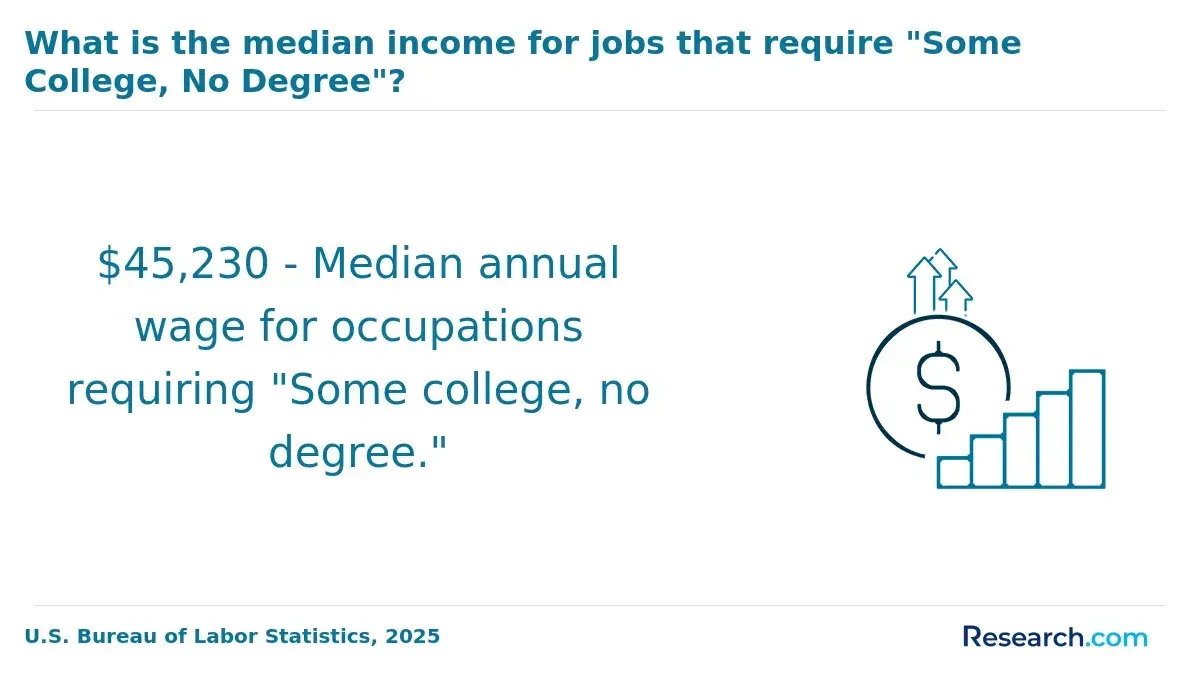
- Employer tuition assistance, which may be tax-free up to $5,250 per year under current federal rules when offered by the employer.
- Institutional scholarships for transfer, adult, military-connected, first-generation, or part-time students.
- Credit for prior learning, which reduces the number of credits you must pay to complete.
Debt should be evaluated differently after 50. A student planning to work another 10 to 15 years may view ROI differently from someone pursuing enrichment, retirement volunteering, or a low-stress part-time role. The smartest target is usually the lowest net cost that still meets accreditation, flexibility, and career requirements.
What career paths and entry-level roles align with common affordable degrees for older students?
Common affordable bachelor's degrees can align with both career advancement and career change, but the right path depends on how much prior experience you can reuse. Students over 50 often have transferable strengths in communication, supervision, budgeting, logistics, customer service, compliance, training, or caregiving.
The table below connects common degrees to entry-level or transition-friendly roles. It is meant for career planning, not as a guarantee of hiring:
| Degree area | Roles to research | Typical responsibilities |
| Business | Operations coordinator, HR specialist, staff accountant, office manager | Budget tracking, reporting, hiring support, workflow coordination, vendor communication. |
| Healthcare administration | Clinic coordinator, patient services manager, health information specialist | Scheduling, compliance, records, billing workflows, staff coordination. |
| Information technology | Help desk analyst, systems support specialist, junior network technician | Troubleshooting, user support, device setup, network monitoring, documentation. |
| Cybersecurity | Security operations associate, compliance analyst, risk analyst | Monitoring alerts, documenting controls, supporting audits, reviewing access permissions. |
| Psychology | Case manager, behavioral health technician, program coordinator | Client support, service referrals, documentation, program assistance. |
| Education | Teacher, instructional aide-to-teacher candidate, corporate trainer | Lesson planning, instruction, assessment, coaching, curriculum support. |
| Criminal justice | Probation support, security manager, victim advocate, compliance assistant | Reporting, safety procedures, case documentation, community resource coordination. |
| Engineering technology | Quality technician, project coordinator, manufacturing supervisor | Process improvement, technical documentation, safety checks, production support. |
When reviewing job postings, look for repeated skill requirements rather than job titles alone. If multiple postings ask for Excel, SQL, project management, medical coding, classroom fieldwork, or a specific certification, choose electives and projects that help you demonstrate those skills.
What salary ranges and job outlook can students over 50 expect after completing these degrees?
Salary outcomes depend on location, experience, industry, age-neutral hiring practices, and whether the role requires licensure or technical skills. The most useful way to read salary data is to treat it as a labor-market benchmark, not a promise of what any individual graduate will earn.
The table below uses BLS May 2024 wage data and current occupational outlook context to show how common degree paths compare. Entry-level pay may be lower than the listed median, while experienced workers or those in high-cost regions may see higher offers:
| Degree path | BLS salary benchmark | Outlook context |
| Business | Business and financial operations occupations had a median annual wage of $80,920 in May 2024. | Best prospects often come from accounting, analytics, HR, supply chain, and compliance skills. |
| Computer science and IT | Computer and information technology occupations had a median annual wage of $105,990 in May 2024. | Demand is supported by cloud systems, software, data, and automation, but portfolios and current skills matter. |
| Cybersecurity | Information security analysts had a median annual wage of $124,910 in May 2024. | BLS projects much faster-than-average growth for this role, but many employers prefer hands-on technical experience. |
| Nursing | Registered nurses had a median annual wage of $93,600 in May 2024. | Licensure, clinical experience, specialty, shift type, and state labor demand strongly affect opportunities. |
| Healthcare administration | Medical and health services managers had a median annual wage of $117,960 in May 2024. | Many management roles require healthcare experience, so career changers may start in coordinator or analyst positions. |
| Education | Teacher pay varies widely by state, district, grade level, and contract structure. | Licensure rules and local shortages matter more than national averages for teaching decisions. |
| Criminal justice | Police and detectives had a median annual wage of $77,270 in May 2024. | Physical requirements, civil service rules, local budgets, and age-related hiring policies can affect eligibility. |
For students over 50, job outlook should be interpreted alongside time to completion. A high-paying field may not be the best investment if the degree requires too many prerequisites, unpaid clinical hours, or a long ramp-up period that does not fit your retirement timeline.
How can students over 50 evaluate and choose the best affordable bachelor's program for their goals?
Choosing the best affordable bachelor's program starts with a personal ROI question: what do you need the degree to do? The answer may be different if you want a promotion, a new profession, a credential for retirement work, or the satisfaction of finishing a long-standing goal.
Use this step-by-step process to compare programs before you enroll:
- Define the outcome you want, such as promotion, licensure, remote work, graduate school, or personal enrichment.
- Identify three to five job titles or goals connected to the degree and review real postings in your state or target industry.
- Compare total net cost, not only tuition, including fees, books, travel, technology, and lost work time.
- Request written transfer-credit evaluations from each school before paying an enrollment deposit.
- Verify institutional accreditation and any programmatic accreditation or state approval required for your field.
- Ask whether courses are asynchronous, synchronous, hybrid, accelerated, or self-paced.
- Review student support services, including tutoring, technology help, career advising, disability accommodations, and adult-learner advising.
- Estimate your weekly study time honestly and choose a pace that you can sustain.
Watch for these common mistakes because they can turn a low-cost degree into an expensive setback:
- Choosing the lowest tuition without checking whether your credits apply to the major.
- Assuming every online degree qualifies for licensure in your state.
- Borrowing heavily without estimating monthly repayment near retirement.
- Picking a broad major without skill-focused electives, projects, or certifications.
- Trusting advertised salary claims instead of checking labor data and local job postings.
- Ignoring technology requirements until classes begin.
The best choice is usually the program that meets minimum quality requirements, accepts the most relevant credits, fits your schedule, and leads to a goal you can explain clearly. If two programs look similar, choose the one that provides stronger advising for adult learners and more transparent cost information.
Other Things You Should Know About
It can be worth it if the degree supports a clear goal, such as promotion, licensure, career change, or personal fulfillment, and if the total cost is manageable. It is less practical when the program requires heavy borrowing without a realistic work or life benefit.
Yes. Federal student aid has no upper age limit, although eligibility depends on factors such as prior degree status, enrollment, financial need, and school participation. Older students may also qualify for state aid, employer tuition assistance, scholarships, and credit for prior learning.
The easiest option depends on your background. Business, organizational leadership, general studies, and applied professional studies may be more manageable for adults with prior credits or work experience, but the best choice should still match your career or personal goal.
Online programs are often a good fit when flexibility, commuting, or caregiving responsibilities matter. Campus or hybrid programs may be better for nursing, education, engineering, science labs, or any degree requiring supervised in-person practice.
References
- Cost of College by Country [2025]: Average Tuition Fees https://educationdata.org/average-cost-of-college-by-country
- 2025 Most Affordable Online Colleges & Degrees https://www.onlineu.com/most-affordable-colleges
- Top Degrees in Demand for the Future: 2026 & Beyond https://skillifysolutions.com/blogs/career-growth/top-degrees-in-demand-for-the-future/
- Top 50 Online and Distance Learning Universities 2026 | EUCDL Distance Accreditation Council https://www.eucdl.com/ranking-2026
- Best Accredited Online Universities in 2025 https://www.study.eu/article/best-accredited-online-universities
- Financial Aid for Adult Learners: Grants, Scholarships & How to Pay for College (2026 Guide) https://www.straighterline.com/blog/financial-aid-resources-adults
- Easy Degrees That Pay Well https://www.citizensbank.com/student/articles/easy-degrees-that-pay-well.aspx
- 31 Affordable Universities in the USA for International Students https://www.wemakescholars.com/blog/cheapest-universities-in-usa-for-international-students
- Comparing Outcomes Across Credentials | HESA https://higheredstrategy.com/comparing-outcomes-across-credentials/
- Free Online Bachelor Program Opportunities - Swiss School of Business and Management Geneva https://www.ssbm.ch/free-online-bachelor-program-opportunities/