2027 Best Certifications With Full-Time Online Options

Co-Founder and Chief Data Scientist
Choosing a full-time online credential means weighing speed against employer recognition, hands-on requirements, and total cost. This guide separates academic certificates from professional certifications, explains which fields can be completed fully online, and identifies when a hybrid or campus option is necessary.
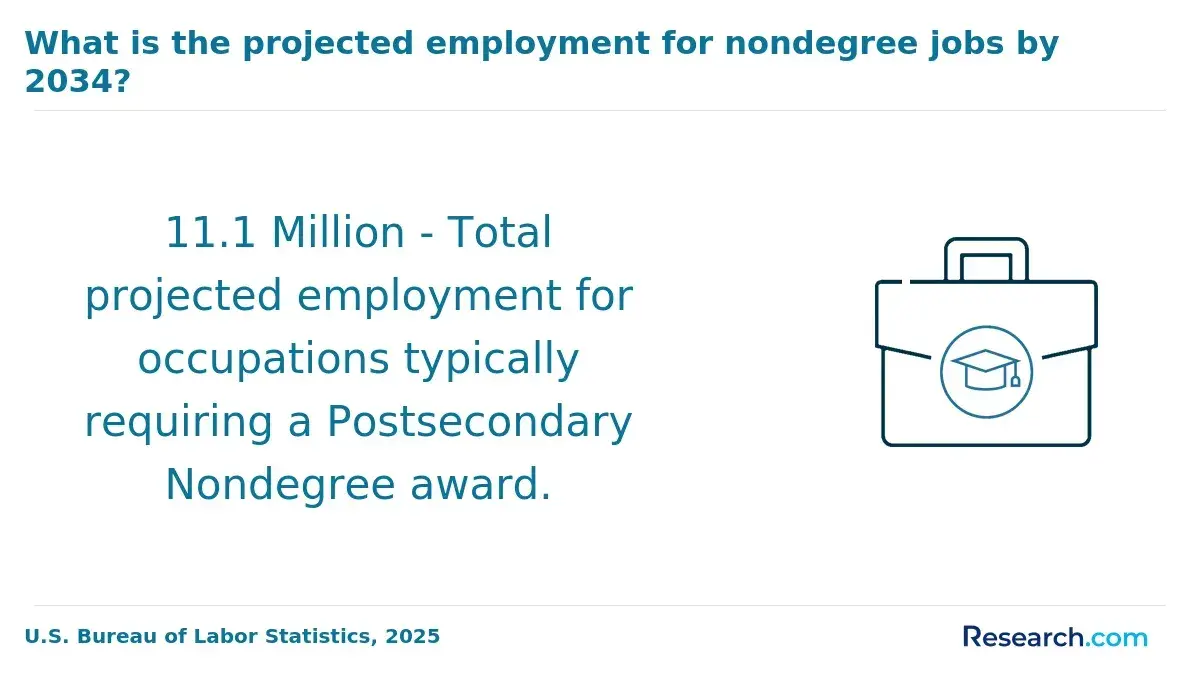
U.S. Bureau of Labor Statistics data show that occupations requiring postsecondary nondegree awards had a 2024 median annual wage of $48,980, but outcomes vary sharply by field. Use these comparisons to choose training that matches your target job rather than simply the shortest program.
Key Things You Should Know
- Full-time online academic certificates usually take about 4 to 12 months; industry certifications may require an exam and, in some cases, verified work experience rather than college enrollment.
- Programs in IT, business, medical coding, legal support, and digital design can often be completed online, while clinical healthcare and skilled-trade credentials usually require in-person labs, externships, or supervised practice.
- For context, the U.S. Bureau of Labor Statistics reported a $48,980 median annual wage for occupations typically requiring a postsecondary nondegree award in 2024; this is an occupational benchmark, not a guaranteed outcome for certificate completers.
Top 10 Best Certifications With Full-Time Online Options
Popular Trade School Programs
Trade certificates in HVAC, electrical technology, welding, construction management, and industrial maintenance can lead to practical entry-level training, but most are not fully online. Full-time online coursework may cover safety, codes, estimating, blueprint reading, and theory; labs, tool practice, and apprenticeships normally occur locally.
An online associate degree in construction management may be more feasible because it emphasizes planning and supervision. Choose a hybrid program when the job requires demonstrated hands-on competence, and verify whether local employers or apprenticeship sponsors recognize the school's training.
Healthcare Programs
Online healthcare certificates commonly include medical billing and coding, health information technology, pharmacy technician theory, medical office administration, and patient care coordination. They differ from clinical programs such as nursing, dental hygiene, sonography, and medical assisting, which require supervised clinical education.
A certificate can prepare a student for an external exam, but completion alone does not confer professional certification or a state license. Before enrolling full time, confirm externship placement rules, exam eligibility, background-check requirements, and whether the credential is accepted by employers in your state.
Criminal Justice / Law Programs
Full-time online certificates and associate degrees in criminal justice, legal studies, paralegal studies, homeland security, and emergency management focus on law, ethics, procedure, research, and report writing. Paralegal education is especially important to verify: employers may prefer programs approved by the American Bar Association, although ABA approval is not required for every paralegal job and many approved programs include in-person components. These credentials can support entry-level legal support or public-safety administration roles, but they do not qualify graduates to practice law or become sworn officers without meeting separate agency and state requirements.
Arts & Design Programs
Online certificates and associate degrees in graphic design, UX design, digital media, web design, animation, and photography can work well for full-time remote study because coursework is portfolio based. Students typically learn design software, visual communication, accessibility, client briefs, and presentation skills.
A school credential can structure learning, but a current portfolio usually carries substantial weight in hiring. Compare software access, faculty critique, portfolio reviews, and rights to retain completed work. Avoid programs that promise freelance income or a design job without showing required project standards and career-support details.
What types of full-time online certifications offer the best career return on investment?
The best career return on investment usually comes from credentials that meet a specific hiring requirement, teach measurable job skills, and cost far less than the additional earnings or advancement they plausibly support. For fully online study, technology, business operations, project coordination, bookkeeping, medical coding, and digital design are generally stronger fits than occupations requiring physical labs or patient care.
The comparison below distinguishes common full-time online paths. Occupational wage figures are U.S. Bureau of Labor Statistics 2024 medians for the job, not earnings promised by a program or automatically available to a new certificate holder.
| Path | Credential type | Online fit | 2024 occupational median wage | ROI consideration |
| IT support or cybersecurity foundations | College certificate or vendor certification | High | Computer user support specialists: $60,340 | Best when paired with labs, a portfolio, and an employer-recognized exam where relevant. |
| Medical billing and coding | Career certificate; optional professional certification | High, with possible practicum | Medical records specialists: $50,250 | Compare exam preparation, coding-system training, and local employer preferences. |
| Web and digital design | Academic or professional certificate | High | Web developers and digital designers: $95,380 | Portfolio quality and prior skills affect access to higher-paid roles. |
| Project management | Professional certificate; later industry certification | High | Project-management roles vary widely | Useful for people who already have domain experience; not always an entry-level ticket. |
Technology credentials can be a sensible option for learners seeking flexible work, but examine actual role requirements before paying for training. Readers considering broader remote-career preparation can compare degrees for remote work with shorter credentials to decide whether a certificate provides enough depth.
A short program is usually a better investment when it fills a clear skill gap or prepares you for a recognized exam. Consider an associate or bachelor's degree instead when job postings routinely require one, when you need broad advancement options, or when a regulated occupation requires degree-level education.
How do full-time online certificate programs compare to campus-based options in quality and outcomes?
A reputable online certificate can deliver comparable academic content to a campus version when the same instructors, assessments, learning outcomes, and student services apply. Online delivery is not automatically lower quality; the decisive question is whether the format can verify the skills the occupation demands. Reading, coding, research, business analysis, and digital portfolio work translate well online. Clinical procedures, equipment operation, and many trade competencies do not.
This comparison helps identify when full-time online study is a practical substitute and when it is not.
| Decision factor | Full-time online option | Campus or hybrid option | Best choice when |
| Schedule | May offer asynchronous coursework, but full-time pacing remains demanding. | Fixed meeting and lab times. | Choose online if you can independently manage weekly deadlines. |
| Hands-on assessment | Simulations, remote labs, projects, or local placements. | Direct instructor observation and equipment access. | Choose hybrid/campus for clinical, shop, or laboratory competencies. |
| Networking | Virtual career events and online collaboration. | Local peers, instructors, and employer relationships. | Choose the format with stronger connections in your target labor market. |
| Credential recognition | Depends on provider, accreditation, and employer familiarity. | Depends on the same factors, not location alone. | Compare curriculum, outcomes, and eligibility for required exams. |
Full-time online study often means 12 or more credit hours per term in a college certificate, or a compressed weekly workload in a noncredit provider. It is not necessarily self-paced. Ask whether live attendance is required, whether exams use proctoring, and how quickly instructors respond when students need help.
What accreditation and licensing requirements should online certification programs meet in the United States?
Accreditation, program approval, and professional certification are separate concepts. Institutional accreditation evaluates a college or school; programmatic accreditation evaluates certain disciplines; licensure is permission from a government authority; and certification is usually awarded by an independent professional body. The right requirement depends on the career, not simply on whether classes are online.
Before paying a deposit, verify the items below directly with the school, the relevant state board, and the intended certification organization.
- For credit-bearing college certificates or associate degrees, confirm that the institution is accredited by an accreditor recognized by the U.S. Department of Education or the Council for Higher Education Accreditation.
- For career training providers, confirm whether the program has state authorization to enroll students where you live and whether it is eligible to prepare students for the named external examination.
- For healthcare, legal, trade, or public-safety paths, check state-specific licensure, clinical, supervised-hours, background-check, and in-person training rules before enrollment.
- For industry certifications, confirm the certifying body's current eligibility rules, exam fees, renewal requirements, and any experience prerequisite.
A major red flag is language suggesting that institutional accreditation alone makes a program license-qualifying. Another is a provider that will not state whether graduates are eligible for the exam or license they advertise. If a school operates across state lines, get its answer for your state in writing.
What are the typical admission requirements for reputable full-time online certification programs?
Admission requirements depend on the credential provider. A college-based undergraduate certificate may require a high school diploma or GED and an application; some selective or advanced certificates require prior college coursework. Noncredit professional certificates may require only payment and basic computer access. Industry certification exams can instead require work experience, training, or prior credentials.
Applicants should expect reputable full-time online programs to request information that matches the level and risk of the training.
- Identity, residency, and age documentation when required by the institution or state authorization rules.
- High school completion records for many entry-level college certificates and associate degree programs.
- Official transcripts or prerequisite-course evidence for advanced, technical, or graduate certificates.
- Technology readiness, including reliable internet, a supported computer, webcam access for proctored exams, and required software.
- Health records, immunizations, drug screening, CPR training, or background checks when a clinical placement or regulated field requires them.
Do not treat a "no GPA requirement" advertisement as proof that a program is accessible or career-ready. Ask about prerequisite skills, withdrawal rules, academic support, and placement requirements. If you need federal aid, confirm that the specific eligible program - not merely the institution - meets applicable requirements.
How long do full-time online certification programs take and what do they cost?
Full-time online certificates range from a few intensive months to roughly one academic year. Credit-bearing programs commonly follow 8-, 12-, or 16-week terms, while noncredit professional certificates may use subscription, cohort, or self-paced pricing. A longer program is not inherently better: duration should reflect the amount of supervised practice and depth needed for the target role.
The cost comparison below shows why readers should calculate total educational expense rather than rely on advertised tuition alone.
| Program type | Typical full-time duration | Common price structure | Costs to verify |
| Community-college credit certificate | 6 to 12 months | Per credit plus institutional fees | Technology, books, lab kits, proctoring, and graduation fees |
| University professional certificate | 3 to 12 months | Program or course bundle price | Required software, exam vouchers, and extension fees |
| Vendor or industry certification preparation | Weeks to months | Training fee, subscription, or self-study materials | Exam, retake, renewal, and membership fees |
| Hybrid clinical or trade certificate | 9 to 18 months | Tuition plus practical training charges | Uniforms, tools, travel, insurance, screening, and licensing expenses |
The National Center for Education Statistics reported that average published tuition and fees for in-district students at public two-year institutions were $3,990 in 2024. That is not a certificate price, but it is a useful baseline for comparing credit-based options against high-cost private training providers.
For a faster academic route, compare accelerated degree programs as well as certificates. A compressed degree can cost more and demand more time, yet may be the stronger value when employers consistently require a degree.
What core courses and skills are covered in leading full-time online certification curricula?
Leading full-time online certificate curricula combine occupation-specific knowledge with evidence that a student can apply it. The strongest programs use projects, simulations, case studies, labs, portfolios, or supervised placements rather than relying only on recorded lectures and multiple-choice quizzes.
Core content varies by field, but reputable programs commonly assess these skill categories.
- Technical knowledge, such as coding systems, networking concepts, software tools, legal research methods, design principles, or industry regulations.
- Applied work, including realistic case files, troubleshooting tasks, client-style projects, documentation, and presentations.
- Communication and professional practice, including teamwork, ethics, privacy, accessibility, customer service, and written reporting.
- Digital fluency, including secure file handling, collaboration platforms, spreadsheets, data literacy, and responsible use of AI-assisted tools.
AI is changing task design in office, technology, and creative roles, so look for programs that teach verification, privacy, prompt evaluation, and human review - not just tool use. Ask to see a syllabus and sample assessment. If the curriculum cannot show what you will produce or demonstrate, it is difficult to judge employer relevance.
What jobs can you get with top full-time online certifications and what are the career paths?
Top online credentials can support entry-level jobs, career changes, or advancement within an existing field, but the credential's value depends on job requirements, experience, portfolio evidence, and local demand. A certificate is usually most effective as a focused bridge into a defined role; it is less effective as a substitute for a required degree, license, apprenticeship, or clinical credential.
These examples show realistic pathways rather than guaranteed placement outcomes.
| Credential focus | Possible entry point | Next career step | Important limitation |
| IT support | Help desk technician or technical support specialist | Systems, network, cloud, or cybersecurity specialization | Employers may expect hands-on troubleshooting and an industry exam. |
| Medical coding | Billing, claims, or coding support role | Specialty coding, auditing, or health-information work | Certification preferences and experience requirements vary by employer. |
| Paralegal studies | Legal assistant or paralegal support role | Litigation, corporate, or compliance specialization | Does not authorize legal practice or replace attorney supervision. |
| Digital design | Junior designer, production artist, or content assistant | UX, product design, art direction, or freelance practice | Portfolio quality is often more important than credential title. |
Some learners will reach better long-term options by pairing a certificate with a degree. Explore highest-paying jobs associated with bachelor's-level study if your target occupation lists a four-year degree as a common entry requirement.
Build a job-search plan before classes end: complete work samples, translate projects into résumé achievements, attend employer events, and apply for internships or support roles where available. This reduces the common mistake of finishing a credential without evidence of practical ability.
What salary ranges and earning potential are associated with in-demand online certifications?
Earning potential varies by occupation, location, experience, industry, and level of responsibility. It should not be presented as the salary of all certificate graduates. U.S. Bureau of Labor Statistics May 2024 wage data provide a useful way to compare target occupations, provided you also check whether the job typically requires a degree, license, or substantial experience.
The following occupation medians illustrate why field selection matters more than a generic "online certificate" label.
| Occupation | 2024 median annual wage | Certificate relevance |
| Medical records specialists | $50,250 | Coding or health-information certificates may be relevant, but employers can prefer professional certification. |
| Computer user support specialists | $60,340 | IT certificates and vendor certifications can support entry, alongside demonstrated technical skills. |
| Paralegals and legal assistants | $61,010 | Paralegal education may help, though employer preferences and state practices vary. |
| Graphic designers | $61,300 | Certificates can develop a portfolio; a credential alone is not a hiring guarantee. |
| Web developers and digital designers | $95,380 | Strong portfolios and technical capability are central, with requirements varying by employer. |
Use salary data as a screening tool, not a forecast. Compare local postings for entry-level requirements, estimate your full program and exam costs, and consider whether you can work while studying. High median wages may reflect experienced workers or roles requiring education beyond a short certificate.
How can prospective students evaluate and choose a reputable full-time online certification program?
Choose a reputable full-time online program by starting with the job, then working backward to the minimum recognized credential. Do not begin with a provider's marketing claim or a low monthly payment. The right choice should meet your state, employer, exam, and scheduling needs without adding unnecessary debt.
Use this sequence to compare finalists before you enroll.
- Collect 10 to 20 current job postings in your target location or remote market and note required education, certifications, software, experience, and licenses.
- Confirm whether you need an academic certificate, an industry certification, an associate degree, an apprenticeship, or a license; do not assume one can replace another.
- Request the full curriculum, instructional format, calendar, assessment examples, student-support details, and total cost in writing.
- Verify institutional accreditation, state authorization, program approval, and external exam or licensing eligibility with the appropriate independent organization.
- Calculate tuition, fees, equipment, examination, travel, and lost-work-time costs against realistic entry-level opportunities in your market.
- Ask about completion, placement definitions, employer partners, refunds, transfer credit, and whether credits stack into a degree when those factors matter to you.
Be cautious of guaranteed employment, vague accreditation language, pressure to sign immediately, unverified salary claims, and programs that cannot explain practical training. If your long-term goal requires graduate-level advancement, a one-year master's degree may be a better comparison point after you have completed the required undergraduate education.
Other Things You Should Know About
Yes, in fields such as IT, business, medical billing and coding, legal studies, and digital design. Programs involving clinical care, equipment operation, or trade skills commonly require local labs, externships, or supervised practical training.
A certificate is usually awarded by a school or training provider after completing coursework. A certification is typically awarded by an independent professional organization after meeting its eligibility standards and passing an examination or assessment.
Some credit-bearing certificate programs at eligible institutions may qualify for federal aid, but many short noncredit and third-party programs do not. Confirm aid eligibility for the exact program and compare employer tuition assistance, scholarships, and payment plans.
Employers generally focus on the provider's reputation, the skills demonstrated, relevant certification exams, portfolio or project work, and whether the program meets industry requirements. Online delivery is less important than credible training and evidence that you can do the work.
References
- CPD Accreditation Explained: Meaning, Cost & How It Works https://www.cpdstandards.com/become-accredited/what-is-cpd-accreditation/
- 2025's Best Online Graduate Certificate Programs in the U.S. https://www.onlinemastersdegrees.org/graduate-certificate-programs/
- How Are Online Education Standards Accredited? https://lakewood.edu/online-education-standards-accreditation/
- COA Accreditation - Social Current https://www.social-current.org/coa-accreditation/
- Online Certificate Programs | Certifications Programs https://www.uscareerinstitute.edu/online-certificate-programs
- The Top 5 Certificate Programs for Jobs With Growth Potential | CourseStorm https://www.coursestorm.com/blog/top-certificate-programs-for-jobs
- CPD Accreditation Standards: What Training Providers Need to Know https://thecpdregister.com/blog/cpd-accreditation-standards-what-training-providers-need-to-know
- 9 Best Online Certificate Programs that Lead to Higher Pay https://blackstone.edu/9-best-online-programs-for-higher-pay/
- How Much Does It Cost to Create an Online Course? A Complete Breakdown for Businesses That Want to Sell Courses https://oasis-lms.com/post/how-much-does-it-cost-to-create-an-online-course
- Online Course Pricing Guide: How to Price Your Course in 2026 https://buddyboss.com/blog/online-course-pricing-guide/