2027 An MHA After a BS in Health Information Management

Co-Founder and Chief Data Scientist
A bachelor's in health information management (HIM) can prepare you to work with health data, records, and information systems. An MHA may help you move toward broader responsibility for healthcare teams, budgets, and operations - but it is not the only route to advancement.
This guide is for HIM graduates weighing that transition. It explains what an MHA adds, which jobs are realistic at different career stages, and how to assess admissions, format, cost, and accreditation before committing.
Key Things You Should Know
- An MHA can complement HIM expertise when your target is healthcare operations or organizational leadership; it does not replace the experience employers seek for senior roles.
- Compare the full program cost with a plausible next job, not a broad salary figure: the $126,520 median wage for U.S. management occupations in May 2025 is not an MHA graduate salary.
- Check both institutional accreditation and any program-specific accreditation you need, then confirm whether an online program's schedule and required activities fit your work.
What Is an MHA After a Bachelor's in Health Information Management?
A Master of Health Administration (MHA) is a graduate degree focused on managing healthcare organizations and services. A BS in HIM, by contrast, generally emphasizes the collection, quality, protection, and use of health information. The combination can be valuable when decisions about records, data, or digital systems need to account for staffing, finances, patient access, and organizational priorities.
The distinction matters when choosing a next step: an MHA broadens your management preparation rather than providing more advanced training in every HIM specialty. If you are still choosing an undergraduate route, see how HIM degree pathways compared with healthcare administration differ in emphasis.
Is an MHA Worth It After Health Information Management?
An MHA is most likely to be worthwhile if you want responsibility beyond a specialized HIM function and can connect the degree to a realistic role, such as managing a department or leading a cross-functional improvement project. It may be less useful if your immediate goal is deeper expertise in coding, data analysis, or a specific information system. In those cases, targeted training, a relevant certification, or experience may be more direct.
Compare the net cost after employer assistance with the time you would spend studying and the opportunities available at your current employer. Ask a supervisor or hiring manager which qualifications matter for the role you want; a degree alone does not create a promotion. If your goal is general business leadership outside healthcare as well, compare tuition for online healthcare management MBAs alongside MHA options, then examine the actual curricula. An MBA's broad business core and an MHA's healthcare-specific focus are different advantages, not interchangeable labels.
What Careers Can You Pursue With an MHA and HIM Background?
Your strongest near-term opportunities will usually build on the HIM work you already know. For example, someone who has coordinated record-quality initiatives may be a credible candidate for a larger information-governance or department-management role. Moving into hospital-wide operations is a bigger transition and may require experience with budgets, staffing, and service delivery that an MHA alone cannot supply.
The following paths differ mainly in how much they extend your existing responsibilities.
| Potential path | How HIM experience helps | Likely additional preparation |
| HIM department manager | Knowledge of records, workflows, and compliance | Staff supervision and budgeting experience |
| Health information governance or data-quality leader | Experience with information standards and stakeholders | Enterprise-wide project leadership |
| Healthcare operations manager | Understanding of how information affects care delivery | Direct exposure to staffing, service lines, and financial decisions |
| Healthcare implementation or consulting manager | Ability to translate information needs into operational changes | Client, vendor, or large-project experience |
If your long-term aim is executive leadership, experience after the MHA will still matter. Some professionals later explore online doctoral leadership study for healthcare professionals, but a doctorate is not a standard prerequisite for the roles above.
Requirements vary by school. Programs generally consider an applicant's completed bachelor's degree and academic record; they may also request a résumé, statement of purpose, recommendations, interview, or standardized test. Some favor healthcare work experience, while others admit applicants earlier in their careers. A HIM degree is relevant preparation, but it does not establish eligibility for every program or waive every requirement.
Before applying, confirm the current prerequisites and ask whether your HIM coursework meets them. Use your application to explain the management responsibility you seek and give concrete examples of collaboration, process improvement, or leadership. If you have limited employment history, review healthcare experience expectations in MHA admissions rather than assuming all schools use the same standard.
MHA coursework commonly addresses healthcare finance, organizational leadership, policy, quality improvement, operations, and strategy. Programs may add applied projects or a practicum. Exact courses and requirements vary, so inspect the catalog rather than assuming every MHA develops the same skills.
For an HIM graduate, the most consequential additions may be budgeting, managing people, and making decisions across departments. Compare those courses with your existing preparation: healthcare administration undergraduate degrees at U.S. universities illustrate why applicants can arrive with different exposure to management topics. Look for assignments that let you apply new skills to a problem relevant to your target job.
Choose based on how you will learn and meet people, not the delivery label alone. An online MHA may let you remain employed, but it can still require scheduled discussions, team meetings, practicums, or campus visits. A campus program may make in-person collaboration easier, but its timetable could limit your ability to keep working.
Ask each program for a sample course schedule, attendance rules, and details of any in-person requirement. Also check how students arrange applied work and access career services. If speed is your priority, treat lists of fast-paced online healthcare administration degree options as a starting point only: verify that an option is specifically a graduate MHA and that its pace is manageable alongside your job.
Completion time depends on required credits, course sequencing, enrollment pace, and any practicum or capstone. Published tuition may be quoted per credit or for the full program; it may exclude mandatory fees, materials, travel, and financing costs. Because these terms vary by school, a headline tuition figure is not a reliable total-cost comparison.
Request a written estimate based on your intended pace, including all required fees and any in-person expenses. Then check employer tuition assistance and consider the earnings or work hours you might give up. One-year graduate pathways in healthcare administration may reduce time in school, but confirm the credential, workload, and applied requirements before treating a faster option as the better value.
First verify that the university holds recognized institutional accreditation. Then check whether the specific MHA has programmatic accreditation from the Commission on Accreditation of Healthcare Management Education (CAHME), if that matters to you or a prospective employer. Institutional and programmatic accreditation answer different questions; do not infer one from the other, or assume every online format shares a campus program's status.
Check current status in the institution's and accreditor's directories, then compare the curriculum, applied experience, scheduling, and total cost. When using tuition comparisons for online health administration programs, verify that you are comparing graduate programs with the accreditation and requirements you want - not simply the lowest advertised prices across different degree levels.
An MHA itself does not confer a clinical license, and many healthcare administration jobs do not require one. Requirements depend on the position and state: for example, certain licensed facility-administrator roles have rules that a general MHA does not automatically satisfy. Review the job description and applicable state board before planning around a regulated role.
HIM credentials and other professional certifications are separate from the MHA. Keep or pursue one when it serves your target role, but do not assume the degree grants it or preserves eligibility automatically. The same distinction applies if you later compare healthcare management research and professional doctorates: a higher academic credential is not a substitute for a required license.
What Salary and Job Outlook Can MHA Graduates Expect?
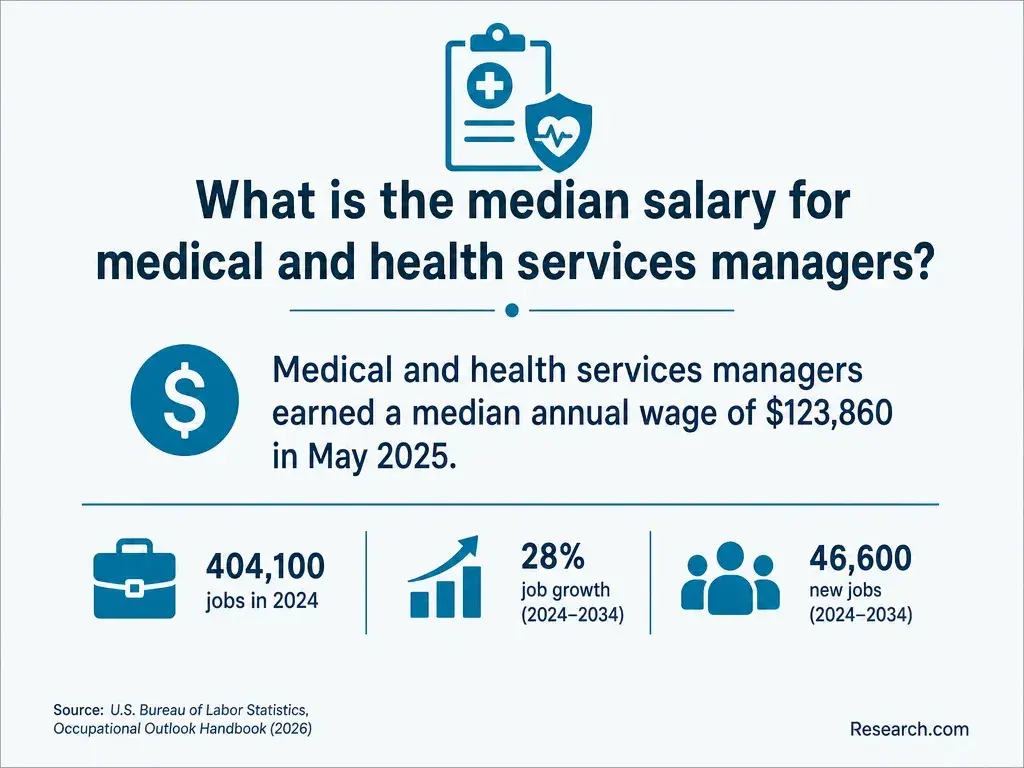
There is no single salary or employment forecast for people with an MHA and a HIM degree. Pay depends on the occupation, location, employer, scope of responsibility, and prior experience. The U.S. Bureau of Labor Statistics reports a $126,520 median annual wage for management occupations in May 2025. That broad occupational figure is context - not a prediction of what an MHA graduate, a new manager, or an HIM professional will earn.
The BLS projects management occupations overall to grow faster than the average for all occupations from 2025 to 2035, but that projection covers many fields beyond healthcare. For a useful personal comparison, review local postings for the specific role you want, note their experience requirements and pay ranges, and compare them with your current position before assigning a financial return to the degree.
Other Things You Should Know About Healthcare Administration
Usually, undergraduate work does not automatically replace graduate requirements. Ask each program whether it offers waivers or advanced standing and what evidence it requires.
Possibly. Programs set their own project and supervision rules, and your employer must be willing to support the work. Confirm approval requirements before enrolling.
Not for every administrative role. You do need to understand how your decisions affect clinical staff and patients; positions involving clinical practice have separate qualifications.
Not necessarily. A program may use a capstone, practicum, another applied assessment, or a thesis. Check its graduation requirements rather than relying on the degree title.
- Accreditation in the U.S. | ed.gov http://www.ed.gov/laws-and-policy/higher-education-laws-and-policy/college-accreditation/accreditation-in-the-us
- Health Administration (M.H.A.) - Academic Catalog https://bulletins.wayne.edu/graduate/college-pharmacy-health-sciences/applied-health-sciences/health-administration/
- What Can You Do with an MHA? | UCLA https://mha.ucla.edu/articles/what-can-you-do-masters-degree-healthcare-administration-mha/
- MBA vs. MHA: Which Degree Is Right for You? | SIUE https://online.siue.edu/degrees/business/mba/healthcare-administration/administrator-salary/
- MHA vs. MPH Degrees: An Overview | American College of Education https://ace.edu/blog/mha-vs-mph-degrees-an-overview/
- The Benefits of Enrolling in a CAHME-Accredited MHA Program | The University of Scranton https://gradadmissions.scranton.edu/blog/articles/healthcare/cahme-accredited-mha-program.shtml
- Costs and Aid - Cornell Brooks Public Policy https://publicpolicy.cornell.edu/masters/sloan/mha/costs-and-aid/
- MHA Application Requirements - Program in Public Health https://publichealth.stonybrookmedicine.edu/admissions/MHA
- Master of Health Administration | Columbia University Mailman School of Public Health https://www.publichealth.columbia.edu/academics/degrees/master-health-administration
- Health Information Management Career Outlook and Salaries | UW Online Collaboratives https://uwex.wisconsin.edu/stories-news/health-information-management-careers-salaries/