2027 An MHA After a Bachelor's in Economics

Co-Founder and Chief Data Scientist
An economics degree gives you a useful foundation for analyzing healthcare spending, incentives, and policy, but it does not automatically prepare you to run a hospital department. A Master of Health Administration (MHA) can bridge that gap if your goal is healthcare management rather than economic research or clinical practice. This guide explains whether economics graduates can qualify, what they would study, how to compare programs and costs, and which jobs are realistic at different experience levels. Use it to decide whether an MHA is the right next step - or whether work experience or another degree would serve you better.
Key Things You Should Know
- Yes. An economics bachelor's degree can qualify you to apply for an MHA; schools set their own prerequisites and work-experience expectations.
- Economics skills transfer to budgeting, analytics, and policy, but you will still need to learn healthcare operations, regulation, and how care organizations function.
- Do not treat management pay as a starting-salary forecast: the Bureau of Labor Statistics reports a $126,520 median annual wage for all management occupations in May 2025, not for new MHA graduates.
What Is an MHA After a Bachelor's in Economics?
An MHA is a graduate degree focused on leading healthcare organizations and services. Students examine decisions involving staffing, finance, quality, regulation, and patient access. For an economics graduate, the move is from explaining how resources and incentives affect healthcare to making operational decisions inside a healthcare organization.
That distinction matters when choosing a degree. An MHA is more directly focused on healthcare delivery management than a general MBA. An MBA with healthcare coursework may be preferable if you want broader mobility across industries, but a healthcare elective is not necessarily a formal healthcare concentration. If that broader path interests you, budgeting for an MBA in healthcare management offers a separate cost comparison.
Can You Get an MHA With an Economics Degree?
Yes. An economics major is not inherently a barrier to MHA admission. Training in statistics, incentives, market behavior, and public finance can be valuable in healthcare, particularly for applicants interested in resource allocation or payment systems. Your preparation will depend on your actual coursework and experience, however; a quantitatively strong applicant may still know little about clinical workflows or healthcare regulation.
If you have completed your economics bachelor's, your next step is to check graduate admissions criteria, not undergraduate transfer rules. If you are still deciding how to finish a bachelor's degree, reviewing transfer requirements for a healthcare administration bachelor's may help you compare undergraduate routes. You generally do not need a second bachelor's solely to seek MHA admission.
What Are the Admission Requirements for an MHA Program?
Requirements vary by school. Programs commonly evaluate an accredited bachelor's degree, transcripts, a résumé, a statement of purpose, and recommendations; some also request an interview, test scores, prerequisites, or relevant work experience. Do not assume that a requirement listed by one program applies to every MHA.
Explain how your economics training connects to a specific healthcare management goal. A class project on insurance markets or experience with budgets can strengthen that explanation, but neither substitutes for learning how providers operate. Before applying, ask whether the program expects professional experience, requires a practicum, and offers placement support for students changing industries. When comparing graduate program options for an online MHA, check each school's current admissions page rather than relying on a general checklist.
MHA coursework typically applies management concepts to healthcare finance, operations, organizational leadership, quality improvement, health policy, and ethics. Economics graduates may recognize the analytical tools behind budgeting and payment decisions, while finding provider operations, patient safety, and regulatory responsibilities less familiar. A project or practicum can help turn those unfamiliar areas into experience you can discuss with employers.
Look closely at course descriptions: a degree labeled "healthcare administration" may emphasize provider leadership more than data systems. If you primarily want to manage health records, information governance, or related systems, online CAHIIM-accredited programs for health information careers represent a different educational route. CAHIIM accreditation in health information education is not interchangeable with MHA program accreditation.
There is no single completion time or price. Both depend on required credits, enrollment pace, tuition rules, fees, and whether the program includes a practicum or in-person activity. An accelerated schedule can shorten enrollment while making it harder to maintain full-time work; part-time study spreads out coursework but may change the total fees you pay.
Compare a school's published total program cost when available. Otherwise, calculate tuition from its required credits and applicable per-credit rate, then add mandatory fees, books or software, travel, and any income you would forgo. Confirm whether tuition differs for online or out-of-state students and whether your employer offers education assistance. A comparison focused on healthcare administration master's tuition planning can help you identify costs beyond the advertised rate.
Neither format is universally better. An online MHA may let you keep working and apply coursework immediately, but online does not mean fully self-paced: live meetings, group work, practicums, and campus visits may still be required. A campus program may offer easier access to local healthcare employers and in-person activities, especially if you are changing fields and need contacts.
For an economics graduate without healthcare experience, access to a substantive practicum or employer project may matter more than the delivery label. Ask where students complete fieldwork, who finds placements, and whether career services support online students. If speed is a priority, examine the actual course sequence and weekly obligations behind online healthcare administration programs with accelerated schedules before committing.
Check two different forms of recognition: the university's institutional accreditation and any specialized accreditation held by the MHA program. The Commission on Accreditation of Healthcare Management Education (CAHME) accredits eligible healthcare management graduate programs. Institutional accreditation alone does not mean the MHA is CAHME-accredited, and a school's general business-school accreditation does not establish that distinction either.
Confirm the status of the specific program and delivery format directly with the school and accreditor. Then compare curriculum, healthcare employer relationships, fieldwork, career support, schedule, and full cost. CAHME accreditation may be important for particular employers or fellowships, but you should verify their current eligibility rules rather than assume it is universally required. A list of online CAHME-accredited MHA programs can be a starting point, not a substitute for checking current status.
Your first realistic role depends heavily on what you did before graduate school. Economics graduates with experience in analysis or budgeting may be competitive for healthcare financial analyst, operations analyst, or strategy-support roles. Those with provider experience may be better positioned for supervisory work. Department director and executive jobs usually require a record of managing people, budgets, or services; the MHA alone does not supply that record.
The comparison below shows how your economics background could apply - and what else an employer may look for.
| Career direction | Economics skills that transfer | Likely additional preparation |
| Healthcare finance or reimbursement analysis | Cost analysis, forecasting, incentives | Provider finances, insurance payment methods, relevant software |
| Operations or service-line management | Resource allocation, performance measurement | Clinical workflows, quality improvement, staff leadership |
| Healthcare strategy or consulting | Market analysis, quantitative research | Client-facing experience, healthcare industry knowledge |
For a career change, seek projects that produce evidence of healthcare-specific work rather than relying on the degree title. Comparing healthcare administration career directions may help you identify a target role before selecting electives or a practicum.
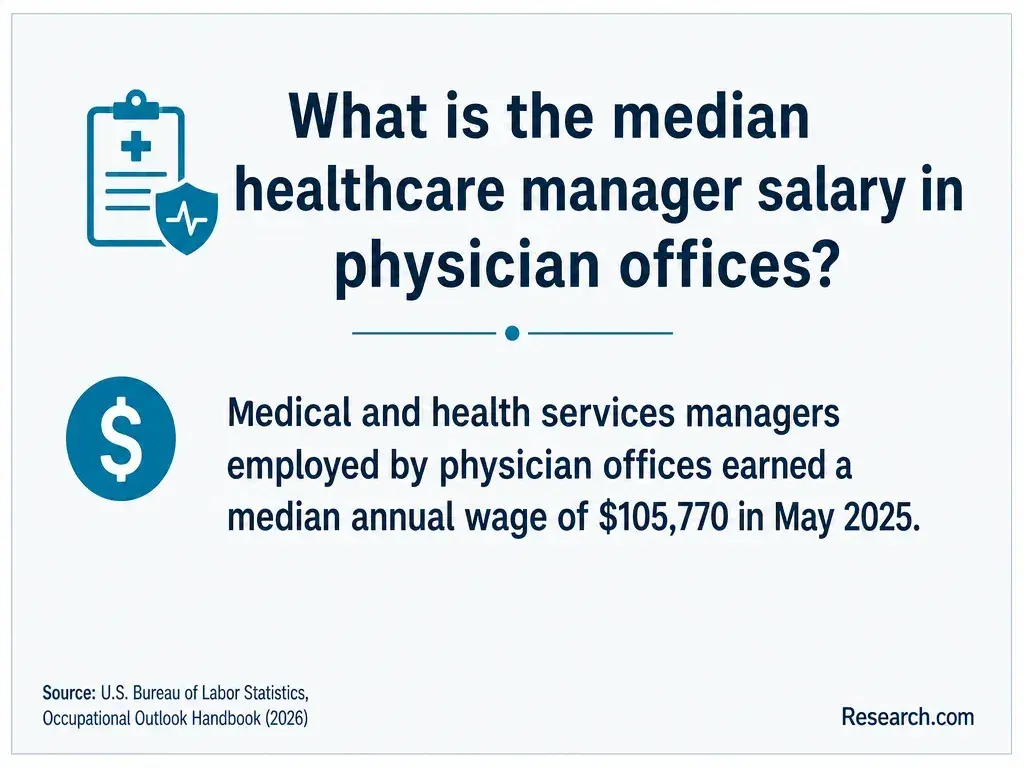
There is no reliable single salary for "an MHA graduate." Pay depends on the occupation, location, employer, responsibilities, and prior experience. For context, the Bureau of Labor Statistics reports a $126,520 median annual wage for all management occupations in May 2025. That broad figure includes managers outside healthcare and at many career stages; it is not an expected starting salary or evidence of an MHA's earnings effect.
For a useful personal estimate, compare local postings for the specific role you could plausibly obtain now with postings for roles you could pursue after gaining healthcare experience. Weigh any expected increase against tuition, financing costs, and time away from work. A doctorate should not be treated as an automatic salary upgrade; if you are considering one later, comparing tuition and duration for healthcare administration doctorates is more useful than assuming another credential will pay for itself.
Do MHA Graduates Need Licenses or Certifications?
An MHA by itself does not confer a clinical license, and most general healthcare administration jobs do not have one universal MHA-specific licensing requirement. Requirements depend on the role and state. Nursing home administrator positions, for example, are regulated; an MHA should not be assumed to meet every state's education, training, examination, or experience rules.
Optional professional certifications may help in a particular function, but employers may also expect relevant work experience. Check the requirements of your target job before paying for an additional credential. A doctorate is not a substitute for a required license either; if it becomes relevant to your goals, review fast-track claims for healthcare administration doctorates against the program's actual requirements.
Other Things You Should Know About Healthcare Administration
An MPH may fit better if you want to focus on population health, epidemiology, or public health programs. An MHA is generally more directly aligned with managing healthcare organizations and services. Compare required courses against your intended job.
Usually, undergraduate courses establish preparation rather than replace graduate requirements. Ask each school whether it permits waivers or advanced standing and whether a waiver reduces the credits or tuition needed to graduate.
It can help, particularly if you have never worked with a provider, insurer, or health agency. Even an analytical or administrative role can clarify your career target and make graduate projects more relevant; some programs also expect professional experience.
Not necessarily. Research-intensive roles may favor advanced training in economics, statistics, or health policy. Choose an MHA when your main objective is applying analysis to healthcare management decisions.
- Knowledge and Skills Needed for Future Health Administrators | nih.gov https://pmc.ncbi.nlm.nih.gov/articles/PMC11188648/
- MPH vs. MHA vs. MBA: Choosing the Right Path for Your Career in Healthcare - Purdue Online https://www.purdue.edu/online/mph-vs-mha-vs-mba-choosing-the-right-path-for-your-career-in-healthcare/
- Cost and Aid: Master of Health Administration | Health Systems and Population Health https://hspop.uw.edu/mha/cost-aid/
- Is an MHA Worth It? | una.edu https://www.una.edu/business/graduate/is-mha-worth-it.html
- Program: Health Administration (MHA) - USC Catalogue https://catalogue.usc.edu/preview_program.php
- What is an MHA Degree and Who Should Pursue One? | Cornell Brooks Public Policy https://publicpolicy.cornell.edu/masters-blog/what-is-an-mha-degree-and-who-should-pursue-one/
- What Is an MHA? A Guide for Healthcare Professionals | UIC https://healthcareadministration.uic.edu/news-stories/what-is-an-mha/
- MHA or MPH? Salary, career path, and ROI | USC Price https://priceschool.usc.edu/price-blog/mha-or-mph-salary-career-path-and-roi/
- Online MHA Frequently Asked Questions | Robert F. Wagner Graduate School of Public Service https://onlinemha.wagner.nyu.edu/admissions-requirements/online-mha-frequently-asked-questions
- Program Information - Master of Health Administration (MHA) | FAU Business https://business.fau.edu/masters-phd/mha/traditional-mha/program-information/