2027 A Second BS in Business Administration After a Bachelor's in Cybersecurity: Credits, Cost, and Alternatives
Audited and Verified:
Our Editorial and Data Verification Process
Research.com uses government datasets, official education statistics and primary institutional information to support its career and degree guides. Our review process checks factual accuracy, occupational definitions, source dates and the requirements associated with the credentials discussed.
How This Article Was Fact-Checked
Our editorial team verifies salary estimates, employment projections, education requirements and program information against original data providers and official organizations. Salary figures are checked against the relevant occupational definitions and reporting periods. Information about licensure, accreditation and required in-person training is reviewed separately.
Fact-checked and verified on:

Co-Founder and Chief Data Scientist
A cybersecurity bachelor's degree may give you the technical foundation for a security career, but moving into budgeting, operations, consulting, or business leadership can expose different skill gaps. A second BS in Business Administration is one way to address them - but it may require more courses and cost more than a targeted alternative.
This guide is for cybersecurity graduates weighing that decision. It explains how schools determine remaining credits, what drives the total cost, and when a master's degree, certificate, or work-based learning may better serve your next role.
Key Things You Should Know
- A second business bachelor's usually does not require repeating an entire degree, but accepted cybersecurity credits count toward graduation only where the new school applies them; its written degree audit determines the remaining courses.
- Compare total cost using required credits, tuition, fees, course availability, and lost work time - not the advertised price per credit alone. A previous bachelor's degree generally rules out federal Pell Grants.
- Choose a second BS for substantial undergraduate business foundations; compare an MBA, specialized master's, certificate, or employer-supported projects when you already have those foundations or need a narrower skill set.
How many credits are required for a second business administration bachelor's degree?
There is no universal number of new credits for a cybersecurity graduate. A conventional US bachelor's degree commonly totals about 120 semester credits, but a second-degree applicant does not necessarily repeat that total. The school must determine which previous courses satisfy its general education, business prerequisites, major, elective, and minimum in-residence requirements.
The distinction that matters is credits accepted versus requirements satisfied. A school might accept a cybersecurity programming course as an elective while still requiring accounting, finance, and operations courses. Its second-degree policy may also set a minimum number of new credits even when much of the first degree transfers.
Ask for a written, program-specific audit that separates accepted credits from outstanding requirements. Then confirm whether required courses run every term; a small remaining credit count does not guarantee a short calendar timeline. Comparisons of fastest bachelor's-level business study options are useful only after you know which courses you must actually take.
How much does a second bachelor's degree in business administration cost?
The defensible estimate is remaining billable courses × the applicable tuition rate, plus mandatory fees and other completion costs. Schools may charge by credit, course, or term, so an advertised rate cannot establish your total without an approved audit and a realistic schedule.
Request an itemized estimate covering tuition for the remaining requirements; technology, assessment, and graduation fees; books or software; and any travel or campus visits. Include the cost of taking fewer paid work hours or waiting an additional term for a required class. A higher per-credit rate can still produce a lower total if more prior coursework applies to the degree.
Because you already hold a bachelor's degree, do not build a budget around receiving a federal Pell Grant. Ask the financial-aid office about any remaining federal loan eligibility and institutional aid, and check employer reimbursement rules before assuming your workplace will pay. Use affordable business education options online to identify schools to investigate, then compare their personalized completion estimates rather than their advertised tuition alone.
Is a second bachelor's degree better than a business master's degree?
Neither credential is inherently better. The deciding question is whether your intended role requires broad, introductory business preparation, graduate-level study, or a smaller set of specific skills. A cybersecurity graduate seeking to understand accounting and organizational operations may benefit from undergraduate coursework; someone already handling budgets and cross-functional projects may find a relevant graduate program more valuable.
The comparison below focuses on what each route adds to a cybersecurity bachelor's degree. Admission rules, prerequisite courses, and costs vary by institution.
| Pathway | Strongest fit | Key limitation to check |
| Second BS in Business Administration | Broad undergraduate business foundations and a second bachelor's credential | Required major and residency courses may outweigh reused credits |
| MBA or specialized business master's | Graduate study aligned with existing work experience or a defined business function | Admissions expectations, prerequisite preparation, and recruiting access differ |
| Certificate, individual courses, or employer training | A defined gap such as financial statements, procurement, or project planning | May not meet an employer's requirement for a business degree |
If your target is coordinating security implementations rather than earning a general business credential, compare relevant project coursework and lower-tuition online programs for project management before committing to another broad degree. A certificate or project course is not equivalent to a degree, but it may address the actual skill gap more directly.
Yes, cybersecurity credits can be considered for transfer, but their placement determines their value. Prior writing, mathematics, statistics, or general education courses may satisfy corresponding requirements. Technical courses may count as electives or, where a curriculum permits it, information systems requirements. They should not be assumed to replace accounting, marketing, or other business-core courses simply because both fields use technology.
Send official transcripts and, for uncertain matches, course descriptions or syllabi to the school's transfer office. Ask the business adviser to identify where each accepted course appears on the degree audit and whether you can seek a substitution or appeal. Also ask about course recency, quarter-credit conversion if relevant, and the school's minimum in-residence work.
If your career goal centers on overseeing technology initiatives, transfer-friendly project management bachelor's degrees provide another curriculum to compare. The institution awarding any degree - not a general transfer guide - has final authority over your credit evaluation.
Schools commonly ask second-degree applicants for an application and official transcripts from prior colleges. They may set minimum academic-standing or GPA rules, require admission to the business major separately, or restrict applicants who already hold a bachelor's degree. A cybersecurity major is not, by itself, a reason to assume you are ineligible or that business prerequisites have been waived.
Before applying, ask admissions whether the school accepts second-bachelor's candidates into the exact BS in Business Administration you want. Then ask the business department which accounting, economics, mathematics, or statistics courses must be completed before entry and which can be taken after admission. Confirm deadlines and whether a preliminary transfer review is available before you pay an application fee.
Free application options at accredited online schools may reduce the cost of exploring choices, but an application-fee policy says nothing about admission, business-major eligibility, or the final transfer audit.
An online BS can be a valid second degree when the institution is appropriately accredited, admits second-degree students to that program, and applies the same stated graduation requirements to their pathway. Delivery format alone neither invalidates the credential nor guarantees that your cybersecurity coursework will transfer.
For a working cybersecurity professional, check the schedule behind the word "online." Ask about live sessions, group presentations, proctored assessments, internship or capstone requirements, campus visits, and whether required business courses are offered when you need them. Accelerated terms can shorten the calendar without reducing the coursework or making it easier to combine with a full-time job.
Review accelerated degree options for working adults as scheduling possibilities, then obtain the actual course rotation and second-degree rules from each school before choosing a pace.
A business administration BS typically combines a business core with general education, electives, and possibly a concentration or capstone. For someone trained in cybersecurity, the most consequential new subjects are often financial and managerial accounting, economics, finance, marketing, management, operations, business law, and quantitative business analysis. Exact requirements and prerequisite sequences belong to the school's catalog and your degree audit.
Read course descriptions for depth, not just titles. An introductory management class may help you interpret organizational decisions, but it does not replace experience managing staff or budgets. A cybersecurity graduate aiming for security governance might prioritize finance, risk-related operations, and stakeholder communication; someone targeting people management may need different coursework and supervised experience.
Compare an official concentration with an informal group of electives, and check whether either adds credits or delays graduation. If your goal is leading teams rather than studying the full range of business functions, organizational leadership degrees with faster completion options offer a different curriculum to evaluate - not an automatic shortcut for a second-degree student.
Start with the institution's current accreditation status and confirm that its recognized accreditor covers the school awarding the degree. Then check any claim of business-specific accreditation - such as AACSB, ACBSP, or IACBE - against the accreditor's own directory and the school's description of which business unit and programs are covered. Institutional accreditation and business-program accreditation are different claims.
Confirm the exact degree title, online delivery option, and location or campus designation as well. A school's business accreditation may not cover every program that sounds business-related. US online business education program comparisons can help build a shortlist, but verify each current accreditation claim with the accreditor and ask the school whether it applies to your intended BS.
The strongest combination is often an adjacent move: applying existing security expertise to business decisions rather than starting over in an unrelated function. Possible directions include security program coordination, technology risk or vendor management, security-focused consulting, and operational roles that translate technical findings into budgets, priorities, and implementation plans. Employers will still assess your actual responsibilities and results, not simply the pairing of degree titles.
For example, a security professional pursuing vendor-risk work could document experience reviewing controls, communicating trade-offs to procurement, and tracking remediation. Business coursework in accounting, operations, and negotiation could fill identifiable gaps. A move into a dedicated HR function is more substantial; compare the role's requirements and what to expect from an HR degree rather than assuming general business study supplies HR-specific preparation.
Before enrolling, collect job postings for your target role and separate requirements you already meet from those needing coursework, a supervised project, or experience. That comparison gives you a more reliable education plan than choosing a degree based on a possible future management title.
What salary and job outlook can business administration graduates expect?
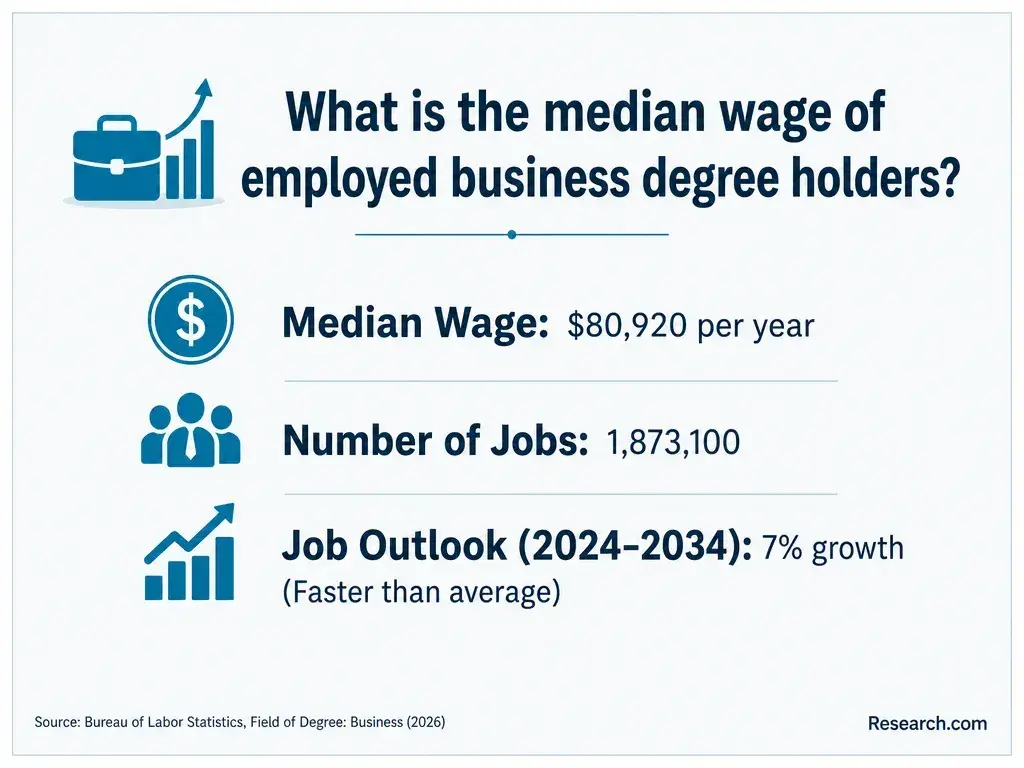
There is no single salary or growth rate for people holding both degrees. The US Bureau of Labor Statistics reports an occupation-wide median annual wage of $102,320 for project management specialists in May 2025 and projects 7% employment growth from 2025 to 2035. Those figures describe an occupation, not starting pay or job prospects guaranteed to a cybersecurity graduate who earns a second BS.
Your likely opportunities depend on whether you can demonstrate project scope, stakeholder communication, budgeting, and relevant technical experience. Compare postings in your location and target industry, including their experience requirements, before using a national occupational median to judge the return on education.
To test affordability against a plausible career path, compare personalized program estimates alongside online business administration program cost-and-time comparisons. Base the decision on the remaining cost and a role you could realistically pursue - not an assumed salary increase from earning another degree.
Other Things You Should Know About Business Administration
No. Your first institution's transcript remains a separate academic record. The new school determines how it calculates and reports grades earned there.
Usually, a minor is awarded as part of an active degree program, not added to a completed degree. Ask your former institution about its policy; individual business courses or a certificate may be more practical.
Possibly, with faculty approval and employer permission. Confirm confidentiality, intellectual-property, and data-use rules before submitting internal budgets, security findings, or client information.
Not automatically. The certification issuer sets renewal and continuing-education rules. Check those rules separately before treating business coursework as eligible credit.
- 8VAC40-31-140. Certification criteria for institutions of higher education. | virginia.gov https://law.lis.virginia.gov/admincode/title8/agency40/chapter31/section140/
- Student Eligibility for Pell Grants | ed.gov https://fsapartners.ed.gov/knowledge-center/fsa-handbook/2024-2025/vol7/ch1-student-eligibility-pell-grants
- Price of Attending an Undergraduate Institution - COE https://nces.ed.gov/programs/coe/indicator/cua/price-of-attending-an-undergraduate-institution
- What kind of aid am I eligible for as a second-degree student? | unc.edu https://studentaid.unc.edu/faq/what-kind-of-aid-am-i-eligible-for-as-a-second-degree-student/
- Bachelor's Degree Requirements | fortlewis.edu https://www.fortlewis.edu/pol-requirements-for-a-bachelors-degree
- Degree Credit and Residency Policy | SUNY Empire https://sunyempire.edu/policies/degree-credit-and-residency-policy.html
- Bachelor of Applied Science in Cybersecurity | Austin Community College District https://programs.austincc.edu/school-of-computer-science-information-technology/bachelor-of-applied-science-in-cybersecurity/
- 15 Best Jobs in Cybersecurity [+ Salary Data] | University of San Diego Online Degrees https://onlinedegrees.sandiego.edu/best-jobs-in-cyber-security/
- MBA vs. Master's Degree: Which Is Right for You? | Notre Dame de Namur University https://www.ndnu.edu/articles/business-management/mba-vs-masters-degree-which-is-right-for-you.html
- Undergraduate and Graduate Tuition and Fees | Purdue Global https://www.purdueglobal.edu/tuition-financial-aid/undergraduate-graduate-tuition-and-fees/