2027 A Second BS in Business Administration After a Bachelor's in Agriculture: Credits, Cost, and Alternatives
Audited and Verified:
Our Editorial and Data Verification Process
Research.com uses government datasets, official education statistics and primary institutional information to support its career and degree guides. Our review process checks factual accuracy, occupational definitions, source dates and the requirements associated with the credentials discussed.
How This Article Was Fact-Checked
Our editorial team verifies salary estimates, employment projections, education requirements and program information against original data providers and official organizations. Salary figures are checked against the relevant occupational definitions and reporting periods. Information about licensure, accreditation and required in-person training is reviewed separately.
Fact-checked and verified on:

Co-Founder and Chief Data Scientist
An agriculture bachelor's degree can prepare you for production, research, or field work without covering every business skill needed for a move into agribusiness operations, marketing, or finance. A second BS in Business Administration may fill those gaps, but your first degree does not automatically make the second one short or inexpensive. This guide shows you how to evaluate remaining credits, costs, scheduling, and career fit - and when a smaller credential or direct work experience may be the better investment.
Key Things You Should Know
- Your agriculture coursework may satisfy general education and electives, but only an official degree audit can establish which business requirements remain.
- Compare the cost of remaining required courses, not the advertised price of an entire bachelor's degree; a prior bachelor's degree generally rules out Pell Grant eligibility.
- Choose a second BS when its required coursework and recruiting opportunities address a specific career gap; targeted courses, a certificate, or an MBA may be more direct.
What Is a Second Bachelor's Degree in Business Administration After Agriculture?
A second bachelor's degree is a separately awarded undergraduate credential completed after your agriculture bachelor's degree. You would meet the new school's business curriculum, credit, and residency requirements, even if it accepts substantial work from your first degree. A BS in Business Administration usually provides a broad foundation across business functions; a BBA or specialized bachelor's may cover similar subjects but have different requirements.
The distinction matters if you already have agricultural experience. Someone moving from crop production into procurement may need accounting, operations, and supplier-management skills more than another broad credential. Someone seeking an agricultural company's HR function may benefit from examining HR degree requirements and job opportunities alongside a general business curriculum. Start with the target role and compare the courses you would actually take, not just the degree titles.
How Many Credits Transfer From an Agriculture Bachelor's Degree?
There is no reliable credit total based on your major alone. A school may accept a course as transfer credit yet apply it only as an elective - not toward its accounting prerequisite, business core, concentration, or required credits taken at that institution. Courses in agricultural economics, statistics, communication, and management are worth reviewing individually, but their titles do not establish equivalency.
The following distinction is the key to comparing schools. Ask each institution for an evaluation against its second-degree business requirements, rather than a general estimate of credits accepted.
| Credit category | What to confirm in the degree audit |
| General education | Whether the completed bachelor's degree fulfills these requirements or individual courses must be reviewed. |
| Business prerequisites and core | Whether prior mathematics, statistics, economics, or other courses match required equivalents. |
| Concentration and electives | Which credits meet a formal focus area and which count only toward the overall credit total. |
| Residency and upper-level work | How many qualifying courses must be completed at the new institution. |
Send official transcripts and, for uncertain matches, course descriptions or syllabi to the transfer-credit office. Have a business adviser confirm the resulting audit and ask about substitution appeals. If you are considering HR instead of general business, HR bachelor's completion with transferred coursework offers another program type to compare - but its transfer decisions will also be school-specific.
How Much Does a Second Business Administration Degree Cost?
The useful price is your cost to finish, not the published cost of earning a bachelor's degree from the beginning. Request a written list of remaining courses, the tuition basis for each term or credit, mandatory fees, and an estimated schedule. Include books, software, proctoring, travel, and any income you would give up to attend. An apparently cheaper program can cost more if it requires additional courses or a longer enrollment period.
A prior bachelor's degree generally makes a student ineligible for a federal Pell Grant. Federal student loans may still be available if you meet applicable eligibility and borrowing-limit rules; ask the financial-aid office to review your record rather than assuming you can borrow the full amount. Employer reimbursement can help, but confirm eligible programs, grade requirements, payment timing, and repayment obligations before relying on it.
Use the same completed-credit evaluation when comparing schools. Listings of lower-tuition online business administration programs can help build a shortlist, but the lowest advertised tuition is not necessarily the lowest remaining cost for a second-degree student.
Expect the school to request transcripts documenting your completed agriculture bachelor's degree. It may also set a minimum academic-standing requirement or separate conditions for entry to the business major. Admission to the institution is not the same as admission to the major, and neither decision guarantees that a prior course fulfills a business requirement.
Ask admissions and the business department whether you must complete mathematics, statistics, accounting, economics, or another course before entering the major - or whether you may take it after admission. Requirements vary, so do not assume an agriculture graduate is either exempt from prerequisites or ineligible without a business background. A business administration degree admissions requirements guide can help you frame questions, but the institution's current catalog and your admission decision control.
Keep the admission decision, transfer evaluation, and degree audit together. If a prerequisite appears to duplicate a prior course, submit its syllabus for an equivalency review before enrolling in a repeat class.
Completion time depends on requirements remaining and when courses are offered, not simply the number of credits a school accepts. A business core with sequential accounting or finance courses can extend the calendar even when your agriculture degree covers general education. Residency rules, upper-level requirements, internships, and part-time enrollment can also affect your finish date.
Ask an adviser to map each remaining requirement by term, marking prerequisites and courses offered infrequently. Then compare that plan with your work schedule and any deadline for a job change. If your goal is supervisory development rather than broad functional business study, completion times for organizational leadership degrees provide a useful comparison - not a promise that another degree will take less time in your case.
Choose the format that lets you complete the remaining courses and gain relevant experience. Online delivery may make it easier to keep an agriculture-sector job, but it does not necessarily mean self-paced study: classes can include live meetings, timed exams, group projects, or fixed presentation dates. Campus study may offer more accessible local recruiting, faculty contact, or project opportunities, while adding commuting and scheduling costs.
Before deciding, request the actual course rotation and assessment expectations for your remaining requirements. Ask whether an internship or capstone can use an approved agribusiness workplace project; current employment alone does not automatically satisfy an academic requirement. When comparing tuition for online business colleges, account for fees and any campus visits as well as tuition.
Requirements vary, but a business administration core commonly covers accounting, finance, economics, marketing, management, operations, quantitative analysis, and business communication. Your agriculture degree may have introduced some of these subjects; the question is whether your target program recognizes that work as equivalent and whether you need greater depth for your intended role.
For an agribusiness transition, match courses to responsibilities. Procurement and supply chain work may call for cost analysis, operations, and supplier evaluation; agricultural marketing may call for customer research and data interpretation. A formal concentration requires the specified courses and approval - it is not created by taking a few related electives. If project coordination is your goal, compare the electives available within the BS with the additional time and cost of accredited project management study before committing to a separate degree.
A second BS makes the strongest case when an employer requires a business bachelor's or when the remaining curriculum, projects, and recruiting access collectively fill substantial gaps. If you already qualify for your target roles, smaller steps may produce more relevant evidence of your skills with less repeated coursework.
These alternatives solve different problems, so compare them against a specific job posting or advancement requirement.
- Targeted courses or a certificate: Useful when you need accounting, analytics, or marketing knowledge rather than another full undergraduate credential.
- Relevant work and documented projects: Useful for an adjacent move, such as taking on purchasing analysis or budgeting responsibilities in an agricultural organization.
- A specialized degree: Worth evaluating when the target function requires deeper preparation; low-cost project management degree options are one comparison for a project-focused goal.
- An MBA or other graduate program: Potentially appropriate if you meet its admission requirements and need graduate-level business study; a business bachelor's is not universally required first.
Compare each option on admission requirements, courses you would still take, total cost, completion time, and access to relevant projects or employers. The shortest credential is not automatically the best choice, but neither is a second bachelor's.
An agriculture graduate might pursue procurement support, operations coordination, agricultural marketing, supply chain analysis, or business development, depending on prior experience and additional skills. A business degree can strengthen preparation, but employers hire for role-specific abilities and results; it does not by itself confer a management position.
For context, the U.S. Bureau of Labor Statistics reports a $82,320 median annual wage for logisticians in May 2025 and projects 18% employment growth for that occupation from 2025 to 2035. That is an occupation-wide figure, not an entry-level salary or an earnings forecast for second-degree graduates. If supply chain is your goal, compare job descriptions for inventory analysis, supplier coordination, and data tools with your agriculture experience and planned coursework.
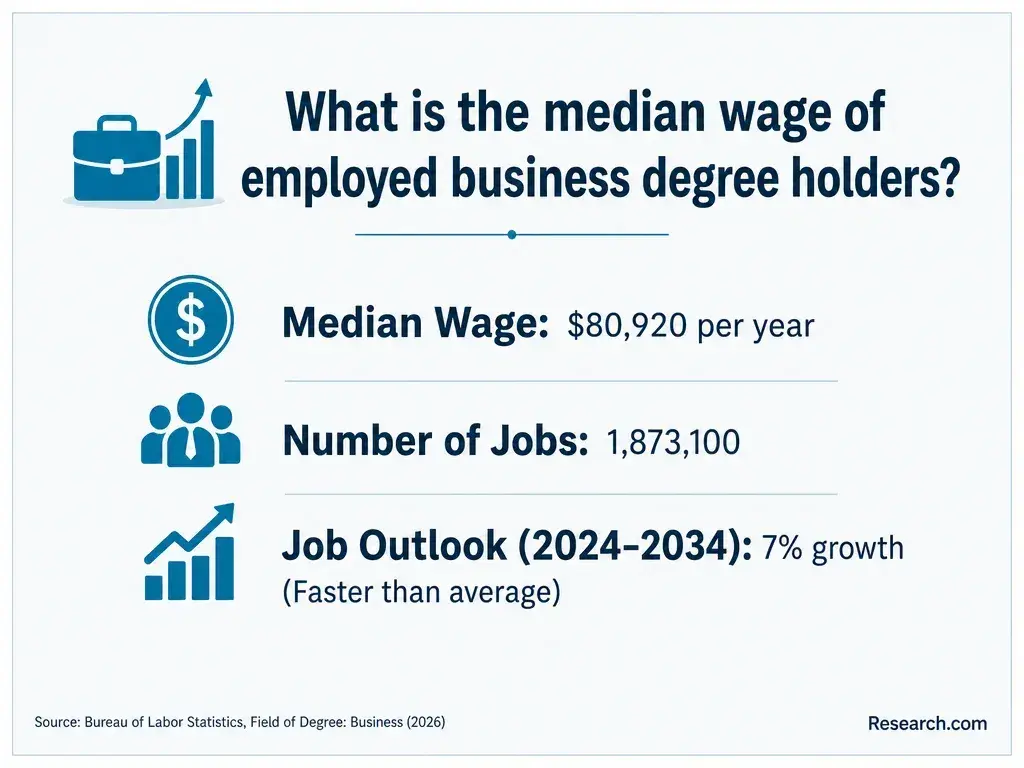
Before paying for another degree, test your transition: speak with employers about their education requirements, seek a relevant project or entry-level opening, and identify skills you cannot yet demonstrate. Resources on affordable business administration study and earnings considerations can inform that comparison, but expected earnings should be based on the occupation, location, and role - not a degree title alone.
How Can You Choose an Accredited Business Administration Program?
First, confirm that the institution holds recognized institutional accreditation and that the exact second-degree program accepts applicants who already have a bachelor's degree. Business-school accreditation from AACSB, ACBSP, or IACBE is a separate consideration; check the accreditor's listing to see what it covers rather than assuming every program at the institution is included.
For your decision, the most valuable document is an institution-approved audit showing remaining requirements. Pair it with a term-by-term course plan and an individualized cost estimate. Ask the registrar or transfer office who can approve equivalencies, the business adviser which courses satisfy the major, and financial aid what assistance remains available to you. If financing is central, use a list of FAFSA-accepting colleges for business administration students as a starting point, then verify your own eligibility - FAFSA participation does not restore Pell Grant eligibility after a completed bachelor's degree.
Other Things You Should Know About Business Administration
Possibly. Ask whether the college permits a second degree in business, what new-credit minimum applies, and whether returning students follow the current catalog.
Only if the school has an applicable prior-learning assessment or credit policy and formally awards the credit. Training certificates or job experience alone do not satisfy a degree requirement.
Do not assume so. The school must authorize any graduate-to-undergraduate substitution, and a course ordinarily cannot be counted twice in ways its policies prohibit.
Not automatically. CPA eligibility is determined by state accountancy-board rules, including specific accounting and other education requirements. Check the state where you intend to seek licensure before choosing courses.
- School-Determined Requirements - FSA Partner Connect https://fsapartners.ed.gov/knowledge-center/fsa-handbook/2026-2027/vol1/ch1-school-determined-requirements
- Fast Facts: Tuition costs of colleges and universities (76) | ed.gov https://nces.ed.gov/fastfacts/display.asp
- Eligibility Requirements | Federal Student Aid https://studentaid.gov/understand-aid/eligibility/requirements
- Requirements for the Bachelor's Degree | University at Albany https://www.albany.edu/undergraduate-bulletin/requirements-for-bachelors-degree.php
- What Careers Can You Get with an Agricultural Business Degree? | Edison State Community College https://www.edisonohio.edu/blog/what-careers-can-you-get-with-an-agricultural-business-degree
- Eligibility Requirements - Office of Student Financial Aid https://financialaid.iastate.edu/getting-started/qualifying-for-aid/eligibility-requirements/
- Guidelines for Second Bachelor's Degree | towson.edu https://catalog.towson.edu/undergraduate/admissions/undergraduate-admissions/guidelines-second-bachelors-degree/
- MBA vs. Master's Degree: Which Is Right for You? | Notre Dame de Namur University https://www.ndnu.edu/articles/business-management/mba-vs-masters-degree-which-is-right-for-you.html
- How Long Does It Take to Get a Business Degree? | SCU https://www.scu.edu/business/blog/admissions/how-long-does-it-take-to-get-a-business-degree/
- How Long Does it Take to Get a Business Degree Online? | stevenson.edu https://www.stevenson.edu/online/about-us/news/how-long-does-it-take-to-get-a-business-degree-online/