2027 BS in Business Administration: Proctored Exams Versus Portfolio Assessments
Audited and Verified:
Our Editorial and Data Verification Process
Research.com uses government datasets, official education statistics and primary institutional information to support its career and degree guides. Our review process checks factual accuracy, occupational definitions, source dates and the requirements associated with the credentials discussed.
How This Article Was Fact-Checked
Our editorial team verifies salary estimates, employment projections, education requirements and program information against original data providers and official organizations. Salary figures are checked against the relevant occupational definitions and reporting periods. Information about licensure, accreditation and required in-person training is reviewed separately.
Fact-checked and verified on:

Co-Founder and Chief Data Scientist
An online BS in Business Administration may advertise flexible study while still requiring exams at fixed times - or it may replace some tests with projects that demand sustained work and feedback. For students balancing coursework with jobs or other commitments, that difference can determine whether a program is workable.
It also affects how well students can demonstrate accounting knowledge, business judgment, and communication skills. This guide compares proctored exams and portfolio assessments, explains what each can and cannot prove, and shows which program policies to check before enrolling.
Key Things You Should Know
- Proctored exams are useful for verifying individual knowledge under controlled conditions; portfolios are better suited to showing how a student develops and explains a business decision.
- Neither "online" nor "portfolio-based" means self-paced. Check exam windows, project milestones, group-work schedules, accessibility arrangements, and any proctoring fees.
- A business bachelor's degree commonly requires about 120 semester credits. Portfolio assignments do not reduce that requirement unless the institution separately approves credit through a prior-learning or transfer-credit process.
What are proctored exams and portfolio assessments in a business administration degree?
A proctored exam is an individual test supervised in person or through an approved remote-proctoring system. A school may use it to assess accounting calculations, statistics, business terminology, or interpretation of a case under specified time and resource limits. Remote proctoring can involve identity checks and restrictions on devices or permitted materials; the exact rules are set by the course.
A portfolio assessment evaluates a collection of work against stated learning outcomes. In business administration, that might include a spreadsheet model, a marketing analysis, a process map, a revised recommendation, and a short explanation of the assumptions behind each. Faculty may assess both the final work and the student's reasoning, revisions, and individual contribution.
A portfolio assignment is not the same as prior-learning assessment, which is a separate institutional process for evaluating learning gained outside a course for possible credit. Likewise, a program's advertised pace does not tell you how it tests students. When reviewing accelerated online bachelor's programs, request actual business-course syllabi rather than inferring assessment methods from the format.
How do proctored exams compare with portfolio assessments for business students?
The practical difference is not simply "tests versus projects." Students should compare how each method handles scheduling, feedback, verification, and the kind of work they hope to show an employer.
The table summarizes typical trade-offs; individual courses may combine methods or set different rules.
| Decision factor | Proctored exam | Portfolio assessment |
| What it shows most clearly | Individual performance on specified knowledge or problems | Application, explanation, and revision across related tasks |
| Scheduling pressure | A reserved appointment or limited testing window may be required | Work may be spread out, but milestones and presentations can be fixed |
| Feedback | Often arrives after a completed test | May be incorporated before final submission if drafts are reviewed |
| Practical constraints | Testing space, equipment, identification, and possible fees | Access to appropriate data, software, collaborators, and permitted work samples |
| Evidence after the course | A grade, usually without a shareable work product | Potential work samples, subject to privacy and ownership rules |
A student with unpredictable shifts may prefer a portfolio with weekly deadlines to a narrow exam appointment. Someone who works best through short, independent study sessions may prefer an exam to a multiweek group project.
Fast pacing can intensify either burden; compare assessment calendars when considering fast-paced online organizational leadership bachelor's programs alongside business administration options.
Which assessment method better measures business administration competencies?
The stronger choice depends on the competency and the evidence required. A supervised exam can establish that a student independently understands a financial statement or selects an appropriate statistical method. A portfolio can show whether that student can use the method, explain uncertainty, and make a defensible recommendation to a business audience.
For example, an HR-related exam could test employment-practice concepts, while a portfolio could assess a proposed onboarding process and its measures. Neither alone proves that the student has managed employees or is qualified for a particular HR position.
Students considering that function can compare the deeper coursework described in human resources degree requirements with the HR exposure in a general business core.
The most convincing assessment often combines individual verification with applied work: a student completes a project, documents data sources and assumptions, then explains decisions independently.
Look for clear rubrics, faculty feedback, and a way to identify each person's contribution to group work. A polished portfolio without those safeguards may reveal less about individual competence than it appears to.
A BS in Business Administration generally combines general education with accounting, economics, finance, marketing, management, operations, quantitative methods, and business communication.
Schools differ in course depth, prerequisites, electives, and whether a capstone is required. A BS and a BBA can overlap substantially; the degree name alone does not establish which has more quantitative work.
Assessment should fit the course. Accounting fundamentals may use individually completed problems; operations may add a process analysis; marketing may require a research-based recommendation. An official concentration, if offered, can bring more advanced courses and applied assignments, but an elective or portfolio topic does not itself confer a concentration.
If supply chain is the intended direction, compare the operations courses, software exposure, and project requirements, not just completion speed, when examining accelerated undergraduate supply chain programs. A general business portfolio can show relevant interest, but it may not provide the same functional depth.
A portfolio can be a course assessment in an accredited business program, provided the school evaluates it under its academic policies. Accreditation does not require every course to use proctored exams, nor does the presence of portfolios establish that a school is accredited. The institution determines course requirements and whether a separate prior-learning portfolio may earn credit.
Check institutional accreditation and, if the school advertises AACSB, ACBSP, or IACBE accreditation, confirm the accreditor's scope covers the relevant business school or program.
Do not assume a claim about the institution applies to every degree it offers. A list of nationally ranked online business programs can supply candidates to investigate, but rankings are not a substitute for checking accreditation and assessment policies directly.
For credit based on prior learning, ask the registrar or prior-learning office which outcomes the portfolio must demonstrate, how it is evaluated, what fees apply, and where awarded credits would fit in the degree audit. Acceptance as elective credit may not satisfy a required business-core course.
Both formats can use exams, presentations, simulations, group cases, and portfolios. The difference is often logistical: an online student may need an approved remote-testing setup or a distant test center, while a campus student may take the same exam during class. Online group projects may also require live meetings despite otherwise asynchronous lessons.
Ask for the assessment schedule of required courses, not just a general statement that classes are flexible. Confirm exam-window length, live presentation times, time-zone rules, permitted testing locations, software requirements, proctoring charges, and the process for requesting disability accommodations. These details are especially important when comparing business programs with accelerated online classes, where overlapping deadlines can leave little room to reschedule.
Campus delivery is not automatically less flexible, and online delivery is not automatically self-paced. The workable option is the one whose actual attendance and assessment obligations fit the student's available hours.
First-year applicants generally submit evidence of secondary-school completion; transfer applicants generally provide transcripts from previous colleges. A school may also set GPA, mathematics, or business-major entry requirements. Policies differ, and admission to the institution does not necessarily mean immediate admission to its business major.
For returning students, the assessment question is often whether previous coursework applies to accounting, statistics, or another requirement, not whether it merely transfers.
Request an official degree audit and ask which prerequisites must be completed before courses that use exams or applied projects. Someone comparing a business degree with an HR pathway can also compare credit acceptance at online HR schools; each institution makes its own equivalency and degree-applicability decisions.
A bachelor's degree commonly totals about 120 semester credits. A full-time student starting without college credit often plans for roughly four academic years; transfer credit, part-time study, course sequencing, and required residency credits can change that timeline. Neither portfolio assignments nor proctored exams automatically shorten a degree.
For an accurate cost comparison, obtain a written estimate covering tuition for remaining applicable credits, mandatory fees, books or software, and any testing or prior-learning-assessment charges. Then compare likely terms of enrollment and any travel or time away from work. Published online business administration school cost comparisons can identify options, but a school-specific degree audit and fee schedule are needed to estimate your own completion cost.
A portfolio-heavy course may avoid a testing appointment yet demand substantial project time. Conversely, paying a proctoring fee could be less disruptive than arranging repeated group meetings. Compare total commitments, not just tuition or the number of exams.
A BS in Business Administration can support applications for roles such as operations coordinator, HR assistant, marketing coordinator, or project coordinator. Coursework supplies broad preparation.
Internships, relevant employment, and demonstrable skills help establish readiness for a particular function. A portfolio may give an applicant a useful work sample, but it does not replace experience or meet every employer's requirements.
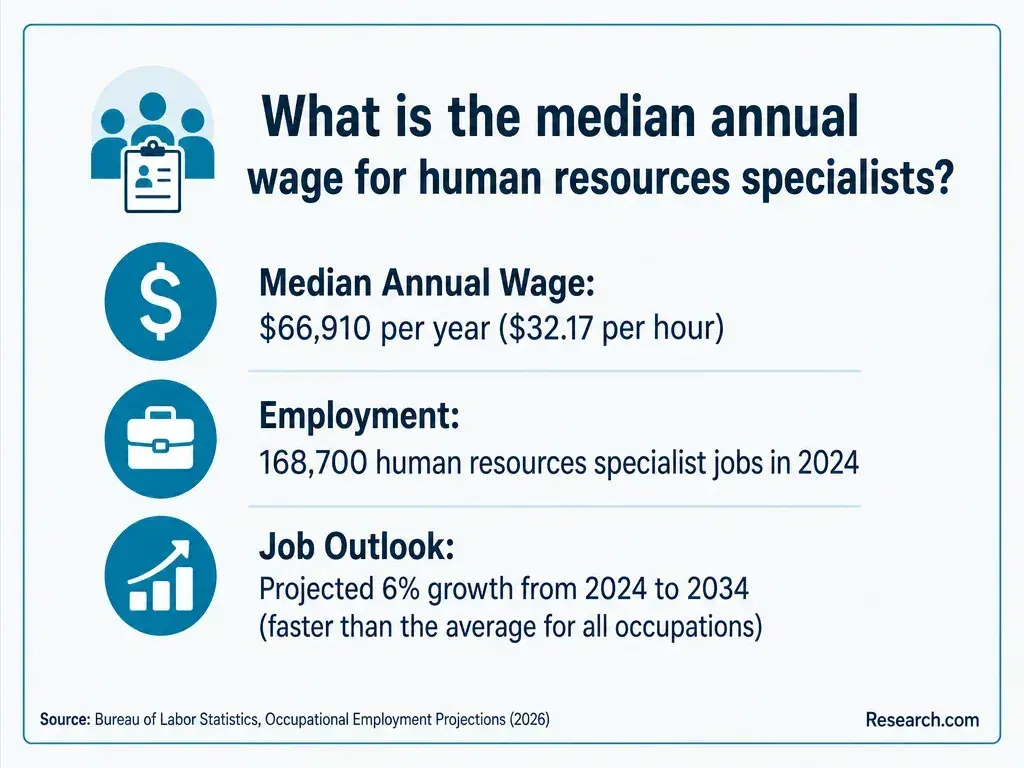
For salary context, the U.S. Bureau of Labor Statistics reports a May 2025 median annual wage of $75,940 for human resources specialists and projects 6% employment growth from 2025 to 2035. Those are occupation-wide figures, not expected earnings or a hiring forecast for new business graduates. Specialized and managerial positions may require substantial additional experience or education.
If project work is the goal, compare role requirements with your actual evidence before paying for a specialized degree. Accredited project management degree cost breakdowns can inform that comparison, but a business degree plus relevant project experience or targeted training may be the more direct route for some applicants.
How can students choose a reputable business administration program?
Start with the degree's required courses and assessment policies, then verify accreditation, cost, and support. A reputable program should be able to explain how it verifies individual learning, evaluates applied work, handles academic integrity, and supports students who need accessibility arrangements or help with technology.
Before committing, ask an adviser for recent syllabi from an accounting course, a quantitative course, and the capstone or equivalent. Check whether exams have fixed appointments, how portfolio work is graded, whether workplace data is optional, and what happens if an approved project becomes unavailable.
Ask the registrar for a degree audit and the financial-aid office for costs and aid rules that apply to your enrollment plan. Use a business degree tuition comparison guide to shortlist schools, then verify each school's current charges and policies directly.
Choose the program whose assessment mix both measures the skills you need and fits the time, equipment, privacy, and financial constraints you actually face, not the one that simply advertises fewer exams.
Other Things You Should Know About Business Administration Programs
Usually you can discuss your own work, but check course rules and any employer or client agreements before sharing files. Remove confidential information and identify a classroom simulation as a simulation.
State the team's goal, your specific tasks, the methods you used, and any limitations. Do not present teammates' analysis or a proposed business result as your individual achievement.
Follow the course's technical-incident procedure immediately and retain any available error record. Ask about the reporting deadline and retake policy before the exam; an interruption does not automatically qualify for a reset.
Only to the extent the course permits. Follow disclosure rules, verify any generated claims or calculations, and do not enter confidential business or personal data into an unapproved tool.
- Effect of unproctored versus proctored examinations on... - PMC https://pmc.ncbi.nlm.nih.gov/articles/PMC11774286/
- Direct Assessment (Competency-Based) Programs | ed.gov http://www.ed.gov/laws-and-policy/higher-education-laws-and-policy/higher-education-policy/direct-assessment-competency-based-programs
- Assessment Measures | Office of Academic Effectiveness https://academiceffectiveness.gatech.edu/assessment-toolkit/assessment-measures
- Measuring student learning | Center for Teaching Innovation https://teaching.cornell.edu/teaching-resources/assessment-evaluation/measuring-student-learning
- Rubrics | Center for the Advancement of Teaching Excellence | University of Illinois Chicago https://teaching.uic.edu/cate-teaching-guides/assessment-grading-practices/rubrics/
- Proctored Exams | Uopeople Catalog https://catalog.uopeople.edu/ug_term1_item/academic-regulations/proctored-exams
- Rubric Guidance | Student Support & Advising Services https://www.colorado.edu/graduateschool/media/573
- What to Know About Online Proctored Exams | The Institutes https://web.theinstitutes.org/blog/everything-you-need-know-about-taking-online-proctored-exam
- Validity and Reliability Considerations for Educational Measurement - AEFP Live Handbook https://livehandbook.org/validity-reliability-considerations-educational-measurement/