2027 Comparing Online BS in Business Administration Options for Students Working a Compressed Workweek
Audited and Verified:
Our Editorial and Data Verification Process
Research.com uses government datasets, official education statistics and primary institutional information to support its career and degree guides. Our review process checks factual accuracy, occupational definitions, source dates and the requirements associated with the credentials discussed.
How This Article Was Fact-Checked
Our editorial team verifies salary estimates, employment projections, education requirements and program information against original data providers and official organizations. Salary figures are checked against the relevant occupational definitions and reporting periods. Information about licensure, accreditation and required in-person training is reviewed separately.
Fact-checked and verified on:

Co-Founder and Chief Data Scientist
A four-day workweek may leave a weekday open for school, but it does not make every online degree manageable. Live classes, group meetings, and exams can still collide with long shifts or a changing day off. This guide is for working students comparing online BS in Business Administration options.
It explains which scheduling policies matter most, how to check the degree's academic value, and how to compare completion time and cost without mistaking an advertised "flexible" format for a workable plan.
Key Things You Should Know
- For a compressed workweek, fixed attendance, exam windows, and group-project meetings matter more than an "online" label; request a sample course schedule before enrolling.
- A four-day, 10-hour work schedule can preserve a weekday for study, but long workdays may make weekly deadlines and accelerated courses harder to manage.
- Compare remaining degree requirements and total cost after an official transfer evaluation, not just advertised tuition or the shortest possible completion time.
What is an online BS in Business Administration for compressed-workweek students?
An online BS in Business Administration is an undergraduate degree covering several business functions, usually including accounting, finance, marketing, management, operations, and quantitative decision-making. "Compressed workweek" describes your employment schedule, not a separate kind of degree: you might work four longer days and reserve a fifth weekday for coursework.
Online courses can still have fixed weekly deadlines. Some require live participation; others let you view lessons on your own time but set specific exam windows. A program advertised among faster undergraduate completion pathways may use shorter terms, which compress assignments as well as the calendar. Judge its pace against your longest workdays and the hours you can reliably study, not only your day off.
How can you compare online and campus-based business administration programs?
Compare the schedule you would actually follow in each format. Campus classes may provide predictable face-to-face contact but require travel and attendance at set times. Online classes remove most commuting yet can shift coordination to video meetings, discussion deadlines, and independently arranged group work.
The following comparison focuses on obligations most likely to disrupt a compressed workweek. Ask each school whether its policies apply to every required business course, not just introductory classes.
| Feature | Online program | Campus-based program |
| Attendance | May be asynchronous, live, or a mix | Usually tied to scheduled class meetings |
| Assessments | May involve timed tests, proctoring, or presentations | May require attendance for in-person tests or presentations |
| Group work | Often requires arranging meetings across schedules | May be easier to coordinate around class, but still takes time outside it |
| Travel | Check for occasional campus visits or internships | Regular commuting and parking may be necessary |
Compare tuition and commuting costs alongside those obligations. A lower-priced program is not a better fit if its required sessions repeatedly conflict with work; online business programs for cost-conscious students are a starting point, not a substitute for checking course schedules and your final bill.
Is an online business administration degree accredited and respected by employers?
An online degree can be a credible qualification when the institution holds recognized accreditation and the curriculum develops skills relevant to the job. Verify the institution's accreditation directly with its accreditor and check whether it covers the school at which you would enroll.
AACSB, ACBSP, and IACBE address business education at different scopes; if a school advertises one, confirm that the specific business program is covered. Business-specific accreditation is distinct from institutional accreditation.
Employers assess more than delivery format. Relevant work responsibilities, spreadsheet and financial skills, communication, and examples of applied work can help you show what you learned. Ask whether the school reports outcomes for online business students specifically, including who was counted and when.
If you expect federal student aid, also check FAFSA eligibility at online business administration schools; accreditation claims alone do not establish your personal aid eligibility.
Expect general education requirements and a business core, though the exact courses and sequencing vary. Common subjects include financial and managerial accounting, economics, business statistics, finance, marketing, organizational behavior, operations, business law, and strategy. A capstone may require a team presentation, simulation, or business analysis, each with different scheduling demands.
Examine the actual course descriptions and assignments for your intended role. A project-management course may introduce schedules and risk, while a dedicated degree offers a different level of focus; students considering that route can compare affordable project management schools against the broader business curriculum.
Likewise, an elective in analytics is not necessarily a formal concentration or proof of specialist proficiency. Ask when prerequisite courses and required capstones are offered online, especially if you plan to enroll part time.
The strongest fit is usually an asynchronous program with predictable weekly deadlines, multiple course-start opportunities, and permission to study part time. That is a format profile, not a promise about every class. If your day off rotates, a program with compulsory live sessions or narrow exam windows may be difficult even if its lectures are recorded.
Before comparing the fastest online business bachelor's programs in the US, ask an adviser for recent syllabi from required courses and get written answers to these scheduling questions:
- Which courses require live attendance, and are sessions offered at times compatible with your shifts?
- How long are exam windows, and do assessments require a proctor, webcam, or testing-center visit?
- Can team meetings, internships, and capstone presentations be arranged around work?
- What happens if an employer changes your day off, and what are the withdrawal, leave, and course-reentry rules?
Test the answers against a difficult workweek, not your easiest one. A slower pace that you can sustain may be more useful than an accelerated schedule that repeatedly forces withdrawals.
Schools commonly request evidence of secondary-school completion and transcripts from previous colleges. Transfer applicants may face separate minimum-credit, GPA, or business-major requirements.
Some programs admit students directly to the major; others require introductory courses before entry. Confirm the current rules with admissions rather than assuming work experience waives coursework.
If you have prior college study, request a formal evaluation showing which credits satisfy general education, the business core, electives, and any residency requirement. Accepted credits do not necessarily replace required accounting, statistics, or other sequenced courses.
The same distinction matters when reviewing a project management bachelor's transfer planning guide as an alternative: only the receiving institution can determine how your credits apply to its degree.
Completion time depends on credits that apply to the degree, the number of courses you can take while working, prerequisite order, and how often required classes run.
Shorter terms do not reduce the work required in each course. A compressed workweek can create a useful study block, but reducing paid hours to accelerate school has an opportunity cost. Fast-track business degree options can be helpful for working students.
Build a comparison from each school's written degree audit and current tuition schedule. Include required fees, books, software, proctoring, possible travel, and the cost of any additional terms. Check financial-aid enrollment rules and whether employer reimbursement arrives after you pay tuition or meet a grade requirement.
The degree can support applications for business roles, but the next step depends heavily on your existing responsibilities. Someone already handling scheduling, purchasing, customers, or budgets may be able to document relevant experience for operations or project-coordination work. A newcomer may need an internship, supervised project, or entry-level role before seeking specialist or management responsibilities.
Match target jobs to evidence you can produce: a process map for operations, a carefully anonymized budget analysis for administrative work, or a permitted campaign report for marketing support.
Ask schools how career services and applied assignments serve working online students; a list of leading American online business degree schools cannot tell you whether a particular employer project will be approved. Do not share confidential workplace data without permission.
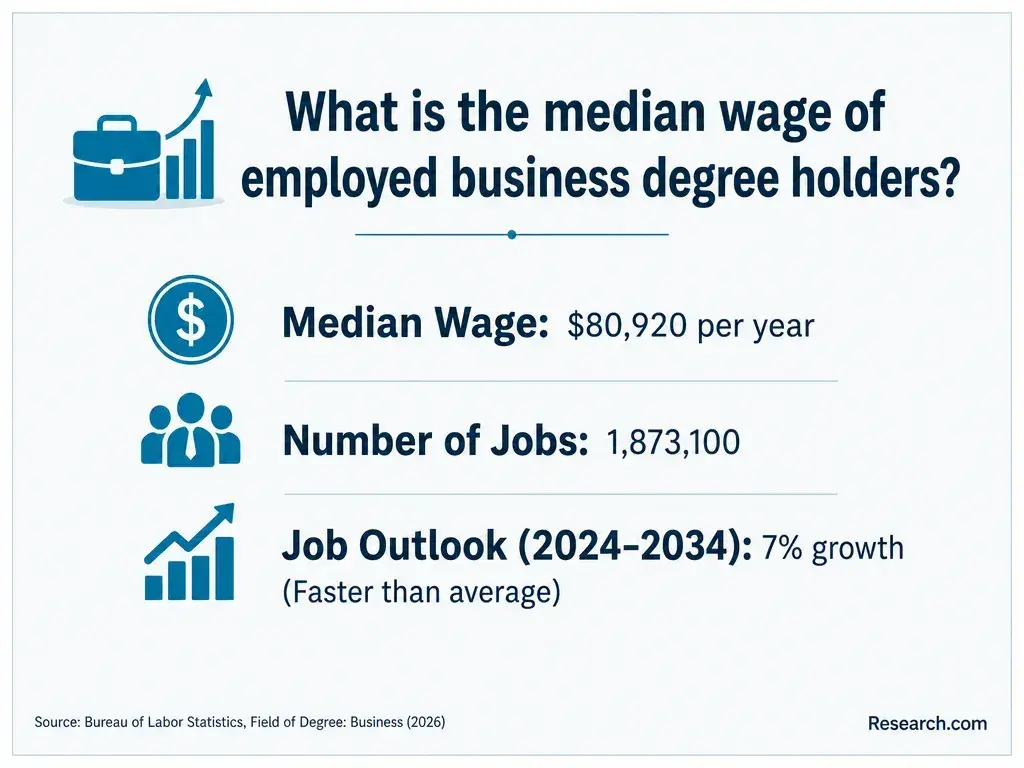
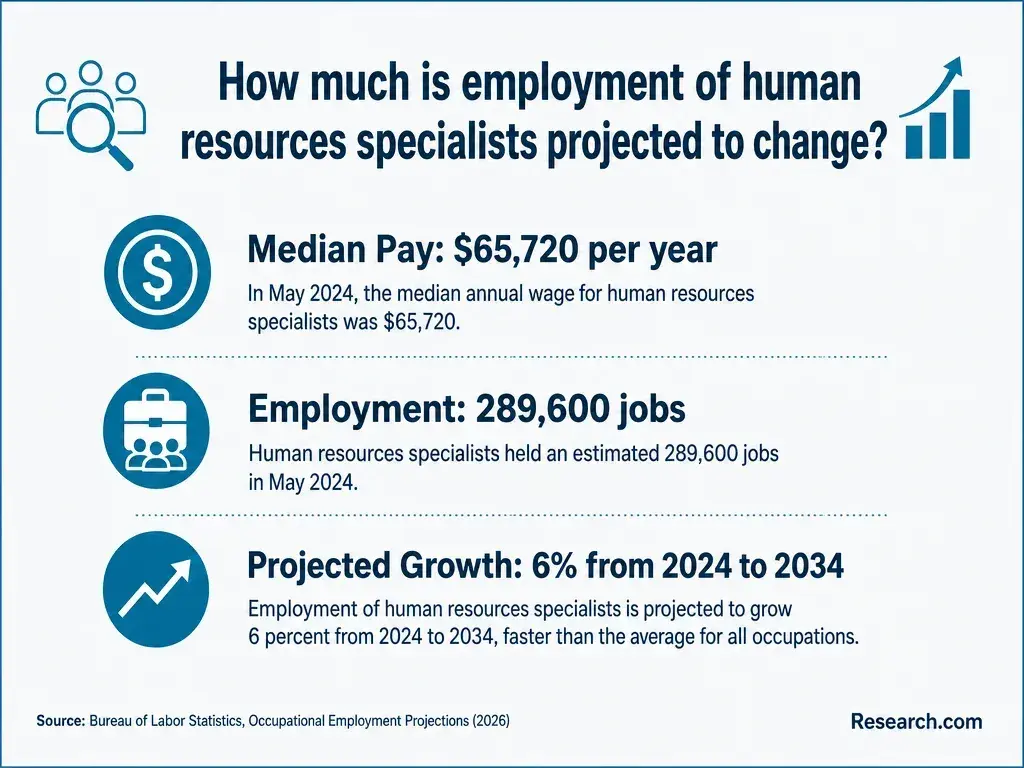
There is no single salary or growth rate for BS in Business Administration graduates: labor statistics describe occupations, not degree holders. For example, the US Bureau of Labor Statistics reports a May 2025 median annual wage of $75,940 for human resources specialists and projects 6% employment growth for that occupation from 2025 to 2035. The median includes experienced workers and is not an expected starting salary for someone completing an online degree.
Use figures for the specific role and location you intend to pursue, then compare job postings with your experience. Supply-chain work, for instance, has different duties from HR; affordable supply chain programs and salary outlook may be more relevant if logistics is your target. Managerial occupation wages should not be used to forecast your earnings immediately after graduation.
Which certifications strengthen an online business administration career?
Choose a certification only after identifying a target job's requirements. Software training may help you demonstrate spreadsheet or analytics skills; HR, project-management, and supply-chain credentials serve different functions and may require qualifying experience or examinations. A business administration degree does not automatically confer any of them.
Compare the credential's eligibility rules, cost, preparation time, and relevance to postings you would realistically pursue. If you need substantial function-specific coursework rather than a supplemental credential, accelerated undergraduate supply chain programs illustrate a different route, but their shorter calendars must still fit your shifts. Your best first investment may instead be an approved workplace project that demonstrates a skill an employer seeks.
Other Things You Should Know About Business Administration Programs
Possibly, but weekly discussions, group work, and exams may fall on other days. Review sample syllabi and plan for smaller study periods during the workweek.
Ask instructors or advisers about attendance and assessment policies before enrolling. Do not assume a recorded lecture means live activities or exam windows can be moved.
Check both school requirements and workplace policies first. You may need approval to use internal information, and a de-identified example may still reveal confidential details.
It may if you already meet the education requirements for your target role and need one defined skill. Check job postings and your employer's advancement rules before committing to either path.
- Cost of Attendance (Budget) | 2025-2026 Federal Student Aid Handbook https://fsapartners.ed.gov/knowledge-center/fsa-handbook/2025-2026/vol3/ch2-cost-attendance-budget
- Plan and Pay for Higher Education - State Controller's Office https://www.sco.ca.gov/eo_higher_education.html
- Semester Course Load and Student Performance - PMC - NIH https://pmc.ncbi.nlm.nih.gov/articles/PMC7568764/
- College Scorecard: Home | ed.gov https://collegescorecard.ed.gov/
- Your financial path to graduation | consumerfinance.gov https://www.consumerfinance.gov/paying-for-college/your-financial-path-to-graduation/
- Experiential Learning Requirements - College Of Business https://business.oregonstate.edu/programs/admission-aid/advising/academic-planning/experiential-learning-requirements
- How Many Credits Do You Need to Graduate College? | snhu.edu https://www.snhu.edu/about-us/newsroom/education/how-many-credits-to-graduate-college
- Bachelor of Science in Business Administration Online | SDSU Global Campus https://globalcampus.sdsu.edu/program/business/bachelor-science-business-administration-online-degree-completion-program/
- Student Course Load Policies | South University https://catalog.southuniversity.edu/student-course-load-policies
- What's the Difference Between Asynchronous and Synchronous Learning? | Ohio State Online https://online.osu.edu/content-hub/blogs/whats-the-difference-between-asynchronous-and-synchronous-learning/