2027 Social Work Service Plans: Connecting Needs, Goals, Actions, and Review Dates
Audited and Verified:
Our Editorial and Data Verification Process
Research.com uses government datasets, official education statistics and primary institutional information to support its career and degree guides. Our review process checks factual accuracy, occupational definitions, source dates and the requirements associated with the credentials discussed.
How This Article Was Fact-Checked
Our editorial team verifies salary estimates, employment projections, education requirements and program information against original data providers and official organizations. Salary figures are checked against the relevant occupational definitions and reporting periods. Information about licensure, accreditation and required in-person training is reviewed separately.
Fact-checked and verified on:

Co-Founder and Chief Data Scientist
A service plan can look complete while leaving everyone unsure what happens next. A useful plan connects the client's priorities to specific actions, identifies who will take them, and sets a date to check whether they helped. This guide is for social work students, new practitioners, and human services staff who write or review plans in agency settings. It explains what to include, how to choose measurable goals without reducing a person to a checklist, and when safety, confidentiality, supervision, or agency rules should change your approach.
Key Things You Should Know
- A usable plan connects each priority need to a client-agreed goal, a measurable objective, a responsible person, and a review date.
- Separate what staff can do—such as submit a referral—from outcomes they cannot promise, such as admission to a housing program.
- There is no universal review interval: record a specific date, follow applicable agency or funder deadlines, and reassess sooner when circumstances change.
What is a social work service plan?
A social work service plan is a working agreement that turns assessment findings into coordinated next steps. It records what the client wants to change or maintain, what support is available, what the client and service providers will do, and when they will evaluate progress. Agencies may call it a case plan, care plan, treatment plan, or individualized service plan; those terms can carry different legal or program requirements.
The plan is not the assessment itself. An assessment explores needs, strengths, risks, preferences, and environmental barriers; the plan selects priorities and actions from that information. Nor is it a guarantee that a referral will result in services. Students considering how this work fits into broader practice can use social work degree planning for prospective students to compare preparation for different settings, but the plan's required format comes from the placement or employing agency.
What should a social work service plan include?
Use the agency's required form first. Whatever the format, a reader should be able to trace a clear line from an identified need to a goal, an action, evidence of progress, and a review decision.
- Context and participation: The client's stated priorities, relevant strengths, people they want involved, applicable consent, and barriers such as transportation or service eligibility.
- Priorities and goals: The needs selected for action and the outcomes the client agrees are worth pursuing.
- Objectives and actions: Observable steps, the person responsible for each step, anticipated timing, and any referral or coordination required.
- Progress and review: A baseline where useful, how progress will be checked, a scheduled review date, and space to record changes and the client's response.
Record only information needed for the plan and the agency's documentation obligations. A concise plan that staff and clients can use is more valuable than one crowded with sensitive history unrelated to the agreed work. For returning learners exploring how these skills are taught, online bachelor's social work options for returning learners are a separate educational choice; no degree-program template replaces an agency-approved plan.
How do you write a social work service plan?
Start with a conversation, not a prefilled intervention. The sequence below helps prevent a common documentation error: listing services without explaining which client-identified goal they support:
- Confirm the purpose of the plan, your role, required agency format, and any immediate safety or reporting procedures that must be handled separately.
- Summarize the client's priorities, strengths, relevant assessment findings, and barriers in plain language; check that the summary reflects their view.
- Agree on a manageable set of goals, then write observable objectives for each one.
- Assign actions to named roles, distinguish client choices from staff responsibilities, and confirm that proposed services are actually accessible.
- Set a review date and describe what evidence you and the client will examine; document agreement, disagreement, or requested changes as agency policy requires.
Illustrative example: For a client who identifies stable housing as a priority, an objective might be to complete an eligibility screening with a housing provider by an agreed date. The worker's action is to offer referral support with consent; the provider decides eligibility. The review checks whether screening occurred and what barrier or next step remains—not whether housing was guaranteed.
Students can practice this reasoning through supervised coursework and field tasks. Before choosing a program, confirm that its field site and instructor support assessment and planning opportunities; a directory of accredited online BSW programs is a starting point, not proof that a particular placement offers those tasks.
A goal states the outcome the client wants; an objective describes a smaller change or milestone that can be checked. Measurement should answer "How will we know what happened?" without claiming the worker controls another agency's decision. Agree on a baseline when it will make progress easier to interpret.
For example, "Improve access to food" is a broad goal. An objective could be "By the agreed review date, the client will decide whether to submit a food-benefit application after receiving eligibility information." The worker can document when information was offered and whether an application was submitted, while preserving the client's choice and avoiding a promise of approval.
If a target proves unrealistic because eligibility rules or service availability change, revise it with the client rather than labeling the client noncompliant. Program cost is likewise separate from practice competence: online MSW programs organized by cost can help students compare expenses, but they should also verify how each program teaches and assesses goal writing in field education.
An intervention is an action intended to advance a goal, such as benefits navigation, advocacy, skills support, or coordinated follow-up within the worker's role. A referral connects the client with another service; it is not proof that the service was received. Choose actions by asking whether they address the stated barrier, fit the client's preferences, and are available under current eligibility and capacity rules.
For each referral, specify who will contact whom, what information may be shared, whether the client wants assistance making contact, and how the result will be checked. If a provider has a waitlist, the plan may need an interim option and a follow-up date. Do not place psychotherapy, diagnosis, or another regulated activity in a worker's assignment unless their license, supervision, setting, and agency policy permit it.
The mix of actions differs across case management, clinical, school, and community roles. Readers exploring roles for master's-prepared social workers should compare actual job duties rather than assume every service-planning role involves clinical treatment.
Explain the plan's purpose, the client's choices, and the limits of confidentiality in language the client can use. Seek required authorization before sharing information for referrals, and disclose only what the receiving party needs. Store and transmit plans through approved systems; avoid putting unnecessary diagnoses, third-party details, or sensitive history into a document circulated among providers.
Client self-determination does not erase safety duties, reporting requirements, or limits on professional scope. The NASW Code of Ethics provides professional guidance, while privacy law, reporting law, licensing rules, contracts, and agency policy can impose separate requirements. When these obligations are unclear or conflict, consult a supervisor and the applicable authority rather than treating a generic template as legal advice.
Students and early-career workers should also clarify which records may be used in supervision and how identifying details are protected. Social work experience requirements and professional milestones address a different documentation question: a service plan or field task does not itself establish qualifying post-degree clinical supervision hours.
What degrees and licenses are needed for social work roles involving service planning?
Requirements depend on the job's actual duties, the employer, and the state - not on the fact that it uses a service plan. Some human services and case-management positions accept other relevant degrees or experience. Jobs using a protected social worker title, school-specific designation, or clinical functions may require a qualifying social work degree, state license, additional credentials, or supervised experience.
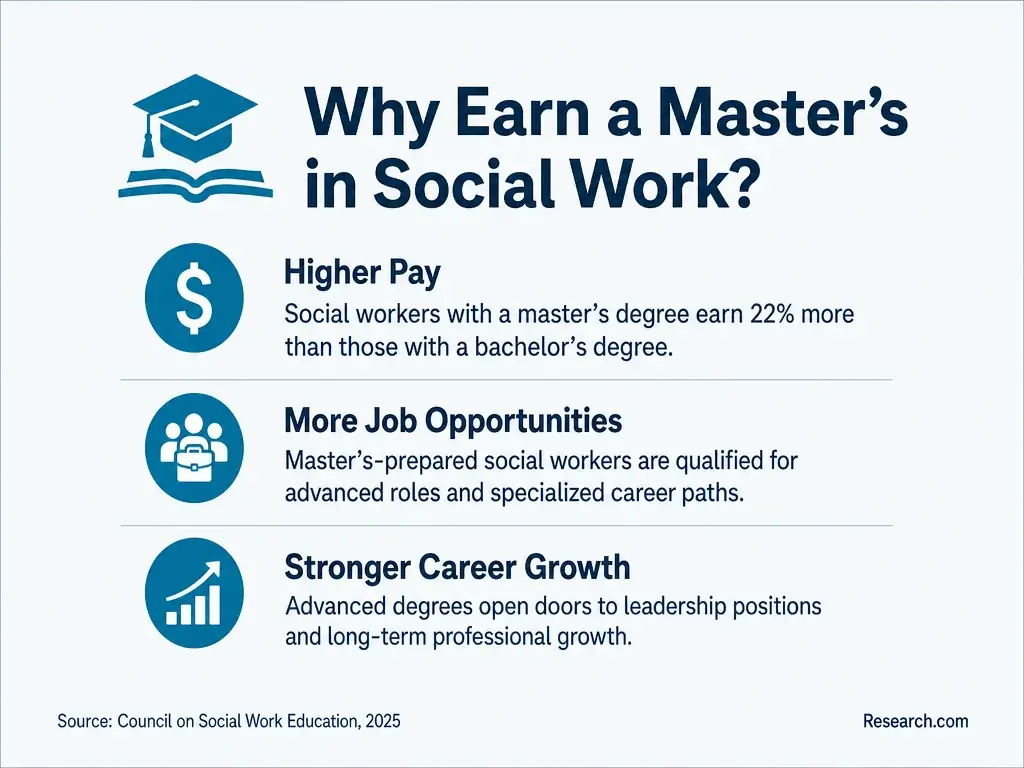
A BSW prepares students for generalist social work roles; an MSW supports more advanced practice preparation. Neither degree alone grants a license or independent clinical authority. Before applying for a job or program, compare its required credential with the state board's current rules and ask whether the planning duties include clinical assessment or treatment. Additional formal education may be unnecessary for a nonclinical coordination role if the employer accepts your present qualifications and appropriate training.
Pay also varies by occupation, setting, and location; it cannot be inferred from plan-writing duties. Social work master's salary geography offers context for career comparisons, not a promised wage for a particular service-planning position.
Other Things You Should Know About Social Work
Record the disagreement accurately, ask what outcome the client would prefer, and revise the plan where possible. Do not document agreement that was not given; consult a supervisor when safety or a mandated service creates constraints.
Often, but access and release procedures depend on the setting and applicable law. Explain the agency's process for requesting a copy or correcting information, and check whether any protected third-party material needs separate handling.
Follow the agency's transfer and consent procedures. A useful handoff identifies current goals, pending actions, and time-sensitive follow-up, but information should be shared only through authorized channels.
No. The plan states agreed goals and intended actions; case notes document contacts, actions taken, observations, and subsequent decisions. Notes can inform a plan update, but they do not replace a clear, current plan.
- Summary of the HIPAA Security Rule | hhs.gov https://www.hhs.gov/hipaa/for-professionals/security/laws-regulations/index.html
- NASW Standards for Social Work Case Management | nycourts.gov https://www.nycourts.gov/reporter/webdocs/nasw_standards_socialwork_casemgt.htm
- Shared decision-making as a method of care - PMC - NIH https://pmc.ncbi.nlm.nih.gov/articles/PMC10423463/
- Documenting Progress and Using Feedback | ku.edu https://ctb.ku.edu/en/best-change-processes/documenting-progress-and-using-feedback/overview
- Behavioral Health Services - Chapter 309 https://secure.sos.state.or.us/oard/displayDivisionRules.action
- NASW Standards for Social Work Case Management | socialworkers.org https://www.socialworkers.org/Practice/NASW-Practice-Standards-Guidelines/NASW-Standards-for-Social-Work-Case-Management
- NSCSW | Guidelines for Social Work Documentation https://nscsw.org/practice/swguidelinesdocumentation/