2027 Critical Consciousness in Social Work: Reflection, Dialogue, and Social Action
Audited and Verified:
Our Editorial and Data Verification Process
Research.com uses government datasets, official education statistics and primary institutional information to support its career and degree guides. Our review process checks factual accuracy, occupational definitions, source dates and the requirements associated with the credentials discussed.
How This Article Was Fact-Checked
Our editorial team verifies salary estimates, employment projections, education requirements and program information against original data providers and official organizations. Salary figures are checked against the relevant occupational definitions and reporting periods. Information about licensure, accreditation and required in-person training is reviewed separately.
Fact-checked and verified on:

Co-Founder and Chief Data Scientist
Critical consciousness asks social workers to examine how policies, institutions, and power affect the people they serve—and to consider what can change. For prospective students and early-career practitioners, the practical issue is whether a program teaches this approach as a usable skill rather than an abstract ideal.
This guide explains reflection, dialogue, and social action; shows how to assess their place in coursework and field education; and puts related degree, licensure, cost, and career decisions in context.
Key Things You Should Know
- Critical consciousness connects three activities: examining assumptions and structural conditions, learning through dialogue with affected people, and taking accountable action.
- Look for evidence of the approach in assignments, supervision, field learning agreements, and community partnerships; a program's stated values alone do not show how students practice it.
- A BSW or MSW can develop these skills, but neither graduation nor field education grants a license or independent clinical authority; requirements depend on the state and role.
What is critical consciousness in social work?
Critical consciousness is the practice of recognizing how social conditions—including racism, poverty, disability-related barriers, and institutional rules—shape individual experiences, then using that understanding to inform change. Associated with educator Paulo Freire's work, it is more than awareness of inequity: it joins reflection, dialogue, and action.
In social work, this complements person-in-environment thinking. A practitioner may assess a person's immediate needs while also asking whether transportation, benefit rules, housing policy, or an agency procedure limits their choices. Critical consciousness does not mean assuming every client interprets an experience the same way or substituting a worker's political priorities for a client's goals.
It is a practice orientation, not a separate license, clinical treatment, or universally named course. If this approach motivates you to consider exploring recognized online BSW education, examine actual coursework and field opportunities rather than relying on a program's mission statement.
How do reflection, dialogue, and social action shape social work practice?
The three elements form a cycle, not a checklist completed once. A worker's interpretation should change when clients, colleagues, or community members provide information the worker had missed.
In a hypothetical benefits-navigation setting, the cycle might look like this:
- Reflect: Notice an assumption that missed appointments signal low motivation; review whether office hours, transportation, language access, or paperwork create barriers.
- Dialogue: Ask service users what makes access difficult, listen without promising a particular outcome, and consult colleagues and supervisors about patterns.
- Act: With appropriate approval, propose clearer notices or appointment options, then assess whether the change improves access without creating new burdens.
Action can be modest and within a worker's role: improving a referral process, supporting a client-defined goal, or contributing to policy analysis. Client consent, confidentiality, agency authority, and applicable law still govern what a worker may share or change. The same cycle applies across many social work master's career options, although a clinician, community organizer, and policy analyst will act in different ways.
Which social work degrees teach critical consciousness?
BSW and MSW programs can develop critical consciousness through policy study, practice courses, research literacy, and field education. The comparison below shows where each route may fit; the presence and quality of specific learning activities vary by program:
| Route | Typical starting point | Most relevant learning opportunity |
| BSW | Undergraduate entry | Connect generalist work with individuals and communities to social policy and structural barriers. |
| Traditional or foundation MSW | Bachelor's degree in social work or another field, subject to program rules | Build foundational social work skills before specialized practice and field learning. |
| Advanced-standing MSW | Qualifying BSW, subject to program criteria | Extend prior generalist preparation into specialized practice without necessarily repeating the full foundation sequence. |
| DSW or PhD | Graduate preparation meeting program requirements | Investigate practice change, leadership, teaching, or research questions rather than obtain an initial social work qualification. |
A psychology, sociology, or human services bachelor's degree may support admission to a traditional MSW, but it does not ordinarily establish advanced-standing eligibility. When choosing between two MSW study pathways, confirm the school's BSW accreditation, recency, grade, and field criteria. If your goal is community advocacy rather than a role requiring a social work credential, targeted organizing or policy training may be more direct than another degree.
Critical consciousness is valuable across licensed and unlicensed roles, but it is not a licensing category. State boards determine license titles, qualifying education, examinations where required, supervised experience, and permitted activities. An MSW can be part of a clinical licensing pathway; it does not itself authorize independent psychotherapy.
Before enrolling for a regulated role, identify the state where you intend to practice and the exact license or job qualification you need. Compare the board's current educational rules with the program's degree and accreditation status, and ask how graduates document any required field or post-degree experience. BSW/MSW field education and post-degree clinical supervision are different requirements.
For remote study, review online social work master's programs and state board requirements alongside the board's own rules; online enrollment does not make a graduate eligible in every state.
Coursework supplies concepts and opportunities to test them: students might critique an eligibility policy, compare competing explanations for a service gap, or practice asking nonleading questions in a simulation. Field education tests whether they can listen, adapt, document appropriately, and work within real agency constraints. Neither a simulation nor a reflective essay proves competence with clients on its own.
A strong placement makes learning observable. Its approved learning agreement can connect a student's tasks to competencies; field instruction can challenge assumptions; and a faculty liaison can help address a mismatch between educational goals and available work. A student interested in housing access, for example, could examine a referral process using information the agency permits them to access, discuss findings in supervision, and propose a feasible change without disclosing client records.
Ask the field office what students actually do, who provides instruction, and whether placements permit community-informed or policy-focused work. Comparing online MSW field coordination models can help clarify who locates and approves sites. Paid employment or volunteering counts as field education only when the program approves the arrangement and its learning requirements.
Requirements vary by school and entry route. BSW applicants generally must meet university requirements and may face a separate application to the social work major. Traditional MSW programs consider applicants with bachelor's degrees in other disciplines; advanced-standing tracks generally require a qualifying BSW and may impose additional recency, grade, or field-performance standards.
Programs may request transcripts, a statement of purpose, references, and evidence of relevant service or academic preparation. Such experience can help an applicant explain an interest in structural issues, but it does not replace an approved field placement. If references are a barrier, have actual policies for social work master's reference requirements compared rather than assuming all MSW applications are alike.
In your statement, a specific example of revising an assumption after listening to others is more informative than claiming to be "passionate about justice." Check prerequisites and field-onboarding conditions separately; admission does not necessarily mean a particular placement is available.
What careers, salaries, and job prospects can social work graduates expect?
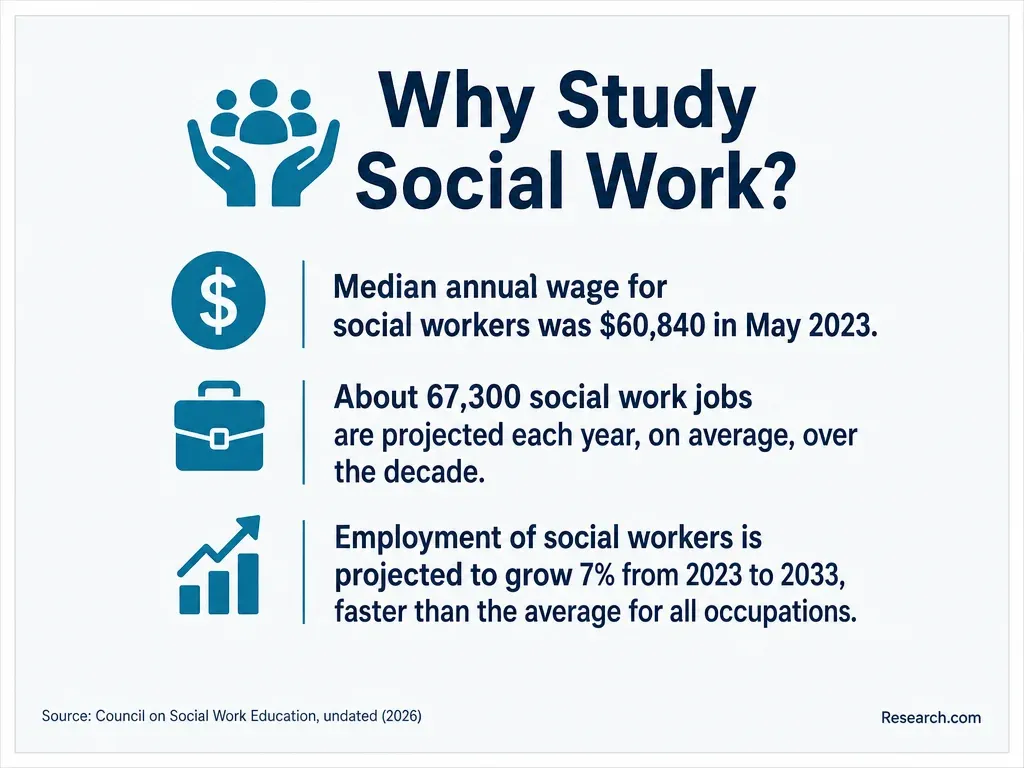
Critical consciousness is useful in case management, child and family services, healthcare, behavioral health, community organizing, and policy work. The job determines which qualification matters: some service-coordination roles accept other degrees, while clinical social work generally requires an MSW and state-specific licensure steps. A macro role may value organizing, evaluation, or policy experience more than clinical training.
U.S. Bureau of Labor Statistics figures below provide occupational context. They are not starting salaries or predicted outcomes for graduates of a particular program.
| BLS occupation | May 2025 median annual pay | Projected employment change, 2025-2035 |
| Social workers, all specialties | $61,780 | +6% |
| Child, family, and school social workers | $59,550 | +4% |
| Healthcare social workers | $67,880 | +8% |
| Mental health and substance abuse social workers | $60,280 | +10% |
The categories describe occupations, not BSW-versus-MSW pay or the value of a critical-consciousness course. Local funding, setting, experience, and license requirements can matter more to an individual offer; review social work salary differences across states when comparing locations. To judge career fit, read job postings for the work you want and ask potential employers about supervision, caseloads, opportunities for service improvement, and authority to act on community feedback.
Other Things You Should Know About Social Work
Use a de-identified reflection or an approved analysis of a public policy or service process. Follow the agency's and school's rules before including any work product in a portfolio.
No. It requires listening seriously, examining evidence and power differences, and explaining disagreements respectfully while honoring client rights and professional responsibilities.
Ask who wants to participate, compensate or support participation when feasible, clarify who makes decisions, and report differing perspectives rather than presenting one person's view as universal.
Document the barrier through approved channels, seek supervision, and consider smaller changes within the agency's authority. Do not promise clients a policy change that has not been approved.
- Transformative Consciousness of Health Inequities - PMC - NIH https://pmc.ncbi.nlm.nih.gov/articles/PMC6345409/
- Critical Consciousness and Wellbeing in Adolescents... - PMC https://pmc.ncbi.nlm.nih.gov/articles/PMC9101980/
- Critical Consciousness in Children and Adolescents | SFA ScholarWorks https://scholarworks.sfasu.edu/cgi/viewcontent.cgi
- Critical Consciousness | nyu.edu https://wp.nyu.edu/rise/understanding-critical-consciousness/
- Measurement (Part II) - Critical Consciousness | Cambridge Core https://www.cambridge.org/core/books/critical-consciousness/measurement/42ED8E6D97F4CBD91C41D5DEA4704831