2027 Cost-Benefit Analysis in Social Work Research: Valuing Program Costs and Benefits
Audited and Verified:
Our Editorial and Data Verification Process
Research.com uses government datasets, official education statistics and primary institutional information to support its career and degree guides. Our review process checks factual accuracy, occupational definitions, source dates and the requirements associated with the credentials discussed.
How This Article Was Fact-Checked
Our editorial team verifies salary estimates, employment projections, education requirements and program information against original data providers and official organizations. Salary figures are checked against the relevant occupational definitions and reporting periods. Information about licensure, accreditation and required in-person training is reviewed separately.
Fact-checked and verified on:

Co-Founder and Chief Data Scientist
A social service program can improve lives and still be difficult to fund if its costs and benefits are unclear. Cost-benefit analysis helps researchers and agencies compare what a program uses with the outcomes it creates, expressed in dollars where credible.
For social work students, evaluators, and nonprofit or public-sector professionals, the challenge is not simply calculating a ratio: it is establishing what would have happened without the program and whose outcomes count. This guide explains the methods, their limits, and how to use findings without reducing client well-being to a dollar figure.
Key Things You Should Know
- Cost-benefit analysis compares incremental costs and benefits against a defined alternative; it should not credit a program with every improvement participants experience.
- Net benefits equal monetized benefits minus costs; the benefit-cost ratio equals benefits divided by costs. In a hypothetical analysis, $260,000 in benefits and $200,000 in costs produce $60,000 in net benefits and a 1.30 ratio.
- Report outcomes that cannot be valued credibly, test uncertain assumptions, and show who bears costs and who receives benefits; a positive ratio alone is not an equity judgment.
What is cost-benefit analysis in social work research?
Cost-benefit analysis, or CBA, is an economic evaluation that compares a program's costs with the monetary value of its effects over a specified period. In social work, it might assess whether an eviction-prevention service produces benefits through greater housing stability and reduced shelter use than a realistic alternative, such as existing referral services.
The unit of analysis matters. An agency perspective considers its own spending and savings; a public-sector perspective may include several government budgets; a societal perspective also considers effects on participants, families, and others. A program can save one agency money while shifting costs to another. State the perspective, comparison, population, and time horizon before collecting figures.
CBA evaluates a service, not the financial return on an individual's education. Readers considering whether to study this method can use social work degree planning for prospective students to examine educational routes separately from an agency's program evaluation.
What costs are included in a social work program analysis?
Count resources needed to deliver the program beyond what the alternative would require. The table separates costs that may fall on different parties, which is particularly important when a service appears inexpensive only because clients or partner agencies absorb part of the work.
| Cost category | Possible measures | Common omission |
| Agency delivery | Staff time, benefits, training, supervision, space, software, and administration | Shared overhead or unpaid startup work |
| Partner services | Referral processing, contracted care, transportation, or interpretation | Costs paid by another organization |
| Participant and family time | Travel, childcare, and time away from paid work | Assuming a free service has no participation cost |
| Implementation and evaluation | System setup, data collection, quality checks, and analysis | Treating a pilot's startup costs as recurring annual costs |
Use actual budgets, payroll records, and service volumes where authorized. Allocate shared costs with a documented rule and distinguish one-time startup costs from ongoing delivery. A payment that merely moves money between parties, such as a cash benefit, needs different treatment from the administrative resources used to deliver it; whether to count it depends on the stated perspective and accounting framework.
For a student evaluating the cost of learning these skills, tuition is a separate decision from the cost of delivering a client program. A comparison of lower-cost online social work master's programs can help with that educational budget, but its tuition figures do not belong in an agency CBA unless students' work is an actual program resource.
How are social work program benefits measured and valued?
Begin with outcomes the program plausibly changes, not with dollars. A housing program might track stable housing, shelter nights, employment, and client-reported well-being. Specify how each outcome is measured, for whom, and over what period. Then monetize only effects with a defensible value, such as avoided shelter expenditures or additional earnings attributable to the program.
The following distinctions help prevent a persuasive-looking total from overstating benefits.
- Measured outcome: A participant used fewer shelter nights than a comparable participant receiving usual services.
- Monetized benefit: The attributable reduction in nights multiplied by a documented cost per night, adjusted if some shelter costs are fixed and cannot actually be avoided.
- Unmonetized benefit: Greater perceived safety or autonomy, reported alongside the monetary results when no credible dollar valuation is available.
Avoid counting the same effect twice. For example, additional earnings and the wages paid by an employer are not two separate benefits. If citing savings from reduced emergency care, verify both the change in use and the cost concept used; a billed charge is not necessarily a resource saving. Protect confidentiality when linking service records across systems, and obtain required agency permissions and research or evaluation oversight before accessing data.
The professional opportunities created by evaluation training are also distinct from client outcomes in a CBA. A guide to professional pathways after an MSW addresses that career question without treating an evaluator's future earnings as a benefit of the service being studied.
The key question is what participants would have experienced without this program. A before-and-after change alone cannot answer it: housing, health, and income may change because of policy, local conditions, or other services. Define a feasible comparator, such as usual care, another intervention, or no additional service, and estimate differences in outcomes and costs between the options.
A randomized comparison can strengthen causal claims when assignment is ethical and feasible. Otherwise, researchers may compare similar eligible clients, use a phased rollout, or examine outcomes before and after a policy change against a credible comparison group. Each design requires scrutiny: clients who enroll may differ from those who do not, agencies may serve different populations, and incomplete follow-up may distort results.
For a student-led evaluation, design strength also depends on access. Agree with the agency on eligible records, data quality, permissions, and a fallback plan before promising an impact estimate. If a project depends on field-site collaboration, a guide to school-supported MSW placements can inform questions about placement support; placement access itself does not authorize research use of client records.
First total the incremental monetized benefits and costs relative to the chosen alternative, using the same population, perspective, and time horizon. Then calculate net benefits = benefits − costs and benefit-cost ratio = benefits ÷ costs. The illustration below is hypothetical, not a finding about an actual social work program.
| Hypothetical result compared with usual services | Amount | Interpretation |
| Incremental monetized benefits | $260,000 | Estimated value of attributable effects |
| Incremental costs | $200,000 | Additional resources used |
| Net benefits | $60,000 | Benefits exceed costs under these assumptions |
| Benefit-cost ratio | 1.30 | $1.30 in valued benefits per $1 in additional costs |
A ratio above 1 indicates that measured, monetized benefits exceed costs under the model's assumptions. It does not prove the program should be funded: estimates may be uncertain, important effects may remain unpriced, and a small program with a high ratio may deliver fewer total benefits than a larger alternative. Compare net benefits as well as ratios, and show the underlying amounts.
Do not confuse this service-level calculation with a prospective student's return on education. For example, faster graduate social work study routes may change an individual's tuition and foregone earnings, but their advertised pace says nothing by itself about a client program's benefit-cost ratio.

Cost-benefit analysis expresses both costs and benefits in money, making it possible to compare programs with different kinds of outcomes - but requiring defensible valuations. Cost-effectiveness analysis compares costs with an outcome in its natural unit, such as cost per additional household stably housed. It can be more appropriate when the main outcome is clear but monetizing it would be speculative.
Cost-effectiveness results are most informative when options pursue the same outcome and use comparable definitions and follow-up periods. Neither method removes the need to establish causal impact, examine harms, or consider whose outcomes matter. An agency might report both: cost per additional household housed, plus a CBA limited to benefits it can value credibly.
Students comparing accredited BSW coursework and placement comparisons can look for research-literacy and evaluation opportunities. A course title alone does not establish that a program teaches both economic methods or provides access to an evaluation project.
Discounting converts future costs and benefits into present values so amounts occurring in different years can be compared. State the time horizon, price year, and discount rate, and explain why they fit the decision. A prevention program with substantial future benefits may look less favorable if the analysis ends too soon or applies a higher discount rate.
Uncertainty deserves more than a single optimistic figure. Recalculate results using plausible alternatives for impact size, service cost, participation, and the value of major benefits. Identify which assumption can reverse the conclusion. Where data permit, report uncertainty around estimated impacts rather than treating a point estimate as certain.
Equity asks who pays, who benefits, and which effects a monetary total misses. Savings to government may accrue later or in another budget, while participants face immediate travel costs. Present results by relevant populations when ethically and statistically feasible, and describe effects on access, autonomy, and trust without claiming those experiences have been fully priced.
Similar time-horizon questions arise in personal education decisions, though they require a separate analysis. Someone weighing practice-focused doctoral study can compare financing and continuation costs through comparing affordable social work practice doctorates; a low advertised tuition figure does not replace a full multiyear cost estimate.
What careers use cost-benefit analysis in social work, and what do they pay?
Program evaluators, policy analysts, research staff, nonprofit managers, and public-agency budget or planning teams may use CBA to assess service options. Direct-service social workers may contribute outcome measures and practice context without conducting the economic analysis themselves. Employers differ: some evaluation positions accept strong research or public-policy preparation without a social work license, while roles combining evaluation with regulated practice may have separate degree and licensing requirements.
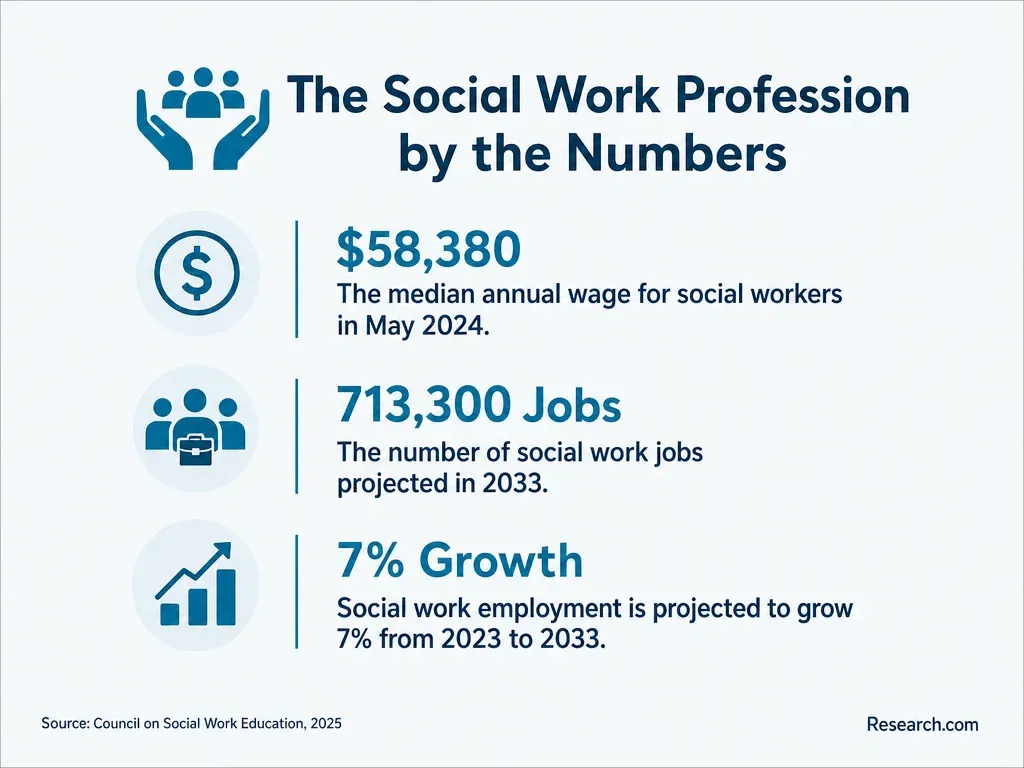
The U.S. Bureau of Labor Statistics reports a May 2025 median annual wage of $61,780 for social workers overall and projects 6% employment growth from 2025 to 2035. Those occupation-wide figures are context for social work employment, not pay or growth estimates for program evaluators: evaluation jobs can fall under different occupational classifications. For social work-specific geographic context, consult a state-level social work pay comparison guide, then check local postings for the actual analyst or evaluator duties, qualifications, and salary range.
To prepare for this work, build evidence that you can define a comparison, work with ethically accessible data, document cost assumptions, test uncertainty, and explain limits to nontechnical stakeholders. An anonymized, approved class project can demonstrate those skills; do not share identifiable client records or agency-confidential findings in a portfolio.
Other Things You Should Know About Social Work
No universal rule applies. The purpose, design, data, institution, and plans to disseminate findings affect oversight requirements. Ask the agency and relevant research office or IRB for a determination before accessing records; do not decide independently that a project is exempt.
Only with appropriate authorization and safeguards under applicable law, agency policy, and school requirements. A de-identified or aggregate dataset may be more feasible, but de-identification also needs proper review.
Report the comparison, costs, outcome estimates, uncertainty, and limitations plainly. Separate "no demonstrated benefit" from evidence that the service causes harm, and explain what the findings can inform about redesign or further evaluation.
Start with a transparent spreadsheet that records each cost, outcome, source, assumption, and calculation. Reliable documentation and sensitivity checks matter more initially than specialized software.
- A Useful Way to Establish the Counterfactual in Clinical Trials? | nih.gov https://pmc.ncbi.nlm.nih.gov/articles/PMC5114686/
- 3A.9 Uncertainty analysis: model inputs and assumptions | pbs.gov.au https://pbac.pbs.gov.au/section-3a/3a-9-uncertainty-analysis-model-inputs-and-assumptions.html
- A Benefit-Cost Analysis Model for Social Service Agencies | ScholarWorks at UMass Boston https://scholarworks.umb.edu/ici_pubs/8/
- Benefit-Cost Analysis and Distributional Weights: An Overview | duke.edu https://scholarship.law.duke.edu/faculty_scholarship/3110/
- Benefit-Cost Analysis (Chapter 3) - Theory and Practice in Policy Analysis | Cambridge Core https://www.cambridge.org/core/books/theory-and-practice-in-policy-analysis/benefitcost-analysis/A24C4D91AA25EEF1285C78A896536A9A
- Chapter 4: Standing and Perspective in CBA - Social Cost Benefit Analysis and Economic Evaluation https://uq.pressbooks.pub/socialcba/chapter/standing-perspective-and-cba/