2027 School Attendance Teams: Social Work Contributions and Role Boundaries
Audited and Verified:
Our Editorial and Data Verification Process
Research.com uses government datasets, official education statistics and primary institutional information to support its career and degree guides. Our review process checks factual accuracy, occupational definitions, source dates and the requirements associated with the credentials discussed.
How This Article Was Fact-Checked
Our editorial team verifies salary estimates, employment projections, education requirements and program information against original data providers and official organizations. Salary figures are checked against the relevant occupational definitions and reporting periods. Information about licensure, accreditation and required in-person training is reviewed separately.
Fact-checked and verified on:

Co-Founder and Chief Data Scientist
When a student misses school repeatedly, an attendance team needs more than an absence count. It needs to understand what is keeping the student away, which supports the family wants, and who is responsible for each response. This guide is for school and human services professionals, social work students, and prospective school social workers. It explains the social worker's contribution, the boundaries that protect students and families, and the education and credentials to check before pursuing the role.
Key Things You Should Know
- Chronic absenteeism commonly means missing at least 10% of enrolled school days, whether absences are excused or unexcused; attendance teams should investigate patterns rather than assume a cause.
- School social workers assess family and systems barriers, coordinate support, and advocate for access. They do not independently set attendance policy, diagnose every absent student, or replace administrators, nurses, counselors, and teachers.
- Requirements for a school social work job vary by state and district. Check the required degree, school credential, and any social work license before choosing a program or placement.
What is a school attendance team, and how does it address chronic absenteeism?
A school attendance team is a group of staff who review absence patterns, contact students and families, coordinate responses, and check whether those responses help. Membership varies, but may include an administrator, attendance clerk, teacher, counselor, nurse, school social worker, and family liaison. A team may also consult special education staff or community partners when appropriate.
Chronic absenteeism generally refers to missing at least 10% of enrolled school days for any reason. The measure helps identify students who may need support; it does not explain why they are absent. A student missing school because of asthma, an unsafe route, caregiving demands, or school avoidance may appear in the same attendance report but need a different response.
Effective teams distinguish identification from intervention. They review reliable attendance records, ask the student and family about barriers, assign a responsible staff member for each agreed action, and revisit the plan.
District policy determines how this support process connects to formal attendance notices or truancy procedures. For readers considering the profession, MSW careers across different practice settings offer a useful comparison: school attendance work is collaborative, school-based practice rather than a stand-alone clinical caseload.
What do school social workers contribute to attendance teams?
School social workers bring a person-in-environment perspective: they consider the student's experience alongside family circumstances, school climate, disability-related access, housing, transportation, and available community services. Their contribution is not to label every absence a family problem. It is to help the team test its assumptions and develop a response the student and family can realistically use.
Depending on the position, qualifications, and district policy, a social worker may engage a family that has not responded to routine outreach; assess service-access barriers; help coordinate housing, food, health, or transportation referrals; support a student's return after a disruption; and track whether agreed supports coincide with improved attendance.
They can also identify recurring barriers across cases and recommend a schoolwide change, such as a clearer referral process.
These tasks require relationship-building, documentation, and judgment developed through supervised practice, not simply a particular degree title. Applicants comparing online MSW entry requirements should also examine whether a program offers school-relevant field learning and preparation for the credential their intended state requires.

How do social workers' attendance responsibilities differ from those of other team members?
The most useful boundary is ownership of the task, not ownership of the student. A social worker can coordinate a response without taking over decisions assigned to another professional. This comparison shows where responsibilities commonly sit; local job descriptions and policies control the final division.
| Team member | Typical attendance contribution | Important boundary |
| Attendance clerk or data staff | Maintain records, flag patterns, and correct coding errors | Do not infer a clinical or family cause from the record alone |
| Teacher | Notice classroom patterns and help plan academic reentry | Do not expect disclosure of private family or treatment details |
| Administrator | Apply district attendance policy and oversee formal decisions | Should not treat a support referral as proof that a family is noncompliant |
| Nurse or health staff | Address school health needs under their professional role | Medical assessment and health-plan decisions are not the social worker's substitute duties |
| Counselor or psychologist | Provide services within the position's qualifications and assignment | Clinical and educational evaluations follow their own authorization processes |
| School social worker | Assess social and environmental barriers, engage families, and coordinate supports | Cannot independently change attendance codes, order services, or practice beyond their credential and scope |
School-based support and independent clinical practice are also different. An MSW placement or school job does not automatically count toward a clinical license; the applicable board decides which supervision, activities, and records qualify. Readers pursuing both paths can use a guide to planning records for social work clinical hours before accepting an arrangement on that assumption.
Attendance teams need enough information to act, not unrestricted access to a student's personal history. A social worker might tell the team that a family needs a transportation contact and an agreed check-in, without sharing unrelated details learned in a private conversation. Staff should use approved records systems, document the purpose of a disclosure, and follow district rules for access and retention.
Student education records maintained by a school are generally governed by the Family Educational Rights and Privacy Act (FERPA); records held by an outside healthcare provider may be subject to different rules, including the Health Insurance Portability and Accountability Act (HIPAA).
Consent, parent and eligible-student rights, exceptions, and mandatory reporting obligations depend on the record, setting, and applicable law. A social worker should check district policy and consult the appropriate privacy or legal authority rather than assume that team membership permits sharing everything.
For an aspiring school social worker, privacy training should be part of evaluating a program, not an afterthought once fieldwork begins. Broader social work program comparisons for future students can help frame questions about supervised documentation, school placements, and instruction in interprofessional ethics.
What are the salary and job outlook for school social workers?
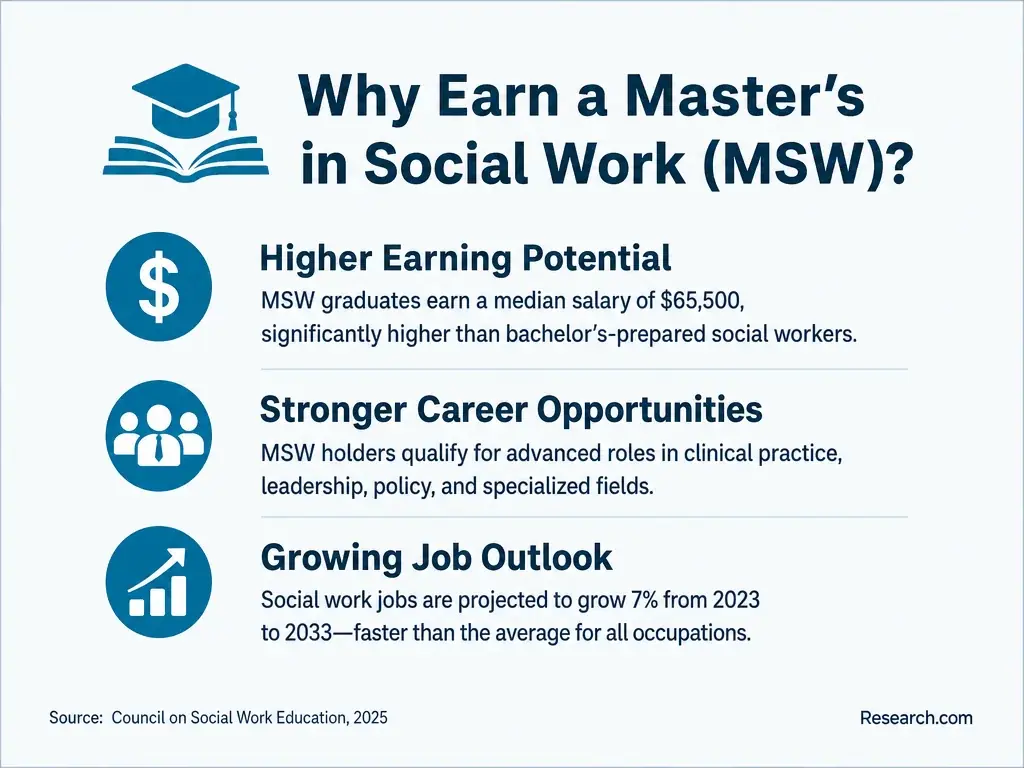
The closest broad federal occupation is child, family, and school social workers. The U.S. Bureau of Labor Statistics reports a May 2025 median annual wage of $59,550 for that combined occupation and projects 4% employment growth from 2025 to 2035. The figures include workers beyond schools; they are not a school-district offer or a predicted salary for an MSW graduate.
For a realistic comparison, look up district salary schedules and check whether the position is paid on a school-year or year-round basis. Experience credit, union agreements, location, credential requirements, and contract length can matter more to an individual offer than the national median. A guide to understanding location differences in MSW earnings provides context, but compare actual school postings and benefits before committing to education costs.
Other Things You Should Know About Social Work
Usually, attendance coding follows district policy and is handled by designated staff. A social worker can help a family understand documentation requirements or raise a possible error, but should not promise to change a code.
No. A team should choose a contact method based on the family's circumstances, consent, staff safety, and district policy. A home visit is not a default response to missed school.
Bring the concern to the staff responsible for the student's applicable support-plan process. The attendance team can coordinate communication, but it should not change an individualized education program or Section 504 plan informally.
Use district criteria and the agreed review plan. Improved attendance matters, but the team should also confirm that supports are in place and the student and family know whom to contact if a barrier returns.
- Role of School Social Worker | NC DPI https://www.dpi.nc.gov/educators/specialized-instructional-support/school-social-work/role-school-social-worker
- FERPA | Protecting Student Privacy - Department of Education https://studentprivacy.ed.gov/ferpa
- Chronic Absenteeism | IES - Institute of Education Sciences https://ies.ed.gov/use-work/supporting-recovery-with-evidence-based-practices/chronic-absenteeism
- Compulsory School Attendance Unlawful Absences and School Attendance Improvement Conferences | pa.gov https://www.pa.gov/agencies/education/resources/policies-acts-and-laws/basic-education-circulars-becs/purdons-statutes/compulsory-school-attendance-unlawful-absences-and-school-attendance-improvement-conferences
- Ohio's Attendance Guide https://education.ohio.gov/getattachment/Topics/Student-Supports/Attendance-Support/Ohio-s-Attendance-Guide.pdf.aspx
- Housing Instability - Healthy People 2030 | odphp.health.gov https://odphp.health.gov/healthypeople/priority-areas/social-determinants-health/literature-summaries/housing-instability
- What can schools do to improve attendance | CT.gov https://portal.ct.gov/sde/publications/reducing-chronic-absence-in-connecticuts-schools/what-can-schools-do-to-improve-attendance
- Disability Barriers to Inclusion | cdc.gov https://www.cdc.gov/disability-inclusion/barriers/index.html
- Strategy 3: Review Available Resources | attendanceworks.org https://www.attendanceworks.org/resources/toolkits/teaching-attendance-2-0/use-data-for-intervention-and-support/strategy-3-review-available-resources/
- Attendance, Chronic Absenteeism, & Truancy | ospi.k12.wa.us https://ospi.k12.wa.us/student-success/support-programs/attendance-chronic-absenteeism-truancy