# 1 position
Best Welding Training Programs & Trade Schools in Washington for 2027
Audited and Verified:
Our Editorial and Data Verification Process
Research.com uses government datasets, official education statistics and primary institutional information to support its career and degree guides. Our review process checks factual accuracy, occupational definitions, source dates and the requirements associated with the credentials discussed.
How This Article Was Fact-Checked
Our editorial team verifies salary estimates, employment projections, education requirements and program information against original data providers and official organizations. Salary figures are checked against the relevant occupational definitions and reporting periods. Information about licensure, accreditation and required in-person training is reviewed separately.
Fact-checked and verified on:

Co-Founder and Chief Data Scientist

Reviewed by Karolina Broda
Fact-Checker and Data Verification
Choosing welding training means comparing shop time, total cost, and the kind of work you want to do - not just school names. The U.S. Bureau of Labor Statistics reports a May 2025 national median wage of $53,750 for welders, cutters, solderers, and brazers, but that is not a starting-pay promise. This guide explains Washington training routes, credentials, costs, and career prospects. It also accompanies the Best Welder Trade Schools in Washington for 2027 ranking, created by the Research.com team of data scientists to help students identify programs worth considering.
Key findings about welder degrees in Washington
- Choose by intended job: a short welding certificate may suit entry-level fabrication, while structural, pipe, or shipyard work calls for practice and qualification tests matched to the employer's welding code.
- The May 2025 U.S. median wage for welders, cutters, solderers, and brazers was $53,750; it describes experienced and new workers together, not expected pay immediately after training (U.S. Bureau of Labor Statistics).
- National employment for that occupation is projected to grow 2.4% from 2025 to 2035. Compare openings in your commuting area and paid apprenticeship options before committing to tuition or debt (U.S. Bureau of Labor Statistics).
Table of Contents
- Best Welding Training Programs & Trade Schools in Washington for 2027
- What can I expect from a welder trade school program in Washington?
- Where can I work with a welder trade school training in Washington?
What can I expect from a welder trade school program in Washington?
Expect welding training to revolve around supervised shop work. Students typically learn to prepare joints, set up equipment, make welds in different positions, inspect their work, and follow safety procedures. A program's value depends less on the word "welding" on its credential than on which processes, materials, and positions students actually practice.
Washington options include public college certificates and associate degrees, private career-school training, and registered apprenticeships that combine employment with instruction. For example, a prospective student might compare offerings at Green River College, Clover Park Technical College, Skagit Valley College, Everett Community College, and Perry Technical Institute - but should verify each provider's current curriculum, schedule, and credential before applying. Washington Labor & Industries oversees registered apprenticeships; school enrollment by itself is not apprenticeship registration (Washington Labor & Industries).
A short program may fit someone seeking an entry-level fabrication job quickly. A broader program can make sense when it adds substantial shop practice, blueprint interpretation, or related manufacturing skills. An apprenticeship may be a better fit if you can secure a position and want wages while learning, although entry depends on sponsor selection and work availability. Unlike best accelerated bachelor's degree online options, welding preparation cannot be accelerated by removing supervised hands-on practice.
Where can I work with a welder trade school training in Washington?
Washington welding skills can lead to work in fabrication shops, construction, equipment manufacturing and repair, and marine-related industries. The work setting determines the useful training: a production shop may emphasize repeatable wire-feed welds, while a structural contractor may require work in demanding positions under specified procedures. Shipyard or field jobs can add travel, access, and worksite-safety demands (U.S. Bureau of Labor Statistics; O*NET).
Before enrolling, search current job postings within a realistic commute and record the processes, codes, shifts, and experience employers request. A program near home may be less useful if its shop practice does not match local openings; conversely, a broader skill set may support mobility between Washington's manufacturing and construction markets. Comparisons with easiest phds do not answer that local, hands-on hiring question.
The U.S. median annual wage for welders, cutters, solderers, and brazers was $53,750 in May 2025 (U.S. Bureau of Labor Statistics). That occupational median is a benchmark, not a Washington wage figure or an entry-level offer. Pay can differ with experience, employer, location, shift, overtime, and the type of welding required.
For a Washington-specific decision, compare the latest occupational wage estimates from the Washington Employment Security Department with actual offers in the area where you intend to work. Ask employers whether posted pay assumes prior code qualifications, travel, or overtime. Treat a school's advertised graduate earnings cautiously unless it identifies the graduating cohort, measurement period, and number of graduates represented.
There is no single required Washington trade-school duration for becoming a welder. Certificate schedules, associate-degree programs, and apprenticeships differ substantially, and course credits are not interchangeable with hours spent welding. Ask each provider for its current calendar length, scheduled shop hours, and opportunities to repeat welds after an unsuccessful test.
A shorter route can reduce time away from paid work, but speed has little value if it omits the process or position an employer tests. Apprenticeship generally takes longer than a short school program because training is integrated with paid work and related instruction; verify the particular sponsor's term and entry conditions with Washington Labor & Industries. Lists of fast paced master's degree programs measure a different kind of speed and cannot substitute for a welding practice schedule.
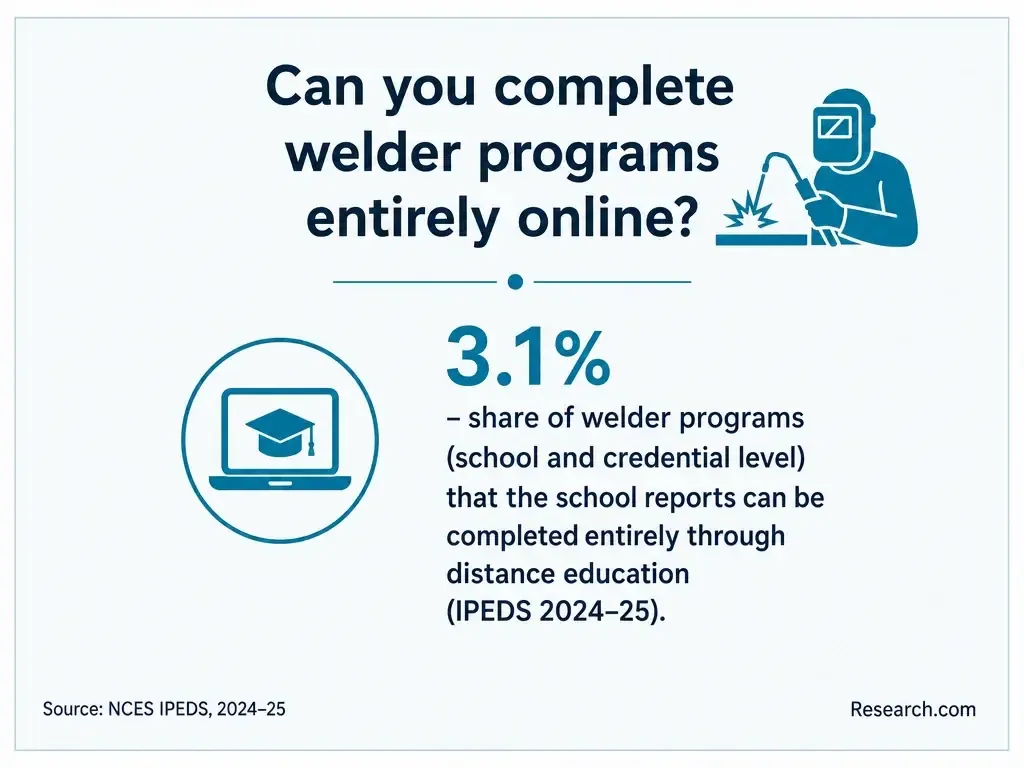
Online instruction can cover welding theory, print reading, terminology, and some safety concepts. It cannot establish that a student can control a weld puddle, position a torch, or produce an acceptable test weld. A credible hybrid option therefore identifies where students use equipment, who supervises them, and how practical skills are assessed.
For most beginners, an accessible in-person shop is more important than remote convenience. If travel is difficult, ask whether required labs meet in blocks and calculate transportation and lodging costs before choosing a hybrid schedule. Even a provider listed among best non profit accredited universities would not make a welding course job-ready without the relevant practical training and employer-required testing.
There is no dependable single statewide price for welding training: schools differ in program length, residency-based tuition, fees, and what equipment they supply. Request a written, program-specific cost of attendance rather than comparing advertised tuition alone. The table shows expenses to check and why they change the decision; it does not assume every provider charges each item.
| Cost component | What to verify | Decision impact |
| Tuition and mandatory fees | Full program price, residency rules, and fees by term | A low first-term quote may hide later charges. |
| Tools, PPE, and materials | Required purchases, supplied equipment, and consumables | Included shop supplies can change the apparent price comparison. |
| Testing and travel | Whether qualification tests are included and where labs or worksites meet | Repeat tests and long commutes add out-of-pocket cost. |
| Time and financing | Work hours forgone, aid eligibility, expected borrowing, and paid-training options | A longer or cheaper program is not necessarily the lower-cost route overall. |
Eligible Washington students can investigate the Washington College Grant through the Washington Student Achievement Council, alongside federal aid where the institution and program qualify. Apprenticeship wages or employer-paid instruction may offset costs, but are not assured. Before taking on debt, compare likely post-training earnings against your current earnings over a realistic time horizon, allowing for completion risk and the time value of money. A list of high paying trade school jobs can provide career context, but it cannot establish the return on a particular welding program.
The award depends on the pathway. A college or career school may award a certificate or, for an eligible academic program, an associate degree. A registered apprenticeship leads to its sponsor's recognized completion credential after the required training. An employer may instead train and assess a worker without awarding a school credential. Confirm the exact award in writing (institution or sponsor; Washington Labor & Industries).
A school credential is not the same as a welding performance qualification. Employers or testing facilities may require a test for a specific process, material, position, and code. Ask whether the program includes such testing, which standard it uses, who issues the record, and whether an employer will accept it. Prior shop learning may qualify for placement or credit at some providers, but request their policy rather than assuming advanced standing.
Entry requirements vary by provider and route. A school may use an application, placement process, or safety orientation; a registered apprenticeship may also require a sponsor application and selection process. Confirm age, education, physical-task, and work-authorization requirements with the specific school or sponsor rather than treating one provider's rules as statewide rules.
Ask admissions staff when shop access begins, whether evening or part-time students receive the same equipment time, and whether any prerequisite delays completion. For an apprenticeship, ask the sponsor about selection dates, required documents, jobsite travel, and whether you must secure employment first. Those answers matter more than an advertised start date if you need to keep working while training.
Core instruction commonly covers measurement, drawings and weld symbols, joint preparation, safe equipment setup, and inspection of finished welds. Programs may teach shielded metal arc welding, gas metal arc welding, flux-cored arc welding, or gas tungsten arc welding, but their depth varies. Practice on the material and welding positions relevant to your target employer is the key comparison (O*NET; American Welding Society).
Look for repeated, supervised practice - not just demonstrations. Ask to see the current course outline and shop schedule, then ask how instructors document progress and help students correct defects. Automation and robotic welding can change production-shop tasks, but employers still need workers who can set up procedures, inspect results, and troubleshoot equipment; choose automation training only if it supports the jobs you are targeting (U.S. Bureau of Labor Statistics; O*NET).
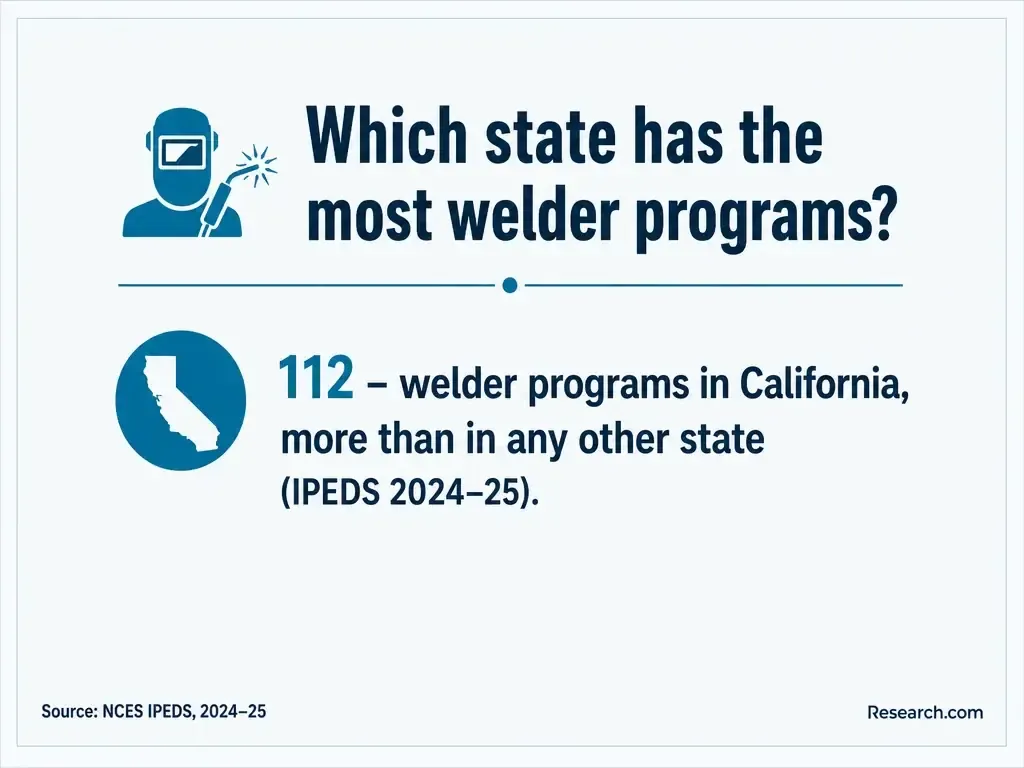
Washington does not impose a general statewide occupational welder license simply to perform ordinary welding work. That does not mean every job is open to anyone who has completed a class: an employer or project may require a documented performance qualification under a specified welding code. Check the actual job and project requirements before paying for a test (Washington Department of Licensing; American Welding Society).
Keep the distinctions clear. Institutional accreditation concerns the school; state authorization concerns permission to operate; apprenticeship registration concerns the training sponsor; and an American Welding Society or other performance credential documents a particular assessment. None automatically replaces an employer's required test or confers a general Washington welding license. Ask who conducts testing, what code applies, and whether retesting or continued work is needed to maintain acceptance.
The best choice is the route that gets you competent and employable for your intended work at a manageable total cost. Compare programs using the same questions, and treat the ranking as a shortlist rather than a substitute for inspecting a shop or speaking with employers.
These checks address the most consequential gaps between a program's description and the training you would receive:
- Identify local target jobs and note the welding processes, materials, positions, and tests they require.
- Request each provider's credential, calendar, shop hours, equipment access, and practical-assessment rules.
- Verify institutional accreditation, applicable school authorization, and any claimed industry recognition separately; ask employers whether they value the specific credential.
- Compare the complete cost, available aid or wages, likely debt, completion support, and realistic work schedule.
- Ask for documented completion and employment outcomes with cohort dates, then tour the shop or speak with recent participants where possible.
Red flags include a promise of guaranteed employment, a claim that online theory alone makes you qualified to weld, or a quoted price that excludes required equipment and tests. Neither public nor private status - and neither nonprofit status alone - settles value. For welding, even comparisons to easiest phds would miss the decisive questions of shop competence, testing, and local employer demand.
Many entrants start in production welding, fabrication, or welding-assistant work and build speed and consistency under supervision. With experience and the right tests, they may move into structural or pipe work, specialized repair, setup, supervision, or inspection-related roles. Requirements for those later roles differ; an entry certificate does not automatically qualify someone to inspect welds or direct a crew (U.S. Bureau of Labor Statistics; American Welding Society).
Choose initial training with room to progress, but do not pay for an advanced specialization you cannot yet use. Ask local employers which qualifications they sponsor after hiring and which skills they expect on day one. That distinction helps you decide whether a broader school program, a focused certificate, or paid work-based training offers the better first step.
National employment of welders, cutters, solderers, and brazers is projected to grow 2.4% from 2025 to 2035 (U.S. Bureau of Labor Statistics, Employment Projections). This is modest growth, not a forecast for a particular Washington county or a guarantee of vacancies at graduation.
Use Washington Employment Security Department occupational projections and current job postings to check where demand matches your intended specialty. Construction projects, manufacturing workloads, and employer testing practices can differ locally. If nearby openings ask for experience you do not yet have, prioritize programs with employer connections, apprenticeships, or a realistic route into entry-level shop work rather than assuming a certificate alone will close that gap.
Best Welding Training Programs & Trade Schools in Washington for 2027
Investing in welding training is a consequential decision. Research.com designed its ranking to help readers compare programs with other programs in the same occupation and location, using reported outcomes, costs, and indicators of quality rather than school names alone. The team reviews data for credibility and accuracy, but readers should still confirm current program details directly with providers.
Only programs with completions reported to IPEDS are included. The best-program ranking considers student outcomes; earnings and return on investment; costs and debt; and quality and recognition. Programmatic accreditation or occupation-relevant industry recognition accounts for 20% of the score, institutional accreditation for 10%, and student support for 10%. The remaining 60% covers outcomes, earnings, and costs, with weights distributed using an entropy-based method that gives more weight to indicators that vary more across programs. The separate most-affordable ranking scores only tuition, attendance cost, debt, and federal loan default rates, also using entropy-based weights; it does not include accreditation or other quality indicators.
The ranking draws on the following databases and organizations. Some sources cover multiple trades rather than welding specifically; their inclusion does not mean that a healthcare accreditor or credentialing body approves a welding program.
- IPEDS database - reported program completions and institutional measures.
- National Center for Education Statistics - federal education data and definitions.
- College Scorecard database - available cost, debt, and earnings measures.
- Peterson's database - supplemental institution and program information.
- Commission on Accreditation of Allied Health Education Programs (CAAHEP) - accreditation information relevant to applicable health programs.
- Accrediting Bureau of Health Education Schools (ABHES) - accreditation information relevant to applicable health programs.
- Commission on Dental Accreditation (CODA) - accreditation information relevant to applicable dental programs.
- Dental Assisting National Board (DANB) - credential information relevant to dental assisting.
- National Center for Construction Education and Research (NCCER) - applicable construction-training recognition.
- Apprenticeship.gov Partner Finder - information on apprenticeship connections.
IPEDS-based rankings cannot capture every union program, registered apprenticeship, or employer training route. Use the ranking to narrow your options, then compare actual welding processes, supervised practice, employer connections, and out-of-pocket costs. More detail about the approach appears on the Research.com methodology page.
# 2 position

# 3 position
Green River College - Welding Technology/Welder.
certificate or diploma # 4 position
# 5 position
Clover Park Technical College - Welding Technology/Welder.
certificate or diploma # 6 position

# 7 position
Skagit Valley College - Welding Technology/Welder.
certificate or diploma # 8 position

# 9 position
Everett Community College - Welding Technology/Welder.
certificate or diploma # 10 position
Spokane Community College - Welding Technology/Welder.
certificate or diploma
# 11 position

# 12 position
Lake Washington Institute of Technology - Welding Technology/Welder.
certificate or diploma # 13 position

# 14 position
Clark College - Welding Technology/Welder.
certificate or diploma # 15 position

# 16 position
Bellingham Technical College - Welding Technology/Welder.
certificate or diploma # 17 position

# 18 position
Lower Columbia College - Welding Technology/Welder.
certificate or diploma # 19 position

# 20 position
Olympic College - Welding Technology/Welder.
certificate or diploma Frequently asked questions about welder programs in Washington
It can be if its shop training matches local jobs and the full cost is manageable. Compare it with paid apprenticeship or employer training before borrowing.
Yes. Employers and registered apprenticeships can provide training. You will still need to demonstrate the skills and pass any tests required for the job.
Theory can be taught remotely, but practical welding and performance assessment require access to equipment and in-person supervision.
There is no general statewide license for ordinary welding work. Employers and projects may require specific performance qualifications.
Choose based on required skills, shop time, cost, and your target job. A longer credential is useful only if its additional training advances that goal.
Not necessarily. Ask whether the program includes a separate performance test, which standard it uses, and who issues the resulting record.
- U.S. Bureau of Labor Statistics - Welders, Cutters, Solderers, and Brazers
Used to verify salary, employment outlook, and typical education requirements.
https://www.bls.gov/ooh/production/welders-cutters-solderers-and-brazers.htm - NCCER - Accredited Training
Used to verify programmatic accreditation or industry recognition of programs.
https://www.nccer.org/ - AWS - Certified Welder
Professional certification reference for graduates of this occupation.
https://www.aws.org/certification-and-education/professional-certification/certified-welder/ - Perry Technical Institute - official website
Official school website (programs, tuition, admissions).
https://www.perrytech.edu/ - Green River College - official website
Official school website (programs, tuition, admissions).
https://www.greenriver.edu/ - Clover Park Technical College - official website
Official school website (programs, tuition, admissions).
https://www.cptc.edu/ - Skagit Valley College - official website
Official school website (programs, tuition, admissions).
https://www.skagit.edu/ - Everett Community College - official website
Official school website (programs, tuition, admissions).
https://www.everettcc.edu/