# 1 position
Tennessee College of Applied Technology-Elizabethton - Plumbing Technology/Plumber.
certificate or diploma

Audited and Verified:
Our Editorial and Data Verification Process
Research.com uses government datasets, official education statistics and primary institutional information to support its career and degree guides. Our review process checks factual accuracy, occupational definitions, source dates and the requirements associated with the credentials discussed.
How This Article Was Fact-Checked
Our editorial team verifies salary estimates, employment projections, education requirements and program information against original data providers and official organizations. Salary figures are checked against the relevant occupational definitions and reporting periods. Information about licensure, accreditation and required in-person training is reviewed separately.
Fact-checked and verified on:

Co-Founder and Chief Data Scientist

Reviewed by Karolina Broda
Fact-Checker and Data Verification
The cheapest plumbing program is not necessarily the least expensive route to a job: tools, travel, and unpaid training time can change the calculation. The Research.com team of data scientists created the Most Affordable Plumber Trade Schools in Tennessee for 2027 ranking to help students identify programs worth considering. With a May 2025 national median wage of $63,800 for plumbers, pipefitters, and steamfitters, the stakes are meaningful (U.S. Bureau of Labor Statistics). This guide helps prospective students and career changers compare costs, practical training, apprenticeships, and Tennessee licensing rules before enrolling.
Expect instruction in reading plans, measuring and cutting pipe, joining materials, installing fixtures, testing systems, and working safely under applicable plumbing codes. A useful program pairs classroom instruction with supervised shop work; ask to see the lab schedule and the tasks each student actually performs. A certificate or diploma establishes training, not independent-work authorization.
There are several routes into the trade. A public technical program may suit someone who wants structured practice before applying for work. A registered apprenticeship combines instruction with paid, supervised job experience but requires finding a sponsor and meeting its entry standards (U.S. Department of Labor, Apprenticeship.gov). Direct employer training can reduce upfront school costs, although the breadth of instruction varies. Tennessee College of Applied Technology-Elizabethton and William R Moore College of Technology are examples to investigate, not interchangeable promises of a particular plumbing credential or current offering; verify each provider's catalog and availability directly.
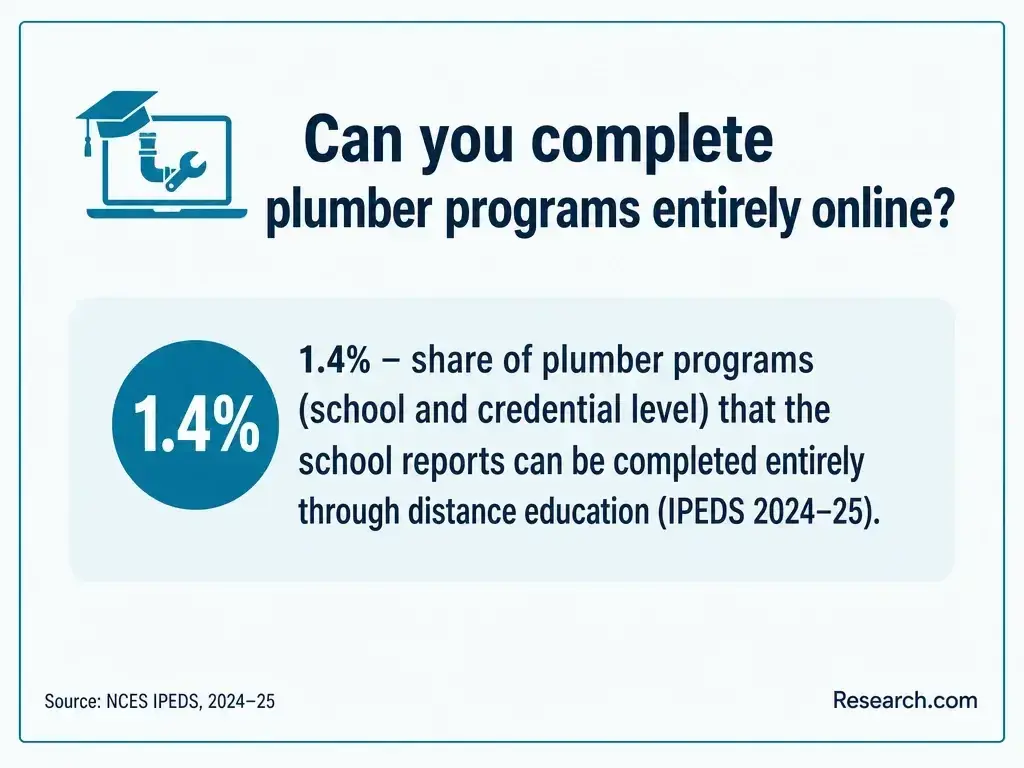
Listings of accredited trade schools online can help identify flexible theory instruction. For plumbing, however, ask where you will practice installations and receive supervised field experience before treating an online option as a route to employment.
Plumbing training can lead to work with residential service contractors, commercial construction firms, building-maintenance teams, and industrial mechanical contractors. The setting changes the training you should prioritize: home-service work emphasizes diagnosis and customer communication, while commercial and industrial work may require more plan reading, large-system installation, or pipefitting skills (U.S. Bureau of Labor Statistics, Occupational Outlook Handbook).
Compare opportunities within your commuting area, not just statewide. A rural student may find a nearby service employer more practical than a distant shop program; someone targeting large commercial projects should ask prospective employers which apprenticeship experience and code knowledge they expect. Pipefitting and steamfitting overlap with plumbing in federal labor statistics but are not identical jobs.
There is no single reliable "plumber starting salary" for every Tennessee trainee. Pay depends on location, employer, specialization, experience, and whether a position is an apprenticeship. The May 2025 U.S. median of $63,800 covers the broader occupation of plumbers, pipefitters, and steamfitters - not new plumbing-program completers or Tennessee alone (U.S. Bureau of Labor Statistics, Occupational Outlook Handbook). It is a career benchmark, not a first-job offer.
For a realistic local estimate, compare current Tennessee Department of Labor and Workforce Development occupational wage data with actual apprentice and helper postings in your commuting area. Ask sponsors for their starting wage and scheduled increases. Compare those figures with what you earn now and the training time you would give up, rather than assuming the national median will repay a program's cost quickly.
There is no single statewide trade-school length that makes someone a plumber. Certificate and diploma schedules depend on the provider, while registered apprenticeships typically extend over multiple years because they combine related instruction with substantial supervised work (U.S. Department of Labor, Apprenticeship.gov). A short program may get you ready to apply for an entry-level job sooner; it should not be mistaken for the work experience needed to perform every task independently.
Ask for the current catalog's total clock hours, weekly schedule, shop hours, and completion time at full- and part-time pace. Also ask whether instruction can count toward an employer's apprenticeship or earn advanced standing; obtain that decision from the apprenticeship sponsor before paying. Even an accelerated associates timeline is a poor substitute for checking the supervised plumbing experience your intended employer or licensing jurisdiction requires.
Online coursework can cover terminology, calculations, safety principles, and code concepts. It cannot by itself demonstrate that you can assemble a leak-free system, handle tools safely, or troubleshoot a fault at a worksite. Campus and hybrid programs should provide access to supervised labs; apprenticeships add employer-site practice.
The comparison below helps identify what each format must deliver before you enroll.
| Format | Potential advantage | Question to resolve |
| Campus-based | Scheduled tool and shop practice | How much supervised individual practice is included? |
| Hybrid | Flexible theory with in-person sessions | Where and when do required labs take place? |
| Online-only theory | Less classroom travel | Who supplies practical training and verifies competence? |
| Registered apprenticeship | Paid, supervised work alongside instruction | Is a sponsor accepting applicants locally? |
Do not select a format on convenience alone: verify lab access, travel demands, and employer recognition. Comparisons of accelerated bachelor's programs do not answer the central plumbing question - where will hands-on competencies be taught and assessed?
A trustworthy statewide average for the total cost of becoming job-ready is not established here. Published tuition may omit mandatory fees, books, consumable materials, tools, protective equipment, transportation, examinations, and any applicable licensing application. Program lengths and paid-work opportunities also differ, so a low tuition figure is not necessarily the least expensive path.
Request an itemized cost and aid estimate from each provider. Include the wages you may forgo while attending, then subtract grants, scholarships, or employer-paid training you actually qualify for. Registered apprenticeships can offset training costs through wages, but compare their entry requirements and the time needed to build experience. Tennessee Promise and Tennessee Reconnect may help eligible students at participating institutions; confirm current program, residency, enrollment, and aid conditions with the school and Tennessee Student Assistance Corporation.
Guides to online colleges that take financial aid cannot establish that a particular plumbing program qualifies for federal aid. Check the exact institution and program with its financial-aid office before including aid in your budget (Federal Student Aid).
Depending on the provider, a student may earn a school certificate or diploma, an industry credential tied to assessed skills, or a registered-apprenticeship completion credential. These recognize different things. A school award documents completion of its curriculum; apprenticeship completion documents a structured combination of related instruction and on-the-job learning (U.S. Department of Labor, Apprenticeship.gov).
Ask what the credential is called, who issues it, which skills are assessed, and whether local employers or apprenticeship sponsors recognize it. Institutional accreditation concerns the school; state authorization concerns permission to operate; industry certification and occupational licenses have separate rules. None automatically replaces another. If you want to continue training later, ask whether completed coursework or prior work can receive credit or advanced standing, and get any agreement in writing.
Entry standards vary by provider and training route. Schools may require an application and proof that you meet their educational prerequisites; apprenticeships can add sponsor-specific eligibility, selection, and employment conditions. Do not assume that admission to a class also secures an apprenticeship placement or job.
Before applying, ask the school or sponsor for its current requirements and deadlines, whether basic math is assessed, what tools or safety gear you must supply, and whether transportation to off-site training is necessary. If you are changing careers, ask how prior construction work is evaluated. Check any employer-required screening separately from school admission so an unexpected worksite condition does not derail your plan.
Core instruction generally covers pipe and fixture installation, drainage and venting concepts, water-supply systems, drawings and measurements, material selection, testing, troubleshooting, jobsite safety, and code-aware work (U.S. Bureau of Labor Statistics, Occupational Outlook Handbook). Employers also need workers who can document a repair, coordinate with other trades, and explain a problem to a customer.
Look beyond a course title. Ask to observe the shop and find out whether you personally assemble systems, use current tools, test for faults, and receive instructor feedback - or mainly watch demonstrations. If your goal is service work, prioritize diagnosis and customer-facing practice; if it is commercial installation, examine the plan-reading and larger-system work. The amount and quality of practical training can matter more than similarly named credentials.
Requirements depend on the work, project value, and jurisdiction - not simply on whether you hold a school certificate. Tennessee's Board for Licensing Contractors regulates contractor licensing for projects with a total cost of $25,000 or more and administers the limited licensed plumber pathway for applicable smaller plumbing work. Local authorities may impose additional plumbing, permit, or examination requirements (Tennessee Board for Licensing Contractors). Confirm the rules for the place and role in which you intend to work.
Working under a licensed contractor is different from contracting independently. Before enrolling, describe your goal - employee, apprentice, or future business owner - to the state board and local building department. Ask which examinations, experience, insurance or financial requirements, and application steps apply. A registered apprenticeship, industry certificate, institutional accreditation, and government-issued license are distinct; completion of one does not automatically grant another.
Start with the job you want, then compare the training routes that can actually prepare you for it. An affordable school program may make sense if you need structured shop practice before employment. A paid apprenticeship may fit better if you can secure a sponsor and need to earn while gaining supervised experience. Neither option is automatically the better investment.
Use the following checks to compare offers and avoid common enrollment mistakes:
For a return-on-investment decision, consider your current earnings, completion prospects, likely post-training pay, debt, time horizon, and the value of money earned or forgone during training. A ranking is a shortlist, not proof of fit. Searches for an easiest phd program address a different educational goal; for plumbing, verified practical experience and the correct route to work should drive the choice.
A typical entry point is helper or apprentice work under supervision. With additional experience, workers may take on more complex service, installation, or pipefitting assignments; some later supervise crews or pursue independent contracting. The steps and permissions for independent work depend on state contractor rules and local requirements (Tennessee Board for Licensing Contractors).
Choose initial training with your intended branch in mind. Residential service values fault-finding and customer communication; commercial projects place greater weight on drawings, coordination, and installation at scale. Optional industry credentials may help document particular skills, but ask employers whether they value a specific credential before paying for it. Trade-school completion alone should not be presented as qualification for a supervisory role or business license.
The U.S. Bureau of Labor Statistics projects 6.8% growth from 2025 to 2035 for the combined occupation of plumbers, pipefitters, and steamfitters. That is a national projection, not a Tennessee hiring guarantee or a forecast for plumbing alone. It supports investigating the trade, but it cannot tell you whether a particular sponsor is hiring near home.
Use Tennessee Department of Labor and Workforce Development projections alongside current employer and apprenticeship openings in the area where you can commute. Separate service vacancies from commercial or industrial roles: they may call for different skills and supervised experience. Before paying for training, ask prospective employers which entry-level qualifications they currently accept.
Education is a significant investment, so Research.com designed this ranking to make local cost comparisons more credible and useful. Programs are compared with others in the same occupation and location; only programs reporting completions to IPEDS are eligible. The most affordable ranking scores tuition, cost of attendance, median student debt, and federal loan default rate. An entropy-based method assigns more weight to cost and debt indicators that differ more across eligible programs.
Research.com also checks the following sources in its ranking process. Some cover other trades or institutional context rather than plumbing-specific approval; their inclusion does not mean every source applies to every listed program.
For context, Research.com's separate best programs methodology also considers student outcomes, earnings, accreditation or industry recognition, and support services. Those quality factors are not part of the most affordable score. The ranking can narrow a price search, but it does not cover apprenticeships or providers without IPEDS-reported completions, and it cannot establish licensing eligibility. Readers can review the fuller approach on Research.com's methodology page.
# 1 position
# 2 position
Compare itemized school costs with registered apprenticeships and employer-sponsored training. A paid route may reduce lost earnings, but you must qualify for an opening; a low-tuition school may still add tool and travel costs.
Online lessons can teach theory, but plumbing requires hands-on tool use and supervised practical experience. Verify where a program provides that training before enrolling.
No. A school credential, industry certification, apprenticeship completion, and occupational license are different. Check state contractor rules and the requirements of the jurisdiction where you plan to work (Tennessee Board for Licensing Contractors).
Choose based on your access to a sponsor, need for paid work, readiness for a jobsite, and the school's practical training. Ask whether school hours receive apprenticeship credit rather than assuming the routes combine automatically.
Not necessarily. Ask for mandatory fees, tools, protective gear, transportation, and any exam or licensing costs, then account for eligible aid and earnings during training.