# 1 position

Audited and Verified:
Our Editorial and Data Verification Process
Research.com uses government datasets, official education statistics and primary institutional information to support its career and degree guides. Our review process checks factual accuracy, occupational definitions, source dates and the requirements associated with the credentials discussed.
How This Article Was Fact-Checked
Our editorial team verifies salary estimates, employment projections, education requirements and program information against original data providers and official organizations. Salary figures are checked against the relevant occupational definitions and reporting periods. Information about licensure, accreditation and required in-person training is reviewed separately.
Fact-checked and verified on:

Co-Founder and Chief Data Scientist

Reviewed by Karolina Broda
Fact-Checker and Data Verification
Choosing plumber training near Raymond, Mississippi, means comparing more than schools: a short course, a college credential, and a paid apprenticeship can lead to different levels of worksite experience. The U.S. Bureau of Labor Statistics projects 6.8% growth for plumbers, pipefitters, and steamfitters from 2025 to 2035. This guide explains costs, credentials, licensing questions, and career prospects. It also accompanies the Best Plumber Trade Schools in Raymond for 2027 ranking, created by the Research.com team of data scientists to help students identify programs worth considering.
Expect a mix of instruction and hands-on practice, not a promise of immediate independent practice. A plumbing-focused certificate or diploma may introduce piping systems, fixture installation, plan reading, safety, and code use in a shop. An associate-degree pathway, where offered, may add broader coursework. Ask how many hours involve installing and testing systems rather than watching demonstrations; similarly named credentials can provide very different practice.
Raymond students should check Hinds Community College's current catalog and campus schedule rather than assume every construction-related offering is taught on the Raymond campus or includes plumbing. A registered apprenticeship or employer-sponsored trainee position is a different route: it pairs paid, supervised job experience with related instruction. That may suit someone ready to work immediately, while a shorter school program may suit someone who first needs foundational skills or help connecting with employers (Hinds Community College; U.S. Department of Labor).
When comparing certificates that make the most money, distinguish a school's completion certificate from an industry credential, an apprenticeship completion credential, and a license. None is interchangeable.
Potential settings include residential service companies, commercial construction contractors, facilities-maintenance teams, and employers installing or repairing piping systems around the Jackson area. Pipefitting and steamfitting may involve different systems and employers than residential plumbing; check whether the program actually teaches the work you want to do. The U.S. Bureau of Labor Statistics describes plumbers, pipefitters, and steamfitters as working in construction, maintenance, and repair settings.
A Raymond-based student may need to commute for both classes and supervised work. Before enrolling, ask whether a provider places trainees with employers you can realistically reach and whether its practical instruction includes the service calls or construction-site tasks relevant to your target job.
There is no reliable Raymond-specific wage figure in the national occupational data. The U.S. Bureau of Labor Statistics reports a May 2025 national median annual wage of $63,800 for plumbers, pipefitters, and steamfitters. This combines related occupations and workers at different experience levels; it should not be treated as a likely first-year offer or a local pay quote.
For a usable Raymond estimate, request current apprentice or helper wage schedules from prospective sponsors and compare nearby job postings by occupation, experience level, and travel requirements. A paid apprenticeship may improve earnings during training even if a shorter school course gets you into an entry-level application process sooner.
Length depends on the credential and schedule: a short introductory course, a certificate or diploma, and an associate-degree program should not be assumed to provide equivalent training. Ask each provider for its actual calendar length, required contact hours, shop hours, and any work placement. If you are comparing what's the easiest associates degree to get, remember that ease of coursework is less important here than adequate supervised practice and a credential employers recognize.
Apprenticeship is generally the longer route to skilled independent work. The U.S. Bureau of Labor Statistics describes plumbing apprenticeships as typically lasting four or five years and combining technical instruction with paid on-the-job training. Confirm a particular sponsor's hours, progress requirements, and whether prior coursework can earn advanced standing; never assume a certificate automatically shortens an apprenticeship.
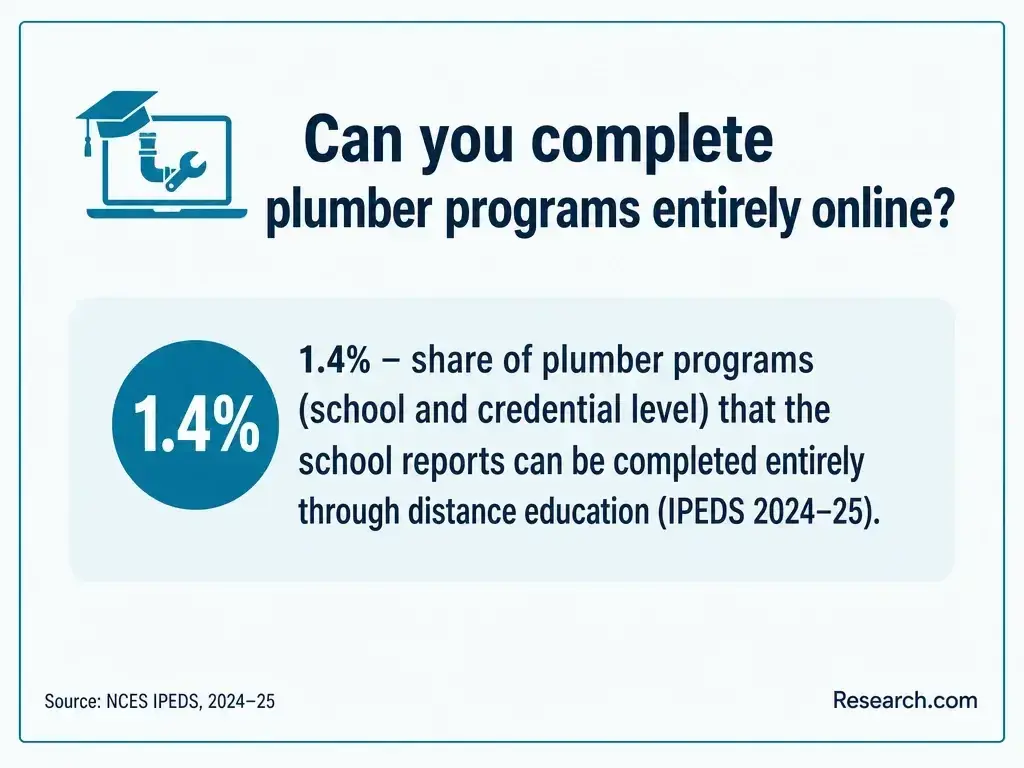
Online instruction can cover terminology, drawings, calculations, and some code concepts. It cannot replace installing pipe, making connections, testing systems, using tools safely, or working under supervision. A hybrid program is useful only if its in-person shop or employer-site component is accessible from Raymond and substantial enough for the intended next step.
Screen online search results carefully: unrelated academic offerings such as phd programs without a dissertation say nothing about plumbing competence. For any remote plumbing course, ask where practical work occurs, who assesses it, and whether an apprenticeship sponsor or prospective employer will recognize the instruction. Do not assume online completion meets a licensing or experience requirement.
A defensible Raymond-wide average is not available from a consistent set of published plumbing-program prices. Request an itemized, current quote instead of using a general college tuition figure as the cost of becoming job-ready. The relevant comparison is the amount you must pay - or can earn - through the point at which an employer will hire you for your intended role.
Use the same cost categories for every option so a short course does not appear cheaper simply because it excludes later training:
Federal aid eligibility depends on both the institution and the specific program; confirm it with the provider's aid office and Federal Student Aid. Mississippi workforce assistance may also depend on eligibility and approved training (Federal Student Aid; Mississippi Department of Employment Security). A list of the cheapest online college per credit hour can help frame classroom-cost questions, but it cannot price the plumbing shop time and supervised work a trainee still needs.
The answer may be a course-completion certificate, diploma, or associate degree, depending on the provider. A registered apprenticeship has its own completion credential and documents structured on-the-job and related instruction (U.S. Department of Labor). An optional industry credential may demonstrate assessed skills, but it is not the same thing as an occupational or contractor license.
Ask to see the exact credential name on the current program description. Then ask local employers and apprenticeship sponsors whether it qualifies you for a trainee position, earns credit toward their instruction, or simply strengthens an application. Institutional accreditation, state authorization to operate, industry recognition, apprenticeship registration, and permission to perform regulated work answer different questions.
Requirements vary. A college may require an application and placement steps; an apprenticeship sponsor may use an application, interview, and assessment of readiness for physical work and classroom instruction. Employers can set additional hiring conditions. Check the current written requirements with Hinds Community College or the specific apprenticeship sponsor rather than relying on a general description (Hinds Community College; U.S. Department of Labor).
Before applying, confirm the program's entry prerequisites, class and work hours, transportation expectations, tool requirements, and whether it helps applicants secure supervised employment. Someone who cannot yet meet a sponsor's entry requirements may find introductory training worthwhile; someone already eligible for paid apprenticeship should compare the value of that offer before purchasing a separate course.
Useful instruction connects drawings, measurements, materials, fittings, drainage, water supply, fixtures, and testing to safe installation and repair. Code interpretation matters because acceptable methods depend on the work and jurisdiction. Troubleshooting leaks and documenting work also matter in service roles (U.S. Bureau of Labor Statistics; O*NET).
Ask a provider to demonstrate how students practice these tasks: individual tool use, assembled systems, pressure or leak testing, and correction of mistakes are more informative than a course title. Also ask which skills are taught in a shop and which must be learned later on an employer's jobsite. That distinction is especially important if your goal is commercial construction rather than residential service.
Do not assume a school credential alone authorizes independent plumbing work. Mississippi's State Board of Contractors regulates contractor licensing, while requirements affecting an individual's work can also depend on the job, employer, and applicable local rules. Verify the requirements for the role you actually intend to hold - trainee, supervised worker, or contractor - with the Mississippi State Board of Contractors and the relevant local authority before paying for training (Mississippi State Board of Contractors).
Ask each program which requirements its instruction satisfies and which remain: documented supervised experience, an examination, registration, or a contractor application may be separate steps. Industry certification can help demonstrate skills, but it does not replace a license where one is required. If you may work outside Mississippi, check that destination's rules separately rather than assuming your training transfers automatically.
Start with the job you want and work backward to its required skills and authorization. A college course may be worth its cost if it supplies substantial shop practice and a credible route into employment; a paid apprenticeship may be the stronger investment if you can enter one and need documented work experience. Neither choice wins on provider type or ranking alone.
Use these checks before accepting an offer, and request answers in writing when possible:
Rankings and a nationally accredited online colleges list can inform a search, but neither verifies hands-on plumbing training or eligibility to work independently. For a financial comparison, consider aid, debt, completion probability, earnings you would otherwise receive, possible earnings after training, and how long it may take to recover your investment. Treat a guaranteed wage or an unexplained "license-ready" claim as a red flag.
An initial course may support an application for a plumbing helper or trainee position; apprenticeship combines continued instruction with supervised work. With additional experience, workers may pursue more complex installation, service, pipefitting, supervision, or contracting. These are possible progressions, not automatic outcomes of a certificate (U.S. Bureau of Labor Statistics).
Choose training that fits the progression you want. Someone interested in residential repair should seek fixture and troubleshooting practice; someone targeting commercial piping should ask about plan reading, larger systems, and relevant worksites. Contractor or supervisory ambitions bring additional experience and regulatory questions, so confirm those requirements before buying an advanced course (Mississippi State Board of Contractors).
The U.S. Bureau of Labor Statistics projects 6.8% national employment growth from 2025 to 2035 for plumbers, pipefitters, and steamfitters. That supports considering the trade, but it is not a Raymond-specific forecast and does not mean every graduate will find a local opening.
For a local decision, look at current openings and apprenticeship intakes across Raymond and the reachable Jackson-area labor market, then separate helper jobs from positions requiring experience. A program's employer connections and your ability to travel to worksites may matter more to your first job than the national growth rate.
Education is a consequential investment, so the Research.com team designed this ranking to help readers compare plumbing programs against other programs in the same occupation and location. The team checks multiple sources for outcomes, costs, recognition, and student support. Only programs with completions reported to IPEDS are included; an unlisted apprenticeship or training provider is not necessarily unavailable or low quality.
Best-program rankings consider completion and full-time and part-time retention; earnings one year after completion and earnings relative to annual attendance cost; tuition, attendance cost, debt - including debt held by students who withdrew - and federal loan default rates; and accreditation or industry recognition and student support. Occupation-relevant programmatic accreditation or industry recognition carries 20% of the score, institutional accreditation 10%, and support services 10%. Outcomes, earnings, and costs make up the remaining 60%, with weights distributed using an entropy-based method that gives more weight to indicators that vary more among programs. Most-affordable rankings instead score only costs and debt, with entropy-based weights; accreditation and other quality indicators are not part of that score.
The team used the following sources to build and check the ranking. Some cover colleges broadly, while others help assess occupation-specific recognition or training pathways:
These comparisons can narrow a shortlist, but a ranking cannot confirm that a particular course meets an employer's or licensing authority's requirements. Readers can review Research.com's full methodology and then verify current program details directly before enrolling.
# 1 position
# 2 position
Not necessarily. A registered apprenticeship or employer-sponsored training can combine instruction with paid, supervised work. Compare entry requirements and the experience each route documents (U.S. Department of Labor).
Check its current catalog and schedule directly. A college's presence in Raymond does not establish that a particular plumbing course is running there or available in your preferred term (Hinds Community College).
Online coursework can teach concepts, but plumbing also requires assessed tool use and supervised practical work. Confirm where those components occur before enrolling.
Do not assume so. Confirm the rules for your intended Mississippi or local role and any remaining experience, examination, or contractor requirements with the relevant authority (Mississippi State Board of Contractors).
It may be if you can secure a place and want wages plus structured work experience. A certificate may be useful preparation if you need foundational practice first. Compare total cost, time, employer recognition, and your likelihood of completing each route.