# 1 position
Best Pharmacy Technician Training Programs & Trade Schools in Miami for 2027
Audited and Verified:
Our Editorial and Data Verification Process
Research.com uses government datasets, official education statistics and primary institutional information to support its career and degree guides. Our review process checks factual accuracy, occupational definitions, source dates and the requirements associated with the credentials discussed.
How This Article Was Fact-Checked
Our editorial team verifies salary estimates, employment projections, education requirements and program information against original data providers and official organizations. Salary figures are checked against the relevant occupational definitions and reporting periods. Information about licensure, accreditation and required in-person training is reviewed separately.
Fact-checked and verified on:

Co-Founder and Chief Data Scientist

Reviewed by Karolina Broda
Fact-Checker and Data Verification
Choosing pharmacy technician training in Miami means checking more than price or course length: Florida registration depends on completing an eligible training program. The U.S. Bureau of Labor Statistics (BLS) projects 6.4% national employment growth for pharmacy technicians from 2025 to 2035. This guide compares training routes, costs, practical experience, and career prospects. It also features a Best Pharmacy Technician Trade Schools in Miami for 2027 ranking, created by the Research.com team of data scientists to help students make an informed choice about which programs are worth considering.
Key findings about pharmacy technician degrees in Miami
- Check Florida eligibility first: Pharmacy technicians must meet Florida Board of Pharmacy registration requirements; a school credential or national certification alone does not replace registration (Florida Board of Pharmacy).
- Compare the whole investment: The national median annual wage was $45,750 in May 2025, not a Miami starting-pay estimate; compare that benchmark with local job offers and your full training cost (BLS).
- Consider work-based routes: The Pharmacy Technician Certification Board offers an experience-based CPhT eligibility route requiring 500 hours of pharmacy technician work experience; confirm separately that any training route satisfies Florida's registration rules (PTCB; Florida Board of Pharmacy).
Table of Contents
- Best Pharmacy Technician Training Programs & Trade Schools in Miami for 2027
- What can I expect from a pharmacy technician trade school program in Miami?
- Where can I work with a pharmacy technician trade school training in Miami?
What can I expect from a pharmacy technician trade school program in Miami?
Expect instruction in medication names, dosage calculations, prescription processing, inventory, pharmacy law, and patient privacy, plus practice with dispensing workflows. Technicians work under pharmacists' supervision; training should teach when to refer a question or potential error to the pharmacist rather than resolve it independently (BLS; Florida Board of Pharmacy).
The useful distinction is not simply "trade school versus college." A public-college certificate, private career-school diploma, and board-eligible employer training may lead toward the same occupation but differ in schedule, price, supervised practice, and credential awarded. An associate-degree route may include additional coursework; people comparing an easiest associates degree should still ask whether its pharmacy technician training meets Florida's requirements. More coursework is not automatically a better or faster entry route.
Before enrolling, ask where you will practice counting, labeling, sterile-technique concepts if taught, and pharmacy software; whether an externship is arranged or must be found independently; and whether its hours and site requirements are documented. Do not treat two similarly named certificates as equivalent without comparing those details.
Where can I work with a pharmacy technician trade school training in Miami?
Pharmacy technicians work in retail pharmacies, hospitals, health-system outpatient pharmacies, and other dispensing settings (BLS). In the Miami area, the setting affects what to prioritize in training: retail work emphasizes prescription intake, insurance processing, and customer communication, while hospital roles may place greater weight on medication distribution systems and preparation procedures. Ask a program where its practical placements occur if you have a particular setting in mind.
Training does not itself authorize employment as a registered technician. Check Florida registration requirements and prospective employers' additional expectations before assuming a placement or job offer will follow graduation (Florida Board of Pharmacy).
A verified Miami-specific wage figure is not established here. For context, the BLS reports a May 2025 national median annual wage of $45,750 for pharmacy technicians. That is the midpoint for employed technicians nationwide - not an entry-level wage, a local offer, or a forecast of what a particular graduate will earn.
For a Miami decision, compare current offers for the shift and setting you can actually work, including benefits and commuting costs. When reviewing published local figures, use the BLS Miami-Fort Lauderdale-West Palm Beach metropolitan area and match its occupation and reference year to any national comparison. A hospital listing requiring experience or additional skills is not a fair substitute for an entry-level retail offer.
Completion time depends on the provider's required instruction, lab schedule, any externship, and whether you attend full- or part-time. Request the total clock hours and calendar schedule, not just the advertised number of weeks. Florida's registration rules focus on qualifying training rather than a single universal duration for every type of program; an employer-based route may have different specifications from a school-based one (Florida Board of Pharmacy).
An accelerated schedule may reduce time away from work but make daytime labs or placements difficult to manage. Part-time study may preserve income while extending the time before you can seek registered-technician work. Ask when required practical hours occur and whether delays in placement can move your completion date.
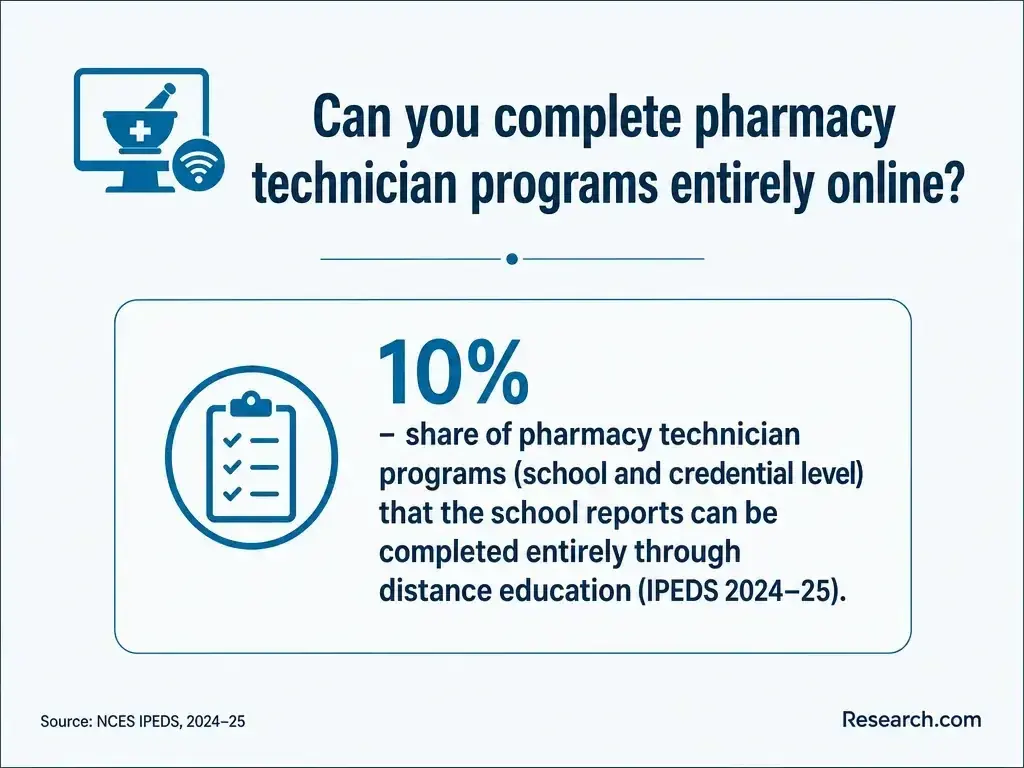
Online delivery can make terminology, calculations, law, and other classroom material easier to fit around work. On-campus or hybrid training can provide scheduled practice with dispensing procedures and direct instructor feedback. Neither format should be judged by convenience alone: ask how the provider verifies practical competencies and arranges any required in-person training.
Someone searching for a fast paced bachelor degree online is evaluating a different kind of educational path. For pharmacy technician entry, the decisive questions are whether the specific training qualifies under Florida's rules and whether its practical components prepare you for the work. Do not assume that an entirely online course establishes Florida registration eligibility (Florida Board of Pharmacy).
There is no reliable single Miami average covering public programs, private career schools, and employer-based training. Compare written, program-specific totals instead of using a quoted tuition figure as the price of becoming job-ready. Provider prices and included services can change, and an employer-sponsored route may offset training expense with wages without eliminating every personal cost.
For each option, add tuition and mandatory fees to books, uniforms, required checks or health documentation, examination and Florida registration charges, and transportation to labs or placements. Then subtract aid you are actually eligible to receive and consider wages forgone while attending. Federal aid depends on the institution and program's eligibility, not merely whether a school advertises accreditation (Federal Student Aid). Miami Dade College and the named career-school options should be compared using their current individual disclosures, not an assumed public-versus-private price rule.
Depending on the route, a provider may award a certificate, diploma, or academic credential; employer training may instead document completion of an approved training program. Those documents describe education completed. Florida registration is the state occupational credential needed for registered-technician practice, while CPhT certification is a separate national credential issued by the Pharmacy Technician Certification Board (Florida Board of Pharmacy; PTCB).
Institutional accreditation evaluates a school, programmatic accreditation evaluates a particular program, and Florida board approval addresses the state training requirement. None should be substituted for another. Request the exact credential name and written confirmation of the route by which that specific program supports Florida registration. If you want national certification, also confirm current PTCB exam eligibility separately.
School admission requirements vary; providers may request evidence of prior schooling and impose requirements for practical placements. A worksite may separately require screening or health documentation. Florida registration has its own application and qualifying-training requirements, so admission to a course is not confirmation that you can register after finishing (Florida Board of Pharmacy).
Ask admissions staff which costs are due before classes begin, whether placement sites impose extra conditions, and what happens if you cannot meet them. Comparing accredited schools online with no fee to apply can highlight an upfront expense, but a waived application fee says nothing about a pharmacy program's Florida eligibility or total cost.
A useful curriculum connects drug terminology and dosage calculations to the actual prescription workflow: receiving an order, entering information, preparing and labeling a medication, managing inventory, and flagging issues for pharmacist review. It should also address controlled substances, privacy, error prevention, and communication with patients and other staff within the technician's permitted role (BLS; Florida Board of Pharmacy).
Compare practical instruction, not course titles alone. Ask for the hours spent in supervised labs or worksites, the equipment and software used, and how instructors assess accuracy. If your goal is a hospital role, ask whether the program introduces the medication-distribution and preparation practices relevant to that setting; verify any additional employer training you would still need.
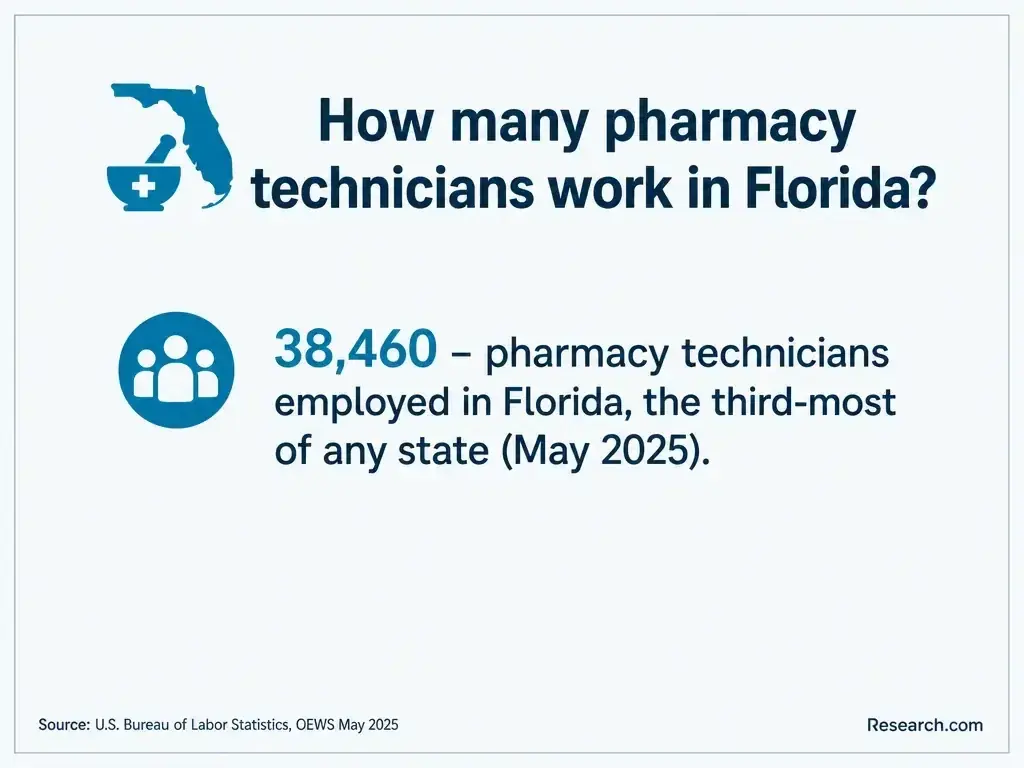
Florida requires pharmacy technician registration through the Florida Board of Pharmacy for registered-technician practice. Applicants must satisfy the board's applicable training and application rules. A school's completion certificate is not the registration, and national PTCB certification does not by itself replace Florida registration (Florida Board of Pharmacy; PTCB).
National certification can be worth considering when an employer requests it or you want to demonstrate additional knowledge. PTCB sets its own eligibility and examination rules, including a recognized education/training route or a qualifying work-experience route (PTCB). Before paying a deposit, check the board's current approved-training information for the exact program and ask how graduates document completion for registration. Recheck the rules when you apply; another state's requirements should not be assumed to transfer to Florida.
Start with the job you want and work backward. Miami Dade College, FVI School of Nursing and Technology, Global Medical & Technical Training Institute, Florida Education Institute, and New Professions Technical Institute are names a local searcher might encounter; verify the current, specific pharmacy technician offering at any provider before treating it as an available option. A ranking helps form a shortlist, but it cannot confirm your schedule, placement access, or eligibility on your enrollment date.
Use this sequence to compare a school route with employer training on the same terms:
- Confirm the exact program's Florida registration pathway with the provider and the Florida Board of Pharmacy.
- Request its credential, total clock hours, practical-training location, placement responsibility, and expected schedule in writing.
- Compare the complete out-of-pocket cost, likely aid or paid-training income, and earnings you would give up while studying.
- Ask for available completion, placement, and certification-exam outcomes, including the cohort and period measured.
- Compare realistic entry-level job requirements and pay with your total investment before enrolling.
Be wary of a provider that promises certification or employment solely because it is accredited, cannot explain its hands-on training, or advertises tuition without mandatory expenses. Unrelated offers - such as phd no dissertation - are not evidence that a provider's technician training fits your goal. The right investment is the qualifying route you can complete and afford, not necessarily the shortest or highest-ranked one.
An initial path is supervised technician work in a community or hospital pharmacy. With experience, a technician may pursue more specialized responsibilities, training newer staff, or a lead role, depending on employer requirements. National certification may support some applications, but it should be treated as an additional credential rather than an automatic promotion (BLS; PTCB).
Pharmacy work suits people who can follow precise procedures and communicate calmly when prescriptions, insurance claims, or inventory need attention. Readers also weighing best jobs for creative introverts should test that preference against this occupation's frequent accuracy demands and patient or team interactions. Ask to observe the type of pharmacy where you hope to work before paying for training aimed at that setting.
The BLS projects 6.4% growth in U.S. pharmacy technician employment from 2025 to 2035. This national projection indicates continued opportunities across the occupation, but it does not measure Miami openings or guarantee a job after training (BLS Employment Projections).
Use local postings to test demand for the role you actually want. Note whether employers request Florida registration, CPhT certification, previous experience, particular shifts, or hospital-specific skills. Prescription-processing technology can change daily tasks, making documented accuracy, software familiarity, and the ability to identify issues for a pharmacist especially useful. A program is a stronger fit when its practical training matches those local requirements, not simply the national growth figure.
Best Pharmacy Technician Training Programs & Trade Schools in Miami for 2027
Education is a substantial investment, so the Research.com team designed the ranking to help readers compare pharmacy technician programs with other programs serving the same occupation and location. The team evaluates reported outcomes, costs, debt, and relevant quality indicators. Only programs with completions reported to IPEDS are eligible for the ranking; an unlisted employer-training program or other provider is not necessarily unsuitable or unapproved.
Best-program rankings assess student completion and full- and part-time retention; median earnings one year after completion and earnings relative to annual attendance cost; tuition, attendance cost, debt - including debt among students who withdrew - and federal loan default rates; and accreditation, relevant recognition, and student support. Programmatic accreditation or relevant industry recognition carries 20% of the score, institutional accreditation 10%, and student support 10%. An entropy-based method distributes the remaining 60% among outcomes, earnings, and cost indicators according to how much they distinguish programs. Most-affordable-program rankings instead score only tuition, attendance cost, median debt, and federal loan default rates using entropy-based weights; accreditation and other quality indicators do not enter that score.
The ranking draws on the following sources. Some are cross-occupation reference sources rather than pharmacy-specific approval authorities; readers should not mistake their inclusion for evidence that they accredit pharmacy technician programs.
- IPEDS database: program completions and institutional reporting.
- National Center for Education Statistics: education data and institutional context.
- College Scorecard database: available cost, debt, and earnings measures.
- Peterson's database: supplemental institutional information.
- Commission on Accreditation of Allied Health Education Programs (CAAHEP): cross-occupation allied-health accreditation reference.
- Accrediting Bureau of Health Education Schools (ABHES): relevant institutional or program accreditation information where applicable.
- Commission on Dental Accreditation (CODA): cross-occupation accreditation reference.
- Dental Assisting National Board (DANB): cross-occupation credential reference.
- National Center for Construction Education and Research (NCCER): cross-occupation industry-recognition reference.
- Apprenticeship.gov Partner Finder: work-based training-provider reference.
Use the ranking to narrow your options, then verify each program's current Florida eligibility, hands-on arrangements, and complete price directly. More detail on the scoring approach is available in Research.com's methodology.
# 2 position
FVI School of Nursing and Technology - Pharmacy Technician/Assistant.
certificate or diploma# 3 position
Global Medical & Technical Training Institute - Pharmacy Technician/Assistant.
certificate or diploma# 4 position
Florida Education Institute - Pharmacy Technician/Assistant.
certificate or diploma# 5 position
New Professions Technical Institute - Pharmacy Technician/Assistant.
certificate or diploma# 6 position
D A Dorsey Technical College - Pharmacy Technician/Assistant.
certificate or diplomaFrequently asked questions about pharmacy technician programs in Miami
Can I become a pharmacy technician in Miami without attending trade school?
Potentially. A qualifying employer-based training route may be an alternative to a school program. Confirm that the specific route meets Florida Board of Pharmacy registration requirements before relying on it.
Is PTCB certification required for Florida pharmacy technician registration?
PTCB certification is separate from Florida registration and does not replace the state's requirements. Check the Florida Board of Pharmacy's current registration rules and any additional requirements imposed by your intended employer.
Can I complete all pharmacy technician training online?
Some coursework may be online, but you should verify how the program provides and assesses practical training. Do not assume an online completion certificate qualifies you for Florida registration.
Is a shorter program always a better value?
No. Compare total cost, qualifying training, hands-on practice, completion likelihood, and time away from paid work. A quick course that does not support your registration or intended job is a poor shortcut.
Does a ranking prove that a program is Florida-approved?
No. Rankings can help you compare reported measures, but you should independently verify the exact program's current registration pathway with the Florida Board of Pharmacy.
- U.S. Bureau of Labor Statistics - Pharmacy Technicians
Used to verify salary, employment outlook, and typical education requirements.
https://www.bls.gov/ooh/healthcare/pharmacy-technicians.htm - NCES College Navigator (IPEDS)
Used to verify programs offered and institutional accreditation.
https://nces.ed.gov/collegenavigator/ - NHA - ExCPT Pharmacy Technician
Professional certification reference for graduates of this occupation.
https://www.nhanow.com/certifications/pharmacy-technician - Miami Dade College - official website
Official school website (programs, tuition, admissions).
https://www.mdc.edu/ - FVI School of Nursing and Technology - official website
Official school website (programs, tuition, admissions).
https://www.fvi.edu/ - Global Medical & Technical Training Institute - official website
Official school website (programs, tuition, admissions).
https://www.gmtti.edu/ - Florida Education Institute - official website
Official school website (programs, tuition, admissions).
https://www.fei.edu/ - New Professions Technical Institute - official website
Official school website (programs, tuition, admissions).
https://www.npti.edu/