# 1 position
Allan Hancock College - Interior Design.
associate

Audited and Verified:
Our Editorial and Data Verification Process
Research.com uses government datasets, official education statistics and primary institutional information to support its career and degree guides. Our review process checks factual accuracy, occupational definitions, source dates and the requirements associated with the credentials discussed.
How This Article Was Fact-Checked
Our editorial team verifies salary estimates, employment projections, education requirements and program information against original data providers and official organizations. Salary figures are checked against the relevant occupational definitions and reporting periods. Information about licensure, accreditation and required in-person training is reviewed separately.
Fact-checked and verified on:

Co-Founder and Chief Data Scientist

Reviewed by Karolina Broda
Fact-Checker and Data Verification
Choosing an affordable interior design program in Santa Maria means looking beyond tuition: the credential, portfolio work, software training, and travel costs all affect its value. The U.S. Bureau of Labor Statistics reports a $67,190 national median annual wage for interior designers in May 2025, but that is not a starting salary or a local wage estimate. This guide accompanies the Most Affordable Interior Design Trade Schools in Santa Maria for 2027 ranking, created by the Research.com team of data scientists to help students identify training programs worth considering and choose a practical route into the field.
Expect a mix of design studio projects and technical work: measuring spaces, developing layouts, selecting finishes, preparing drawings, and explaining choices to a client. Software matters, but a program's value depends on whether you repeatedly turn a brief into a documented, buildable proposal and receive useful critique. The U.S. Bureau of Labor Statistics describes interior designers as working with drawings, materials, costs, and building-code considerations - not simply decorating rooms.
For a Santa Maria student, the first decision is whether a nearby option actually teaches interior design or only an adjacent subject. Check Allan Hancock College's current catalog for the precise credential and courses available for your intended start term; do not assume that a design-related course sequence awards an interior design credential. If local offerings do not cover the work you want, compare hybrid training with the cost and time of traveling to in-person studios elsewhere.
A short program can be worthwhile for someone adding presentation or drafting skills to existing work. Someone seeking a wider range of design responsibilities should give more weight to sustained studio practice, construction documentation, and a strong portfolio than to speed alone.
Potential settings include residential design businesses, furniture and finish showrooms, kitchen-and-bath businesses, and firms that prepare plans for renovation or commercial spaces. Work may also be available with employers serving the wider Central Coast. Because a local program does not establish the size of the local job market, review actual vacancies and their software, portfolio, travel, and experience requirements before choosing a specialization.
Entry-level titles may be more realistic than "interior designer" immediately after a short certificate: showroom associate, design assistant, or drafting support can provide exposure to clients and products. An employer-sponsored route may be more efficient for someone who can obtain supervised work now, although workplace training may be narrower than a structured studio curriculum. The U.S. Bureau of Labor Statistics notes that designers commonly coordinate with architects, builders, and other specialists; ask whether a program gives you practice communicating with those collaborators.
The U.S. Bureau of Labor Statistics reports a $67,190 median annual wage for U.S. interior designers in May 2025. A median describes workers across experience levels and locations; it is neither a Santa Maria wage nor a reasonable promise of first-job earnings. The same occupational category may not describe pay for showroom or drafting-support jobs.
For a useful local estimate, compare current Santa Maria-area postings for the exact role you could enter after training. Separate hourly employment from contract work, and account for benefits, commuting, and any unpaid time spent finding clients. If a program advertises earnings, ask whether the figure covers its own completers, which jobs it includes, and how many people were measured.
There is no single required training length for entry into California interior design work. A focused certificate may take less time than an associate degree, but actual completion depends on course availability, prerequisites, studio scheduling, and whether you attend part time. Request the current course sequence and the next term each required course is offered before treating a published completion timeline as achievable.
Interior design programs generally describe requirements in academic units and studio courses rather than a universal set of occupational clock hours. Ask how many hours involve instructor-supervised projects, drawing, material selection, and critique. Workplace learning can add experience, but it is not automatically a registered apprenticeship or a substitute for a credential's stated requirements. If speed is the main concern, compare the portfolio you would produce - not just the calendar - with options marketed as fast track degrees.
Online study can work well for design history, some software instruction, and project feedback. Campus or scheduled in-person sessions can make it easier to examine materials, take accurate measurements, use shared equipment, and present work to instructors and peers. A hybrid program may offer a workable compromise for a Santa Maria student facing a long commute, provided its required in-person sessions are feasible.
The distinction is practical rather than a blanket judgment about quality. Before enrolling, ask how drawings and portfolio projects are assessed, whether you need specific software and a capable computer, and where any supervised studio or field activities occur. An entirely online certificate should not be assumed to satisfy the education or experience rules for optional professional credentials. Flexibility matters, but lists of affordable online universities for working students do not replace checking an interior design program's actual practical training.
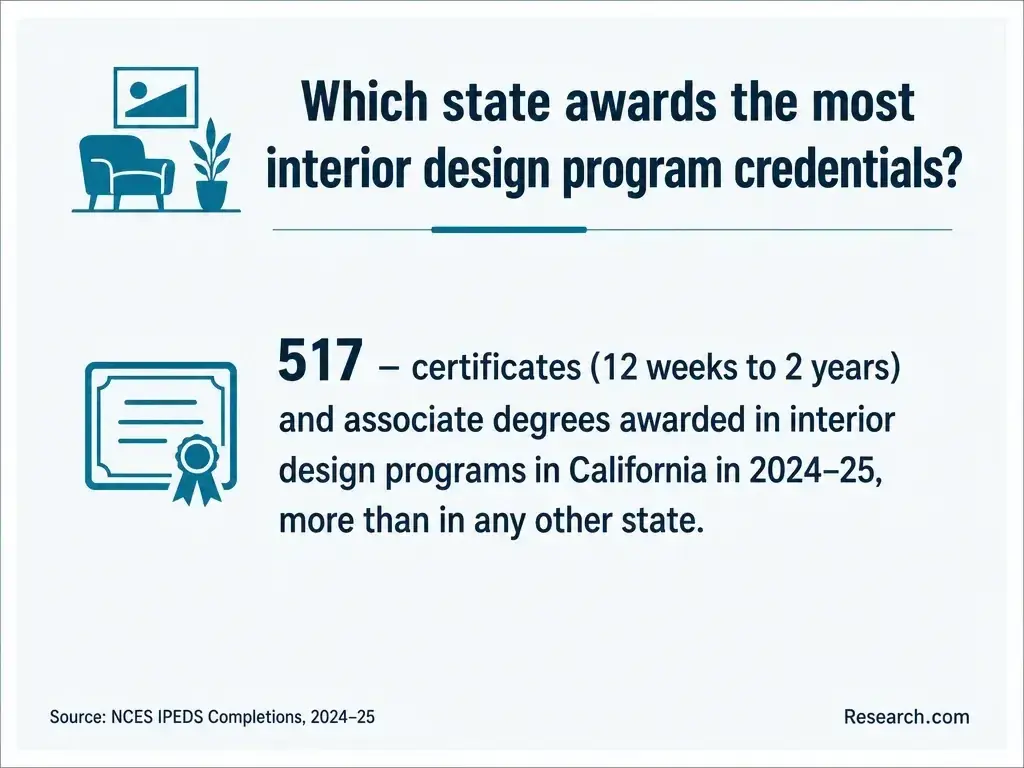
A reliable Santa Maria-wide average is not available from a comprehensive inventory of interior design trade programs. Published tuition alone would also be misleading: a student who must travel for studio classes or purchase design software can face a different total cost from one taking local courses with existing equipment. Compare each program using an itemized estimate for your own enrollment status and schedule.
The table shows costs that can change which option is genuinely affordable. Ask each provider which items are included in its stated cost of attendance and which you must pay separately.
| Cost factor | What to verify |
| Tuition and mandatory fees | Charges for every required course, including repeat-course and nonresident charges if applicable |
| Materials and technology | Software subscriptions, computer specifications, printing, samples, and project supplies |
| Attendance and career entry | Travel for studios or work experience, portfolio expenses, and any optional credential application or exam fees |
| Time and financing | Lost earnings, available grants, and debt needed to finish |
Ask Allan Hancock College or any prospective provider about current aid eligibility and California state aid where applicable; eligibility depends on the student and program, according to Federal Student Aid and the California Student Aid Commission. A low-cost course is not a bargain if it cannot be completed on your schedule or does not build the portfolio needed for your target job.
The award depends on the specific program: it might be a course-completion certificate, an occupational certificate, or an associate degree. These are not interchangeable. A standalone software course documents a narrower skill; a longer studio-based credential may produce more varied work samples. Confirm the exact award printed on the transcript or certificate, not just the program's marketing name.
This comparison helps match training to a first job rather than assuming the longest - or shortest - route is always best. The timelines are program-dependent, so verify the current catalog before applying.
| Pathway | Potential fit | Key limitation to check |
| Focused course or short certificate | Adding drafting, software, or presentation skills | May provide too few complete projects for a design portfolio |
| Studio-based certificate | Seeking structured practice and an entry-level portfolio | Course depth and supervised project time vary |
| Associate degree | Seeking broader technical and studio preparation | Longer attendance can raise total cost and lost earnings |
| Employer training | Entering a showroom or support role while learning on the job | Instruction may reflect one employer's products or workflow |
Institutional accreditation concerns the school; specialized program accreditation, where available, concerns a particular program. Neither automatically grants California's optional "Certified Interior Designer" designation or eligibility for a professional examination. Keep that distinction in mind even if you are comparing education searches such as easiest phd degree programs: for this occupational decision, the awarded credential and demonstrated work are the relevant checks.
Requirements vary by provider and credential. A prospective student may need to complete a general college application, establish placement or prerequisites, or meet software and computer requirements before a technical course. Ask whether a portfolio is needed for admission or developed during training; those are different barriers for a beginner.
Request the current program map, prerequisite list, and enrollment dates from Allan Hancock College if considering its courses. Ask how prior coursework or documented experience is evaluated and whether credits apply toward the specific award you want. For employer training, entry is governed by hiring requirements rather than school admission; a paid position may be attractive, but access depends on an employer offering and selecting you.
A useful curriculum connects aesthetics with constraints. Look for measured plans, spatial layouts, materials and finishes, lighting concepts, computer-aided drawing, client presentations, and budgets. Projects should require revisions after critique, because a polished image alone does not show whether a design can be communicated and implemented. The U.S. Bureau of Labor Statistics identifies planning spaces, specifying materials, producing drawings, and coordinating with other professionals as parts of interior designers' work.
For each program, inspect student work and ask which assignments become portfolio pieces. If your goal is kitchen-and-bath support, look for detailed layouts and product specifications; if it is commercial work, ask how the curriculum addresses accessibility, documentation, and applicable codes. A general credential name cannot tell you whether those competencies are taught. Searches for a high paying master's degree answer a different question; here, the decisive evidence is whether training matches the work an entry-level employer requests.
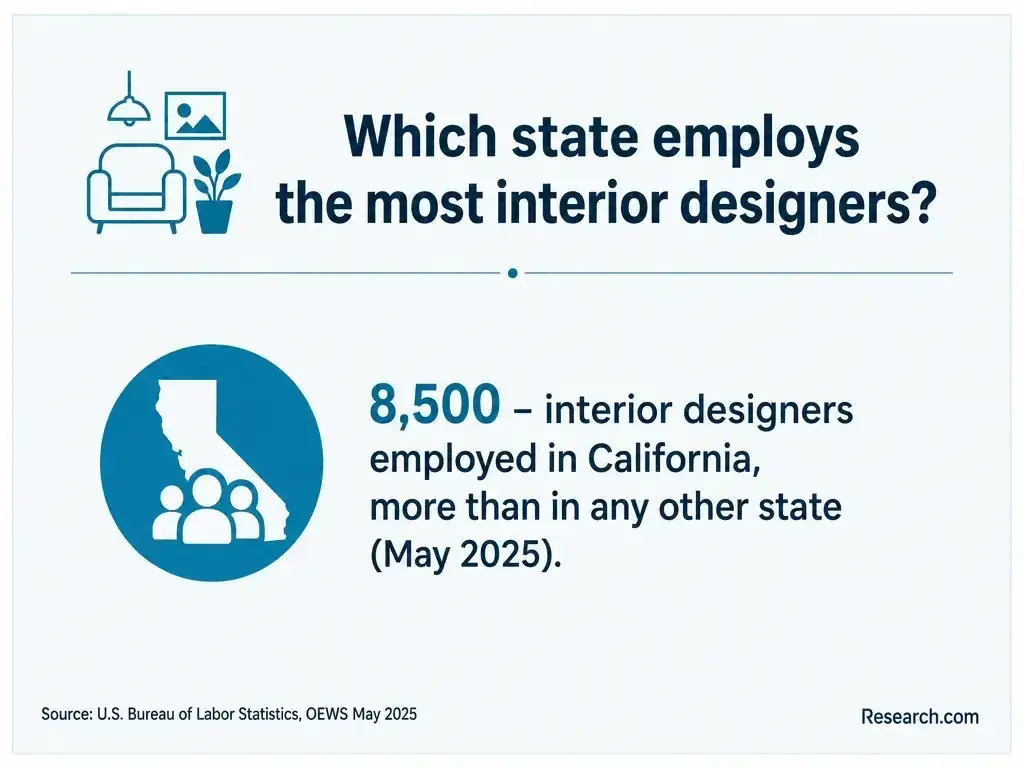
California does not require a general occupational license simply to work as an interior designer. California does regulate use of the "Certified Interior Designer" designation through a separate certification framework administered by the California Council for Interior Design Certification (CCIDC). Certification is not the same as school graduation, institutional accreditation, or an architect's license. Check CCIDC's current education, experience, and examination routes before selecting a program specifically to pursue that designation.
The National Council for Interior Design Qualification (CIDQ) also sets eligibility rules for its NCIDQ examination, including education and work-experience criteria. It is an optional professional pathway for many roles, not an automatic entry requirement for every showroom or design-assistant job. If you plan to prepare or approve work reserved to another licensed profession, training in interior design does not itself confer that authority; confirm the scope of the proposed job with the appropriate California regulator or employer.
Start with the job you want, then test each program against it. The most affordable ranking can identify covered programs with comparatively favorable cost and debt measures, but it does not score accreditation or verify that a particular studio sequence meets your goals. These checks help prevent a low sticker price from becoming an expensive mismatch:
Red flags include an unclear credential title, no opportunity to review completed student projects, promises of a specific salary, or claims that "accredited" means "certified." A program is worth the investment when its likely portfolio and job access justify its full cost and time commitment for your starting earnings and goals. That is a more useful comparison than a generic search for a one year doctorate.
A practical progression may begin in a showroom or design-assistant position, move into more independent project work after portfolio and client experience, and later develop into a specialty or self-employment. The route is not automatic: employers may distinguish between someone trained to sell and specify products and someone able to produce detailed plans and coordinate a project.
Choose training accordingly. A focused certificate plus employer coaching may be enough to test an interest in products or client service without a long absence from work. Broader technical and studio training makes more sense if you want to compete for roles requiring detailed drawings and varied projects. Optional certification can become relevant as responsibilities grow; check its requirements before paying for coursework on the assumption that it will count.
The U.S. Bureau of Labor Statistics projects 2.7% U.S. employment growth for interior designers from 2025 to 2035. That national projection is not a forecast of openings in Santa Maria, and it does not include every adjacent showroom or drafting-support role. It suggests students should plan for a competitive search rather than assume that completing a credential will produce a local design position.
Before committing to a program, sample local and commutable-area job listings over several weeks. Record which roles are genuinely entry level, what portfolio examples and software they request, and whether the travel is sustainable. If suitable openings are scarce, a narrower paid support role may be a sensible first step while you build experience and decide whether more training is justified.
Education is a consequential investment, so Research.com evaluates affordability using more than an advertised tuition figure. For its most affordable program rankings, the team compares programs in the same occupation and location using tuition, cost of attendance, median student debt, and federal loan default rate. Indicator weights are assigned through an entropy-based method, which gives more weight to measures that differ more across programs. Accreditation and other quality indicators do not enter the affordability score.
Only programs with completions reported to IPEDS are eligible. That makes the ranking a useful comparison of covered programs, not a complete inventory of Santa Maria training: an employer training route or a provider missing from college-oriented datasets is not thereby unapproved or inferior. Research.com draws on the following sources in its ranking work; occupation-specific recognition sources are relevant only when they apply to the program being evaluated:
Readers can use the ranking to narrow a cost comparison, then verify current program content, aid eligibility, and portfolio opportunities directly. The full explanation of Research.com's ranking approach is available on its methodology page.
# 1 position
# 2 position
No general trade-school credential is required simply to work in interior design. Specific employers set their hiring criteria, while California's optional "Certified Interior Designer" designation has separate requirements administered by CCIDC.
Yes, some theory, software instruction, and project feedback can be delivered online. Check how the program handles supervised projects, material work, and portfolio critique, as well as any in-person attendance before enrolling.
It depends on the first job you want. Compare the actual studio projects and total cost: a certificate may suit a focused support role, while an associate degree may offer broader preparation at a greater time commitment.
Check its current catalog for the credential title, required courses, and upcoming schedule. A related design course is not necessarily a complete interior design training program.
Not automatically. Check the current education, experience, and examination requirements directly with CIDQ or CCIDC, and ask the program to document how its coursework fits the route you intend to pursue.