# 1 position

Audited and Verified:
Our Editorial and Data Verification Process
Research.com uses government datasets, official education statistics and primary institutional information to support its career and degree guides. Our review process checks factual accuracy, occupational definitions, source dates and the requirements associated with the credentials discussed.
How This Article Was Fact-Checked
Our editorial team verifies salary estimates, employment projections, education requirements and program information against original data providers and official organizations. Salary figures are checked against the relevant occupational definitions and reporting periods. Information about licensure, accreditation and required in-person training is reviewed separately.
Fact-checked and verified on:

Co-Founder and Chief Data Scientist

Reviewed by Karolina Broda
Fact-Checker and Data Verification
Choosing affordable HVAC training in San Jose means looking beyond tuition: a short program is only a bargain if it builds the hands-on skills employers need. The U.S. Bureau of Labor Statistics projects 10.9% national growth for HVAC mechanics and installers from 2025 to 2035. This guide compares training routes, costs, credentials, and California rules. It also accompanies the Most Affordable HVAC Technician Trade Schools in San Jose for 2027 ranking, created by the Research.com team of data scientists to help students make an informed choice about programs worth considering.
Expect instruction in heating, ventilation, air conditioning, and refrigeration systems, followed by supervised practice with tools and equipment. A useful entry-level program lets students wire controls, read electrical measurements, trace faults, work safely around refrigerants, and explain repairs - not just watch demonstrations. Ask to see the lab schedule and equipment list before paying a deposit.
The routes below serve different needs. A short credential may get someone into an assistant role sooner; a longer route can provide more time to practice diagnosing equipment.
| Route | Credential or outcome | Best fit and main trade-off |
| Career-school or community-college certificate or diploma | School-awarded occupational credential | Structured preparation for entry-level work; compare lab access, total price, and placement claims. |
| Associate-level HVAC program | Academic associate degree | Broader technical coursework; usually a larger time commitment than a short certificate. |
| Registered apprenticeship | Paid, supervised work and related instruction; completion credential | Earn while learning, but entry depends on openings and the sponsor's selection process. |
| Employer-sponsored entry | On-the-job training; credentials depend on employer | Can reduce upfront school cost, but the scope and consistency of instruction vary. |
Trade school is most compelling when you need a structured route into the field and can verify substantial hands-on practice. If you already have an offer from an employer willing to train you, compare that paid route before taking on tuition or debt.
Potential workplaces include residential service contractors, commercial-building maintenance teams, facilities departments, refrigeration service firms, and contractors installing or maintaining heat pumps. Silicon Valley's offices, apartments, healthcare facilities, and other occupied buildings create different service settings: a program focused only on residential equipment may be a poor match for someone seeking commercial controls or refrigeration work.
Ask local employers which systems their entry-level technicians actually service and whether they hire trainees before Section 608 certification. A school's employer contacts are useful only if they connect students to the type of work the student wants; request recent, program-specific placement information and its definition of "placed."
The U.S. Bureau of Labor Statistics reports a $61,010 national median annual wage in May 2025 for heating, air conditioning, and refrigeration mechanics and installers. That is the midpoint for workers across experience levels and locations, not an entry-level San Jose offer. Do not use it as a promised salary - or assume that higher local pay automatically offsets Bay Area housing and commuting costs.
For a local decision, compare current trainee and service-technician offers for the same type of work, including hourly pay, overtime expectations, benefits, travel between jobs, and whether tools are provided. Compare those offers with what you earn now before estimating how long training costs might take to recover.
Completion time depends on the credential, weekly schedule, and amount of lab and worksite instruction. A focused certificate can lead to job applications sooner than an associate-level program, while a registered apprenticeship combines employment with instruction over a substantially longer progression. Neither faster completion nor more classroom time alone establishes job readiness.
Request the published calendar and a breakdown of total clock or contact hours, supervised lab hours, and any required worksite hours. Check whether part-time attendance delays course sequences or Section 608 exam preparation. General searches for accelerated college degrees are not a substitute for checking the practical hours in a specific HVAC credential.
Online coursework can cover concepts such as system operation, electrical theory, codes, and diagnostic reasoning. It cannot by itself show that you can use gauges and meters safely, troubleshoot a live system, or perform supervised field tasks. A hybrid program is credible only when its in-person labs and assessments are clearly scheduled and accessible from where you live or work.
Before choosing a remote option from a most popular school for trade skills online listing, get written answers about where practical instruction occurs, who evaluates it, and whether the school prepares students for the appropriate EPA Section 608 exam. A general list of top accredited online colleges non profit does not establish that an HVAC course includes the required practical training; institutional accreditation and occupational competence are different checks.
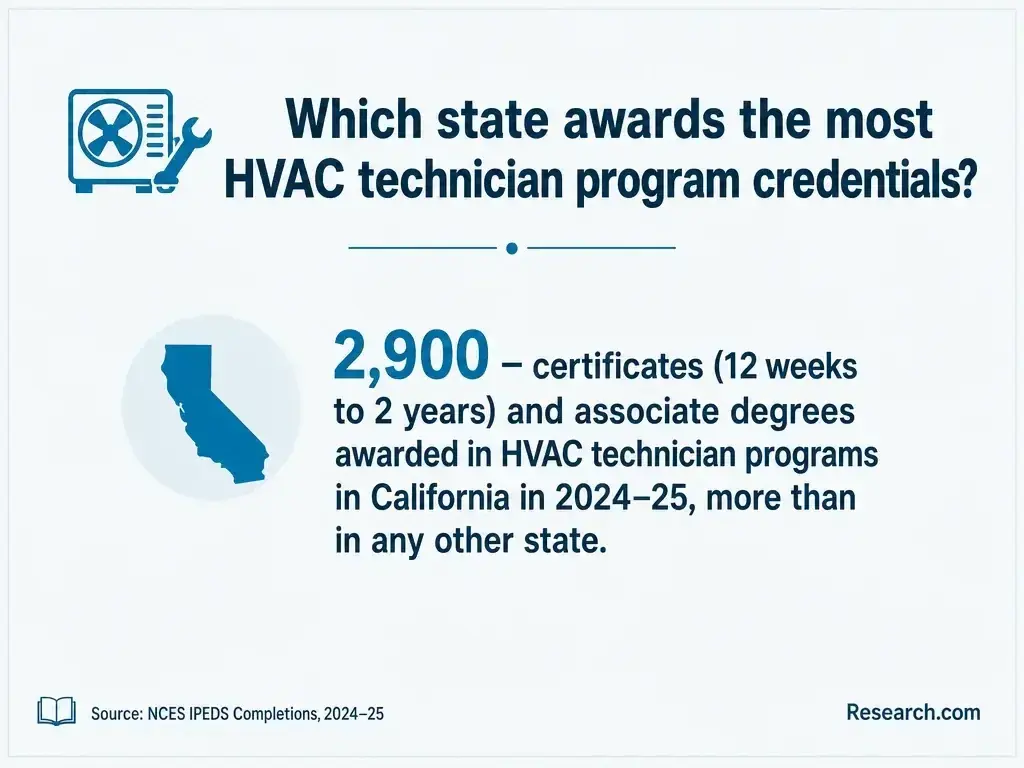
There is no single reliable San Jose-wide average that fairly combines career schools, community-college programs, paid apprenticeships, and employer training. Published tuition is especially incomplete when one provider includes tools or exam preparation and another charges separately. For 2027 enrollment, obtain an itemized, written cost estimate from each provider rather than treating a ranking price as your final bill.
Use the same cost checklist for every route so a shorter program is not automatically mistaken for a cheaper one:
Ask a school's aid office whether its specific program qualifies for federal student aid and which charges are covered. California workforce agencies may also identify eligible training assistance, while apprenticeship wages can change the upfront-cost calculation. For a realistic return-on-investment comparison, account for completion likelihood, borrowing, your current earnings, plausible post-training pay, the time needed to earn back costs, and the value of receiving earnings later rather than sooner.
A provider may award a certificate, diploma, or associate degree; a registered apprenticeship has its own completion credential. None is automatically an EPA certification or a California contractor license. Look for the exact award on the program description and ask whether students can take an EPA Section 608 exam during training.
Section 608 certification is tied to refrigerant-handling work, with exam types corresponding to the equipment serviced; the U.S. Environmental Protection Agency also offers a Universal credential for technicians who pass the applicable types. Optional manufacturer or industry credentials can help demonstrate additional skills, but ask employers whether they value a particular one before paying for it. A search for the easiest bachelor of science degree addresses a different education goal, not an HVAC entry credential.
Requirements vary by provider and route. Schools may ask for proof of prior schooling and require an assessment or orientation; apprenticeships and employers set their own application, work-eligibility, and selection requirements. Ask about physical tasks and safe tool use, as HVAC work can involve lifting, confined spaces, ladders, and electrical hazards (U.S. Bureau of Labor Statistics, Occupational Outlook Handbook).
Before applying, confirm the minimum entry requirements directly with the provider and ask whether an existing credential or relevant work experience earns credit or advanced standing. Do not assume prior coursework shortens a program - or that a school's admission offer guarantees an apprenticeship position or job.
Core training should connect refrigeration-cycle theory to installation and diagnosis: electrical circuits, motors, controls, airflow, heating and cooling equipment, refrigerant safety, and systematic fault-finding. Customer communication, documentation, and safe work practices matter because technicians must explain findings and work in occupied homes or commercial buildings (U.S. Bureau of Labor Statistics, Occupational Outlook Handbook).
For the local job you want, inspect the equipment mix rather than relying on a broad "HVAC" course title. Ask whether students practice on heat pumps, commercial systems, or refrigeration equipment relevant to their target employers, and whether each student performs diagnostics rather than sharing a single demonstration station.
Refrigerant work: The U.S. Environmental Protection Agency requires appropriate Section 608 technician certification for technicians who maintain, service, repair, or dispose of equipment in ways that could release regulated refrigerants. School completion alone does not confer it. Verify which exam type matches the equipment you expect to handle.
Employment versus contracting: California's Contractors State License Board regulates contractors, including work within its C-20 warm-air heating, ventilating, and air-conditioning classification. Working as an employee technician is not the same as independently taking on jobs as a licensed contractor. If self-employment is your goal, check the board's current experience, examination, and application rules before assuming a school credential will qualify you. School authorization, institutional accreditation, apprenticeship registration, EPA certification, and a contractor license each serve different purposes (California Contractors State License Board; U.S. Environmental Protection Agency).
Start with the job you want - residential service, commercial maintenance, refrigeration, or a path toward contracting - then compare programs against that goal. An affordability ranking is a shortlist, not proof that a program's labs, schedule, or credential fit you.
Ask each provider these questions before enrolling; written, program-specific answers make prices and training claims easier to compare:
Verify institutional accreditation with the accreditor or U.S. Department of Education, and check applicable California school authorization with the relevant state regulator; neither check replaces evidence of lab quality or certification preparation. For an apprenticeship, verify registration and the sponsor's entry rules through California's Division of Apprenticeship Standards or the sponsor. Red flags include an unexplained all-in price, vague placement claims, little individual equipment time, or a promise that graduation alone makes you licensed.
A common starting point is installation helper, maintenance trainee, or entry-level service technician, depending on the employer and practical preparation. With supervised experience, technicians may move into more independent diagnostics, commercial systems, refrigeration, controls, lead-technician work, or supervision. Contracting is a separate step governed by California licensing rules, not an automatic promotion after graduation (U.S. Bureau of Labor Statistics; California Contractors State License Board).
Choose training that matches the first role you can realistically obtain, then plan additional skills around the equipment you encounter at work. Searches for fastest masters programs concern a different pathway; for HVAC advancement, documented field experience and relevant technical credentials are the more immediate questions.
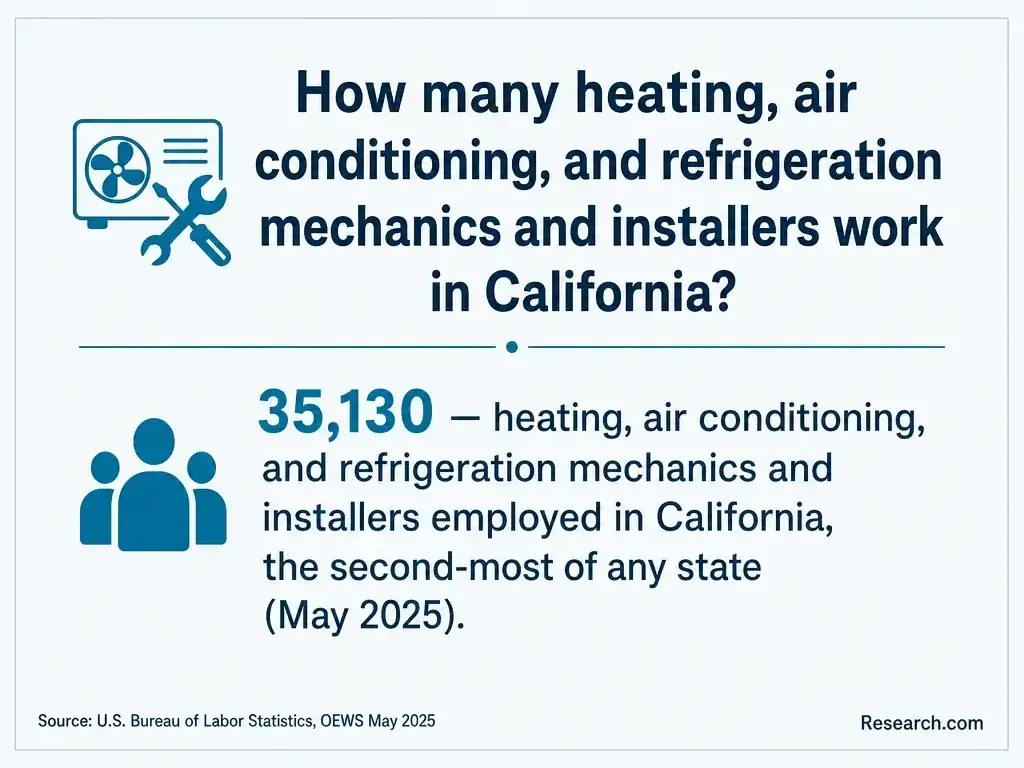
The U.S. Bureau of Labor Statistics projects 10.9% U.S. employment growth from 2025 to 2035 for heating, air conditioning, and refrigeration mechanics and installers. This supports investigating the field, but it is a national projection - not a forecast of openings in San Jose or a guarantee of placement after training.
For a local test of demand, review current vacancies by equipment type and required experience, then ask prospective employers whether they take trainees. In the Bay Area, the distance between a school, lab, and dispersed service calls can materially affect both training attendance and job costs. A program is a better investment when its schedule and practical training match the positions you can actually reach.
Investing in training is an important decision, so Research.com compares programs with other programs in the same occupation and location rather than with unrelated schools. Only programs reporting completions to the Integrated Postsecondary Education Data System (IPEDS) are eligible for this ranking. That makes the comparison more consistent, but it also means a registered apprenticeship or employer training program may be worth considering even if it does not appear.
For most affordable rankings, Research.com scores costs and debt: tuition, cost of attendance, median student debt, and federal loan default rate. Weights are assigned through an entropy-based method, which gives more weight to indicators that vary more among programs. Accreditation and other quality measures do not enter the affordability score; readers should check them separately before enrolling.
Research.com also produces best programs rankings using a different model. Those consider completion and full-time and part-time retention; earnings one year after completion and earnings relative to annual attendance cost; tuition, attendance cost, debt - including debt held by students who withdrew - and loan defaults; and institutional accreditation, occupation-relevant programmatic accreditation or industry recognition, and student support. In that model, occupation-relevant recognition carries 20%, institutional accreditation 10%, support services 10%, and outcomes, earnings, and costs together 60%, with the latter indicators weighted by the entropy-based method. A high affordability placement should therefore not be read as a comprehensive quality judgment.
The team draws on the following data sources when creating its trade-program rankings. Some cover other occupations and are not HVAC-specific; their inclusion in the overall source set does not mean an HVAC program needs healthcare accreditation.
The ranking can narrow a cost-focused search, not replace a written program quote or a check of practical training and certification preparation. See Research.com's methodology for more about how rankings are created.
# 1 position
# 2 position

Compare paid apprenticeships and employer-sponsored trainee roles with the full, after-aid cost of school programs. The lowest tuition is not necessarily the lowest cost once tools, travel, and lost earnings are included.
Online classes can teach theory, but equipment diagnosis and safe tool use require in-person practice. Check the location and amount of supervised lab or worksite training before enrolling.
Yes, for covered work that could release regulated refrigerants. Ask which certification type fits the equipment you intend to service (U.S. Environmental Protection Agency).
No. The California Contractors State License Board sets separate requirements for contractor licensing. Employment as a technician and independently contracting for work are different paths.
Choose a certificate if you need a structured entry course and its cost and hands-on training fit your goal. Compare an apprenticeship if you want paid, supervised work alongside instruction and can meet the sponsor's entry requirements.