
Most Affordable HVAC Technician Schools & Training in Visalia for 2027
Audited and Verified:
Our Editorial and Data Verification Process
Research.com uses government datasets, official education statistics and primary institutional information to support its career and degree guides. Our review process checks factual accuracy, occupational definitions, source dates and the requirements associated with the credentials discussed.
How This Article Was Fact-Checked
Our editorial team verifies salary estimates, employment projections, education requirements and program information against original data providers and official organizations. Salary figures are checked against the relevant occupational definitions and reporting periods. Information about licensure, accreditation and required in-person training is reviewed separately.
Fact-checked and verified on:

Co-Founder and Chief Data Scientist

Reviewed by Karolina Broda
Fact-Checker and Data Verification
Choosing HVAC training in Visalia means comparing more than tuition: you need a route to hands-on competence, refrigerant certification, and an affordable first job. The U.S. Bureau of Labor Statistics projects 10.9% national growth for HVAC mechanics and installers from 2025 to 2035, making training choices consequential. This guide explains local pathways, costs, credentials, and career prospects. It also accompanies the Most Affordable HVAC Technician Trade Schools in Visalia for 2027 ranking, created by the Research.com team of data scientists to help students identify programs worth considering.
Key findings about HVAC technician degrees in Visalia
- The lowest-ranked cost is not necessarily the lowest cost to become job-ready: compare fees, tools, travel, certification expenses, aid, and earnings forgone while training.
- HVAC mechanics and installers had a $61,010 U.S. median annual wage in May 2025, not an expected starting wage in Visalia (U.S. Bureau of Labor Statistics).
- California does not require an individual HVAC employee to hold a statewide contractor license simply to work for a licensed contractor; refrigerant-handling work generally requires the appropriate federal EPA Section 608 certification (California Contractors State License Board; U.S. Environmental Protection Agency).
Table of Contents
- Most Affordable HVAC Technician Schools & Training in Visalia for 2027
- What can I expect from an HVAC technician trade school program in Visalia?
- Where can I work with an HVAC technician trade school training in Visalia?
What can I expect from an HVAC technician trade school program in Visalia?
Expect instruction in heating, ventilation, air conditioning, and refrigeration systems, followed by practice diagnosing faults rather than just memorizing components. Useful labs let students measure electrical values, test airflow, work with controls, practice safe refrigerant procedures, and explain repair findings. Ask how many hours are spent actually using equipment: two programs can award similarly named certificates while providing very different amounts of practice.
Visalia-area students should compare a career-school program with community-college training, a registered apprenticeship, and entry-level employer training. A school can provide structured preparation before a job search; an apprenticeship combines classroom instruction with paid, supervised work but depends on sponsor openings and usually takes longer. Employer training can reduce upfront cost, although the breadth of instruction and credential offered varies. Confirm that the specific campus and schedule you can attend offer HVAC training before treating any provider as a local option.
Where can I work with an HVAC technician trade school training in Visalia?
Potential workplaces include residential service contractors, commercial HVAC firms, building-maintenance departments, and refrigeration service businesses. In the Visalia area, compare programs against the work you want to do: servicing home cooling systems, maintaining equipment in commercial buildings, and supporting temperature-controlled food operations can call for different practice and employer contacts. The U.S. Bureau of Labor Statistics describes HVAC technicians as installers and repairers who often travel between customer sites.
Ask programs which local employers host work-based learning and whether students observe real service calls. A placement contact is useful, but it is not a job guarantee; check whether any reported placement figure covers HVAC jobs specifically and which graduates it counts.
The U.S. median annual wage for heating, air conditioning, and refrigeration mechanics and installers was $61,010 in May 2025 (U.S. Bureau of Labor Statistics, Occupational Outlook Handbook). This is a national figure for workers at different experience levels - not a Visalia wage or a likely first-year offer. Use it as context, then ask local employers and apprenticeship sponsors about entry wages, raises during training, benefits, and whether travel between jobsites is paid.
Higher earnings may require diagnostic experience, refrigeration or controls expertise, supervisory responsibility, or contractor ownership. Those outcomes also entail time, additional training, and, for contracting, California licensing requirements. If pay is your primary reason for enrolling, compare HVAC's progression with other trade school high paying jobs rather than assuming the occupational median applies immediately after a certificate.
Length depends on the credential, weekly schedule, and amount of supervised practice. A focused certificate may take months; an associate degree generally requires a longer commitment because it includes additional coursework. A registered apprenticeship is a multiyear, paid training route rather than a short school program. There is no single California clock-hour requirement that every prospective employee must complete at an HVAC school before entering the occupation (California Contractors State License Board; U.S. Department of Labor).
Request each program's total clock or credit hours, lab hours, calendar length, and expected completion date for your intended schedule. If you need broader coursework, an accelerated associates degree comparison may help frame the time commitment, but verify that the particular HVAC option includes in-person technical practice. Faster completion has little value if it leaves you unprepared for equipment work or unable to attend required labs.
Online coursework can cover electrical theory, system diagrams, codes, calculations, and certification exam preparation. It cannot by itself demonstrate safe wiring, pressure measurement, brazing, troubleshooting, or refrigerant-handling technique on real equipment. A hybrid program makes sense when its in-person labs or employer worksite are accessible from Visalia; an entirely remote course is better treated as supplemental knowledge unless it identifies how practical skills will be assessed.
Compare required lab dates, equipment access, instructor feedback, and the cost of travel before choosing a format. The cheapest online school is not necessarily the least expensive HVAC route once required in-person training is included. Do not assume online course completion itself confers EPA certification or qualifies you for California contractor licensure.
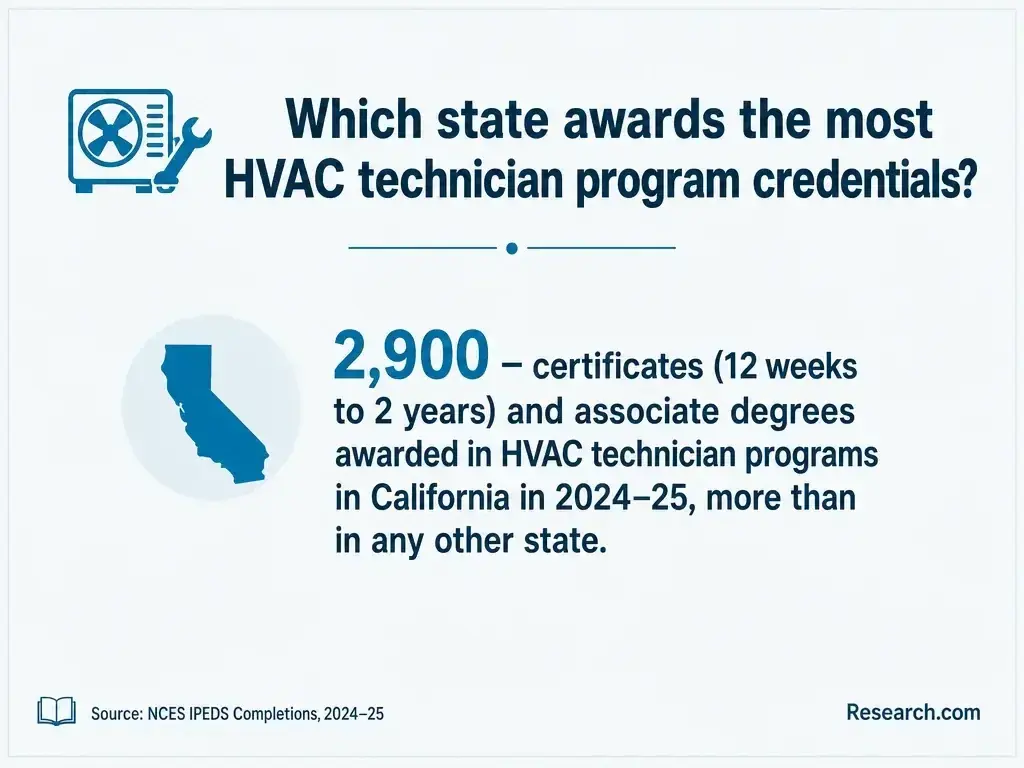
There is no reliable single average that covers Visalia career schools, community-college options, paid apprenticeships, and employer training on the same basis. Ask for a current, program-specific cost sheet instead of using a citywide estimate or comparing tuition alone. A paid apprenticeship may have a lower upfront school bill and provide wages while training, but it can take longer and admission depends on available positions.
To compare offers fairly, collect the same cost categories from every provider:
- Tuition and mandatory registration, lab, and materials fees.
- Tools, meters, personal protective equipment, textbooks, and consumables.
- EPA exam charges and any other exam fees the program does not include.
- Travel to campus and worksites, plus earnings you may give up while attending.
- Grants, scholarships, eligible federal or California aid, employer contributions, and expected borrowing.
Federal aid eligibility depends on both the institution and the particular program; California aid and workforce funding have separate eligibility rules (Federal Student Aid; California Student Aid Commission). Estimate your net cost, likely debt payment, completion prospects, and plausible entry pay over several years. That is a more useful return-on-investment test than comparing sticker prices or treating the ranking as a recommendation to enroll.
A school may award a certificate, diploma, or, where offered, an associate degree. A registered apprenticeship documents completion of a structured work-and-classroom pathway; employer training may instead provide internal records of skills. Ask what appears on the final credential and whether completed coursework can count toward another credential or receive advanced standing. Do not assume credits transfer without a written agreement from the receiving provider.
These credentials are distinct from EPA Section 608 technician certification, which applies to covered refrigerant-handling activities, and from a California contractor license. A school should explain which EPA exam types its training prepares you for and whether testing is included, but a school credential alone is not either credential (U.S. Environmental Protection Agency; California Contractors State License Board).
Requirements vary by provider. Ask whether the program requires a high school diploma or equivalent, an assessment, a minimum age, a driver's license for field placements, or particular safety equipment. Apprenticeship sponsors and employers set their own entry and hiring criteria; admission to a school does not secure an apprenticeship position. If a program advertises jobsite training, find out who arranges it and what a student must satisfy before participating.
HVAC is a hands-on trade, not an option to choose solely because it appears easier to enter than another subject. Lists of easy majors do not tell you whether you will enjoy electrical diagnosis, physical jobsite work, or customer-facing service. If those tasks are a poor fit, investigate the work before paying an enrollment deposit.
Core instruction typically covers refrigeration cycles, electrical fundamentals, motors and controls, airflow, heating systems, installation, diagnostics, safety, and customer communication (U.S. Bureau of Labor Statistics, Occupational Outlook Handbook). Look for opportunities to diagnose deliberately introduced faults and document the repair - not just watch demonstrations. For students interested in California installation work, ask how the curriculum addresses applicable energy-efficiency requirements and current equipment, including newer refrigerants and their safety procedures (California Energy Commission; U.S. Environmental Protection Agency).
The strongest curriculum for your goal depends on your intended first job. A residential-service applicant needs troubleshooting and customer interaction; a refrigeration applicant should ask for relevant equipment and refrigerant practice. Obtain a course outline and equipment list before deciding that a broad "HVAC" label matches either path.
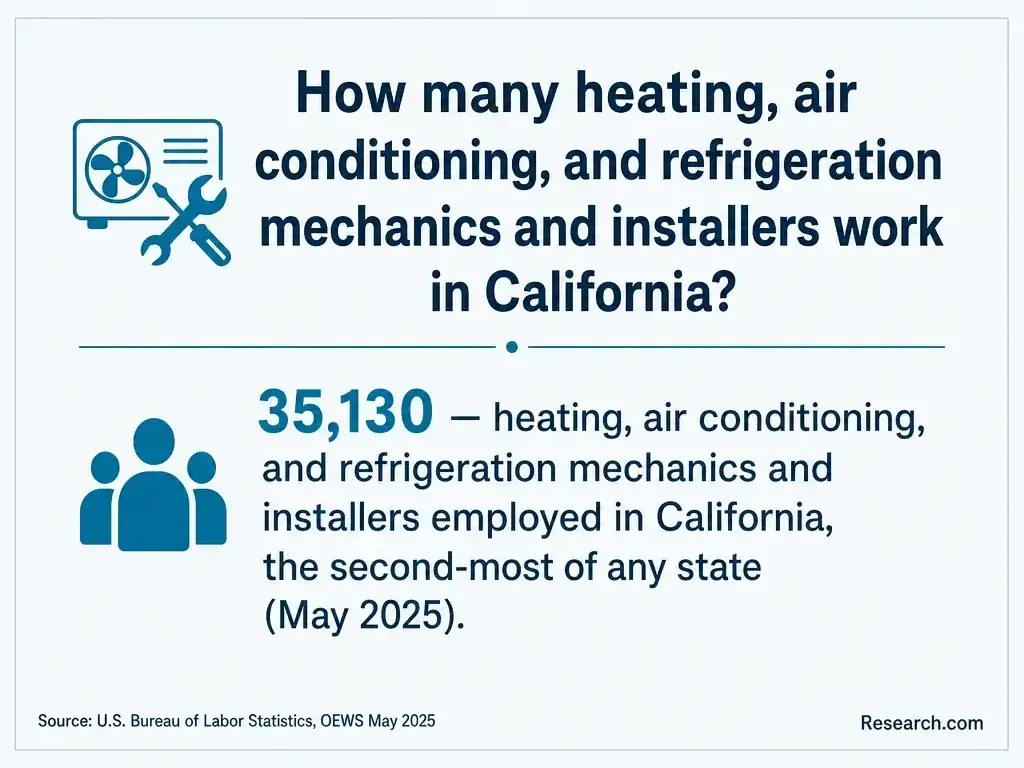
Employees and contractors face different rules. California does not impose a general statewide HVAC technician license on an individual simply for working as an employee of a licensed contractor. Technicians who perform covered work with regulated refrigerants generally need the appropriate federal EPA Section 608 certification; its exam types reflect the equipment worked on (California Contractors State License Board; U.S. Environmental Protection Agency).
Someone intending to bid on and perform contracting work independently must separately check California Contractors State License Board requirements, commonly involving the C-20 warm-air HVAC contractor classification. Contractor licensing involves qualifying experience and examinations; completing a trade-school program does not automatically meet those requirements or award a license (California Contractors State License Board). Institutional accreditation, state authorization of a school, industry credentials, EPA certification, apprenticeship registration, and contractor licensure answer different questions. Verify the one relevant to the work you plan to perform.
Start with the job you want, then compare programs on what they deliver - not just where they sit in an affordability ranking. If evaluating San Joaquin Valley College-Visalia, confirm its current campus-specific HVAC offering directly; do not assume a program advertised elsewhere is available on your schedule. Use the same questions for any school, apprenticeship sponsor, or employer pathway.
Before committing, work through these checks:
- Request the credential name, curriculum, total hours, supervised lab or worksite hours, and a schedule you can attend.
- Ask which EPA Section 608 exams the training prepares you for and whether exam fees and testing are included.
- Verify institutional accreditation with the accreditor, school authorization with the relevant California regulator, and any claimed industry recognition with its issuer; do not treat one as a substitute for another.
- Obtain an itemized total-cost estimate and written aid terms, then compare it with paid apprenticeship or employer-training opportunities.
- Ask for HVAC-specific completion and employment information, including the reporting period and who is excluded.
Warning signs include vague lab access, an advertised price that excludes required tools, claims that graduation automatically produces a contractor license, and placement figures with no clear definition. An affordable program is worth considering when its cost, schedule, practical training, and likely first-job pathway work together for your circumstances.
A common starting point is an installer helper, maintenance assistant, or entry-level service technician working under experienced staff. With documented skill and experience, a worker may move toward independent service assignments, commercial systems, refrigeration, controls, supervision, or sales and estimating. Contractor ownership is a separate progression that requires meeting California licensing rules (California Contractors State License Board).
Choose early training to match that first step, not an advanced title on a brochure. For example, an applicant seeking commercial refrigeration work should ask for relevant lab equipment and employer connections; someone aiming to earn while learning may prefer a registered apprenticeship. Additional certifications can support specialization, but they should be evaluated against actual job requirements rather than purchased automatically.
National employment of heating, air conditioning, and refrigeration mechanics and installers is projected to grow 10.9% from 2025 to 2035 (U.S. Bureau of Labor Statistics, Employment Projections). That indicates broader occupational demand, not a guaranteed number of openings in Visalia. Local hiring also depends on construction activity, replacement and maintenance work, business needs, and how far you are willing to travel for jobsites.
For a decision grounded in the local market, compare current entry-level postings with each program's taught equipment and ask apprenticeship sponsors and employers when they recruit. A longer commute may widen opportunities but also raises training and work costs. Treat national growth as a reason to investigate the field, not as proof that a particular credential will secure employment.
Most Affordable HVAC Technician Schools & Training in Visalia for 2027
Research.com created this ranking because education is a significant investment, and a low advertised tuition figure does not necessarily mean a low overall cost. Its team checks multiple education and occupational data sources to make comparisons more credible. Programs are compared with other HVAC programs in the same location; only programs with completions reported to the Integrated Postsecondary Education Data System (IPEDS) are eligible. Consequently, a paid apprenticeship or employer training program may be a worthwhile option even if it does not appear in the ranking.
This is a most-affordable ranking, not a best-programs ranking. The affordability score uses tuition, cost of attendance, median student debt, and federal loan default rate. Weights are assigned through an entropy-based method, which gives more weight to indicators that differ more across eligible programs. Accreditation, student support, and other quality measures do not enter the affordability score. Research.com's separate best-programs methodology considers student outcomes, earnings and return on investment, costs and debt, and quality and recognition. For that methodology, occupation-relevant programmatic accreditation or industry recognition carries 20%, institutional accreditation 10%, student support 10%, and the remaining 60% is distributed across outcomes, earnings, and costs using the entropy-based method.
The following sources inform Research.com's ranking work. Some accreditation and certification sources cover other trades or healthcare occupations; their inclusion does not imply that they accredit HVAC programs.
- IPEDS database: program completions and institutional reporting.
- National Center for Education Statistics: federal education data and definitions.
- College Scorecard database: available college costs, debt, and outcomes.
- Peterson's database: supplementary institutional information.
- Commission on Accreditation of Allied Health Education Programs (CAAHEP): occupation-specific accreditation reference where applicable.
- Accrediting Bureau of Health Education Schools (ABHES): institutional and program accreditation reference where applicable.
- Commission on Dental Accreditation (CODA): occupation-specific accreditation reference where applicable.
- Dental Assisting National Board (DANB): occupation-specific credential reference where applicable.
- National Center for Construction Education and Research (NCCER): construction-training and industry-credential reference.
- Apprenticeship.gov Partner Finder: registered-apprenticeship pathway reference.
Use the ranking to narrow your cost comparison, then confirm each campus's current HVAC offering, practical training, credential, and full written price. See Research.com's methodology for more about how its rankings are created.
# 2 position

Frequently asked questions about HVAC technician programs in Visalia
Is trade school required to become an HVAC technician in Visalia?
No general California rule requires an HVAC employee to graduate from trade school. Apprenticeships and employer training are alternatives, although employers may prefer applicants with relevant training and practical skills (California Contractors State License Board; U.S. Bureau of Labor Statistics).
Can I complete HVAC training entirely online?
You can study theory online, but practical equipment work requires in-person labs or supervised jobsite training. Ask any remote provider where and how those skills are assessed.
Is EPA certification included in a school certificate?
Not automatically. EPA Section 608 certification requires passing the applicable exam; ask whether exam preparation, testing, and fees are included (U.S. Environmental Protection Agency).
Is the cheapest program the best investment?
Not necessarily. Compare total cost after aid with hands-on training, completion prospects, schedule, and a realistic route to your intended first job.
Does finishing HVAC school qualify me to start a contracting business?
No. Independent contracting is subject to California Contractors State License Board licensing requirements separate from a school credential.
- U.S. Bureau of Labor Statistics - Heating, Air Conditioning, and Refrigeration Mechanics and Installers
Used to verify salary, employment outlook, and typical education requirements.
https://www.bls.gov/ooh/installation-maintenance-and-repair/heating-air-conditioning-and-refrigeration-mechanics-and-installers.htm - NCCER - Accredited Training
Used to verify programmatic accreditation or industry recognition of programs.
https://www.nccer.org/ - EPA - Section 608 Technician Certification
Professional certification reference for graduates of this occupation.
https://www.epa.gov/section608/section-608-technician-certification - San Joaquin Valley College-Visalia - official website
Official school website (programs, tuition, admissions).
https://www.sjvc.edu/