# 1 position

Audited and Verified:
Our Editorial and Data Verification Process
Research.com uses government datasets, official education statistics and primary institutional information to support its career and degree guides. Our review process checks factual accuracy, occupational definitions, source dates and the requirements associated with the credentials discussed.
How This Article Was Fact-Checked
Our editorial team verifies salary estimates, employment projections, education requirements and program information against original data providers and official organizations. Salary figures are checked against the relevant occupational definitions and reporting periods. Information about licensure, accreditation and required in-person training is reviewed separately.
Fact-checked and verified on:

Co-Founder and Chief Data Scientist

Reviewed by Karolina Broda
Fact-Checker and Data Verification
Choosing electrician training in Kalispell means comparing more than classrooms: you need a route to supervised work and eventual Montana licensure. The U.S. Bureau of Labor Statistics projects 9.2% national growth in electrician employment from 2025 to 2035, making the choice timely. This guide explains local training options, costs, wages, and licensing checkpoints. It also accompanies the Best Electrician Trade Schools in Kalispell for 2027 ranking, created by the Research.com team of data scientists to help students make an informed choice about programs worth considering.
Expect electrical theory and supervised practice - not immediate qualification to work independently. A campus program may teach wiring methods and troubleshooting in a lab, while an apprenticeship combines instruction with paid work under experienced electricians. For a student whose goal is a Montana journeyman license, the decisive question is how the training connects to documented, qualifying work experience (Montana Board of Electricians).
The comparison below separates credentials that can sound similar but lead to different next steps. Availability and schedules can change, so verify current offerings directly with Flathead Valley Community College and apprenticeship sponsors before applying.
| Pathway | What it provides | Best fit and main limitation |
| College certificate or other short program | Foundational coursework and, if offered, supervised electrical labs | Useful for testing the field or preparing to seek work; ask whether a sponsor recognizes the coursework, because the credential alone is not a license. |
| Associate-degree program, if currently offered | A longer academic program that may include broader technical and general coursework | Useful when those added subjects support a specific goal; check the electrical lab content and added cost before choosing it over a shorter route. |
| Registered apprenticeship | Related instruction plus structured, paid, supervised work | A direct work-and-training route for applicants able to secure a position; entry depends on sponsor requirements and openings. |
| Employer-sponsored entry | Paid introductory work that may lead into a registered apprenticeship | Can reduce upfront school cost; verify who provides instruction and how experience is documented. |
Neither a school credential nor apprenticeship registration is itself an occupational license. Ask where lab practice ends, where supervised fieldwork begins, and who will sign off on your experience. If you are weighing an expedited bachelor's degree against electrician training, treat them as different career investments: the academic route does not replace electrical field experience.
Electrical contractors are a primary place to seek supervised entry-level work. Other possible settings include building construction, renovation, facility maintenance, and industrial operations. The U.S. Bureau of Labor Statistics describes electricians as installing, maintaining, and repairing electrical power, communications, lighting, and control systems; the tasks available to a trainee depend on employer needs and supervision.
Kalispell's smaller labor market makes the location of the worksite as important as the location of the classroom. Ask a prospective sponsor whether jobs regularly require travel across the Flathead Valley or farther afield, whether travel time is paid, and whether the assignments will provide the range of experience relevant to your licensing goal. A nearby class is less convenient than it appears if the required work cannot be reached reliably.
A reliable Kalispell-specific electrician median is not established here, so the national figure is a benchmark rather than a local offer. Electricians had a $63,190 national median annual wage in May 2025, according to the U.S. Bureau of Labor Statistics. That median covers workers at different experience levels; it should not be used as an apprentice starting-pay estimate.
To evaluate an actual opportunity, request the sponsor's written apprentice wage progression and ask local employers about work hours, overtime practices, travel, and benefits. Compare those terms with your current earnings. Paid training can improve the financial case for an apprenticeship, but take-home pay and work availability matter more to your budget than a national occupational median.
School completion and time to independent electrical work are different timelines. A preparatory program may end after its scheduled coursework and labs; a registered apprenticeship extends through its required related instruction and supervised work. Montana journeyman eligibility depends on documented qualifying experience and the Board's examination requirements, not simply on finishing a classroom program (Montana Board of Electricians).
Before enrolling, request the program's current calendar, total classroom and lab hours, and any part-time schedule. Then ask an apprenticeship sponsor whether it awards credit for that coursework or prior experience, under what conditions, and how remaining work hours will be recorded. Do not assume that a shorter program shortens the licensing timeline by the same amount.
Online delivery can suit electrical calculations, code study, and some theory. Wiring circuits, using meters, identifying faults, and applying safe work practices require supervised practice with equipment. A hybrid program can therefore reduce classroom travel without removing the need to reach a lab or worksite. Compare the actual practical-training schedule, not just a program's "online" label.
Listings of best online vocational schools can help you identify remote coursework, but ask each provider where its electrical labs take place and who supervises them. Also ask a Montana apprenticeship sponsor whether it accepts the instruction. An entirely remote course should not be assumed to establish work experience or licensing eligibility (Montana Board of Electricians).
There is no single defensible average for Kalispell electrician training across college programs, short courses, and paid apprenticeships. Charges and compensation follow different models. Flathead Valley Community College's current program and residency-based charges, if an electrical option is available, should be checked against a sponsor's current apprenticeship terms - not compared with a tuition figure alone.
Build a cost-to-job-readiness estimate that includes tuition and mandatory fees, books, tools, work clothes and protective equipment, transportation to labs and jobsites, and applicable examination or licensing charges. Subtract confirmed grants or employer-paid expenses, then account for wages earned - or forgone - during training. Federal student aid depends on the student and program's eligibility; Montana workforce assistance may depend on individual circumstances (Federal Student Aid; Montana Department of Labor & Industry).
Searches for an online university cheapest option may surface low tuition figures, but those figures do not price the tools, travel, and supervised work needed for electrical entry. Request an itemized estimate before committing. For return on investment, also consider completion probability, likely debt, your current pay, expected pay progression, and how long you expect to work in the trade.
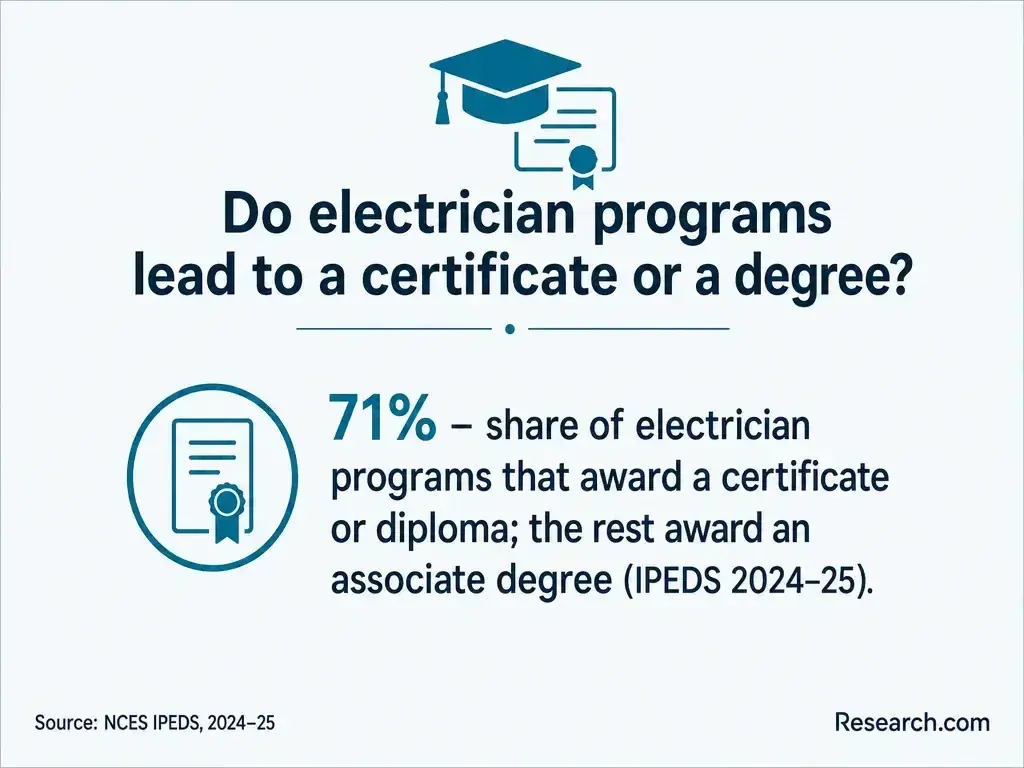
The award depends on the route: a school may award a certificate or, for an eligible longer program, an associate degree; a registered apprenticeship leads to its own completion credential. These document different training. Neither should be described as a Montana journeyman license, which is issued through the state licensing process (Montana Board of Electricians; U.S. Department of Labor).
Check the exact credential name on the current program description. Ask whether instruction aligns with a particular apprenticeship, whether any prior learning can receive credit, and whether an employer or sponsor recognizes that credit in writing. Industry training credentials, where offered, can document skills but should not be confused with institutional accreditation, apprenticeship registration, or occupational licensure.
Requirements vary by provider. A school may ask for an application and evidence of readiness for technical math; an apprenticeship sponsor may additionally screen applicants for work eligibility, safety readiness, transportation, or other job-related conditions. Obtain the current requirements from Flathead Valley Community College or the specific sponsor rather than assuming admission to one also secures an apprenticeship position.
Career changers should ask whether prior coursework or electrical work can be assessed for credit without losing needed hands-on practice. Readers considering best degrees for seniors online may value schedule flexibility, but electrical entry has a separate constraint: the ability to attend practical training and meet worksite requirements. Ask about physical job demands and part-time instruction before paying an application or enrollment charge.
Useful electrician training connects theory to tasks: reading plans, calculating loads, selecting materials, installing circuits, testing with appropriate instruments, and troubleshooting safely. Code instruction matters because electrical work must meet applicable standards, but memorizing rules is not a substitute for supervised installation and fault-finding (U.S. Bureau of Labor Statistics; Montana Board of Electricians).
Ask to see the curriculum and lab inventory. Specifically, find out whether students build and test circuits, practice safe isolation and protective procedures, receive feedback on workmanship, and work with systems relevant to their intended residential, commercial, or maintenance jobs. Programs with similarly named credentials can provide substantially different amounts of practical preparation.
Montana regulates electrical work through its Board of Electricians. A person pursuing independent, licensed electrician work must meet the requirements for the applicable license classification, including qualifying experience and examination; a school completion document does not confer that license. Apprentices work under the applicable supervision and registration rules, which should be confirmed with the Board and the employing sponsor before work begins (Montana Board of Electricians).
Ask the Board which license classification matches the work you want to do and what documentation it will accept. Ask a prospective sponsor how it records supervised experience and whether proposed school instruction receives any credit. Institutional accreditation addresses a school's educational oversight; industry certificates address specific training; neither substitutes for state occupational licensure or a registered apprenticeship.
The best fit is the route that gets you from your current skills to qualifying, supervised work at a cost and schedule you can sustain. A ranking helps identify reported college options, but it cannot establish that an apprenticeship opening exists or that a particular course will receive sponsor credit. Compare Flathead Valley Community College's current offerings with registered apprenticeships and employer training before deciding.
Use the following checks in conversations with admissions staff and sponsors; each addresses a mistake that can delay entry or raise the total cost.
A red flag is a promise that graduation alone makes you a licensed electrician. Another is an "online" offer that cannot explain how practical skills are taught and assessed. Verify licensing claims with the Montana Board of Electricians, not solely with a recruiter.
A common progression is introductory training or supervised entry, apprenticeship, and then application for the appropriate Montana electrician license once the Board's conditions are met. Experience can open paths in residential installation, commercial construction, maintenance, troubleshooting, or supervisory work. More advanced licensing or operating a contracting business brings additional requirements; neither follows automatically from an entry-level credential (Montana Board of Electricians).
Choose early training with your intended setting in mind. Someone seeking broad construction experience should ask how assignments are distributed; someone interested in maintenance should ask about equipment and fault-finding exposure. Comparisons with 4 year degrees that pay well answer a different question: electrician training's value depends heavily on paid experience, licensing progression, and the cost of reaching each stage, not on an academic credential's advertised salary.
The U.S. Bureau of Labor Statistics projects 9.2% national growth in electrician employment from 2025 to 2035. This supports considering the occupation, but it is not a forecast of vacancies in Kalispell or a guarantee of an apprenticeship place. Local hiring can vary with construction projects, contractor workloads, and the availability of qualified supervisors.
Use the national outlook as background, then test your local plan: ask sponsors when they recruit, whether they have work within a feasible commute, and what happens if a project ends. If opportunities nearby are limited, decide in advance whether you can travel for supervised experience rather than enrolling on the assumption that a local job will appear.
Investing in training is a consequential decision. Research.com created its ranking to help readers compare electrician programs with other programs serving the same occupation and location, rather than with unrelated schools. The team evaluates reported outcomes, costs, recognition, and student support; only programs with completions reported to the Integrated Postsecondary Education Data System (IPEDS) are eligible. A registered apprenticeship or employer program absent from the ranking may still be a strong option.
For best-program rankings, programmatic accreditation or occupation-relevant industry recognition accounts for 20% of the score, institutional accreditation for 10%, and student support for 10%. The remaining 60% covers completion and retention, earnings and return on investment, and costs and debt; an entropy-based method gives more weight to indicators that vary more across programs. The cost measures include tuition, attendance cost, student debt - including debt held by students who withdrew - and federal loan default rates. Most-affordable rankings instead score only costs and debt using entropy-based weights; accreditation and other quality indicators are not part of that score.
The ranking draws on the following sources. Some cover occupations other than electrical work; their inclusion in the research process does not imply that those organizations approve electrician programs.
The result is a starting point for comparing reported programs, not a substitute for checking current availability, hands-on training, or Montana licensing eligibility. Readers can find further details on Research.com's ranking methodology.
# 1 position
# 2 position
Not necessarily. A registered apprenticeship can combine related instruction with paid, supervised work. Compare its entry requirements and openings with current school options, then confirm Montana licensing rules with the Board of Electricians.
No. Montana licensure has separate experience and examination requirements. Ask the school and an apprenticeship sponsor whether the coursework receives any credit, and verify the answer with the Montana Board of Electricians.
Online coursework may cover theory or code study, but electrical installation, testing, and supervised job experience require in-person participation. Check where labs and worksites are located before enrolling.
It may be better if you can secure a place and need income while learning. A school program may help build foundational skills first. Compare admission timing, practical instruction, written credit policies, wages, and total out-of-pocket cost.
Confirm the current program or apprenticeship is accepting applicants, identify its credential and hands-on requirements, and ask how it leads to documented work experience. Then request an itemized cost and schedule you can realistically meet.