
Best Electrical Technician Training Programs & Trade Schools in Gresham for 2027
Audited and Verified:
Our Editorial and Data Verification Process
Research.com uses government datasets, official education statistics and primary institutional information to support its career and degree guides. Our review process checks factual accuracy, occupational definitions, source dates and the requirements associated with the credentials discussed.
How This Article Was Fact-Checked
Our editorial team verifies salary estimates, employment projections, education requirements and program information against original data providers and official organizations. Salary figures are checked against the relevant occupational definitions and reporting periods. Information about licensure, accreditation and required in-person training is reviewed separately.
Fact-checked and verified on:

Co-Founder and Chief Data Scientist

Reviewed by Karolina Broda
Fact-Checker and Data Verification
Choosing electrician training in Gresham means deciding whether a classroom program, a paid apprenticeship, or both will move you toward an Oregon license. The stakes are real: the U.S. Bureau of Labor Statistics projects electrician employment to grow 9.2% nationally from 2025 to 2035. This guide explains the costs, training hours, credentials, and local opportunities behind that decision. It also accompanies the Best Electrician Trade Schools in Gresham for 2027 ranking, created by the Research.com team of data scientists to help students identify programs worth considering.
Key findings about electrician degrees in Gresham
- For Oregon's general journeyman electrician pathway, the standard approved apprenticeship includes 8,000 hours of supervised work and 576 hours of related instruction, according to the Oregon Building Codes Division. A stand-alone school certificate is not a substitute for those requirements.
- The U.S. Bureau of Labor Statistics reports a $63,190 national median annual wage for electricians in May 2025. That is an occupational midpoint, not an expected starting wage for a Gresham trainee.
- Compare a Gresham-area school program with registered apprenticeships before paying tuition: apprentices earn wages while completing required work experience, while a preparatory program may help someone build skills or compete for an apprenticeship without itself granting a license.
Table of Contents
- Best Electrical Technician Training Programs & Trade Schools in Gresham for 2027
- What can I expect from an electrician trade school program in Gresham?
- Where can I work with an electrician trade school training in Gresham?
What can I expect from an electrician trade school program in Gresham?
Expect training in electrical theory, code, blueprint reading, calculations, safe tool use, and supervised installation practice. The decisive question is what role that training plays in Oregon's licensing pathway. A short preparatory credential can help you qualify for interviews; registered-apprenticeship related instruction is paired with documented paid work; an associate degree adds broader coursework but does not replace required experience or an examination.
These pathways lead to different outcomes even when their catalogs use similar words such as "electrical training."
| Pathway | What you receive | Best fit and key limitation |
| Pre-apprenticeship or introductory certificate | Foundational instruction and, where offered, shop practice | Useful for exploring the trade or strengthening an application; verify whether any hours receive credit. |
| Registered electrical apprenticeship | Related instruction, supervised paid work, and documented progress toward an occupation-specific credential | Strong fit for someone ready to work while training; entry and work placements can be competitive. |
| Community-college certificate or associate degree | A school credential with a program-specific mix of classroom and lab instruction | May suit students seeking structured preparation; ask how, or whether, it connects to an approved apprenticeship. |
Someone comparing a easy bachelor's degree with a quicker route into electrical work should focus on the occupational requirement: Oregon electrician licensing depends on qualifying training, experience, and examination, not simply on earning an academic credential.
Where can I work with an electrician trade school training in Gresham?
Gresham residents can seek work across the Portland metropolitan area in residential construction, commercial building projects, building maintenance, industrial facilities, and electrical contracting. That larger commuting area matters: an apprenticeship placement or first job may be outside city limits, so travel time and access to a vehicle can affect which opportunity is practical. The U.S. Bureau of Labor Statistics identifies construction contractors, manufacturers, and government among electrician employers.
Training alone does not authorize unsupervised electrical work. Ask prospective employers whether a position is an approved apprenticeship placement, another supervised entry role, or a job requiring an existing Oregon license. Work across the Columbia River also warrants a separate licensing check because Oregon credentials should not be assumed to authorize electrical work in Washington. For readers weighing hands-on work against other career paths for introverts, remember that electricians often work independently on tasks but must still coordinate closely with crews, customers, and inspectors.
The U.S. Bureau of Labor Statistics reports a $63,190 national median annual wage for electricians in May 2025. This describes employed electricians across experience levels, not Gresham starting pay or apprentice earnings. Use it as a long-term occupational benchmark, then request the current wage schedule from each apprenticeship sponsor or a written pay range from an employer.
Local earnings depend on license type, experience, contractor, overtime, and project mix. When comparing a paid apprenticeship with a tuition-charging program, count wages earned during training and the time each route takes to reach licensed work. Do not use the national median as a promised return on either option.
Length depends on the credential and the work experience attached to it. An introductory course or certificate may finish well before a registered apprenticeship, but finishing school is not the same as becoming a journeyman. Under the Oregon Building Codes Division's standard general journeyman apprenticeship pathway, trainees complete 8,000 hours of supervised work and 576 hours of related instruction before meeting the training requirements for examination. Other electrical license classifications have different scopes and requirements.
Ask a provider for its published calendar, weekly lab schedule, and the exact hours its graduates can document toward their intended license. If you have prior qualifying experience, ask the apprenticeship sponsor and Oregon Building Codes Division whether it can be evaluated for credit rather than assuming it shortens training.
Online instruction can make code study, theory, and some calculations easier to schedule around work. Campus labs and employer worksites are where trainees practice wiring methods, testing, troubleshooting, tool handling, and jobsite safety under supervision. For an aspiring Oregon journeyman, remote coursework alone cannot provide the documented supervised work required by the Oregon Building Codes Division.
A hybrid option is useful if its in-person labs and work placement are accessible from Gresham and its related instruction is accepted by the relevant apprenticeship sponsor. Before paying for an online program - whether it appears in a cheapest degree online comparison or a trade-training advertisement - get written answers about required site visits, lab locations, work-hour documentation, and Oregon licensing alignment.
There is no single defensible Gresham-wide average that covers college courses, short preparatory programs, and paid apprenticeships on the same basis. Published tuition may omit tools, protective equipment, books or code materials, mandatory fees, transportation to Portland-area jobsites, and licensing examination costs. A paid apprenticeship can offset training costs with wages, although apprentices still need to budget for commuting and any required supplies.
Request a written, itemized estimate from each provider and compare cost to reach your intended license, not just cost to finish its classes. Ask Mt. Hood Community College about current program charges and any applicable aid; ask apprenticeship sponsors who pays for related instruction and tools. Federal aid eligibility depends on the program, while Oregon workforce assistance may depend on individual eligibility. Neither should be assumed before it is confirmed.
A program's value also depends on completion likelihood, wages during training, foregone earnings, debt, and the time until licensed work - not its sticker price alone. A 1 year masters online comparison, for example, does not measure the supervised work and licensing costs that determine an electrician trainee's investment.
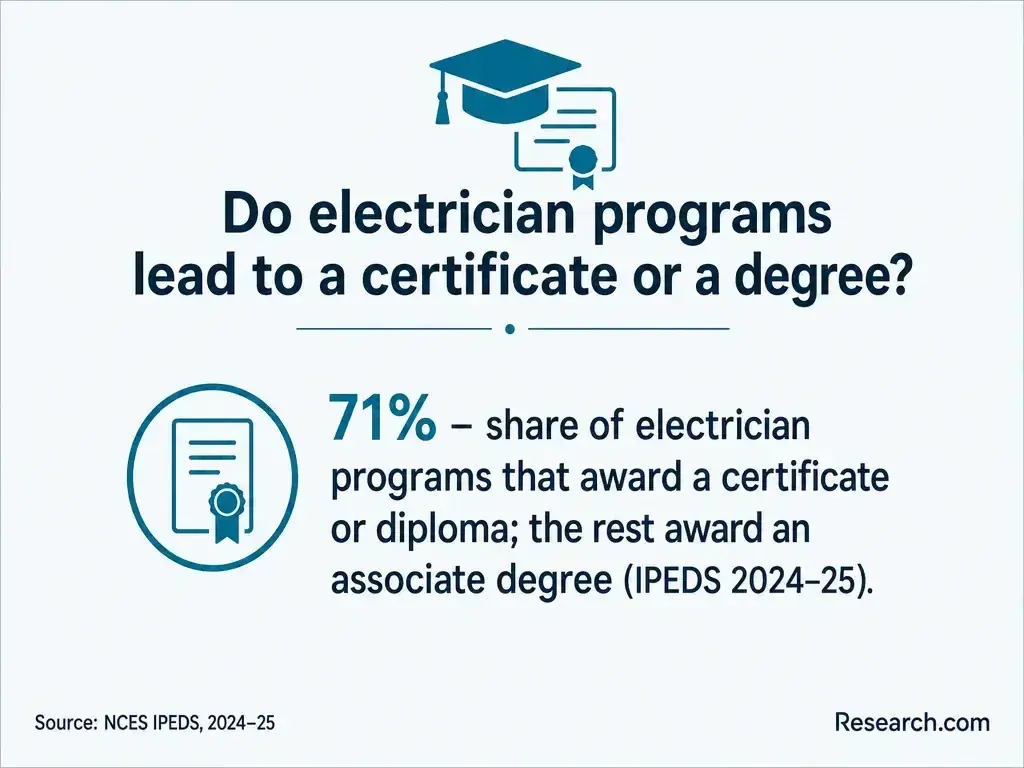
The credential depends on the provider: it might be a completion certificate, an associate degree, or documented completion of a registered apprenticeship. These are not interchangeable with an Oregon electrician license. Oregon's Building Codes Division administers electrical licensing; completing a school program does not by itself establish examination eligibility or permission to work independently.
Institutional accreditation concerns the school, state authorization concerns permission to operate, apprenticeship registration concerns the training arrangement, and occupational licensure concerns legal authority to perform regulated work. Check each separately. If a provider cites an industry certificate, ask employers and the apprenticeship sponsor whether they recognize it and whether it earns any advanced standing.
School admission and apprenticeship selection are different processes. A school may ask for prior education records or a placement assessment; a registered-apprenticeship sponsor may also assess math readiness, require an application and interview, and set job-related entry conditions. Requirements vary by sponsor, so obtain the current notice rather than relying on another program's checklist.
Before applying, ask whether you need algebra preparation, a driver's license or reliable transportation, and the ability to attend both classes and changing worksites. If a preparatory program advertises preferential apprenticeship entry, ask for the written agreement and its conditions. A certificate alone should not be treated as an offer of placement.
Core instruction covers electrical calculations, circuits, wiring methods, reading plans, code use, and identifying hazards. Effective practical training lets students install and test components, diagnose faults, and explain why a setup is safe - not merely watch demonstrations. Apprentices then apply those skills on supervised jobsites, where documenting work across required tasks matters for Oregon licensing (Oregon Building Codes Division).
Ask to see a lab tour or equipment list and a sample of the work trainees actually perform. Compare hours spent practicing with hours spent watching videos, and confirm who supervises jobsite work. Emerging building systems and changing equipment make troubleshooting and code literacy more durable skills than familiarity with one product.
Yes - electrical work in Gresham is regulated by Oregon's Building Codes Division. The applicable license or supervised trainee status depends on the work performed. For the general journeyman route, qualifying training and documented experience are followed by the state's licensing examination; an apprenticeship or school certificate alone is not the license. Limited-scope electrical licenses have different eligibility and work limits (Oregon Building Codes Division).
Before enrolling, tell the provider which electrical work you want to do and ask it to identify the corresponding Oregon license classification. Then verify the training and experience requirements directly with the Building Codes Division and, for a registered apprenticeship, the Oregon Bureau of Labor and Industries. Optional industry certifications may help demonstrate a skill, but they do not replace state licensure.
Start with the license and job you want, then compare the routes that actually lead there. A school program can be worthwhile for structured preparation, especially if it offers substantial lab practice and a documented connection to an apprenticeship. If you can enter a suitable paid apprenticeship directly, paying for preparatory training may offer less value.
Use these checks before committing money or time; they address the most costly gaps between a program's marketing and occupational entry.
- Ask the Oregon Building Codes Division which license fits your intended work, and ask the provider how its training applies to that license.
- Confirm whether an apprenticeship is registered with the Oregon Bureau of Labor and Industries and how classroom and supervised work hours are recorded.
- Request total charges, required tools and travel costs, aid eligibility, and any apprentice wage schedule in writing.
- Compare hands-on lab access, work-placement arrangements, completion outcomes, and the commute from Gresham.
- Verify school accreditation separately from apprenticeship registration and licensing eligibility; ask for written proof of any promised transfer or advanced-standing credit.
Warning signs include a promise of licensure on graduation without an experience plan, an "all-online" route claiming to replace jobsite hours, or a quoted tuition figure that excludes required supplies. Rankings help narrow a search, but these checks determine whether a particular route is right for you.
A common progression is supervised trainee or apprentice, licensed electrician, and then more specialized or supervisory work as experience grows. Depending on the license held and additional qualifications, electricians may focus on residential projects, commercial construction, industrial maintenance, controls, or estimating. Owning or operating an electrical contracting business involves separate Oregon contractor requirements; a journeyman license should not be mistaken for business authorization (Oregon Building Codes Division).
Choose training around the work you want to perform. A limited-scope pathway can be appropriate for a defined role but may not serve someone seeking the broader general journeyman scope. Lists of the most lucrative masters degree options are not a useful proxy for this decision: compare the electrician pathway's paid training, licensing timeline, and realistic local work opportunities instead.
The U.S. Bureau of Labor Statistics projects 9.2% growth in electrician employment nationally from 2025 to 2035. That supports considering the trade, but it does not forecast the number of openings in Gresham or guarantee an apprenticeship placement. Construction cycles and the availability of qualified supervisors can affect when a new trainee gets hired.
For a local decision, search current Portland-area apprenticeship openings and entry-level postings, then note their license requirements, worksites, and commute. Compare that evidence with the program's placement support before borrowing for training. The strongest option is the one that connects affordable instruction to verifiable supervised experience and the Oregon license your target jobs require.
Best Electrical Technician Training Programs & Trade Schools in Gresham for 2027
Investing in training is a consequential decision, so Research.com evaluates programs against other options in the same occupation and location rather than treating every trade program as interchangeable. The ranking includes only programs with completions reported to the Integrated Postsecondary Education Data System (IPEDS). That makes its comparisons useful, but it also means a registered apprenticeship or employer training program may be a strong option without appearing in the ranking.
For best-program rankings, student outcomes, earnings, and costs account for 60% of the score, with weights distributed using an entropy-based method that gives more weight to indicators that differ more across programs. Occupation-relevant programmatic accreditation or industry recognition accounts for 20%, institutional accreditation for 10%, and student support services for 10%. The underlying measures include completion and full- and part-time retention; earnings one year after completion and relative to annual attendance cost; tuition, attendance cost, debt, and federal loan default rates. Most-affordable rankings instead score only costs and debt using entropy-based weights; accreditation and other quality measures are not part of that score.
Research.com uses the following data sources to check education, outcomes, recognition, and training information. Some recognition sources cover other trades and health fields; their inclusion as ranking data sources does not imply that they accredit Oregon electrician programs.
- IPEDS database - institutional enrollment, completions, and cost reporting.
- National Center for Education Statistics - federal education data and definitions.
- College Scorecard database - available cost, debt, and earnings measures.
- Peterson's database - supplemental program and institution information.
- Commission on Accreditation of Allied Health Education Programs (CAAHEP) - occupation-specific recognition information where relevant.
- Accrediting Bureau of Health Education Schools (ABHES) - occupation-specific recognition information where relevant.
- Commission on Dental Accreditation (CODA) - occupation-specific recognition information where relevant.
- Dental Assisting National Board (DANB) - occupation-specific credential information where relevant.
- National Center for Construction Education and Research (NCCER) - construction-training recognition information.
- Apprenticeship.gov Partner Finder - registered-apprenticeship pathway information.
These checks help readers compare documented program outcomes and costs, not just advertising claims. See Research.com's methodology for more on how the ranking is created. Before enrolling, independently confirm that a program's training applies to the Oregon electrical license you want; a ranking score cannot establish licensing eligibility.
# 2 position
Frequently asked questions about electrician programs in Gresham
Can I become an Oregon electrician by finishing trade school?
Not through a school credential alone. For the general journeyman pathway, Oregon requires qualifying instruction, documented supervised experience, and a licensing examination (Oregon Building Codes Division).
Is an apprenticeship better than trade school?
It depends on your starting point. A registered apprenticeship combines paid work with required instruction; a preparatory school program may help you build skills or qualify for selection. Ask whether school hours receive apprenticeship credit before paying.
Can I complete electrician training online?
Some theory can be taught remotely. Labs and the supervised jobsite experience needed for Oregon's general journeyman pathway require in-person participation (Oregon Building Codes Division).
Does Mt. Hood Community College training count toward an electrician license?
Do not assume that every electrical offering does. Ask the college which credential a current program awards and whether its instruction is accepted by the apprenticeship sponsor and Oregon Building Codes Division for your intended license.
Should I use national electrician wages to estimate my first paycheck?
No. The U.S. Bureau of Labor Statistics' May 2025 national median covers electricians at different career stages. Request an apprentice wage schedule or a local employer's entry-level pay range instead.
- U.S. Bureau of Labor Statistics - Electricians
Used to verify salary, employment outlook, and typical education requirements.
https://www.bls.gov/ooh/construction-and-extraction/electricians.htm - NCCER - Accredited Training
Used to verify programmatic accreditation or industry recognition of programs.
https://www.nccer.org/ - O*NET OnLine - Electricians
Used to verify common responsibilities, skills, work settings, and education expectations.
https://www.onetonline.org/link/summary/47-2111.00 - Mt Hood Community College - official website
Official school website (programs, tuition, admissions).
https://www.mhcc.edu/