Best Cybersecurity Associate Degree Programs & Schools in New Mexico for 2027
Audited and Verified:
Our Editorial and Data Verification Process
Research.com uses government datasets, official education statistics and primary institutional information to support its career and degree guides. Our review process checks factual accuracy, occupational definitions, source dates and the requirements associated with the credentials discussed.
How This Article Was Fact-Checked
Our editorial team verifies salary estimates, employment projections, education requirements and program information against original data providers and official organizations. Salary figures are checked against the relevant occupational definitions and reporting periods. Information about licensure, accreditation and required in-person training is reviewed separately.
Fact-checked and verified on:

Co-Founder and Chief Data Scientist

Reviewed by Karolina Broda
Fact-Checker and Data Verification
Choosing a cybersecurity associate degree in New Mexico means weighing job-ready technical skills against cost, location, and the option to continue studying. The stakes are real: information security analyst employment is projected to grow 21% nationally from 2025 to 2035, according to the U.S. Bureau of Labor Statistics. This guide explains what to compare before enrolling. It also accompanies the Best Cybersecurity Associate Degree Programs in New Mexico for 2027 ranking, created by the Research.com team of data scientists to help students identify programs worth considering.
Key findings about associate cybersecurity degrees in New Mexico
- Choose by outcome: a career-focused AAS may prioritize security labs and immediate technical work, while an AA or AS may offer a clearer transfer route. Confirm the actual degree awarded and where its credits apply.
- Budget beyond advertised tuition. New Mexico public-college aid may reduce eligible tuition and fees, but software, equipment, commuting, and reduced work hours can still affect the total cost.
- The national median for information security analysts was $129,180 in May 2025, with 21% projected employment growth for 2025-2035 (U.S. Bureau of Labor Statistics). Neither figure represents a typical first job or expected pay for a new associate degree graduate.
Table of Contents
- Best Cybersecurity Associate Degree Programs & Schools in New Mexico for 2027
- What can I expect from an associate cybersecurity degree in New Mexico?
- Where can I work with an associate cybersecurity degree in New Mexico?
What can I expect from an associate cybersecurity degree in New Mexico?
Expect a mix of general education, computing fundamentals, and applied security work. A useful program teaches students to configure systems, understand networks, document vulnerabilities, and respond responsibly to incidents - not just memorize security terminology. The degree title matters because similarly named programs can allocate very different amounts of credit to technical labs and transferable coursework.
This comparison shows how common associate degree designs serve different goals. Check the school's catalog rather than assuming that every program follows the same pattern.
| Degree design | Typical emphasis | Best fit | Check before enrolling |
| AA or AS | General education and foundational computing | Students who want flexibility to continue their education | Which cybersecurity and computing courses transfer as major requirements? |
| AAS | Applied networking, systems, security tools, and labs | Students seeking technical work soon after graduation | How much hands-on work is required, and which credits transfer? |
For a student deciding among top college majors in demand, cybersecurity is most compelling when the daily work - troubleshooting, careful documentation, and continual learning - also fits. A degree alone is not proof of readiness for a security analyst role.
Where can I work with an associate cybersecurity degree in New Mexico?
Potential workplaces include healthcare organizations, financial institutions, schools, state and local government, IT service providers, and contractors supporting federal facilities. In New Mexico, proximity to government and research-related employers can shape opportunities, but some roles require a background investigation, citizenship, or a security clearance. An associate degree does not satisfy those employer conditions by itself.
Students outside major employment centers should ask about local internships, remote-work eligibility, and whether the program's lab schedule requires travel. An employer-facing capstone or supervised IT work can be especially valuable where entry-level security vacancies are scarce: it gives applicants evidence of practical skills that a course list cannot show.
The U.S. Bureau of Labor Statistics reports a $129,180 national median annual wage for information security analysts in May 2025. That is a midpoint across employed analysts at different experience levels, not a New Mexico starting salary or an outcome attributable to an associate degree. Analyst positions often call for related IT experience, so graduates may first pursue support, systems, or network roles.
To estimate a realistic return, compare pay for the specific entry-level titles you can qualify for in your commuting area, then account for tuition, aid, debt, time out of work, and the likelihood of finishing. Ask colleges for outcomes specific to their cybersecurity associate degree graduates; institution-wide earnings cannot answer that question.
A full-time associate degree commonly takes about two academic years, but the catalog's required credits and course sequence - not the advertised timeline - determine your plan. Part-time enrollment can extend completion, particularly if a networking or security course is offered only in certain terms. Ask whether labs have prerequisites and whether summer enrollment is necessary to finish on schedule.
Accelerated associate degree programs can reduce calendar time when courses are available and prior credits apply. Speed is less useful if it leaves too little time for hands-on practice or requires giving up earnings. Request a term-by-term plan based on your placement results and previously earned credit.
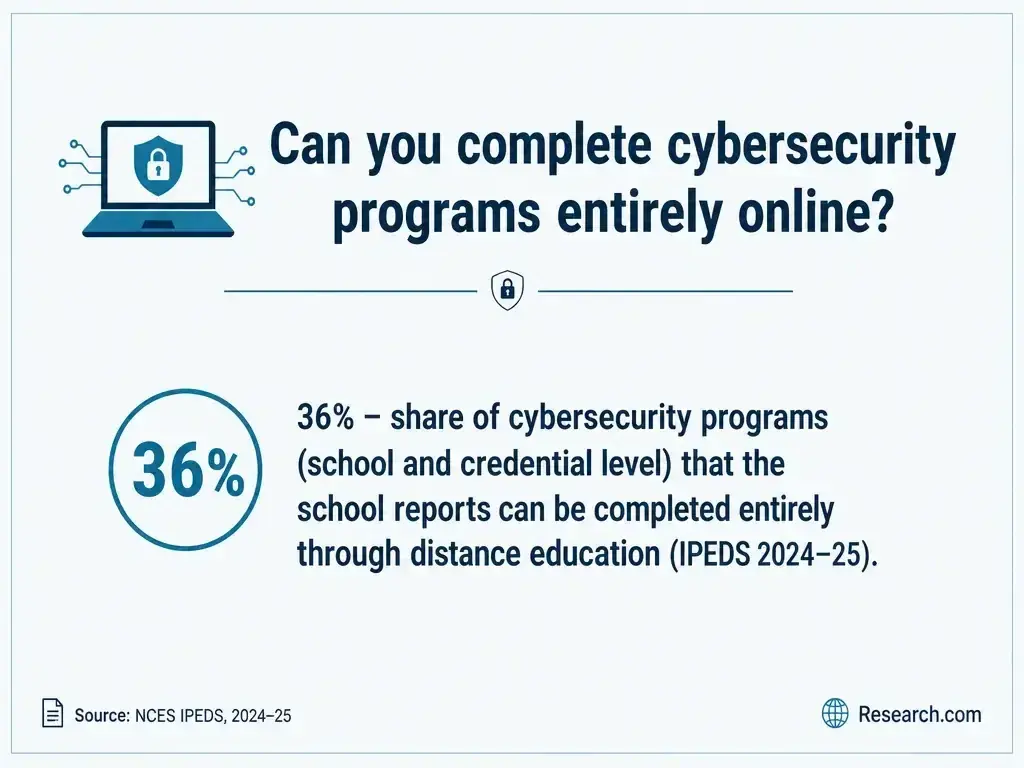
Online coursework can make lectures, reading, and some virtual security labs easier to fit around work or a rural commute. Campus study may offer direct access to networking equipment, instructors, and local employers. Hybrid programs combine these approaches, but "online" does not establish that every lab, assessment, or internship can be completed remotely.
Ask for the delivery format of each required course, including whether lab software needs a capable computer or scheduled access. If comparing institutions through a best ranked online universities resource, verify that the particular cybersecurity associate degree - not just the institution - is available to New Mexico students and fits your practical-learning needs. Cybersecurity work generally does not require a New Mexico occupational license, but online delivery also does not guarantee eligibility for a professional certification exam.
There is no single reliable statewide price for this degree: charges vary by college, residency classification, enrollment load, and whether courses carry lab or technology fees. A published tuition rate is therefore a starting point, not an average total cost. Compare current itemized estimates from the programs you are considering.
Your estimate should include required tuition and fees, books, software, a suitable computer, possible certification exam fees, transportation, and living expenses. Add earnings you may forgo if a lab schedule reduces your work hours; subtract aid you are actually eligible to receive. Compare the resulting cost with your likely first job, not the national analyst median. If further study is part of your plan, a cheap bachelor degree online listing may help frame later costs, but it does not establish that your associate credits will transfer.
Start with the Free Application for Federal Student Aid to determine eligibility for federal grants, loans, and other aid at an eligible institution (Federal Student Aid). New Mexico residents should also ask the college whether they qualify for the New Mexico Opportunity Scholarship or, if applicable, the Legislative Lottery Scholarship. Eligibility, covered charges, enrollment rules, and continuation requirements differ; an aid offer is more useful than a general scholarship description (New Mexico Higher Education Department).
Ask the financial aid office to show net cost by term, including fees and expenses that scholarships will not cover. Working students can also ask employers about tuition assistance. Do not assume that aid pays for a laptop, optional certification exam, or travel to required labs.
Admissions requirements vary by institution. Applicants should expect to submit an application and academic records; colleges may also use placement information to determine where students start in mathematics, writing, or computing. A student new to IT may be able to enroll without prior cybersecurity experience but could need introductory courses before advanced security labs.
At University of New Mexico-Los Alamos Campus or Eastern New Mexico University Ruidoso Branch Community College, verify the current degree award, catalog year, prerequisites, and course schedule directly before applying. Ask whether prior college coursework or documented learning can satisfy requirements, and obtain a written evaluation rather than assuming credits will count toward the cybersecurity major.
A strong course plan connects general education - especially writing and quantitative reasoning - with operating systems, networking, scripting, system administration, and security fundamentals. Applied courses may involve configuring a network, analyzing logs, managing access, or writing an incident report. Those tasks mirror the communication and troubleshooting skills employers assess alongside technical knowledge.
Compare the required curriculum, not the list of electives. If a program advertises penetration testing but requires little networking or systems work, ask how students build the foundations for that course. Also ask which labs use current tools, whether projects can become portfolio examples, and whether an internship or capstone is required or merely available.
Associate-level programs may emphasize network defense, systems administration, digital forensics, or secure cloud operations through electives or project choices. A specialization is useful only if foundational courses remain strong: someone interested in incident response still needs networking, operating-system, and documentation skills.
Match the emphasis to opportunities you can reach. A network-focused path may align with an initial IT operations role, while a forensics emphasis is less persuasive without substantial lab work and a realistic local hiring route. Confirm whether a named concentration appears on the degree record or is simply a suggested set of electives.
Start with your intended first job and whether you want the option to continue studying. Then compare programs against the requirements that would make that outcome plausible. Rankings can narrow a shortlist, but they cannot tell you whether a particular lab schedule, transfer agreement, or net price works for you.
Use these checks when speaking with admissions, an academic adviser, and program faculty:
- Confirm the exact degree awarded, required credits, course rotation, and a term-by-term completion plan.
- Verify institutional accreditation with the recognized accreditor and ask how any claimed industry recognition applies to this specific program; neither guarantees a job or certification.
- Request an itemized total-cost and aid estimate, including required technology and travel.
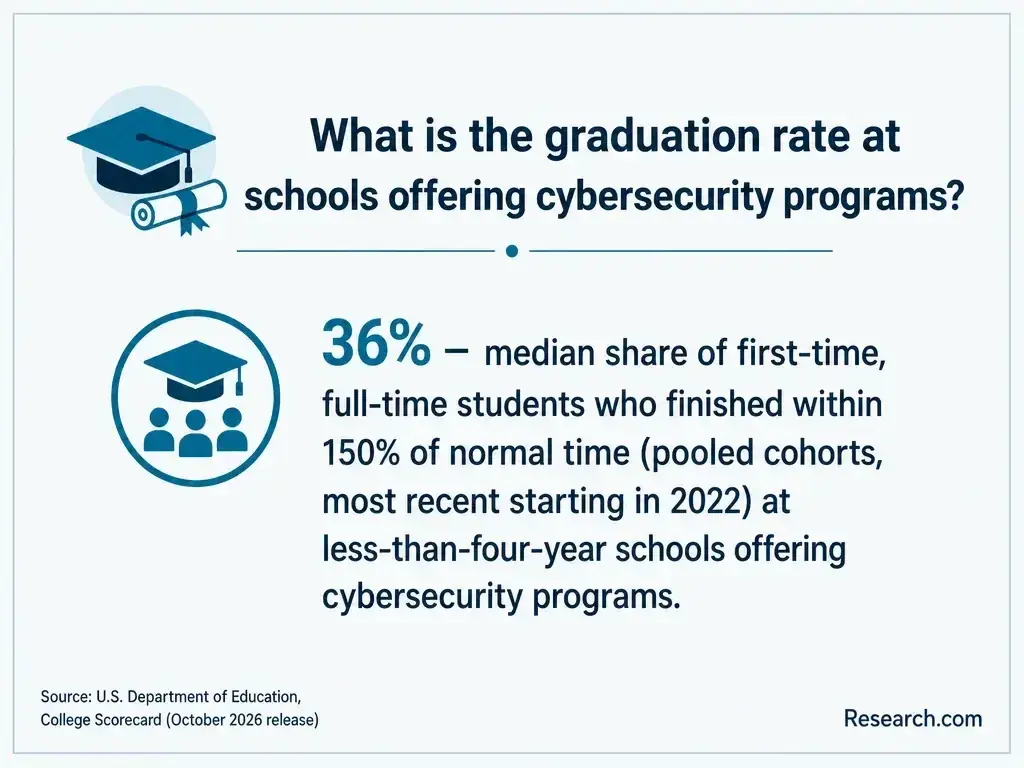
- Ask to see lab assignments, internship access, and outcomes for associate degree graduates rather than college-wide averages.
- If transfer matters, obtain a written course-by-course evaluation from the receiving institution before choosing electives.
Two common mistakes are choosing an AAS solely because its title sounds job-ready without checking hands-on content, and choosing an AA or AS solely for transfer without checking how major courses apply. Students planning further study can use an easy bachelors degree resource to explore possibilities, but should rely on an official transfer evaluation - not a list or ranking - to protect the value of their associate credits.
Realistic first steps can include IT support, junior network support, or systems operations roles with security responsibilities. With experience and demonstrated ability to investigate alerts, secure systems, and communicate findings, a graduate may become competitive for more specialized security work. Information security analyst is a useful long-term comparison occupation, not a promised first position.
Professional certifications can help demonstrate particular skills, but requirements and employer preferences vary. They are generally optional hiring signals rather than New Mexico occupational licenses. Ask whether a program's courses prepare students for a specific exam, whether the exam is included in the cost, and whether local employers value it. A strong project portfolio and relevant work experience may be just as important to the first move into security.
The U.S. Bureau of Labor Statistics projects 21% national growth for information security analysts from 2025 to 2035. That signals sustained demand for the occupation, but it is not a projection of New Mexico openings or entry-level vacancies. Graduates should search by both security and foundational IT job titles, then compare postings for experience, clearance, and location requirements.
Geography matters: an employer may require on-site work even when much of the technical work uses remote systems. For students considering a rural campus or an online degree, access to local IT work and internships may matter more than the program's delivery label. AI-assisted security tools also make it important to practice validating alerts and explaining decisions, rather than depending on a tool's output alone.
Best Cybersecurity Associate Degree Programs & Schools in New Mexico for 2027
Investing in an associate degree is an important decision. Research.com created its ranking to make relevant local options easier to compare, using reported outcomes, costs, debt, accreditation, and student-support measures rather than relying on a program name alone. The team checks available data for quality and consistency, but rankings should complement - not replace - a review of each program's current catalog and costs.
Best-program rankings compare programs in the same occupation and location and include only programs with completions reported to IPEDS. They assess student outcomes, earnings and return on investment, costs and debt, and quality and recognition. Relevant programmatic accreditation or industry recognition accounts for 20% of the score, institutional accreditation for 10%, and student support for 10%. Outcomes, earnings, and costs make up the remaining 60%, with weights distributed through an entropy-based method. Most-affordable rankings instead score costs and debt only; accreditation and other quality measures are not part of that score.
The ranking draws on the following sources. Some cover occupations other than cybersecurity and should not be mistaken for cybersecurity-specific approval bodies:
- IPEDS database - institutional reporting, including program completions and college measures.
- National Center for Education Statistics - federal education data and definitions.
- College Scorecard database - available college cost, debt, and earnings measures.
- Peterson's database - supplemental institutional information.
- Commission on Accreditation of Allied Health Education Programs - occupation-specific recognition data where applicable, not cybersecurity accreditation.
- Accrediting Bureau of Health Education Schools - health-education accreditation data where applicable.
- Commission on Dental Accreditation - dental-program accreditation data where applicable.
- Dental Assisting National Board - dental-assisting recognition information where applicable.
- National Center for Construction Education and Research - construction-industry recognition information where applicable.
- Apprenticeship.gov Partner Finder - apprenticeship-provider information where applicable.
These sources help readers compare reported value and outcomes, but IPEDS coverage excludes programs without reported completions. A missing program is not necessarily unapproved or poor quality. For more detail, see Research.com's ranking methodology.


Frequently asked questions about cybersecurity programs in New Mexico
Is a cybersecurity associate degree worth it?
It can be if the net cost is manageable and the program provides substantial labs, a feasible completion schedule, and a route to the jobs you can realistically pursue. Compare likely entry-level IT work with the total cost; do not use experienced analyst pay as your expected starting salary.
Should I choose an AAS or an AA/AS?
Choose based on the curriculum and your goal. An AAS often emphasizes applied work; an AA or AS may give you more transferable coursework. Neither label guarantees employment or transfer credit, so verify both outcomes with the relevant institutions.
Can I complete the degree entirely online?
Possibly, but delivery varies by program and required course. Confirm how labs, assessments, and any internship work, including equipment needs and in-person attendance, before enrolling.
Do I need a license to work in cybersecurity in New Mexico?
Cybersecurity roles generally do not require a New Mexico occupational license. Employers may instead request experience, particular technical skills, certifications, or clearance eligibility; check the roles you want.
Will financial aid cover the entire degree?
Not necessarily. Federal and New Mexico aid depends on eligibility and may leave fees or living and technology costs uncovered. Ask for a personalized, term-by-term net-cost estimate.
- U.S. Bureau of Labor Statistics - Information Security Analysts
Used to verify salary, employment outlook, and typical education requirements.
https://www.bls.gov/ooh/computer-and-information-technology/information-security-analysts.htm - NCES College Navigator (IPEDS)
Used to verify programs offered and institutional accreditation.
https://nces.ed.gov/collegenavigator/ - CompTIA Security+
Professional certification reference for graduates of this occupation.
https://www.comptia.org/certifications/security - University of New Mexico-Los Alamos Campus - official website
Official school website (programs, tuition, admissions).
https://losalamos.unm.edu/ - Eastern New Mexico University Ruidoso Branch Community College - official website
Official school website (programs, tuition, admissions).
https://www.ruidoso.enmu.edu/