# 1 position


Audited and Verified:
Our Editorial and Data Verification Process
Research.com uses government datasets, official education statistics and primary institutional information to support its career and degree guides. Our review process checks factual accuracy, occupational definitions, source dates and the requirements associated with the credentials discussed.
How This Article Was Fact-Checked
Our editorial team verifies salary estimates, employment projections, education requirements and program information against original data providers and official organizations. Salary figures are checked against the relevant occupational definitions and reporting periods. Information about licensure, accreditation and required in-person training is reviewed separately.
Fact-checked and verified on:

Co-Founder and Chief Data Scientist

Reviewed by Karolina Broda
Fact-Checker and Data Verification
Choosing a criminal justice associate degree in Trinidad means checking more than a program name: you need to know what you will study, what it will cost, and whether it supports your career goal. The U.S. Bureau of Labor Statistics projects 3.5% growth for police and sheriff's patrol officers from 2025 to 2035, but a degree alone does not qualify someone for that job. This guide helps prospective students and working adults evaluate their options alongside the Research.com team of data scientists' Best Criminal Justice Associate Degree Programs in Trinidad for 2027 ranking.
Expect an introduction to how courts, law enforcement, and corrections operate, alongside general education that develops writing, research, and quantitative reasoning. An associate degree can support employment applications or further study, but its value depends on the degree awarded and the courses a future school or employer will recognize.
The distinction between degree types matters more than a similar-sounding program title. Use this comparison to identify which curriculum questions to take to Trinidad State College; it does not establish that every degree type is offered locally.
| Associate degree type | Typical emphasis | Best fit | Point to verify |
| AA | General education and social sciences | Students prioritizing transferable coursework | How required criminal justice courses transfer |
| AS | General education with more quantitative or scientific coursework | Students seeking that course mix and a transfer pathway | Whether the intended pathway accepts the credits |
| AAS | Occupation-focused coursework | Students prioritizing applied preparation | Whether technical credits transfer if plans change |
Ask for the current catalog and degree map, including any internship, observation, or applied course requirements. Similar degree names do not mean identical practical experience or credit-transfer outcomes.
Possible workplaces include local or county government, courts, correctional facilities, and organizations that need security or administrative support. In a smaller community such as Trinidad, the number and type of nearby openings may be limited; check actual vacancies and commuting expectations before choosing a career-focused curriculum.
Job titles have different entry rules. A records or administrative role may emphasize writing, confidentiality, and database skills, while a sworn police role has separate Colorado Peace Officer Standards and Training requirements and employer screening. A criminal justice associate degree may strengthen an application, but it is not itself authorization to serve as a peace officer.
There is no reliable single salary for all criminal justice associate degree holders in Trinidad. The U.S. Bureau of Labor Statistics reports a $76,210 national median annual wage for police and sheriff's patrol officers in May 2025. That median covers workers across experience levels and locations; it is neither a Trinidad wage nor a likely starting salary. It is relevant only if you pursue and qualify for a patrol-officer position.
For a useful pay comparison, match the exact job title on current local postings to its stated pay range, schedule, and eligibility rules. Compare that potential income with what you could earn without the degree, rather than treating one national occupational median as the return on every criminal justice pathway.
Associate degrees commonly require roughly two years of full-time study, but the controlling figures are the college's published credit requirements and course schedule. Part-time enrollment, prerequisites, course availability, or an internship can extend the timeline. Transfer or approved prior-learning credit may shorten it if the college applies those credits to this specific degree.
Be cautious with promises resembling an online associate's degree in 6 months. An accelerated timeline is only useful if you can complete the remaining required credits, take courses when offered, and meet any practical requirements without sacrificing the pathway you need. Request a term-by-term completion plan before budgeting around a projected finish date.
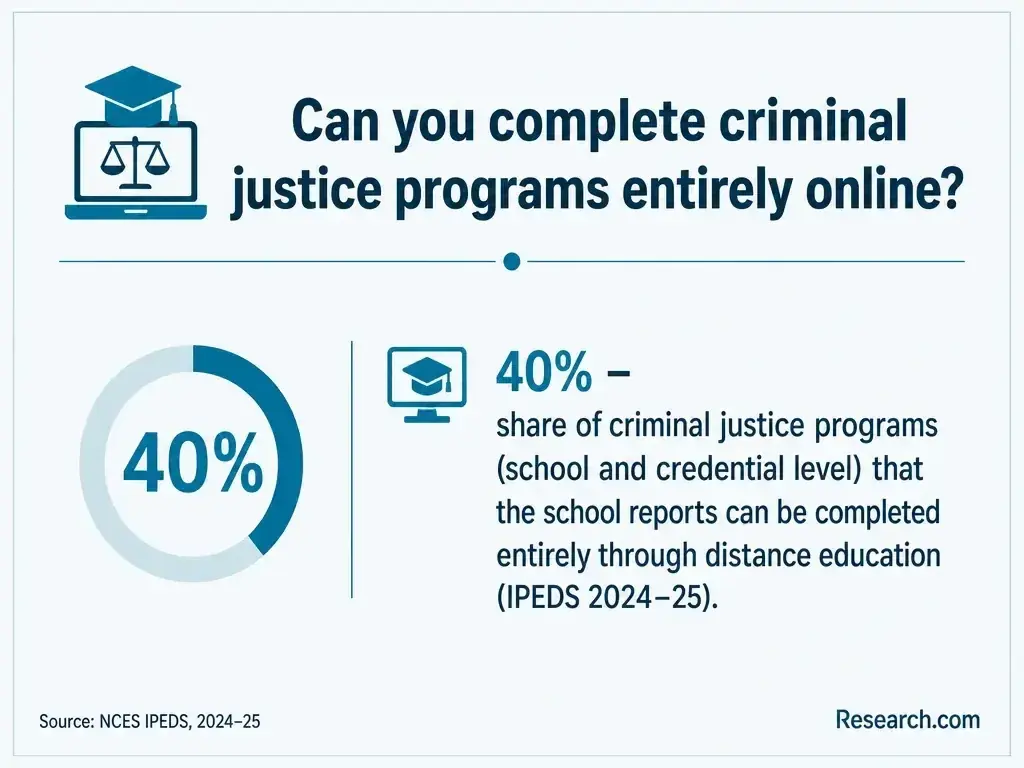
Online coursework can make reading, writing, and scheduled discussions easier to fit around work. Campus courses may offer more direct access to instructors and local contacts. A hybrid degree can combine both, but an online course label does not establish that an entire program can be completed remotely.
Check whether examinations, orientation, field observation, internships, or other applied requirements require attendance at a particular site. For a Trinidad resident, travel to a placement can outweigh the convenience of online classes. When comparing accredited online colleges non profit, verify each institution's accreditation, the specific associate degree's availability to Colorado students, total charges, and how its credits will be evaluated. Accreditation does not, by itself, establish transferability or eligibility for a particular occupation.
A defensible Trinidad-wide average cannot be given without comparable, current prices for the specific associate programs a student can attend. Instead, obtain a written estimate from Trinidad State College for your residency status, enrollment pace, and expected completion time. For an online alternative, request the same information so the comparisons use equivalent assumptions.
Tuition is only part of the investment. Add mandatory fees, books and software, a computer and internet access, travel to campus or any required placement, living expenses, and earnings forgone while studying. Include background-check or application expenses only where your intended placement or job actually requires them. Subtract grants, scholarships, and employer assistance you are eligible to receive; treat loans as financing, not a price reduction.
A low per-credit price can still be costly if courses are offered infrequently or credits do not count toward your goal. Compare the estimated cost to complete, not just the advertised tuition rate.
Eligible students can use the Free Application for Federal Student Aid to be considered for federal aid, including Pell Grants and federal loans, at a participating institution. Colorado students should also ask Trinidad State College about state aid, institutional scholarships, residency rules, and application deadlines. Federal Student Aid and college financial aid offices are the authoritative sources for individual eligibility; an associate degree's subject alone does not determine an award.
If you work, ask whether your employer reimburses approved coursework and whether reimbursement depends on grades or continued employment. Compare aid offers using the amount you must repay and the cost of staying enrolled long enough to finish. Borrowing less for a program that cannot meet your goal is not necessarily the better deal.
Start with the current Trinidad State College admissions and program pages. Confirm the application documents, placement process, residency classification, and whether any major courses have prerequisites. College admission and admission to a particular course or field placement can be different steps.
Ask separately about any background screening or other conditions for an internship or intended employer. Do not assume that being admitted to a criminal justice associate degree means you will meet a law enforcement agency's hiring standards or Colorado peace-officer eligibility rules.
Criminal justice associate curricula commonly combine introductory criminal justice, policing, courts, corrections, and criminal law with writing and other general education. Depending on the degree map, students may also encounter ethics, research, or applied coursework. These are examples to check against the current Trinidad State College catalog, not a claim that every course is offered in every term.
Read course descriptions, not only titles. Writing accurate reports, evaluating evidence, communicating with the public, handling confidential information, and understanding legal limits are useful across several roles. If you need practical experience, ask whether the degree includes an internship or field activity, whether it is required, and who arranges the placement.
Relevant areas of emphasis may include policing, courts, corrections, or security, but availability must be confirmed in the current catalog. A collection of electives is not necessarily a formally designated specialization. Ask which courses satisfy degree requirements, how often they run, and whether the emphasis appears on the academic record.
Choose electives for a defined next step. Someone interested in court administration might prioritize legal processes and precise writing; someone considering policing should examine applied coursework while separately checking Colorado Peace Officer Standards and Training requirements. Do not pay for extra classes on the assumption that a specialization changes occupational eligibility.
Start with the job or next academic step you want, then work backward to the required degree, coursework, experience, and eligibility rules. The 2027 ranking can help narrow the options, but it cannot tell you whether a particular curriculum fits your plans. Searches for an easiest bachelor degree, for example, do not answer whether the associate credits you are buying now will be accepted later.
Use these checks when speaking with admissions staff and the criminal justice program:
A common mistake is selecting the least expensive advertised program without accounting for completion probability, debt, lost work time, and the value of credits that actually advance your goal. A reasonable return-on-investment comparison also considers your current earnings, plausible later earnings, the period over which benefits may occur, and the value of receiving those benefits later rather than now.
An associate degree can support applications for criminal justice-related administrative or security work, provide coursework relevant to corrections, or form part of a longer academic plan. These paths differ substantially: an office-based role may depend most on records and communication skills, while sworn law enforcement requires separate screening and Colorado-specific qualification steps.
Progression may come through experience, employer instruction, and responsibility for more complex work; it is not automatic on graduation. Likewise, lists of masters degrees with the highest roi cannot establish whether this associate degree is a sound investment. Judge it against the requirements and earnings prospects of the specific path you intend to pursue.
The U.S. Bureau of Labor Statistics projects 3.5% national employment growth for police and sheriff's patrol officers from 2025 to 2035. This indicates a national occupational outlook, not the number of openings in Trinidad or demand for associate degree holders. Local hiring may depend on agency budgets, vacancies, and applicants' ability to meet entry standards.
Before enrolling, review recent openings within a commute you would accept. Record the job titles, minimum education, screening requirements, starting pay, and whether an associate degree is required, preferred, or not mentioned. If nearby opportunities do not match the degree's coursework, consider whether the skills or credits will serve another realistic goal. Comparing high paying trade school jobs may clarify your earnings priorities, but those occupations have different preparation and entry requirements; their advertised pay is not a direct measure of this degree's value.
Investing in an associate degree is an important decision. Research.com created its program ranking to help readers compare options using outcomes, costs, and quality indicators rather than reputation alone. Programs are compared with others in the same occupation and location; only programs with completions reported to IPEDS are included. That makes the ranking a useful starting point, not a complete inventory of every possible program.
Best-program rankings evaluate student completion and full-time and part-time retention; earnings one year after completion and earnings relative to annual attendance cost; tuition, attendance cost, debt, and federal loan default rates; and accreditation, relevant recognition, and student support. Programmatic accreditation or relevant industry recognition accounts for 20% of the score, institutional accreditation for 10%, and student support for 10%. The remaining 60% covers outcomes, earnings, and costs, with indicator weights assigned through an entropy-based method. A separate most-affordable ranking uses only cost and debt measures, also weighted through that method; its score does not include accreditation or other quality indicators.
Research.com used the following sources across its program-ranking methodology. Some address occupations other than criminal justice and should not be mistaken for criminal justice program accreditors:
These measures help readers identify programs worth investigating, but school-level earnings or debt may not describe criminal justice graduates specifically. Verify the current degree, curriculum, price, and career requirements directly with the college. See Research.com's methodology for more information about how rankings are created.
# 1 position
# 2 position
Criminal Justice/Police Science
Delivery mode: On Campus (May Include Online Courses)
30.86
/ 100
Final score
Accreditation
Institutional accreditation from Higher Learning Commission.
Trinidad State College received a Research.com Trade Program Score of 30.86/100.
Check its current catalog for the exact criminal justice degree title, required courses, delivery format, and availability. Do not assume that similarly named degrees have the same transfer or career-focused requirements.
No degree alone establishes that eligibility. Check Colorado Peace Officer Standards and Training requirements and the hiring agency's standards before choosing courses for that goal.
An AA generally favors transferable general education, while an AAS generally emphasizes applied coursework. The better choice depends on your intended next step and written confirmation of how the specific credits will count.
Possibly, but verify the requirements of the specific program. An internship, field activity, examination, or other component may require in-person attendance even when classes are online.
It may be if the degree supplies coursework, transferable credits, or skills your goal calls for at a manageable total cost. Compare aid-adjusted expenses and time away from work with actual job requirements; neither a ranking nor a national salary figure can establish your individual return.