Choosing a fast online counseling master's program means checking more than its advertised finish date: the degree must also fit your work schedule, budget, and intended Ohio credential. This guide is for career changers and working professionals comparing those trade-offs. It accompanies the 2027 Fastest Online Master's in Counseling Degree Programs Ranking in Ohio, created by the Research.com team of data scientists to help students make an informed choice about which programs are worth considering. You'll learn how to assess timelines, clinical training, costs, and career outcomes before applying.
Key findings about online Counseling degrees in Ohio
For Ohio clinical practice, verify that a program's coursework and supervised training align with the Ohio Counselor, Social Worker, and Marriage and Family Therapist Board's requirements; online delivery alone does not establish license eligibility.
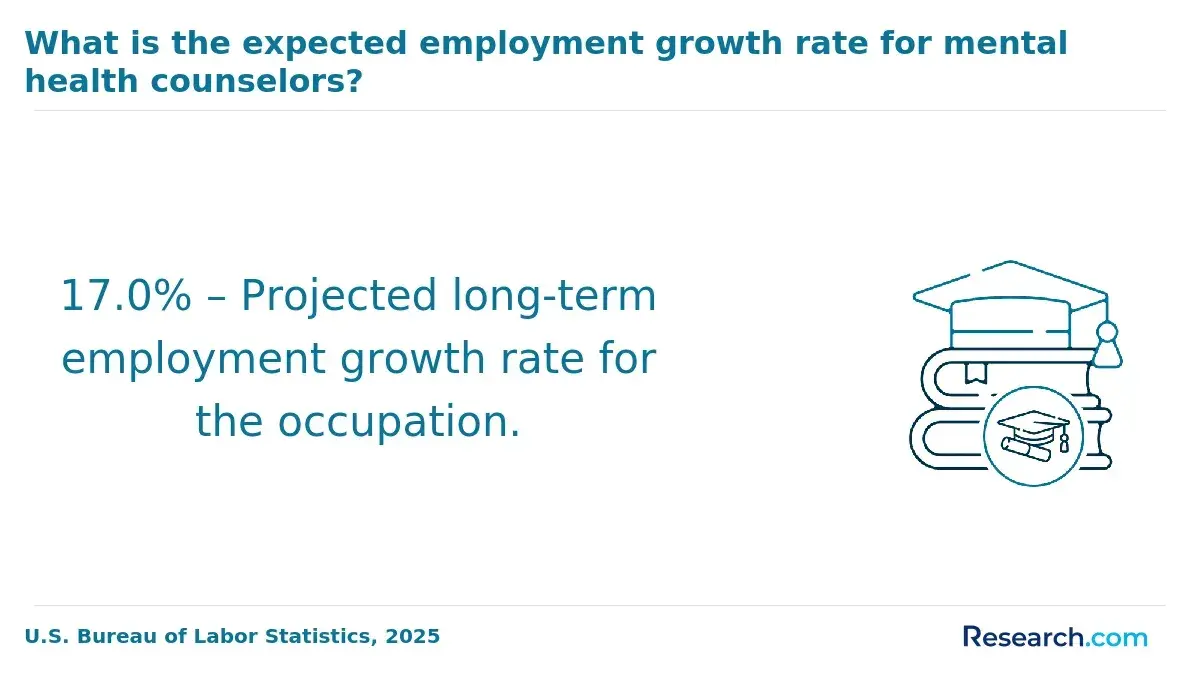
Nationally, the median annual wage for substance abuse, behavioral disorder, and mental health counselors was $59,350 in May 2025, with employment projected to grow 18% from 2025 to 2035 (U.S. Bureau of Labor Statistics). Those figures describe occupations, not the earnings of new graduates.
The fastest practical route is the one that lets you complete both courses and a suitable local placement on schedule. Compare total tuition, placement support, and your ability to keep working - not just the advertised number of semesters.
What can I expect from an online Counseling degree in Ohio?
An online counseling master's combines graduate coursework with supervised, in-person clinical or school-based experience. Classes may be live, self-paced within deadlines, or a mix of both; "online" does not mean that client-contact requirements can be completed remotely. Expect training in assessment, ethics, counseling techniques, and work with diverse clients, followed by a practicum and internship arranged under program rules.
Your intended credential should drive the search. Clinical mental health counseling prepares students for the Ohio professional counselor pathway, while school counseling targets work with pupils and a separate state educator credential. A general master's or a certificate may suit professional development, but it is a poor substitute for a qualifying degree if licensure is the goal. Compare the degree's stated outcomes with the Ohio Counselor, Social Worker, and Marriage and Family Therapist Board or the Ohio Department of Education and Workforce, as applicable.
Use the best counseling programs comparison alongside the fastest ranking if curriculum and outcomes matter more to you than finishing at the earliest possible date.
Where can I work with an online Counseling degree in Ohio?
Clinical mental health graduates may pursue roles in community mental health organizations, hospitals, outpatient practices, substance-use treatment programs, or, once appropriately licensed, private practice. School counseling graduates generally seek positions in Ohio schools. Rehabilitation-focused training may lead toward vocational rehabilitation or disability services. The appropriate degree, credential, and job duties differ across these settings (Ohio Counselor, Social Worker, and Marriage and Family Therapist Board; Ohio Department of Education and Workforce; U.S. Bureau of Labor Statistics).
Location affects the choice of program as well as the later job search. If you live far from a campus or a large healthcare network, ask whether the university can approve a placement near your home and whether the available supervisors meet its standards. If you expect to move after graduation, check the destination state's rules before enrolling; an Ohio-oriented curriculum is not an automatic license in another state.
Pay depends on the occupation, employer, experience, and license - not simply possession of a master's. The table compares national occupational medians from May 2025. It is useful for distinguishing career directions, but it should not be read as an Ohio starting-salary forecast (U.S. Bureau of Labor Statistics, Occupational Outlook Handbook).
Career direction
U.S. median annual wage, May 2025
What to consider
Clinical mental health or addiction counseling
$59,350
Check the credential and supervision a specific position requires.
School counseling
$64,330
Compare school-district pay schedules and educator-credential rules.
Rehabilitation counseling
$46,850
Assess whether the program's training fits rehabilitation roles.
To judge whether the degree is worth its cost, compare your likely post-degree opportunities with your current earnings. Include tuition, borrowing, income you might give up while studying, and any period of supervised work before reaching your target role. A national median is a benchmark, not a promised return.
The program pages below point to different decisions: credential target, delivery format, published requirements, and educational setting. Treat each as a starting point for verification, particularly because a program's online courses do not eliminate in-person fieldwork.
Capital University - counselor education catalog: The academic bulletin is the place to inspect the program's formal course and degree requirements, rather than relying on an abbreviated description. Use it to ask an adviser which required courses are offered in each term and whether your proposed pace is feasible (Capital University academic bulletin).
John Carroll University - online clinical mental health counseling: This is the clearest explicitly online, clinical-mental-health-focused option among John Carroll's listed counseling pages. It merits a closer look if you need remote coursework but can secure the program's required supervised experience where you live (John Carroll University program page).
Capital University - master's in counselor education: The main program page provides a prospective-student view to read alongside Capital's formal bulletin. Comparing the two helps applicants distinguish the program's advertised format and pathways from the specific requirements they would have to complete (Capital University program page and academic bulletin).
Heidelberg University - Master of Arts in Counseling: Its counseling degree page is the key source for identifying the pathway that matches your intended practice setting. Applicants should confirm the current delivery format and field-placement arrangements for their chosen pathway rather than assuming every option can be completed online (Heidelberg University program page).
John Carroll University - school counseling: This separate school-counseling program addresses a different credential goal from John Carroll's online clinical mental health program. Choose between them based on whether you want to counsel students in schools or pursue clinical practice; verify the school program's current course format before comparing completion times (John Carroll University program pages).
Winebrenner Theological Seminary - clinical counseling: The seminary setting is a concrete distinction for applicants who want to evaluate clinical training in that educational environment. Confirm the degree's current delivery, clinical-site expectations, and alignment with your intended state license before treating it as interchangeable with another clinical counseling program (Winebrenner Theological Seminary program page).
These descriptions do not establish a comparable completion, placement, or licensure-pass rate across the programs. Request current program-level figures directly from each school before using outcomes to break a tie.
Plan on roughly two to three years for a counseling master's, depending on the program and whether you attend full time or part time. An accelerated schedule may shorten the coursework portion, but clinical placements, course sequencing, and site availability can determine the actual graduation date. Ask for a term-by-term plan built around your intended start date and work hours, not just the shortest timeline in a brochure (Capital University; John Carroll University; Heidelberg University; Winebrenner Theological Seminary program materials).
A faster program makes sense when required courses are offered predictably and you can devote enough time to fieldwork without risking a delayed placement. If you must work full time or arrange care responsibilities around an internship, a longer, reliable part-time route may be the faster route to a completed degree in practice.
The principal difference is where you take classes, not whether you need supervised experience. This comparison helps you match delivery format to the parts of counseling training that are least flexible.
Consideration
Online program
On-campus program
Course attendance
Remote classes, sometimes with scheduled live meetings
Regular travel to campus for classes
Field experience
Requires an approved site and supervision under program rules
Also requires approved field experience; nearby school relationships may help
Best fit
Students who need geographic or scheduling flexibility and can arrange a suitable placement
Students who prefer face-to-face classes and can reach campus consistently
Ask about required campus visits, live-session times, placement approval, and support for students outside the university's immediate area. Neither format establishes Ohio licensure eligibility by itself; the curriculum and supervised training must fit the relevant state pathway (Ohio Counselor, Social Worker, and Marriage and Family Therapist Board; Ohio Department of Education and Workforce).
There is no single verified statewide average in the cited sources that represents the total price of an online counseling master's. Published tuition may be quoted by credit, semester, or program, and it can exclude fees, books, travel for placements, and any required campus visits. Public-university resident pricing may also differ from nonresident or online pricing; confirm the rate that applies to your enrollment rather than assuming an in-state discount (National Center for Education Statistics, IPEDS; institutional tuition schedules).
For a usable comparison, request each school's required credits, current tuition and mandatory fees, expected completion schedule, and placement-related costs. Then compare estimated total cost after grants and employer support. The most affordable counseling programs list can narrow your search, but the lowest tuition quote is not necessarily the lowest cost to finish.
Eligible students may use federal graduate aid at participating institutions, alongside institutional scholarships, employer tuition assistance, and any Ohio funding for which their program and personal circumstances qualify. Submit the FAFSA and ask the financial aid office which awards apply to online graduate enrollment. Confirm scholarship renewal rules and whether a change to part-time study affects eligibility (Federal Student Aid; institutional financial aid offices).
Do not assume a new graduate student can use Graduate PLUS to cover any remaining balance. Under the federal rules effective July 1, 2026, new graduate borrowers generally cannot take out new Graduate PLUS loans; limited transitional eligibility may apply to students who borrowed for the same program before that date. Check your individual status with the school and Federal Student Aid before committing to a financing plan (Federal Student Aid).
Borrow only after comparing the net cost with the earnings and credential requirements of your intended job. A potentially valuable degree can still be a poor financial fit if its payment schedule requires debt you cannot reasonably manage.
View the chart data as a table
Program length distribution across ranked programs (Source: Research.com)
Category
Value
24–25 months
4
26–27 months
0
28–29 months
0
30–31 months
1
32–33 months
0
34–35 months
1
Applicants generally need a bachelor's degree and must meet a school's stated academic and application requirements. Programs may request transcripts, recommendations, a statement of purpose, an interview, or evidence of readiness for supervised work; prerequisites and deadlines vary, so use the current admissions page for each program rather than a general checklist (Capital University; John Carroll University; Heidelberg University; Winebrenner Theological Seminary admissions and program materials).
If you are changing careers, ask whether a psychology major is required, whether prior coursework can satisfy a prerequisite, and whether any graduate transfer credits will be accepted. The easiest counseling programs comparison may help you explore admissions options, but a less restrictive entry process does not reduce the clinical or licensure requirements you may face later.
Expect coursework in counseling theories, helping skills, ethics, assessment, human development, research, and work with culturally diverse clients. Clinical mental health pathways add clinically oriented assessment and treatment preparation; school counseling pathways focus on student development and the school setting. Supervised practicum and internship connect classroom skills to the intended role (Council for Accreditation of Counseling and Related Educational Programs; institutional program catalogs).
Compare course sequence as carefully as course titles. If a prerequisite is offered only at certain times, missing it may delay fieldwork even in an accelerated program. Request the current catalog and sample schedule, then check that the curriculum matches the Ohio credential you plan to seek.
Common directions include clinical mental health, school, addiction, and rehabilitation counseling. They are not interchangeable labels: each points toward different clients, work settings, and potentially different credential requirements. The Ohio programs highlighted here illustrate why applicants should identify a specific pathway within a degree instead of relying on "counseling" in its title (institutional program pages; Ohio Counselor, Social Worker, and Marriage and Family Therapist Board; Ohio Department of Education and Workforce).
Choose clinical mental health if your goal is the relevant Ohio professional counselor pathway; choose school counseling if you intend to work as a school counselor and need the corresponding educator preparation. For addiction or rehabilitation work, ask whether the available courses and field sites provide the preparation required by your target employer or credentialing body. A concentration is valuable when it changes your training in a way your intended role recognizes.
Start with the job and credential you want, then compare programs against requirements that could prevent you from reaching them. A fast timeline or attractive price is not enough if required courses, supervision, or placements do not fit your location and schedule.
Use these checks before applying or paying a deposit:
Identify the intended Ohio license or school credential and ask the relevant state authority which education and supervised-experience rules apply.
Verify the institution's recognized accreditation, any programmatic accreditation claimed, and the program's written explanation of how its curriculum fits your intended credential.
Request a personalized course sequence, including fieldwork, required live classes, and any campus visits; ask what happens if a placement is delayed.
Compare total estimated cost after aid, likely borrowing, lost work time, and the probability that your schedule will let you finish.
Ask for current program-level completion, placement, and applicable exam-result information, including the reporting period and the number of students represented.
A common mistake is treating accreditation, licensure eligibility, and a license as the same thing. They are separate checks: institutional or programmatic accreditation describes educational recognition; state eligibility depends on the applicable rules; licensure requires completing the state's remaining steps. Use the most valuable counseling programs comparison to broaden your shortlist, then test value against your own costs, current earnings, likely career change, and time horizon.
View the chart data as a table
Median wage by counseling career path (U.S., BLS May 2025) (Source: BLS)
Category
Value
Psychologists
99,110
Postsecondary Teachers
85,330
Marriage & Family Therapists
66,940
School & Career Counselors
64,330
Mental Health Counselors
59,350
Rehabilitation Counselors
46,850
A clinical counseling graduate might begin in an appropriately supervised position and work toward a higher level of independent practice where eligible. A school counseling graduate would follow the educator-credential route for school roles. Depending on their preparation and an employer's requirements, graduates may also consider addiction treatment, rehabilitation services, or related community-service work (Ohio Counselor, Social Worker, and Marriage and Family Therapist Board; Ohio Department of Education and Workforce; U.S. Bureau of Labor Statistics).
If your goal is independent clinical practice, ask programs how their graduates typically move from degree completion through examination, supervised experience, and Ohio licensure. If your goal is school work, compare approved school placements and educator-credential preparation instead. Students seeking a quick move into a nonlicensed helping role should also compare the master's investment with roles that do not require it.
View the chart data as a table
Projected job growth 2025-2035 - Substance Abuse, Behavioral Disorder, and Mental Health Counselors (U.S.) (Source: BLS)
Category
Value
Substance Abuse, Behavioral Disorder, and Mental Health Counselors
18
All occupations
3
National demand varies substantially by specialty. The U.S. Bureau of Labor Statistics projects 18% employment growth for substance abuse, behavioral disorder, and mental health counselors from 2025 to 2035. That projection suggests a stronger national growth environment for clinical and addiction work than for some other counseling specialties, but it does not measure vacancies in your Ohio community or guarantee a job after graduation (U.S. Bureau of Labor Statistics, Employment Projections).
For a local decision, review current postings from the types of Ohio employers where you want to work. Note the credential level, supervision arrangements, location, and experience they request. Then ask prospective programs whether they can support placements in that setting. This is particularly important if you need to remain in a rural area or cannot relocate for supervised training.
2027 Fastest Online Master's in Counseling Degree Programs Ranking in Ohio
Investing in a graduate degree is a consequential decision. Research.com developed its counseling rankings to help readers compare programs using consistent evidence rather than promotional claims, and its team checks the quality, credibility, and accuracy of the underlying information. The fastest ranking orders programs by its named dimension; a short advertised timeline should still be checked against each school's current course schedule and field-placement requirements.
The ranking draws on these data sources:
IPEDS database: institutional reporting on enrollment, completion, and costs.
Peterson's database: program and institutional information used in comparisons.
Research.com's broader counseling methodology evaluates graduate outcomes, applicable licensure-exam results, accreditation, federal aid eligibility, and cost. Readers can use the fastest ranking to identify promising timelines, then compare the programs' fit and financial implications. See Research.com's methodology for more detail on how its rankings are created.
# 1 position
Capital University
Master
Master of Arts in Clinical Mental Health Counseling
Delivery mode: hybrid
78.30
/ 100
Final score
Program length
two years (full-time)
Specialization
Clinical Mental Health Counseling
Required credits
64 semester credits
GPA range
3.00 - 4.00
Program completion rate
100% (2024-25)
Employment or doctoral admission
100% (2024-25)
Licensure exam pass rate
96.4% (2024-25)
Application deadline
Priority Deadline: December 1; Final Deadline: March 15
Class size
31
Application process
direct
Prerequisites
Bachelor's degree or recognized equivalent from an accredited institution, with a satisfactory GPA, usually a minimum of 3.0 (B); applicants below 3.0 are reviewed individually and, if admitted, placed on a probationary period.
Additional requirements
Online application; statement of intent; three professional references; resume or CV; official transcripts from all institutions; signed Statement of Assurance of Good Moral Character; in-person interview if invited. Fall admission only.
Accreditation
Accredited by the Council for Accreditation of Counseling and Related Educational Programs (CACREP), with institutional accreditation from the Higher Learning Commission (HLC).
Capital University earned a Research.com Completion Speed Score of 78.3/100, supported by 2-year completion pathway and 64 semester credits. The program is CACREP-accredited, valid through 2031-10-31.
# 2 position
John Carroll University
Master
M.A. in Clinical Mental Health Counseling (Online)
Delivery mode: hybrid
78.30
/ 100
Final score
Program length
2 Years / six semesters
Specialization
Clinical Mental Health Counseling
GPA range
3.00 - 4.00
Employment or doctoral admission
100% (2024-25)
Licensure exam pass rate
97% (2024-25)
Application deadline
rolling (priority date Aug 1 for Fall start)
Application process
direct
GRE
no
Prerequisites
An undergraduate degree in a recognized area from an accredited institution; undergraduate cumulative GPA of at least 3.0.
Additional requirements
Official transcripts from all colleges/universities attended; Resume/CV; Two letters of recommendation; Statement of purpose (400-600 words); Faculty Interview. Program requirement: two on-campus weekend residencies (University Heights, OH).
Accreditation
Accredited by the Council for Accreditation of Counseling and Related Educational Programs (CACREP), with institutional accreditation from the Higher Learning Commission (HLC).
John Carroll University earned a Research.com Completion Speed Score of 78.3/100, supported by 2-year completion pathway and 97% licensure exam pass rate. The program is CACREP-accredited, valid through 2029-10-31.
# 3 position
Capital University
Master
Master of Arts in Education in School Counseling
Delivery mode: hybrid
78.30
/ 100
Final score
Program length
two years (full-time)
Specialization
School Counseling
Required credits
64 semester credits
GPA range
3.00 - 4.00
Program completion rate
75% (2024-25)
Employment or doctoral admission
100% (2024-25)
Licensure exam pass rate
100% (2024-25)
Application deadline
Priority: December 1; Final: March 15
Class size
4
Application process
direct
GRE
no
Prerequisites
Bachelor's degree or recognized equivalent from an accredited institution; no specific undergraduate major or coursework required.
Additional requirements
Writing sample/statement of intent, three letters of professional reference, current resume/CV, official transcripts from all institutions attended, and an admissions interview.
Accreditation
Accredited by the Council for Accreditation of Counseling and Related Educational Programs (CACREP), with institutional accreditation from the Higher Learning Commission (HLC).
Capital University earned a Research.com Completion Speed Score of 78.3/100, supported by 2-year completion pathway and 64 semester credits. The program is CACREP-accredited, valid through 2031-10-31.
# 4 position
Heidelberg University
Master
Master of Arts in Counseling
Delivery mode: hybrid
78.30
/ 100
Final score
Program length
approximately 2 calendar years
Specialization
Clinical Mental Health Counseling
Required credits
60 semester credits
GPA range
3.00 - 4.00
Application deadline
rolling
Application process
direct
GRE
no
Prerequisites
Minimum GPA of 3.0 on a 4.0 scale.
Additional requirements
Graduate application, transcripts, two recommendation letters, a 2–3-page personal statement of professional goals, and Ohio BCI and FBI background checks. Admission is conditional; a faculty interview after nine credits is required.
Accreditation
Accredited by the Council for Accreditation of Counseling and Related Educational Programs (CACREP), with institutional accreditation from the Higher Learning Commission (HLC).
Heidelberg University earned a Research.com Completion Speed Score of 78.3/100, supported by 2-year completion pathway and 60 semester credits. The program is CACREP-accredited, valid through 2028-03-31.
# 5 position
John Carroll University
Master
M.Ed. in School Counseling
Delivery mode: hybrid
65.20
/ 100
Final score
Program length
as few as 2.5 years
Specialization
School Counseling
Required credits
60 semester credits
GPA range
3.00 - 4.00
Employment or doctoral admission
100% (2024-25)
Application deadline
Rolling; for best consideration - Fall: Aug 1; Spring: Dec 1; Summer: Apr 1
Application process
direct
GRE
no
Prerequisites
An undergraduate degree in a recognized area from an accredited institution; undergraduate cumulative GPA of at least 3.0
Additional requirements
Official transcripts from all colleges/universities attended; Resume/CV; Two letters of recommendation; Statement of Purpose (400-600 words); Faculty Interview
Accreditation
Accredited by the Council for Accreditation of Counseling and Related Educational Programs (CACREP), with institutional accreditation from the Higher Learning Commission (HLC).
John Carroll University earned a Research.com Completion Speed Score of 65.2/100, supported by 30-month completion pathway and 60 semester credits. The program is CACREP-accredited, valid through 2029-10-31.
An accredited Bachelor of Arts or Science degree or its equivalent is required for admission to the master's program.
Additional requirements
Completed application form, application fee, transcripts, undergraduate cumulative GPA of 3.0, interview with the program director and/or other MACC faculty, and a current resume (older catalog also cites three letters of recommendation).
Accreditation
Accredited by the Council for Accreditation of Counseling and Related Educational Programs (CACREP), with institutional accreditation from the Higher Learning Commission (HLC) and the Commission on Accrediting of the Association of Theological Schools (ATS).
Winebrenner Theological Seminary earned a Research.com Completion Speed Score of 52.2/100, supported by 3-year completion pathway and 64 semester credits. The program is CACREP-accredited, valid through 2027-03-31.
Frequently asked questions about online Counseling degree in Ohio
Can I become an Ohio counselor with an online master's degree?
Potentially, but online delivery does not establish eligibility. Check the program's curriculum and supervised training against the Ohio Counselor, Social Worker, and Marriage and Family Therapist Board's requirements, then confirm the remaining examination and licensure steps.
Can I complete the degree entirely from home?
Usually not. Even when classes are online, counseling programs require supervised field experiences at approved sites; some also require scheduled live classes or campus attendance. Confirm those obligations with each school.
What is the fastest realistic completion time?
It depends on course sequencing, attendance intensity, and placement availability. Many students should plan around a two- to three-year master's timeline and request a personalized schedule before relying on an advertised accelerated pace.
Do I need a psychology bachelor's degree to apply?
Not necessarily. Admissions and prerequisite rules are program-specific. Ask whether your existing degree meets the requirements and whether you must complete any additional courses before or after admission.
Is a faster counseling master's worth it?
It can be if it fits your intended credential, keeps borrowing manageable, and lets you finish supervised training without disrupting work more than expected. Compare its total cost and realistic completion plan with your current earnings and target role - not speed alone.
See What Experts Have To Say About Studying Counseling