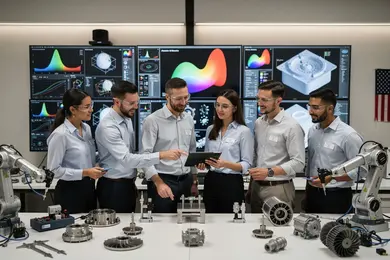
2027 Online Mechanical Engineering Degrees With Practice-Ready Engineering Curricula

Co-Founder and Chief Data Scientist
Choosing an online mechanical engineering degree is a high-stakes decision because the program must teach hands-on design, analysis, and lab skills without sacrificing flexibility. The field remains financially meaningful: the U. S. Bureau of Labor Statistics reported a $102,320 median annual wage for mechanical engineers in May 2024. This guide is for students, transfer learners, working technicians, and career changers who need to compare accreditation, curriculum, cost, timelines, and career paths before enrolling.
Key Things You Should Know
- ABET accreditation is program-specific, not school-wide, so verify the exact online mechanical engineering degree before assuming it supports FE exam preparation, PE licensure pathways, or employer requirements.
- Cost varies widely: College Board's 2024-25 national benchmarks list average published tuition and fees of $11,610 for in-state public four-year colleges and $43,350 for private nonprofit four-year colleges, before aid.
- Mechanical engineering has strong labor-market relevance, with BLS data showing a $102,320 median annual wage in May 2024 and projected employment growth above the average for all occupations over the 2023-2033 period.
What are online mechanical engineering degrees?
Online mechanical engineering degrees are college programs that teach the principles used to design, analyze, build, test, and improve machines, thermal systems, manufacturing processes, robotics, vehicles, energy systems, and mechanical components. At the bachelor's level, the degree is usually a Bachelor of Science in Mechanical Engineering or a closely related engineering degree with a mechanical concentration. At the graduate level, programs may focus on advanced design, controls, materials, fluids, energy, manufacturing, or computational engineering.
The word "online" describes course delivery, not the level of technical rigor. A strong program still requires calculus, physics, engineering mechanics, computer-aided design, simulation, labs, team projects, and a capstone design experience. Some schools deliver lectures asynchronously while requiring scheduled exams, virtual labs, mailed lab kits, local proctoring, short campus residencies, or partnerships with approved facilities.
Online mechanical engineering is often a good fit for working adults, military-affiliated students, transfer students, and technicians who cannot relocate. It may be a poor fit for students who need daily in-person lab access, extensive campus research participation, or a highly structured classroom schedule. If you are still comparing engineering fields, a broader list of online engineering degree programs can help you see whether mechanical, electrical, civil, industrial, or software-focused options better match your goals.
The main degree options differ in purpose and career use. The table below summarizes how each path usually functions so readers can avoid choosing a credential that is too narrow, too advanced, or not aligned with their target role.
| Credential | Best fit | Typical focus | Decision note |
| Associate degree or pre-engineering pathway | Students planning to transfer | Calculus, physics, chemistry, drafting, introductory engineering | Useful if transfer agreements are clear; risky if credits do not map into an ABET-accredited bachelor's program |
| Bachelor's in mechanical engineering | Students seeking entry-level engineering roles | Core engineering science, labs, design, capstone, technical electives | Usually the standard degree for mechanical engineer positions |
| Bachelor's in mechanical engineering technology | Students interested in applied testing, production, and implementation roles | Hands-on applications, manufacturing, testing, applied design | Can be valuable, but may not meet the same licensure or graduate-school expectations as engineering programs |
| Master's in mechanical engineering | Engineers seeking specialization or advancement | Advanced analysis, simulation, research, design optimization, controls, thermal systems | Best when it supports a defined technical specialty or promotion path |
| Graduate certificate | Engineers adding a targeted skill | Robotics, additive manufacturing, energy systems, CAD/CAE, systems engineering | Lower commitment than a degree, but usually not a substitute for an engineering bachelor's |
Are online mechanical engineering degrees ABET-accredited?
Some online mechanical engineering degrees are ABET-accredited, but not all of them are. ABET accreditation is one of the most important quality signals for engineering because it evaluates whether a specific program meets standards for curriculum, faculty, facilities, student outcomes, continuous improvement, and professional preparation. The key word is "specific": a university may be accredited institutionally while a particular online engineering program is not ABET-accredited.
ABET matters most for students who want the clearest route into traditional engineering roles, the Fundamentals of Engineering exam, and eventually Professional Engineer licensure. It can also matter to employers in defense, aerospace, energy, infrastructure, manufacturing, and regulated industries. However, not every mechanical engineering job legally requires PE licensure, and some advanced manufacturing, product design, robotics, and simulation roles may focus more on skills, projects, and experience.
Before enrolling, use a short verification process rather than relying on marketing language. These checks help you distinguish a strong online engineering program from one that sounds similar but may not support your long-term goals.
- Search ABET's official Accredited Program Search for the exact institution, degree name, program delivery format, and accreditation dates.
- Confirm whether the online version is accredited separately or included under the same accredited program as the campus version.
- Ask admissions whether the curriculum is designed to support FE exam preparation and whether graduates have historically pursued PE licensure.
- Check whether the program includes required labs, design projects, and a culminating capstone experience rather than only lecture-based coursework.
- Request written confirmation if you plan to use the degree for licensure, military advancement, employer reimbursement, or graduate admission.
Common red flags include vague claims such as "ABET-aligned," "modeled after ABET," or "engineering-based" when the actual program does not appear in ABET's database. Another mistake is assuming that regional or institutional accreditation replaces programmatic engineering accreditation; it does not serve the same purpose.
How do online and campus mechanical engineering programs differ?
Online and campus mechanical engineering programs can lead to similar academic outcomes when the online program is carefully designed, accredited where appropriate, and supported by meaningful lab and design experiences. The biggest differences are not usually the equations or textbooks; they are scheduling, lab access, collaboration format, and how easily students can build professional networks.
The table below compares the practical differences that affect learning quality, career preparation, and student fit. Use it to identify where flexibility helps and where an online format requires extra planning.
| Factor | Online mechanical engineering | Campus mechanical engineering | What it means for the student |
| Schedule | Often asynchronous or hybrid, with some live sessions | Fixed class, lab, and project times | Online works better for working adults; campus may help students who need structure |
| Labs | May use simulations, lab kits, local labs, remote instruments, or short residencies | Usually completed in campus laboratories | Ask exactly how fluids, materials, controls, and thermodynamics labs are completed |
| Team projects | Conducted through video meetings, shared CAD files, project platforms, and scheduled reviews | Often conducted in studios, labs, and makerspaces | Online students need strong communication habits and reliable collaboration tools |
| Internships | Student may need to find local or employer-based opportunities | Campus career offices may have stronger local employer pipelines | Online learners should evaluate career support before enrolling |
| Networking | Requires intentional participation in virtual office hours, student chapters, and industry events | More informal contact with peers, faculty, recruiters, and labs | Online students should plan networking as part of the degree, not as an afterthought |
| Cost and relocation | May reduce relocation, commuting, and opportunity costs | May require relocation or commuting but provides direct facilities access | The cheaper option depends on tuition, aid, residency rules, and lost work time |
Online may be the stronger choice if you already work in a technical role, have access to workplace equipment, can study independently, and need to preserve income while earning the degree. Campus may be better if you want extensive hands-on club participation, undergraduate research, frequent lab access, or a traditional residential experience.
A common mistake is choosing online only because it is convenient. Mechanical engineering is mathematically and technically demanding, so students should also evaluate tutoring, faculty access, lab logistics, project support, exam proctoring, and software requirements before committing.
What courses are in a mechanical engineering curriculum?
A practice-ready mechanical engineering curriculum combines engineering science with applied design. Students learn how forces, motion, heat, fluids, materials, manufacturing methods, and control systems affect real products and systems. The strongest programs also require students to use CAD, simulation, programming, technical writing, and team-based design reviews.
The table below summarizes common courses and why they matter. Course names vary by school, but the competencies are broadly consistent across rigorous mechanical engineering programs.
| Curriculum area | Common courses | Practice-ready skill developed |
| Mathematics and science foundation | Calculus, differential equations, physics, chemistry, statistics | Builds the quantitative base for engineering analysis and modeling |
| Engineering mechanics | Statics, dynamics, mechanics of materials | Helps students calculate loads, motion, stress, strain, and failure risk |
| Thermal and fluid systems | Thermodynamics, heat transfer, fluid mechanics | Prepares students for HVAC, energy, propulsion, cooling, and process systems |
| Design and manufacturing | Machine design, manufacturing processes, CAD, additive manufacturing | Connects analysis to manufacturable parts, assemblies, and production decisions |
| Controls and mechatronics | Control systems, instrumentation, robotics, sensors | Supports work with automated equipment, robotics, and smart mechanical systems |
| Computing and simulation | Programming, numerical methods, finite element analysis, computational tools | Develops the ability to model systems and test design decisions digitally |
| Professional practice | Engineering ethics, technical communication, project management, capstone design | Prepares students to communicate trade-offs, meet constraints, and work in teams |
Current engineering practice is being shaped by AI-assisted design, digital twins, robotics, additive manufacturing, and data-rich product testing. Mechanical engineers do not need to become data scientists to succeed, but students who want roles in predictive maintenance, autonomous systems, simulation, or smart manufacturing may benefit from analytics electives or a later data science master online if their career goals move toward machine learning and large-scale engineering data.
When comparing curricula, look for evidence that students do more than watch lectures. Practice-ready programs usually show several concrete learning experiences.
- Required design projects that progress from first-year engineering through senior capstone work
- Labs that cover measurement, uncertainty, materials testing, thermal systems, fluids, controls, or instrumentation
- Use of industry-relevant tools such as CAD, MATLAB, Python, finite element analysis, computational fluid dynamics, or product lifecycle management software
- Team deliverables that include design reports, drawings, prototypes, presentations, budgets, and test results
- Technical electives tied to career pathways such as aerospace, energy, manufacturing, biomedical devices, automotive systems, or robotics
One mistake to avoid is treating a long course catalog as proof of quality. A better signal is whether the program shows how students build, test, revise, document, and defend engineering decisions under real constraints.
What admission requirements do online mechanical engineering programs have?
Admission requirements vary by degree level, school selectivity, and whether the student is entering as a first-year applicant, transfer student, or graduate student. Because mechanical engineering depends heavily on sequencing, missing prerequisites can add time even when a student is admitted.
Most undergraduate online mechanical engineering programs review academic readiness in math and science first. Applicants commonly need the following materials or qualifications.
- High school diploma, GED, or prior college coursework
- Strong preparation in algebra, trigonometry, precalculus, calculus, physics, and chemistry
- Official transcripts from all schools attended
- Minimum GPA set by the institution or engineering department
- Placement scores or completed college math prerequisites, especially for transfer students
- Application form, fee, personal statement, and sometimes letters of recommendation
- English proficiency documentation for applicants whose prior education was not in English
Graduate mechanical engineering programs usually expect a bachelor's degree in mechanical engineering or a closely related engineering field. Students from physics, mathematics, engineering technology, or other STEM backgrounds may be considered, but they may need bridge courses in mechanics, thermodynamics, fluids, or design.
The table below shows how admission review often differs by applicant type. This matters because the same school may be accessible for one pathway but difficult or inefficient for another.
| Applicant type | What schools usually evaluate | Main risk to check |
| First-year undergraduate | High school math, science preparation, GPA, placement readiness | Starting below calculus can extend the degree timeline |
| Transfer student | Prior college GPA, completed calculus and physics, course equivalencies | Technical credits may not transfer cleanly into engineering requirements |
| Engineering technology graduate | Applied coursework, math depth, lab background | May need additional theory-based engineering prerequisites |
| Master's applicant | Bachelor's field, upper-level engineering coursework, GPA, recommendations, statement of purpose | Non-engineering backgrounds may require leveling courses |
| Working professional | Prior college record, employer experience, scheduling fit | Work experience usually does not replace core engineering prerequisites |
Before applying, ask the admissions team for a degree audit or unofficial transfer review. The most expensive admissions mistake is enrolling before confirming how many credits will actually count toward the engineering major, not just toward general electives.
How long does an online mechanical engineering degree take?
An online bachelor's degree in mechanical engineering commonly takes about four years of full-time study for first-time students who begin calculus-ready and follow the recommended sequence. Transfer students may finish faster if they bring approved calculus, physics, chemistry, and general education credits. Part-time students often need longer because engineering courses build on each other in strict prerequisite chains.
Time to completion depends less on the online format itself and more on course sequencing. For example, calculus supports physics, physics supports statics and dynamics, and those courses support machine design, fluids, thermodynamics, and capstone projects. Missing one prerequisite can delay multiple future courses.
Students who want to shorten the timeline should focus on planning rather than simply taking more credits. These steps can reduce delays without increasing the risk of burnout.
- Start with a prerequisite map showing the order of calculus, physics, chemistry, engineering mechanics, labs, and capstone requirements.
- Request a transfer-credit evaluation before enrolling, especially for calculus, physics, CAD, programming, and engineering science courses.
- Ask how often required courses are offered online because some upper-level engineering classes may run only once per year.
- Confirm whether summer terms include technical courses or only general education courses.
- Limit outside work hours during semesters that include multiple lab, design, or advanced analysis courses.
Accelerated study can make sense for students with prior credits, strong math preparation, and flexible schedules. It may be a poor choice for students working full time, returning after a long break from math, or balancing family responsibilities. A slower path that preserves grades, learning, and project quality can produce a better outcome than rushing through the sequence.
How much do online mechanical engineering degrees cost?
The cost of an online mechanical engineering degree depends on tuition, residency status, transfer credits, fees, software, equipment, proctoring, travel for residencies, books, and the number of semesters needed to finish. Online programs are not automatically cheaper, but they may reduce relocation, commuting, parking, and lost-income costs.
For a national benchmark, College Board's 2024-25 data shows the following average published tuition and fees before grants, scholarships, or institutional aid. These figures are not engineering-specific, but they help students evaluate whether a quoted online tuition rate is unusually low, typical, or high.
- Public four-year college, in-state: $11,610 per year in published tuition and fees
- Public four-year college, out-of-state: $30,780 per year in published tuition and fees
- Private nonprofit four-year college: $43,350 per year in published tuition and fees
Mechanical engineering students should also budget for costs that may not appear in headline tuition. The table below summarizes common cost drivers and why they can change the true price of the degree.
| Cost factor | Why it matters | Question to ask |
| Residency tuition rules | Some online public programs charge different rates for in-state and out-of-state students | Will my tuition rate change if I move or study fully online? |
| Engineering fees | Engineering programs may charge lab, technology, or program fees beyond base tuition | Are there per-course or per-semester engineering fees? |
| Lab requirements | Lab kits, local lab access, or short campus residencies can add costs | Are any in-person visits, equipment purchases, or lab kits required? |
| Software and hardware | CAD, simulation, and analysis tools may require a capable computer | Which software and hardware are required, and are student licenses included? |
| Transfer credit loss | Credits that transfer as electives may not shorten the engineering sequence | How many credits apply directly to the major, not just total graduation credits? |
| Time to completion | Extra semesters can raise tuition, fees, and opportunity costs | How often are required upper-level courses offered online? |
To reduce cost, prioritize accredited public options, transfer-friendly pathways, employer tuition assistance, military or veteran benefits, scholarships, and co-op or internship income. Students who are unsure whether they want engineering or analytics should test the waters with a lower-cost course before committing to a full degree; those comparing analytics options may also ask what is the cheapest data science course in the US? as part of a broader career-cost comparison.
The biggest cost mistake is focusing only on per-credit tuition. A slightly higher tuition rate can be a better value if the program accepts more transfer credits, offers required courses more often, includes software, provides stronger career support, or helps students graduate sooner.
What careers can mechanical engineering graduates pursue?
Mechanical engineering graduates can pursue roles in industries that design, build, operate, test, and improve physical systems. Common employers include manufacturers, aerospace and defense companies, automotive firms, energy companies, robotics and automation firms, medical device companies, consulting firms, government agencies, research laboratories, and facilities or utilities organizations.
The table below outlines common career directions and the type of work associated with each. Job titles vary by employer, and some roles may require specific industry experience, security clearance, graduate education, or licensure.
| Career path | Typical responsibilities | Useful preparation |
| Mechanical design engineer | Designs components, assemblies, mechanisms, and product improvements | CAD, machine design, materials, tolerancing, prototyping |
| Manufacturing engineer | Improves production processes, tooling, quality, and factory workflows | Manufacturing processes, automation, lean methods, statistics |
| Thermal or fluids engineer | Works on heat transfer, cooling, HVAC, energy systems, pumps, or flow systems | Thermodynamics, fluid mechanics, heat transfer, simulation |
| Controls or mechatronics engineer | Develops systems involving sensors, actuators, robotics, and automation | Controls, programming, instrumentation, electronics basics |
| Test engineer | Plans experiments, collects data, validates designs, and documents performance | Measurement, uncertainty analysis, lab methods, technical writing |
| Quality or reliability engineer | Analyzes defects, failure modes, process variation, and lifecycle performance | Statistics, materials, root-cause analysis, quality systems |
| Project engineer | Coordinates technical work, schedules, suppliers, budgets, and stakeholder communication | Engineering fundamentals, project management, communication |
Students should build career readiness while enrolled, not after graduation. Mechanical engineering employers often evaluate internships, senior design projects, portfolios, software skills, lab experience, and communication ability alongside GPA.
Use the degree to create evidence of skill. The following actions help students move from coursework to employability.
- Save polished examples of CAD models, simulations, test reports, design calculations, and capstone deliverables for a portfolio.
- Pursue internships, co-ops, research assistantships, or employer-based projects whenever possible.
- Join engineering organizations, design competitions, robotics teams, Formula SAE, ASME activities, or local manufacturing networks if available online or nearby.
- Practice explaining design trade-offs involving cost, safety, manufacturability, reliability, and performance.
- Learn the tools used in your target industry, such as SolidWorks, Creo, CATIA, ANSYS, MATLAB, Python, LabVIEW, or PLC-related systems.
Mechanical engineering is not the only route into technical work. Students more interested in technical documentation, knowledge organization, archives, patent research support, data stewardship, or information services may find that an MLIS degree online better fits their strengths than an engineering design curriculum.
What salary can mechanical engineers earn?
Mechanical engineering can offer strong earning potential, but salary varies by industry, region, employer, degree level, experience, licensure, security clearance, and technical specialty. The most useful national benchmark is from the U.S. Bureau of Labor Statistics, which reported a $102,320 median annual wage for mechanical engineers in May 2024. That figure means half of workers in the occupation earned more and half earned less; it should not be read as a guaranteed starting salary.
Salary outcomes often improve when engineers develop specialized skills that employers can apply directly to product development, manufacturing efficiency, energy systems, automation, testing, or regulated engineering work. Graduate education can help in some advanced technical roles, but it is not automatically the best financial move unless it supports a specific job target.
Several factors usually influence compensation more than the delivery format of the degree. Consider these variables when evaluating return on investment.
- Industry, with aerospace, energy, defense, advanced manufacturing, and technology-adjacent employers often paying differently from smaller local firms
- Location, because salaries and living costs vary across metropolitan areas and states
- Experience level, especially internships, co-ops, capstone quality, and prior technician or manufacturing experience
- Technical specialization, including simulation, controls, robotics, thermal systems, reliability, or high-value manufacturing processes
- Licensure, certifications, or clearances when they are relevant to the employer's work
- Portfolio strength, including documented design, analysis, testing, and communication skills
A practical ROI check is to compare total degree cost against realistic entry-level roles in your target region, not only national median pay. Students should also ask programs for career services data, internship access, employer partners, graduate-school placement, and examples of recent capstone projects.
Do mechanical engineers need licensure or certification?
Mechanical engineers do not always need a license to work, but licensure can be important for engineers who offer services to the public, approve engineering work, supervise regulated projects, or work in fields tied to public safety. Requirements vary by state licensing board, so students should verify rules in the state where they plan to practice.
The common U.S. licensure pathway involves the FE exam, engineer intern or engineer-in-training status, supervised engineering experience, and the PE exam. An ABET-accredited engineering degree is often the cleanest educational route, although state rules can differ.
Students who may want PE licensure should plan early. The general sequence usually looks like this.
- Complete an engineering degree that meets the education requirements of the relevant state board.
- Take the Fundamentals of Engineering exam, often near graduation or shortly after completing the degree.
- Gain qualifying engineering experience under appropriate supervision, when required by the state.
- Apply to take the Principles and Practice of Engineering exam in the appropriate discipline.
- Maintain licensure through continuing education if required by the state board.
Certifications are different from licensure. They are usually voluntary credentials that signal skill in a specific area, such as geometric dimensioning and tolerancing, manufacturing, quality, reliability, project management, Six Sigma, welding, HVAC systems, or software tools. Certifications can help when they match a job description, but they do not replace an accredited engineering degree when an employer or licensing board requires one.
A common mistake is waiting until senior year to ask whether an online degree supports licensure. If PE eligibility is even a possibility, verify the program's ABET status, state-board recognition, FE preparation, and required experience pathway before enrolling.
Other Things You Should Know About Mechanical Engineering
Online mechanical engineering programs in 2027 require a computer with a fast processor (e.g., Intel i5 or higher), 8GB RAM or more, and a dedicated graphics card to handle CAD software. Additionally, a stable internet connection and sufficient storage for software and projects are essential.
Yes, but work experience usually does not replace core engineering coursework. Technicians should request a transfer review, confirm math placement, and choose projects that connect their practical experience with engineering analysis and design.
Many programs use online proctoring, approved testing centers, live oral reviews, project defenses, or timed assessments. Ask how exams are administered, what technology is required, and whether proctoring fees are included in tuition.
References
- Online Mechanical Engineering Degrees 2025 https://www.affordablecollegesonline.org/degrees/engineering-programs/mechanical-engineering/
- What is a PE? https://www.nspe.org/about/about-professional-engineering/what-pe
- How Long to Become a Mechanical Engineer? | University of Bridgeport https://www.bridgeport.edu/news/time-to-become-a-mechanical-engineer/
- Licensure | NCEES https://ncees.org/licensure/
- Online ABET-Accredited Engineering Degree Guide - Educating Engineers https://educatingengineers.com/online-engineering-schools/abet-accredited-degree/
- Find Programs - ABET https://www.abet.org/accreditation/find-programs/
- What jobs can you do with a mechanical engineering degree? https://targetjobs.co.uk/careers-advice/engineering/what-jobs-can-you-do-mechanical-engineering-degree
- 2025 Best Online Mechanical Engineering Degrees https://www.onlineu.com/degrees/mechanical-engineering
- Salaries in Mechanical Engineering, Poland - Pensjometr https://www.pensjometr.pl/en/salaryinfo/mechanical-engineering