2027 How to Choose an Online Food Industry Management Degree for Food Manufacturing Careers

Co-Founder and Chief Data Scientist
Choosing an online food industry management degree is really a career investment decision: will the program help you move into production, quality, safety, or plant leadership roles? The stakes are meaningful. The U. S. Bureau of Labor Statistics reported a May 2024 median annual wage of $121,440 for industrial production managers, a common target role for manufacturing-focused graduates. This guide is for students, working food plant employees, career changers, and military learners comparing online options. You will learn how to evaluate degree levels, costs, accreditation, skills, jobs, and ROI before enrolling.
Key Things You Should Know
- An online food industry management degree is most useful when it combines food safety, manufacturing operations, supply chain, quality systems, and business leadership rather than offering only general management courses.
- Costs vary widely: College Board's 2024 pricing data lists average published tuition and fees at $4,050 for public two-year colleges, $11,610 for in-state public four-year colleges, and $43,350 for private nonprofit four-year colleges.
- For manufacturing management roles, institutional accreditation is essential; programmatic accreditation can be helpful, but no single specialized accreditor is universally required for food industry management jobs.
What is an online food industry management degree and how does it support food manufacturing careers?
An online food industry management degree prepares students to manage people, processes, compliance, and production systems in companies that make, package, store, and distribute food. It sits at the intersection of business administration, food science, operations management, safety regulation, and supply chain logistics.
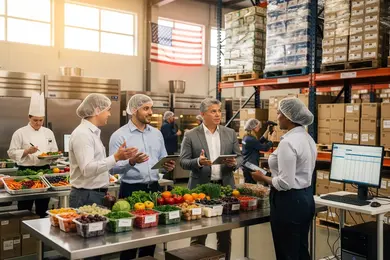
In food manufacturing, managers do more than supervise a line. They help prevent contamination, reduce waste, improve throughput, coordinate maintenance, document compliance, manage audits, and lead cross-functional teams. That is why a strong program should cover both technical food topics and leadership skills.
Direct answer: this degree supports food manufacturing careers by helping students translate plant-floor experience into supervisory and management readiness. It can be especially valuable for employees already working in quality assurance, production, sanitation, warehousing, procurement, or maintenance who want a credential aligned with advancement.
The best fit is usually a learner who wants to work in one of these areas and needs more than a general business degree. A food-specific curriculum can make employer conversations easier because it signals familiarity with sanitation controls, Hazard Analysis and Critical Control Points, preventive controls, traceability, supplier standards, and production metrics.
It may not be the best option if your goal is becoming a registered dietitian, laboratory food scientist, or research chemist. Those paths may require different prerequisites, supervised practice, graduate study, or science-heavy programs. For food manufacturing leadership, however, the degree can be a practical bridge between operations knowledge and management responsibility.
How do online food industry management programs compare with campus-based options for aspiring manufacturing managers?
Online and campus-based programs can both lead to manufacturing careers, but they serve different learners. The right choice depends on whether you need scheduling flexibility, hands-on facilities, local employer access, or a faster completion path.
The table below compares the most important trade-offs for aspiring food manufacturing managers. Use it to decide which format matches your current work schedule, learning style, and career stage.
| Factor | Online food industry management program | Campus-based program | Best fit |
| Scheduling | Often asynchronous or evening-friendly | Usually fixed class times | Online is stronger for working plant employees on shifts |
| Hands-on learning | May use local internships, virtual labs, simulations, or employer-based projects | May offer campus labs, pilot plants, and in-person demonstrations | Campus is stronger if the program has specialized food processing facilities |
| Networking | Often national, with classmates from multiple regions and employers | Often local or regional, with stronger nearby industry ties | Campus may help if you want jobs near the school's employer network |
| Cost control | Can reduce commuting and relocation costs | May provide access to campus facilities included in tuition | Online may be better if you can keep earning while studying |
| Career services | Quality varies; strong programs offer remote coaching and employer connections | May include in-person career fairs and faculty introductions | Choose based on actual employer outcomes, not format alone |
Online study is often the smarter option if you already work in food manufacturing and can complete projects at your workplace. Campus study can make more sense if you need intensive lab exposure, are entering the industry with little experience, or want a traditional internship pipeline.
If your goal is broad operations leadership rather than a food-specific career, comparing this path with a fastest online business degree can help you decide whether speed and general business flexibility matter more than specialized food manufacturing coursework.
What accreditation and institutional quality standards should you require in an online food industry management degree?
Accreditation should be a nonnegotiable requirement. For U.S. students, the school should hold institutional accreditation from an accreditor recognized by the U.S. Department of Education or the Council for Higher Education Accreditation. This affects credit transfer, graduate school eligibility, employer confidence, and access to federal financial aid.
Programmatic accreditation is more nuanced. Food industry management does not have one universal accreditor that every employer requires. Depending on the curriculum, relevant quality signals may include business accreditation, food science recognition, strong industry advisory boards, documented internship partnerships, or alignment with food safety credential preparation.
Before you apply, verify these quality markers because they can affect both educational value and employability:
- Institutional accreditation is active and listed by the U.S. Department of Education's accreditation database.
- The online program is authorized to enroll students in your state, especially if internships or field experiences are required.
- Faculty have food manufacturing, quality assurance, supply chain, operations, or food safety backgrounds.
- The curriculum includes manufacturing-relevant coursework instead of only generic business management classes.
- Career services can support online learners with resumes, internships, employer introductions, or promotion-focused coaching.
- The school publishes clear transfer credit, prior learning assessment, and military credit policies.
Be cautious with programs that advertise vague "industry certification" without naming the credential, issuer, or exam requirements. Also avoid assuming that an online degree is automatically weaker or stronger than a campus degree. Accreditation, curriculum depth, student support, and employer relevance matter more than delivery format.
Students who are leaning toward nutrition counseling, dietetics, or clinical food careers should compare manufacturing management programs with an online masters in nutrition and dietetics, because dietetics-related pathways can involve different accreditation and supervised practice expectations.
Which types of degrees best fit food manufacturing careers: certificate, associate, bachelor's, or master's?
The best degree level depends on your current education, work experience, and target role. A certificate may help you move from line work into quality support, while a bachelor's or master's may be more appropriate for plant management, continuous improvement, or multi-site operations leadership.
The comparison below summarizes common degree options. Use it to match your credential choice to the level of responsibility you want rather than choosing the fastest or cheapest option by default.
| Credential | Typical learner | Common career use | When it makes sense | When to be cautious |
| Certificate | Working adults, career changers, or employees needing focused upskilling | Food safety, quality support, sanitation leadership, supervisor preparation | You need targeted skills quickly and already have work experience | It may not satisfy degree requirements for management postings |
| Associate degree | Entry-level students or workers building a foundation | Production supervisor trainee, quality technician, warehouse lead | You want a lower-cost starting point and possible transfer pathway | Some employers prefer a bachelor's for manager-track roles |
| Bachelor's degree | Students seeking broad professional preparation | Production supervisor, QA coordinator, supply chain analyst, operations manager track | You want the most versatile credential for food manufacturing advancement | It requires more time and cost than a certificate or associate degree |
| Master's degree | Experienced professionals or bachelor's graduates | Plant manager, operations director, quality systems leader, corporate food safety role | You already have experience and want leadership, analytics, or executive-level preparation | It may be premature without relevant work history |
A bachelor's degree is often the most balanced choice for long-term manufacturing management because it combines technical, operational, and business coursework. However, experienced employees should not overlook certificates or associate-to-bachelor pathways if they reduce cost and build momentum.
If you are comparing operations-oriented careers beyond food plants, a construction management degree online can be a useful contrast because it serves a different regulated production environment with project management, safety, scheduling, and cost-control demands.
What core courses and technical skills will you learn for leadership roles in food manufacturing?
A strong online food industry management curriculum should prepare you to speak both the language of the plant floor and the language of business leadership. Employers generally value graduates who can connect safety, quality, cost, productivity, and people management.
Look for programs that include the following course areas because they map directly to food manufacturing responsibilities:
- Food safety systems, including HACCP, preventive controls, sanitation, allergen management, traceability, and recall procedures.
- Food processing and packaging fundamentals, including thermal processing, preservation, packaging materials, and shelf-life considerations.
- Quality assurance and quality control, including audits, documentation, statistical process control, corrective actions, and continuous improvement.
- Operations management, including capacity planning, lean manufacturing, scheduling, maintenance coordination, and bottleneck reduction.
- Supply chain and procurement, including supplier approval, cold chain logistics, inventory planning, and distribution risk.
- Regulatory and compliance topics, including FDA, USDA, labeling, recordkeeping, and plant inspection readiness where relevant.
- Business leadership, including accounting, finance, human resources, labor relations, project management, and team supervision.
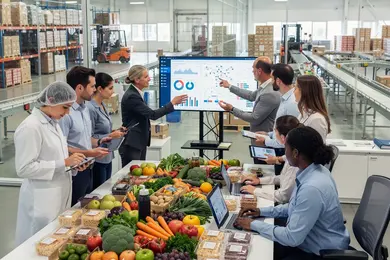
- Data and technology skills, including spreadsheets, dashboards, enterprise resource planning systems, manufacturing execution systems, and basic analytics.
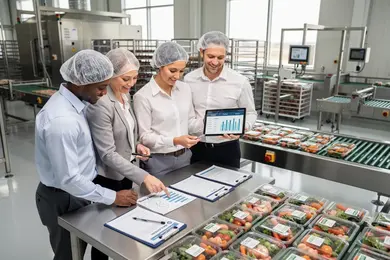
Technology is changing food manufacturing management. Automation, robotics, sensors, AI-supported quality inspection, predictive maintenance, and digital traceability systems are becoming more common in modern plants. You do not need to become a software engineer, but you should be comfortable interpreting production data and asking better operational questions.
For leadership roles, technical knowledge alone is not enough. Programs should also develop communication, conflict resolution, coaching, shift handoff discipline, change management, and ethical decision-making. Food manufacturing problems are often cross-functional, so managers need to coordinate sanitation, maintenance, quality, procurement, production, and corporate teams under time pressure.
What are typical admission requirements for online food industry management programs in the United States?
Admission requirements vary by school and degree level, but most online food industry management programs are designed for adult learners, transfer students, or working professionals. The most important step is to confirm whether the program expects prior college credit, science prerequisites, or manufacturing experience.
Common requirements differ by credential level. The table below gives a practical overview so you can estimate your readiness before contacting admissions.
| Program level | Common admission requirements | What can strengthen your application |
| Certificate | High school diploma or equivalent; sometimes current employment or basic science readiness | Food plant experience, ServSafe or food safety training, supervisor interest |
| Associate degree | High school diploma or equivalent; placement testing or transcripts | Transferable general education credits and documented work experience |
| Bachelor's degree | High school diploma or transfer credits; transcripts; minimum GPA policies vary | Associate degree, prior manufacturing experience, military training, or technical college credits |
| Master's degree | Bachelor's degree; transcripts; sometimes resume, statement of purpose, letters, or prerequisite coursework | Operations, quality, supply chain, food safety, engineering, or management experience |
If you have prior college credits, ask for an unofficial transfer review before applying. Transfer credit can shorten time to graduation, but policies vary by institution, course age, grade earned, accreditation of the sending school, and whether credits match the degree plan.
Applicants with limited food industry experience can still be competitive, but they should look for programs with internships, capstones, simulations, or employer-based projects. If you already work in a plant, ask whether your workplace can be used for applied assignments, process improvement projects, or supervised experiential learning.
Before enrolling, complete these practical checks:
- Request a written degree plan showing how many credits you must complete after transfer evaluation.
- Ask whether science or statistics prerequisites are required before upper-level courses.
- Confirm whether internships, practicums, or campus visits are mandatory.
- Review technology requirements, proctoring policies, and expected weekly study time.
- Ask whether the program admits students from your state and whether field placements are available there.
How long do online food industry management degrees take, and what tuition and total costs should you expect?
Program length depends on degree level, transfer credits, enrollment pace, and whether courses are offered in traditional semesters or accelerated terms. A certificate may take a few months to a year, an associate degree usually takes about two years full time, a bachelor's degree commonly takes about four years from the start, and a master's degree often takes one to three years.
Tuition is only one part of cost. College Board's 2024 data shows average published tuition and fees of $11,610 for in-state students at public four-year institutions and $43,350 at private nonprofit four-year institutions, which is a reminder to compare net price, aid, and transfer credit rather than sticker price alone.
The table below summarizes the cost categories you should include in your budget. This matters because the lowest tuition rate is not always the lowest total cost if a program has limited transfer credit, required travel, or expensive course materials.
| Cost factor | Why it matters for online students | How to evaluate it |
| Tuition rate | Usually charged per credit or per term | Multiply by remaining credits after transfer evaluation |
| Fees | Online, technology, graduation, lab, or proctoring fees can add up | Ask for a full cost sheet, not just tuition |
| Books and materials | Food safety, science, and operations courses may use specialized materials | Check whether digital materials are included |
| Travel requirements | Some online programs require campus labs, residencies, or internship travel | Confirm whether any in-person attendance is mandatory |
| Lost income | Full-time study may reduce work hours | Compare full-time and part-time plans against your income needs |
| Transfer credit | Accepted credits can reduce both time and cost | Get a written transfer estimate before committing |
Financial aid may include federal grants, federal student loans, employer tuition assistance, military benefits, scholarships, and workforce development funding. Working adults should ask their employer whether the degree qualifies for tuition reimbursement, especially if the company has internal promotion tracks for production, quality, or safety leadership.
To understand how online program pricing can differ across management-related fields, reviewing construction management degree online cost comparisons can help you build a more disciplined checklist for tuition, fees, transfer credits, and total completion cost.
What jobs can you get in food manufacturing with an online food industry management degree?
An online food industry management degree can support several career paths, especially when paired with plant experience. Many roles are not titled "food industry manager," so search for production, quality, operations, supply chain, safety, and continuous improvement titles.
The table below shows common food manufacturing roles and what they typically involve. Use it to identify which degree level and skill mix align with your target job.
| Role | Typical responsibilities | Useful preparation |
| Production supervisor | Oversees shifts, staffing, output, safety practices, and daily production targets | Associate or bachelor's degree plus line experience |
| Quality assurance coordinator | Maintains documentation, supports audits, investigates deviations, and monitors quality systems | Food safety, statistics, HACCP, and regulatory coursework |
| Sanitation manager | Leads sanitation crews, verifies cleaning procedures, manages chemicals, and supports inspection readiness | Food safety, sanitation, leadership, and compliance training |
| Supply chain or inventory analyst | Tracks materials, forecasts demand, coordinates suppliers, and supports inventory accuracy | Operations, analytics, procurement, and ERP experience |
| Continuous improvement specialist | Uses lean methods, data, and process mapping to reduce waste and improve throughput | Lean, Six Sigma, process analysis, and plant-floor project work |
| Plant operations manager | Coordinates production, quality, maintenance, staffing, cost control, and strategic improvements | Bachelor's or master's degree plus significant manufacturing experience |
Career progress is often stepwise. A common path is production associate or technician, then lead, then supervisor, then department manager, and eventually plant or operations manager. A degree can strengthen that path, but employers still usually value demonstrated reliability, safety judgment, communication, and problem-solving under pressure.
Certifications can also help, depending on your target role. Examples include HACCP training, Preventive Controls Qualified Individual training, ServSafe for certain environments, Lean Six Sigma, project management credentials, and internal auditor training. These are not always required, but they can make your resume more specific and role-ready.
Be careful not to assume the degree alone will move you directly into senior management. For manufacturing careers, the strongest candidates usually combine formal education with measurable workplace achievements, such as reducing downtime, improving audit readiness, lowering waste, strengthening training, or helping launch a new line.
What are the salary ranges and job outlook for food manufacturing managers and related roles?
Salary potential depends on role, location, plant size, union environment, shift demands, product category, and years of experience. A degree can improve eligibility for management-track roles, but it does not create a guaranteed salary outcome.
For a high-level benchmark, the U.S. Bureau of Labor Statistics reported a May 2024 median annual wage of $121,440 for industrial production managers. BLS also projected employment for industrial production managers to grow 3% from 2023 to 2033, which indicates modest overall growth rather than a rapidly expanding occupation.
The table below gives a practical salary and outlook context for food manufacturing career planning. Use it as a starting point, then compare local job postings and BLS state or metro data for your target region.
| Career area | Salary context | Outlook interpretation |
| Production supervision | Usually below plant manager compensation but can improve with shift leadership, technical knowledge, and overtime policies | Demand is tied to plant operations, turnover, automation adoption, and regional manufacturing concentration |
| Quality assurance and food safety | Pay often rises with audit responsibility, regulatory knowledge, and experience with complex products | Food safety expectations remain important because recalls, allergen controls, and traceability failures carry high business risk |
| Industrial production management | BLS reported a May 2024 national median of $121,440 for industrial production managers | Projected 3% growth from 2023 to 2033 suggests stable but competitive advancement opportunities |
| Plant and operations leadership | Compensation can vary widely by employer size, product category, bonus structure, and multi-site responsibility | Advancement usually depends on proven results, not degree level alone |
Automation can change the mix of jobs rather than simply eliminate management needs. Plants adopting robotics, machine vision, connected sensors, and AI-supported analytics still need managers who understand production flow, safety, maintenance coordination, workforce training, and compliance documentation.
For ROI, compare the program's total cost with realistic next-step roles, not only long-term executive roles. If the degree helps you qualify for supervisor, QA, or operations analyst positions sooner while you keep working, the investment may be easier to justify. If you already hold a bachelor's and have strong experience, a targeted certificate may offer better short-term value than another full degree.
How can you compare and choose the best online food industry management program for your goals?
The best online food industry management program is the one that matches your target role, background, budget, and schedule. Rankings can be useful, but they should not replace a detailed fit analysis.
Use the following steps to compare programs in a practical order. This sequence helps you avoid choosing a school based only on advertising, speed, or tuition.
- Define your target job first, such as production supervisor, QA manager, sanitation manager, supply chain analyst, or plant operations manager.
- Match the curriculum to that job by checking for food safety, operations, quality systems, supply chain, leadership, and analytics courses.
- Verify institutional accreditation and state authorization before discussing price or start dates.
- Request a transfer credit evaluation and written graduation plan showing remaining credits and expected completion time.
- Calculate total cost, including fees, books, travel, proctoring, and lost income from reduced work hours.
- Ask about career support for online students, including internships, employer partnerships, resume coaching, and alumni outcomes.
- Review course format, weekly workload, term length, and whether live attendance is required.
- Compare faculty experience and industry advisory boards to ensure the program understands food manufacturing realities.
Some red flags should slow down your decision. These issues do not always mean a program is poor, but they deserve careful follow-up before you enroll.
- The school cannot clearly explain its accreditation status or state authorization.
- The curriculum is mostly generic business coursework with little food safety, quality, or manufacturing content.
- Admissions staff pressure you to enroll before providing a full cost estimate or transfer review.
- The program promises specific salaries, promotions, or job placement outcomes.
- Required internships or labs are mentioned late in the process and may not be available near you.
- Credits are unlikely to transfer if you later change schools or pursue graduate study.
A good final test is to compare two or three program plans side by side and ask, "Which one makes me more credible for the next job I actually want?" The strongest choice is usually not the cheapest or fastest program alone. It is the program that gives you relevant skills, a respected credential, manageable cost, and a realistic path from your current role to your next manufacturing opportunity.
Other Things You Should Know About Food Industry Management
Yes, if it comes from an institutionally accredited school and includes relevant food manufacturing coursework. Employers usually care most about accreditation, skills, experience, and whether you can apply what you learned to plant operations.
Not always. Entry-level students can start with a certificate, associate, or bachelor's program, but experience helps. If you lack industry background, choose a program with internships, applied projects, or strong career support.
No. Food science is more focused on product chemistry, formulation, processing, and laboratory or technical work. Food industry management focuses more on operations, quality systems, safety compliance, supply chain, and leadership.
Yes, a food industry management degree in 2027 can be beneficial for aspiring plant managers. It offers critical skills in operations, logistics, and management, aligning with industry standards. However, complementing it with specific training or experience in plant operations can enhance your qualifications.
References
- FOOD INDUSTRY JOBS https://m.careersinfood.com/
- Developing Food Safety Leadership Skills: Building the Workforce of Tomorrow | Food Safety Magazine https://www.food-safety.com/articles/9241-developing-food-safety-leadership-skills-building-the-workforce-of-tomorrow
- How to choose a culinary and restaurant management course? https://insights.ehl.edu/choosing-culinary-and-restaurant-management-course
- Food Production Manager | Salary & Career Guide - Advocate Group https://www.advocate-group.co.uk/blog/food-production-manager-salary-career-guide-195
- Manufacturing managers | WorkBC https://www.workbc.ca/career-profiles/manufacturing-managers
- Online Master’s in Food Business - CIA School of Graduate and Professional Studies https://masters.culinary.edu/food-business-masters-degree/
- 15 Top Culinary Degree Careers | CIA Culinary School https://www.ciachef.edu/blog/what-can-you-do-with-a-culinary-degree/
- Food Industry Management https://www.niagara.edu/programs/food-industry-management/
- Our Specialties | Leadership Training in Manufacturing https://www.vital-learning.com/leadership-training-in-manufacturing
- Certificate in Food Safety and Quality Management | DkIT https://www.dkit.ie/courses/certificate-in-food-safety-and-quality-management