2027 Online Digital Photography Degrees With Studio Photography Coursework

Co-Founder and Chief Data Scientist
Choosing an online digital photography degree is really a question about skill, cost, credibility, and career fit. The U. S. Bureau of Labor Statistics reported a May 2024 median annual wage of $42,520 for photographers, which means students should evaluate programs carefully instead of assuming a degree alone will drive earnings. This guide is for aspiring photographers who want online flexibility without losing studio practice. You will learn how these programs work, which schools offer them, what they cost, and how to compare options before enrolling.
Key Things You Should Know
- Online digital photography degrees can include real studio work through lighting assignments, home-studio setups, critiques, portfolio reviews, and locally completed shoots rather than daily campus lab attendance.
- For cost planning, College Board's 2024-25 national tuition benchmarks show $4,050 for public two-year colleges and $11,610 for in-state public four-year colleges before equipment, software, and fees.
- The BLS May 2024 median annual wage for photographers was $42,520, so program ROI depends heavily on portfolio quality, business skills, specialization, location, and freelance client development.
What is an online digital photography degree with studio photography coursework?
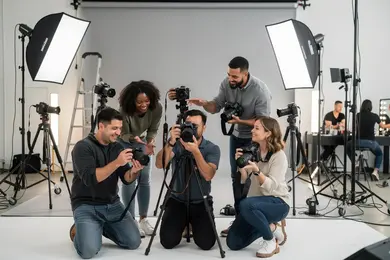
An online digital photography degree is an associate or bachelor's program that teaches image capture, editing, visual storytelling, lighting, color, composition, and professional practice through a distance-learning format. The "studio photography coursework" part matters because it means the program goes beyond camera basics and asks students to practice controlled lighting, portrait setups, product photography, backdrop use, posing, and critique-based image refinement.
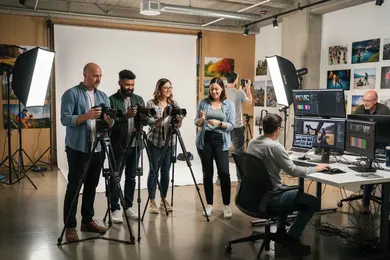
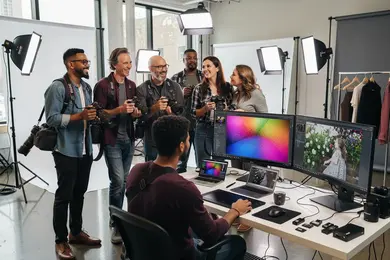
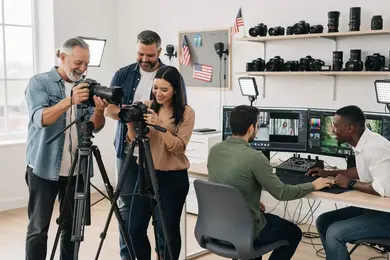
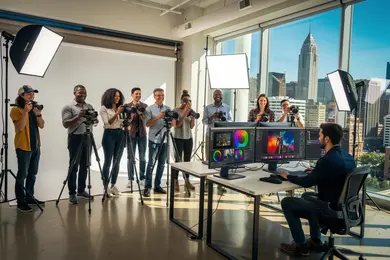
In a strong online program, studio work is not imaginary or purely theoretical. Students usually complete shoots where they live, submit contact sheets and final edits through a learning platform, receive instructor feedback, and build a portfolio that shows technical control. Some schools also use synchronous critique sessions, recorded demonstrations, equipment checklists, virtual lighting diagrams, and optional campus intensives.
These degrees are best for students who want structured training and a credential but need flexibility because of work, family, military service, or location. They are not the only path into photography. A short certificate, apprenticeship, community college course, or self-directed portfolio may be enough for some freelance niches. A degree makes more sense when a student wants a broader visual arts foundation, career services, financial aid eligibility, transfer options, or a path toward creative leadership roles.
The main degree options differ in depth, cost, and career preparation. The table below summarizes how common online photography credentials compare so readers can match the credential to their goals.
| Credential | Typical focus | Best fit | Limitations to consider |
| Certificate | Camera operation, editing, lighting basics, or a specific niche | Career changers, hobbyists, freelancers testing the field | May not include general education, transfer credit, or advanced portfolio development |
| Associate degree | Foundational photography, digital imaging, studio practice, composition, and general education | Students seeking an affordable entry point or transfer pathway | May not go as deeply into advanced concept development, branding, or business strategy |
| Bachelor's degree | Advanced photography, art history, professional portfolio, business, criticism, and capstone work | Students pursuing professional creative roles, graduate study, or long-term advancement | Higher total cost and longer time commitment |
A practical way to think about this degree is simple: the online format delivers instruction and critique, while the studio component proves that students can control light, space, subject, and final image quality in real shooting conditions.
How do online digital photography degrees compare to campus-based photography programs?
Online and campus-based photography programs can teach similar technical concepts, but they deliver practice differently. The right choice depends on how much structure, equipment access, face-to-face critique, and scheduling flexibility a student needs.
Online programs tend to work well for self-directed students who can create shooting opportunities at home, rent or borrow equipment when needed, and stay organized without a fixed campus schedule. Campus programs may be better for students who need daily access to lighting studios, darkrooms, printing labs, faculty in person, and local creative communities. Students who are considering broader visual communication careers may also compare photography with graphic design graduate programs, especially if they are interested in brand identity, digital media, or art direction.
The table below compares the trade-offs that matter most when deciding between online and campus-based photography study.
| Factor | Online digital photography degree | Campus-based photography program |
| Flexibility | Usually stronger for working adults and students outside major creative markets | Usually less flexible because studio, lab, and critique times are scheduled |
| Studio access | Often relies on home setups, local rentals, mailed kits, or student-owned gear | Often provides dedicated studio space, lighting equipment, printers, and labs |
| Critique format | Delivered through discussion boards, video meetings, annotated files, and portfolio reviews | Often live and in person, which can help students learn by observing peer work |
| Cost structure | May reduce commuting and housing costs but can shift equipment costs to the student | May include campus fees and relocation costs but can provide shared equipment access |
| Networking | Depends on virtual critique, internships, local projects, and alumni engagement | Often easier for students who want in-person peer networks and faculty introductions |
Online study is not automatically easier. It often requires more independence because students must schedule shoots, recruit models, secure locations, troubleshoot lighting, and meet critique deadlines without a studio manager nearby. Campus study is not automatically better either; a student who cannot attend consistently or afford relocation may get more value from a flexible online program with strong faculty feedback.
The best decision usually comes down to the student's working style. Choose online if flexibility, lower relocation burden, and self-paced project planning are priorities. Choose campus if daily equipment access, live collaboration, and immersive studio culture are essential to learning.
Which accredited schools offer online digital photography degrees that include studio work?
Several U.S. institutions offer online photography degrees or closely related programs that include digital imaging, lighting, studio practice, critique, and portfolio development. Availability changes, so students should confirm the current catalog, delivery format, accreditation status, tuition, and course sequence directly with each school before applying.
Photography does not usually have a single required programmatic accreditor in the way nursing or teacher education might. For most students, the first quality checkpoint is institutional accreditation from a recognized accreditor. The examples below are useful starting points for researching accredited online programs with studio-relevant coursework.
| School | Example online photography credential | Accreditation type to verify | Studio-related elements to look for |
| Southern New Hampshire University | Online BA in Digital Photography | Regional institutional accreditation | Digital photography, lighting, image editing, business of photography, portfolio work |
| Academy of Art University | Online photography degree options | Institutional accreditation | Studio lighting, commercial photography, portraiture, conceptual image-making, critique |
| Rocky Mountain College of Art + Design | Online BFA in Photography or related visual arts pathways, subject to current catalog | Regional institutional accreditation | Digital workflow, lighting, visual storytelling, portfolio development, professional practice |
| Sessions College | Online associate-level photography or digital media options, subject to current catalog | Institutional accreditation | Photography fundamentals, lighting techniques, digital imaging, portfolio assignments |
| Savannah College of Art and Design | Online or remote photography-related options, subject to current delivery availability | Regional institutional accreditation | Fine art and commercial photography, studio practice, critique, professional portfolio |
When reviewing a school, do not stop at the program title. A "digital media" or "visual arts" degree may include photography but not enough studio coursework for a student who wants portrait, product, fashion, editorial, or commercial photography training. Conversely, a program titled "digital photography" may be strong technically but limited in business preparation. The safest approach is to read the required course list and ask admissions for sample syllabi from lighting, studio, and portfolio courses.
Students should also ask whether the school provides access to Adobe Creative Cloud, capture software, printing labs, equipment discounts, virtual critiques, internships, and alumni portfolio showcases. These support services can affect career readiness as much as the degree name.
What studio photography courses and hands-on projects are included in these programs?
Studio coursework teaches students to make deliberate images instead of relying only on available light or automatic camera settings. In online programs, the work often happens in a home studio, rented space, community location, employer setting, or controlled room where students can manage light and background.
Typical courses combine technical demonstrations with critique-based assignments. The table below shows common studio-related courses and what students usually produce in each area.
| Course area | What students learn | Common hands-on output |
| Studio lighting | Key light, fill light, backlight, modifiers, ratios, shadows, and reflective surfaces | Portrait, product, still-life, or editorial lighting series |
| Digital imaging and workflow | RAW processing, color correction, retouching, file organization, and export standards | Edited image sets with before-and-after workflow documentation |
| Portrait photography | Posing, expression, subject direction, lens choice, and controlled backgrounds | Environmental portrait, studio headshot, and creative portrait assignments |
| Commercial or product photography | Lighting reflective objects, styling, brand requirements, and client-oriented deliverables | Product catalog images, advertising-style shots, or mock client campaigns |
| Portfolio and capstone | Sequencing, artist statements, professional presentation, and critique revision | Final portfolio, website, printed series, or exhibition-ready body of work |
Students should expect hands-on work that builds both technical control and creative judgment. A well-designed online studio sequence may require the following kinds of projects:
- Create a three-light portrait setup and submit a lighting diagram, contact sheet, final edits, and reflection on what changed during the shoot.
- Photograph a product with controlled reflections, consistent color, and multiple deliverable formats for a mock client brief.
- Build a cohesive photo essay or editorial series that demonstrates lighting consistency, visual narrative, and post-production discipline.
- Complete peer critiques that evaluate exposure, composition, concept, retouching choices, and whether the final image meets the assignment goal.
- Revise portfolio images based on instructor feedback rather than treating the first submission as the finished product.
Prospective students should ask how the program handles equipment barriers. Some schools provide minimum gear lists, rental guidance, student discounts, or alternatives for students who do not own professional strobes. A program that requires expensive gear without explaining substitutions may create hidden cost pressure.
What admission requirements apply to online digital photography bachelor's and associate degrees?
Admission requirements vary by school and degree level, but most online associate and bachelor's programs ask for proof of high school completion or prior college credit. Selective art schools may also request a portfolio, while broader-access online universities may admit beginners and build portfolio development into the curriculum.
The table below summarizes common requirements so students can identify what they may need before applying.
| Requirement | Associate degree | Bachelor's degree | Why it matters |
| High school diploma or GED | Commonly required | Commonly required | Establishes basic eligibility for undergraduate admission |
| Transcripts | High school and any college transcripts | High school and any college transcripts | Used for admission, placement, and transfer-credit review |
| Portfolio | Sometimes optional | May be required at art-focused schools | Helps faculty assess visual readiness and creative potential |
| Minimum GPA | Varies by institution | Varies by institution | Can affect admission, scholarships, or transfer acceptance |
| Technology access | Computer, internet, camera access, editing software | Computer, internet, camera access, editing software | Necessary for image capture, editing, uploads, and critiques |
Students with previous college coursework should request a transfer evaluation before committing. Transfer credit can shorten the timeline and reduce cost, but schools differ in how they evaluate studio art courses, general education, military credit, and prior learning.
Applicants can prepare a stronger file by completing a few practical steps before the deadline:
- Collect official transcripts early, especially if prior colleges have separate ordering systems or account holds.
- Build a small portfolio that shows range, including portraits, still life, documentary work, and edited final images when a portfolio is requested.
- Check camera, computer, storage, and software requirements against what the first studio course actually expects.
- Ask whether placement tests, orientation modules, or prerequisite art courses are required before beginning photography classes.
- Confirm whether the program is designed for beginners or assumes prior DSLR, mirrorless, lighting, or editing experience.
A common mistake is applying only to the school with the most attractive website. A better approach is to compare admission standards, transfer policies, faculty feedback methods, and first-year course requirements together.
How long do online digital photography degrees take, and what do they cost?
Most online associate degrees in photography take about two years of full-time study, while bachelor's degrees commonly take about four years. Students with transfer credits, prior learning, military training, or year-round course loads may finish sooner, while part-time students may need longer.
Tuition varies widely, so students should separate published tuition from total cost. College Board's 2024-25 national benchmarks put average published tuition and fees at $4,050 for public two-year in-district colleges, $11,610 for in-state public four-year colleges, and $43,350 for private nonprofit four-year colleges. These figures are not photography-specific, but they help students see why institution type, transfer strategy, and financial aid can change the total investment significantly.
Photography students should budget for more than tuition. The main cost categories usually include:
- Tuition and mandatory online, technology, studio, or graduation fees.
- Camera body, lenses, tripod, memory cards, storage drives, color-calibrated monitor, and backup equipment.
- Lighting gear such as continuous lights, strobes, stands, modifiers, backdrops, reflectors, or rental access.
- Editing software, cloud storage, portfolio website hosting, printing, mounting, and final portfolio presentation.
- Travel for local shoots, internships, optional campus intensives, exhibitions, or client-style assignments.
The table below gives a practical view of timing and cost factors by credential rather than promising a single price that may not match a student's school or aid package.
| Program type | Typical full-time length | Cost factors that change the total | Best cost-control strategy |
| Certificate | Several months to one year | Shorter curriculum, fewer general education courses, limited aid eligibility at some schools | Use it to test the field before committing to a degree |
| Associate degree | About two years | Lower community college tuition in many cases, transferability, equipment purchases | Complete general education affordably and confirm transfer agreements |
| Bachelor's degree | About four years | Upper-division art courses, portfolio courses, private or public tuition, transfer credits | Maximize accepted credits and compare net price after aid |
Students who need scheduling flexibility should ask about term length and start dates. Programs with monthly or multiple annual starts can be useful for adults who do not want to wait for a traditional fall semester, and readers comparing flexible formats can review online colleges with frequent start dates to understand how start-date models differ.
Financial aid may be available for eligible students enrolled in accredited degree programs, but aid rules depend on enrollment status, school participation, satisfactory academic progress, and the student's own financial profile. Before enrolling, compare the net price after grants and scholarships, not just the advertised tuition rate.
What careers can graduates pursue with an online digital photography degree?
Graduates can pursue photography roles in freelance, commercial, media, nonprofit, education, corporate, and creative production settings. The degree can help students build technical discipline and a portfolio, but employers and clients usually evaluate image quality, reliability, editing workflow, communication, and specialization more heavily than the credential alone.
The table below outlines common career paths and the kind of work graduates may pursue after building a competitive portfolio.
| Career path | Typical responsibilities | Portfolio evidence employers or clients look for |
| Portrait or studio photographer | Create headshots, family portraits, senior portraits, branding images, and studio sessions | Consistent lighting, flattering posing, retouching quality, client-ready galleries |
| Commercial or product photographer | Photograph products, food, apparel, interiors, or brand assets for marketing use | Clean lighting, color accuracy, attention to detail, ability to follow a brief |
| Editorial or documentary photographer | Produce images for publications, nonprofits, events, or storytelling projects | Strong sequencing, timing, ethical representation, narrative clarity |
| Photo editor or digital imaging specialist | Select, retouch, organize, color-correct, and prepare image assets | Before-and-after examples, file management, consistent editing style |
| Visual content producer | Combine photography with video, social content, brand campaigns, and digital asset production | Multi-platform content samples, lighting versatility, editing and storytelling skills |
Students should be realistic about entry-level work. Many photographers begin with assistant roles, second-shooter opportunities, e-commerce product work, local portrait sessions, internships, or part-time freelance assignments. Over time, they may move into higher-value niches such as commercial campaigns, corporate branding, luxury weddings, fine art sales, art direction, or studio ownership.
Technology is changing the field. AI-assisted editing, automated masking, generative fill, image culling, and client gallery platforms can speed up routine tasks. However, these tools do not replace the need to direct subjects, solve lighting problems, negotiate client expectations, protect image rights, and deliver consistent work under real deadlines. Students who learn both photography and workflow automation may be better positioned for modern creative teams.
This degree is likely a good fit for students who enjoy visual problem-solving, independent project work, critique, client communication, and constant portfolio revision. It may be a weaker fit for students who want predictable schedules, guaranteed income, or a career where the degree itself determines employment eligibility.
What salary ranges and earning potential exist for digital and studio photographers?
Photography income varies more than many degree fields because many professionals are self-employed, work project to project, combine multiple income streams, or specialize in niches with very different pricing models. The BLS May 2024 median annual wage for photographers was $42,520, which is a useful national reference point but not a guarantee for any graduate.
Students should use salary data as a planning tool, not as a promise. The table below explains how different photography paths can influence earning potential.
| Path | Income pattern | Main factors affecting earnings |
| Entry-level studio assistant or production assistant | Often hourly or project-based | Local market, technical reliability, editing speed, willingness to support shoots |
| Portrait or wedding photographer | Often seasonal and client-based | Brand reputation, referrals, sales process, package pricing, local demand |
| Commercial photographer | Often project, day-rate, or licensing-based | Client type, usage rights, production complexity, portfolio specialization |
| Corporate or in-house visual content role | Often salary-based | Photography plus video, editing, asset management, marketing collaboration |
| Fine art or gallery-focused photographer | Often inconsistent and sales-based | Exhibition history, collector base, grants, teaching, limited editions |
Location matters. Photographers in larger metropolitan markets may find more commercial clients, agencies, studios, and creative teams, but they also face higher competition and business costs. Smaller markets may offer fewer large clients but stronger local relationship-based opportunities.
Students who want stronger earning potential should build business skills alongside technical skills. That includes pricing, contracts, licensing, client communication, bookkeeping, marketing analytics, search visibility, and repeat-client systems. For freelancers, a polished portfolio without a business process may not produce stable income.
It is also important to think in terms of total career strategy. Some photographers combine studio portraits, product work, event coverage, teaching, stock licensing, photo editing, and content production. This diversified approach can reduce dependence on a single client type, but it also requires strong time management and brand clarity.
What professional certifications or portfolios strengthen a digital photography career?
Photography is portfolio-driven, so the strongest career asset is usually a focused body of work that proves the student can produce client-ready images. Certifications can help in specific contexts, especially when they validate software, drone operation, business professionalism, or specialized technical skills, but they rarely substitute for a strong portfolio.
The most useful career-building credentials and assets usually fall into a few categories. Students should choose them based on the work they want, not simply collect badges.
- Professional portfolio: A curated website with 15 to 30 strong images per specialty is often more persuasive than a large gallery of mixed work.
- Adobe or editing software credentials: These can support photo editing, retouching, digital asset management, and production roles.
- FAA Part 107 remote pilot certification: This is important for photographers who want to legally offer commercial drone photography in the U.S.
- Business documentation: Contracts, model releases, licensing templates, insurance, invoices, and client workflow systems strengthen freelance credibility.
- Exhibitions, publications, and client case studies: These show that the photographer can complete public-facing work and meet real requirements.
Students should also pay attention to AI literacy. Modern photographers increasingly use AI-assisted tools for selection, masking, noise reduction, retouching, keywording, and content-aware editing. Those interested in the technical side of creative automation may explore broader pathways such as an online PhD in AI, although that route is designed for advanced computing and research goals rather than photography practice alone.
A strong portfolio should be specific. A student who wants product photography should show controlled lighting, clean backgrounds, accurate color, and commercial consistency. A student who wants editorial work should show narrative sequencing and ethical subject representation. A student who wants portrait clients should show direction, posing, retouching restraint, and emotional range.
One common mistake is showing too much. Employers and clients may judge a photographer by the weakest image in the portfolio. A better strategy is to curate tightly, explain the goal of each project, and update the portfolio as skills improve.
How can prospective students evaluate and choose a reputable online photography program?
Prospective students should evaluate an online photography program the same way they would evaluate any education investment: accreditation, curriculum fit, faculty feedback, portfolio outcomes, total cost, transfer value, and career support. The difference is that photography also requires close attention to equipment, studio practice, and critique quality.
Use a step-by-step process before applying or signing an enrollment agreement:
- Verify institutional accreditation through the school and recognized accreditation databases rather than relying only on marketing language.
- Read the full curriculum and confirm that lighting, studio photography, digital imaging, critique, and portfolio development are required rather than optional.
- Ask for minimum equipment requirements and estimate the cost of camera, lenses, lighting, storage, software, printing, and website hosting.
- Review faculty work, student portfolios, alumni examples, and capstone expectations to see whether the program's style matches your goals.
- Ask how often instructors provide feedback and whether critiques are written, video-based, live, peer-reviewed, or one-on-one.
- Request a transfer-credit evaluation before enrolling if you have prior college coursework or military training.
- Compare net price after grants, scholarships, transfer credits, and employer benefits instead of comparing sticker tuition alone.
- Ask about internships, career services, business-of-photography courses, alumni networks, and portfolio review opportunities.
The table below highlights common red flags and better alternatives so students can avoid costly enrollment mistakes.
| Red flag | Why it is risky | Better alternative |
| No clear accreditation information | Credits may not transfer, and financial aid eligibility may be limited | Choose a school with recognized institutional accreditation and transparent disclosures |
| Studio work is only mentioned in marketing | The program may not provide enough lighting or hands-on practice | Ask for course descriptions, sample assignments, and portfolio requirements |
| Equipment costs are unclear | Students may face unexpected expenses after enrollment | Request a complete gear and software list before committing |
| No critique structure | Photography skills improve through feedback, not just lecture videos | Look for regular instructor critique, peer review, and revision opportunities |
| Career claims sound guaranteed | Creative careers depend on portfolio, market, business skill, and experience | Use salary data carefully and ask for realistic career support information |
Students comparing multiple online degrees can use the same decision framework across fields. For example, someone weighing photography against a science-related option such as an online animal science degree would still need to compare accreditation, hands-on requirements, total cost, and career alignment, even though the industries are very different.
The best program is not automatically the cheapest, fastest, or most famous. It is the one that fits your career goal, gives you enough studio practice to build a credible portfolio, offers transparent costs, and provides feedback strong enough to improve your work before you enter the market.
Other Things You Should Know About Digital Photography
Most programs require high-resolution JPEG or TIFF files for critiques and portfolio reviews, with RAW files often requested for editing assignments. Many schools specify 300 dpi for print-ready work and sRGB color space for web submission, so students should keep both edited and original files.
It can help show composition and visual thinking, but degree programs focused on studio photography usually expect manual exposure control, interchangeable lenses, RAW workflow, and controlled lighting. Smartphone work is best used as a supplement unless the assignment specifically allows it.
Yes. Photographers should understand image ownership, licensing, model releases, commercial usage, and client permissions. These issues affect pricing, contracts, portfolio use, and how images may be shared or edited.
In 2027, understanding printing remains crucial in digital photography courses, as it bridges digital and physical artistry. It allows students to master color accuracy, print technology, and material choice, enhancing their comprehensive skill set in presenting high-quality images professionally.
References
- Photography School https://www.nyfa.edu/photography-school/
- How to Choose the Right Photography Program https://nossi.edu/how-to-choose-the-right-photography-program/
- Photography Classes | The Complete Guide to Learning Photography in 2026 https://www.theschoolofphotography.com/tutorials/photography-classes
- Product photography courses and guide https://www.clippingpathassociate.com/blog/10-best-product-photography-classes-and-trainings
- Top 5 reasons to study a photography degree online https://www.falmouth.ac.uk/news/top-5-reasons-study-photography-degree-online
- How to evaluate an online photography course https://www.upskillist.com/blog/how-to-evaluate-an-online-photography-course/
- Professional Photography Course Overview https://www.nyip.edu/courses/professional-photography
- Best Online Photography Degrees https://www.onlineu.com/degrees/photography
- How to Become a Certified Professional Photographer | Insureon https://www.insureon.com/blog/should-you-become-a-certified-professional-photographer
- College Certificate vs Online Photography School | Cameraderie https://cameraderie.org/threads/college-certificate-vs-online-photography-school.56322/