2027 AI Master's vs Machine Learning Master's

Co-Founder and Chief Data Scientist
Many professionals with unrelated undergraduate degrees seek to enter the expanding artificial intelligence industry, facing the challenge of choosing between a master's in AI or machine learning. Each program offers distinct skills that affect career paths and job market readiness. Understanding these differences is crucial for selecting the right degree to meet individual goals and industry demands.
This article compares 2027 AI master's and machine learning master's programs, clarifying their focuses, outcomes, and flexibility, helping readers make informed decisions that optimize their transition into the artificial intelligence field.
Key Things You Should Know
- AI master's programs in 2027 emphasize broad interdisciplinary skills, while machine learning master's focus more narrowly on statistical modeling and algorithm design.
- Data from 2025 shows 62% of AI graduates pursue roles in diverse sectors, whereas 75% of machine learning graduates specifically enter tech and research-driven jobs.
- Tuition for both typically ranges from $25,000 to $50,000 annually, with AI degrees often incorporating more courses in ethics and human-computer interaction.
What is the core difference between an AI Master's degree and a Machine Learning Master's degree?
The core differences between AI master's and machine learning master's degrees in the United States stem from their academic scope and specialization. AI master's programs cover a broad range of topics including knowledge representation, natural language processing, robotics, computer vision, and ethical considerations. In contrast, machine learning master's degrees focus narrowly on algorithms and statistical models that enable computers to learn from data, emphasizing deep learning, reinforcement learning, and advanced data modeling techniques.
When comparing AI and machine learning master's programs in the United States, AI students explore symbolic reasoning and interdisciplinary approaches, preparing them to develop comprehensive AI systems. Machine learning students concentrate on neural network architectures and optimization methods, aiming for roles centered on data-driven algorithmic development.
The labor market underscores these distinctions. According to the LinkedIn Jobs Report, AI-related job postings increased by 74% year-over-year, while machine learning roles grew by 32%. This trend highlights rising demand for professionals with broad AI skills capable of innovating across multiple subfields.
Prospective students should consider whether they prefer a wide-ranging AI curriculum or a focused machine learning study. Those interested in strategic AI development or multidisciplinary applications may explore what is applied artificial intelligence, while others seeking predictive modeling expertise might find a machine learning degree more relevant.
Which master's program aligns better with my career goals: AI or Machine Learning?
Choosing between a master's in AI and a master's in machine learning depends largely on your career goals. A master's degree in AI suits those seeking a broader scope across natural language processing, robotics, computer vision, and cognitive computing. AI professionals often address diverse challenges like autonomous systems and ethical AI frameworks, offering flexibility across multiple industries. This makes it one of the best master's degrees for a career in artificial intelligence or machine learning focused on interdisciplinary applications and leadership roles.
In contrast, a master's in machine learning is tailored for those who want to specialize in designing algorithms that learn from data. Machine learning engineers develop predictive models, recommendation systems, and other data-driven applications, emphasizing algorithm development, statistical techniques, and large-scale data engineering. This degree aligns well with a specialization in core algorithm research and building advanced machine learning pipelines.
Salary data shows AI specialists with a median salary of $180,000, slightly higher than the $165,000 median for machine learning engineers, reflecting AI's broader responsibilities and integration across technologies. Both degrees require strong programming, mathematics, and data analysis foundations, though AI programs often include coursework on symbolic reasoning and human-computer interaction, while machine learning focuses more on statistics and optimization.
If you're exploring options beyond AI and machine learning, consider related fields such as an online degree in mechanical engineering to complement your technical skills.
Deciding which master's program suits career goals in AI versus machine learning involves evaluating your preferred technical depth, job roles, and curriculum focus to ensure alignment with your ambitions.
How do curriculum and coursework differ between AI and Machine Learning master's programs?
Curriculum and coursework in ai master's programs emphasize a broader interdisciplinary approach compared to traditional machine learning master's programs. AI programs include modules on natural language processing, robotics, computer vision, and knowledge representation, showcasing the field's diverse applications. Conversely, machine learning programs focus on statistical modeling, optimization, and algorithmic techniques for data-driven prediction and pattern recognition. Such differences in ai and machine learning master's curriculum highlight AI's wider scope versus ML's specialization.
A notable variation in coursework comparison between ai and machine learning graduate programs is found in incorporating emerging technologies. The ACM Computing Curricula Survey 2024 reports that 73% of ai master's programs include courses on generative AI and large language models, while only 41% of ML programs cover these topics. This shows AI curricula lead in adopting advances like GPT-style transformers and synthetic content generation, preparing students for cutting-edge roles.
Students in AI programs engage with multi-agent systems, cognitive computing, and ethics in AI, equipping them for sectors such as autonomous systems and intelligent user interfaces. Machine learning students receive intensive training in supervised, unsupervised, and reinforcement learning, focusing on scalable computing and matrix factorization to excel in data science and algorithm development.
AI programs typically feature interdisciplinary projects fostering system integration and human-AI interaction skills, while ML programs emphasize mathematical foundations and experimentation with large datasets. Prospective students should consider if they prefer AI's broad application-driven curriculum or ML's deep algorithmic focus, as this choice shapes career paths. Those interested in interdisciplinary development might also explore a game design and development degree for expanded technical skills.
What are the admission requirements and prerequisites for AI and Machine Learning master's programs?
Admission requirements for artificial intelligence master's programs typically include a strong foundation in STEM fields, especially computer science, mathematics, or engineering. Candidates usually need a bachelor's degree with coursework in calculus, linear algebra, probability, statistics, and programming languages like Python or Java. Many programs also look for prior exposure to algorithms, data structures, and basic AI or machine learning concepts. This foundation is essential for meeting the prerequisites for machine learning master's degrees in North America.
Graduate programs are increasingly competitive, reflected in rising GRE quantitative scores, which moved from an average of 162 to 168 for admitted students between 2022 and 2024. While some schools are adopting test-optional policies, GRE quantitative scores remain important for many applicants. Work experience in relevant fields can enhance applications but is rarely mandatory. A statement of purpose and letters of recommendation that demonstrate technical and quantitative skills are often required.
Machine learning programs often emphasize hands-on experience with software development and frameworks like TensorFlow or PyTorch. Conditional admission or prerequisite courses may be offered to applicants lacking certain technical skills. Prospective students without formal computer science degrees but with strong quantitative and programming backgrounds may still be eligible, especially if they showcase proficiency through online courses or projects. International applicants must also meet English proficiency standards, usually via TOEFL or IELTS.
For those interested in related fields, affordable options exist and can be explored through resources such as online masters data science programs. These programs can complement AI and machine learning education by expanding technical expertise and career opportunities.
How much does an AI or Machine Learning master's degree cost, and what is the typical program length?
Full-time master's programs in artificial intelligence and machine learning generally have tuition fees ranging from $40,000 to $120,000. Graduates commonly recover this investment within 18 to 24 months due to the salary premiums these skills command in the job market, according to the National Association of Graduate-Professional Students. Program lengths vary from 12 to 24 months depending on the institution and curriculum design.
Some universities offer accelerated one-year tracks for those with strong computer science backgrounds, while others allow two-year flexible options to balance part-time study with professional commitments. Public universities typically charge lower tuition than private ones, often reflecting residency status where in-state students pay less than out-of-state learners. Additional technology, lab, and materials fees may add thousands to the overall cost and should be accounted for.
Online master's degrees may offer more affordable tuition and schedule flexibility, although prospective students should confirm these options deliver comparable career advantages. Researching programs with specialized tracks, certifications, or industry partnerships can improve career prospects and justify tuition expenses. Aligning program choice with financial goals and desired career outcomes is essential in advancing a career in this evolving AI and machine learning field.
Are AI and Machine Learning master's programs available online, and how do they compare to campus-based options?
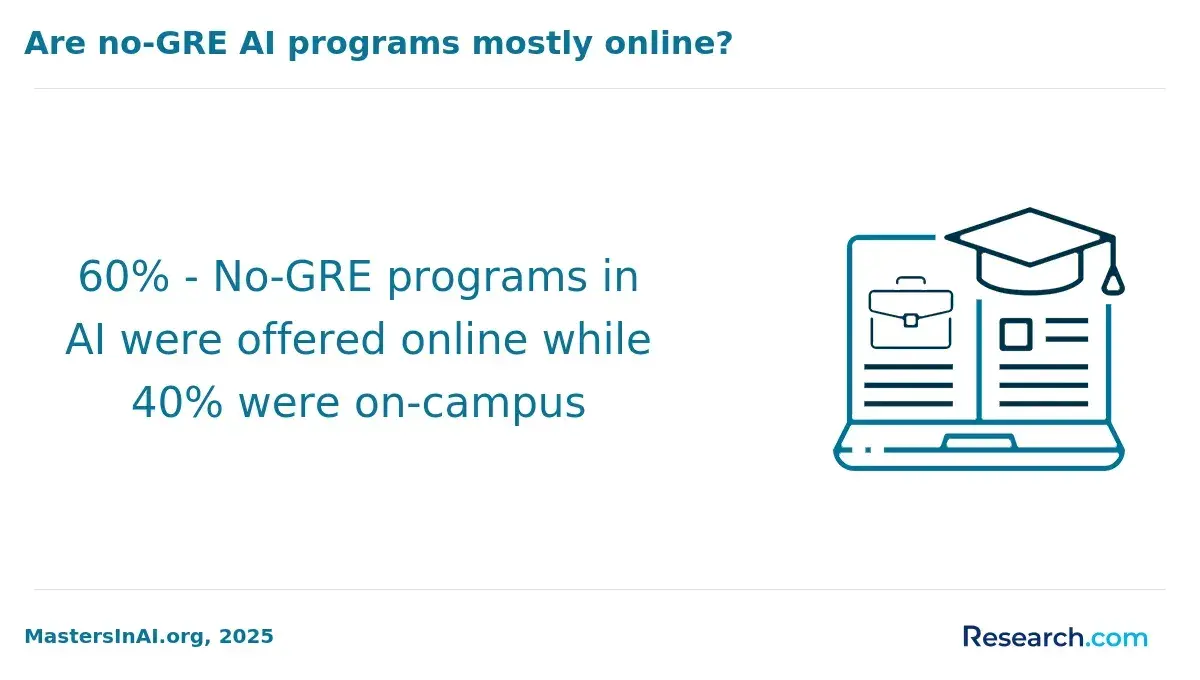
Master's programs in AI and machine learning are increasingly offered both online and on campus, with online enrollment growing by 156% between 2022 and 2024. Now, online courses make up 42% of total master's students, reflecting advancements in remote teaching and growing employer recognition of online degrees.
Online formats provide flexibility, ideal for professionals balancing work or those living outside major cities. Many accredited universities maintain the same curriculum and faculty for online and campus students. Some online programs include live classes and virtual labs, while others are fully asynchronous, allowing students to set their own pace.
Campus programs, however, offer valuable benefits such as direct networking, in-person mentorship, and access to specialized labs-important for hands-on AI projects that require specific hardware. The face-to-face environment also supports collaboration and immediate feedback, which can be key to mastering complex machine learning topics.
Cost-wise, online degrees often save on housing and travel but usually have similar tuition fees. Prospective students should consider accreditation, faculty expertise, and research or internship opportunities when choosing programs. Both paths uphold rigorous standards but demand strong self-motivation and time management for success in AI education.
What is the job outlook and salary potential for AI master's graduates versus Machine Learning master's graduates?
Graduates with a master's degree in artificial intelligence generally experience stronger job prospects and higher starting salaries than those holding a master's in machine learning. According to the National Association of Colleges and Employers 2024 report, 94% of AI master's graduates secure employment within three months, compared to 87% for machine learning graduates. This difference reflects the wider industry need for AI specialists who can integrate various technologies beyond just algorithm development.
Starting salaries for AI roles also tend to be about 12% higher. For instance, entry-level AI professionals often receive offers near $95,000 annually, while machine learning graduates typically start closer to $85,000. This salary gap is linked to the multidisciplinary skills AI programs emphasize, such as robotics, natural language processing, and cognitive computing.
Typical job roles for AI graduates include AI research scientist, AI software engineer, and AI product manager-positions requiring both theoretical and practical expertise. Machine learning graduates mostly work as data scientists and ML engineers, focusing more narrowly on algorithm optimization and predictive analytics. Students should weigh their career goals carefully, as AI master's degrees open broader opportunities in sectors like autonomous vehicles, healthcare AI, and advanced robotics.
Those seeking immediate employment and higher earnings often benefit from AI programs with strong industry connections. However, machine learning skills remain vital for specialized data-driven innovation, offering solid but comparatively lower placement rates and compensation. Continuous upskilling is essential in both fields to stay competitive.
Which accredited universities offer the most respected AI and Machine Learning master's programs in the United States?
Carnegie Mellon University, Stanford University, the Massachusetts Institute of Technology (MIT), and the University of California, Berkeley stand out as the leading accredited universities in the United States offering master's programs in artificial intelligence and machine learning. Together, they graduate 31% of AI and machine learning master's graduates hired by Fortune 500 companies, based on LinkedIn Recruiter Data from 2024, underscoring their critical role in preparing professionals for top industry positions.
Carnegie Mellon's program is known for its technical rigor and strong industry ties, ideal for research and development careers. Stanford emphasizes entrepreneurial use of artificial intelligence and its integration with related technologies, appealing to those interested in startups and innovation. MIT balances foundational machine learning theory with practical AI system design, supporting careers in both academia and business. Berkeley's curriculum combines theoretical coursework with hands-on projects, equipping graduates for varied roles across sectors.
Prospective students should also evaluate faculty expertise, lab resources, industry partnerships, and alumni networks when choosing a program. Universities like University of Washington and Georgia Tech offer strong machine learning curricula, though they currently have less impact on Fortune 500 hiring. Deciding between artificial intelligence or machine learning master's tracks depends on career goals-AI covers broader areas such as robotics and vision, while machine learning focuses more on algorithms and data-driven modeling. Attending these top institutions can enhance access to influential job opportunities and career growth in tech.
What professional certifications or credentials complement an AI or Machine Learning master's degree?
Professional certifications greatly boost the value of an AI or machine learning master's degree by validating specialized skills and enhancing job prospects. Certifications from major cloud providers such as AWS Certified Machine Learning - Specialty, Google Cloud Professional Machine Learning Engineer, and Microsoft Certified: Azure AI Engineer Associate complement these degrees by proving practical expertise in deploying AI solutions on popular cloud platforms. These are highly sought after by employers looking for hands-on experience.
Beyond cloud certifications, credentials like Certified Artificial Intelligence Practitioner (CAIP) and the TensorFlow Developer Certificate focus on algorithm implementation and model optimization, providing deeper technical proficiency beyond theoretical knowledge. These certifications suit candidates aiming for AI model development, data pipeline integration, or production AI roles.
Many professionals also benefit from data science-related certifications such as the Certified Data Scientist (CDS) from the Data Science Council of America, which strengthens analytical skills useful across AI and machine learning projects.
According to the Stack Overflow Developer Survey 2024, master's graduates with AWS, Google Cloud, or Azure AI certifications earned a 23% higher salary within 12 months of graduation, underscoring the financial advantage of industry-recognized credentials.
Choosing the right certification depends on career goals and target industries. Combining practical experience, continuous learning, and vendor-specific certifications creates a strong competitive edge in AI and machine learning careers.
How should I evaluate and choose between AI and Machine Learning master's programs based on industry demand and specialization options?
Evaluate AI and machine learning master's programs by focusing on industry demand and specialization opportunities. Specialized AI tracks-such as healthcare ai, autonomous systems, and robotics-show job growth rates 3.2 times faster than general machine learning programs, according to Indeed Hiring Lab (2024). Students aiming for rapid employability and cutting-edge fields should prioritize these specialized paths.
Career goals and targeted sectors matter when choosing a program. Healthcare ai specializations, for instance, include coursework on medical imaging, precision medicine, and ethical issues unique to healthcare. Meanwhile, many machine learning programs emphasize core algorithmic principles and statistical methods applicable across industries but often lack deep specialization.
Employers increasingly favor candidates with domain-specific AI expertise. For example, autonomous vehicle fields require knowledge of ai integration with sensors and control systems, while robotics demands AI techniques optimized for real-time decision-making. Graduates from programs offering applied skills in these areas enjoy stronger job prospects.
Program flexibility and electives also play a key role. Some institutions offer hybrid curricula blending ai and machine learning, allowing students to customize their skillsets. Partnerships with industry and active research projects further strengthen pathways to employment.
Choosing between a broad theoretical foundation and specialized, high-growth fields depends on personal career aims. Consider which approach aligns best with your goals and the sectors you wish to enter.
Other Things You Should Know About Artificial Intelligence
A master's in artificial intelligence offers specialized knowledge in AI concepts, tools, and applications that are highly valued in today's tech-driven job market. Graduates can access roles in various sectors such as healthcare, finance, and autonomous systems, often commanding competitive salaries. The degree is especially valuable for those seeking to advance into research, development, or leadership positions within AI-focused organizations.
With a master's in artificial intelligence, graduates qualify for roles such as AI software engineer, data scientist, machine learning engineer, and robotics developer. These positions involve designing intelligent systems, developing algorithms, and working with large datasets to create predictive models. Many AI professionals also contribute to emerging fields like natural language processing and computer vision.
Most master's programs in artificial intelligence typically take one to two years to complete, depending on whether students attend full-time or part-time. Accelerated programs may shorten this duration, while part-time or online formats offer flexibility but extend the timeline. The length also varies based on program structure and any required internships or thesis projects.
An AI master's program offers a broader focus, encompassing various AI applications, which can include opportunities in fields like finance, as highlighted in this AI and finance master’s program. Meanwhile, a Machine Learning master's typically concentrates on algorithm development, suitable for roles in data science and analytics.
References
- 11 Best AI Certifications in 2025 to Deepen Your Technical Knowledge | DigitalOcean https://www.digitalocean.com/resources/articles/ai-certifications
- Most Affordable Online Master's in AI for 2025 https://www.mastersinai.org/degrees/affordable-online-masters-in-ai/
- 5 Certifications to Validate Your Machine Learning Skills (+ Training) https://www.skillsoft.com/blog/top-machine-learning-certifications
- Tuition fees and costs - Master Artificial Intelligence https://www.uva.nl/shared-content/programmas/en/masters/artificial-intelligence/tuition-fee-and-costs/tuition-fees-and-costs.html
- Finding Your Ideal AI Career Path: Which Field in Artificial Intelligence Suits You Best? https://dev.to/furqanahmadrao/finding-your-ideal-ai-career-path-which-field-in-artificial-intelligence-suits-you-best-an5
- 11 Best Machine Learning Certifications in 2026 https://www.dataquest.io/blog/best-machine-learning-certifications/
- A Guide to The Top Machine Learning Certifications For 2025 | DataCamp https://www.datacamp.com/blog/top-machine-learning-certifications
- Best Master’s in Artificial Intelligence (AI) Programs in the USA | Top Universities for AI in 2025 | Aionlinecourse https://www.aionlinecourse.com/blog/best-masters-in-artificial-intelligence-ai-programs-in-the-usa-top-universities-for-ai-in-2025
- Certifications in AI that would allow you standout in job hunting https://community.deeplearning.ai/t/certifications-in-ai-that-would-allow-you-standout-in-job-hunting/871654
- Top 10 AI certifications and courses for 2025 https://www.techtarget.com/whatis/feature/10-top-artificial-intelligence-certifications-and-courses