
World Online Ranking of Best Earth Scientists - 2026 Report

Co-Founder and Chief Data Scientist
On May 20, 2026, Research.com released the 5th edition of its best earth scientists ranking. This report aims to increase the visibility of outstanding scientists and help the academic community identify where influential research is taking place. It highlights leading experts whose work continues to shape the field of earth science through research, collaboration, and innovation.
The ranking is designed to support researchers, students, and academic leaders around the world. It recognizes exceptional contributions in earth science while showing how universities, research institutes, and scientific organizations contribute to progress in the discipline. This report also provides insight into current research trends and the institutions producing some of the field’s most influential work.
For the 2026 edition, Research.com reviewed nearly 9,400 scientist profiles gathered from trusted bibliometric databases. Researchers were evaluated using multiple indicators and performance metrics to identify scientists with strong research impact and consistent academic contributions.
To qualify for inclusion, scientists needed a D-index of at least 30, with the majority of their published work focused on earth science. The evaluation also considered the share of publications within the discipline, along with awards, recognitions, and professional achievements. This process helps ensure that the ranking reflects scientists who have made meaningful and lasting contributions to earth science.
Earth science discoveries defining a new era of research
One of the most important developments in earth science research this year comes from the discovery of extensive freshwater systems buried beneath the ocean floor. In 2026, an international team of geocientists from the University of Leicester in England confirmed and directly sampled large volumes of ancient freshened water trapped beneath subseafloor sediments for thousands of years. These underground reservoirs could improve understanding of long-term sea level change, underground water circulation, and the geological history of coastal regions. The findings may also reshape how researchers study hidden water resources and climate-related changes beneath the seafloor.
Another major breakthrough in earth science research comes from the first global mapping of rare earthquakes occurring deep within Earth’s mantle rather than the crust. A research team led by scientists from Stanford University identified hundreds of these hidden mantle earthquakes, with many concentrated near the Himalayas and the Bering Strait. The discovery provides new insight into tectonic plate movement, earthquake formation, and the structure of Earth’s interior. The findings could improve future seismic risk assessments and strengthen geological monitoring efforts worldwide.
The key findings for the 5th edition of the best earth science scientists ranking
- The United States leads the ranking with 442 scientists included in the top 1000 earth scientists worldwide.
- Chinese Academy of Sciences has the highest number of leading earth scientists, with 22 scholars ranked.
- The average discipline H-index for the top 1% of scientists in the ranking is 147.0.
- Average discipline-specific publications among the top 1% of scientists reach 1,081.38, compared to 367.33 for all ranked scientists.
- The average number of discipline-specific citations for the top 1% is 85,108.62, while the overall average across the ranking is 26,695.5.
The full ranking for the 2026 list of best earth scientists can be found here:
WORLD’S BEST EARTH SCIENTISTS RANKING
Countries with the highest number of leading earth science scientists
The United States continues to lead the World Online Ranking of Best Earth Scientists in 2026 with 442 scientists in the top 1000, although this is lower than last year’s 481. The United Kingdom remains second with 101 scientists, improving from 91, while China rises to third place with 67 scientists, up from 52 last year.
Germany ranks fourth with 65 scientists from 58 last year, followed closely by Australia with 64, despite a decline from 70 previously. France records 56 scientists, slightly improving from 55, while Canada remains stable with 46 scientists.
The Netherlands increases its total from 27 to 33 scientists, placing eighth. Switzerland maintains 27 scientists, and Japan rounds out the top 10 with 16 scientists, slightly improving from 15 last year.
Please note that the country associated with a scientist is based on the affiliated research institution according to MAG, not on their actual nationality.
Institutions with the highest number of leading scientists
The Chinese Academy of Sciences leads this year’s ranking with 22 scientists in the top 1000, moving ahead of last year’s leader, California Institute of Technology, which now ranks fifth with 14 scientists compared to 23 previously. Utrecht University rises to second place with 21 scientists, continuing its upward momentum from 19 last year, while Stanford University places third with 18 scientists, slightly down from 21.
University of Colorado Boulder enters the top five with 17 scientists. Both United States Geological Survey and Caltech record 14 scientists, while University of Cambridge, ETH Zurich, and University of Oxford each list 13 scientists.
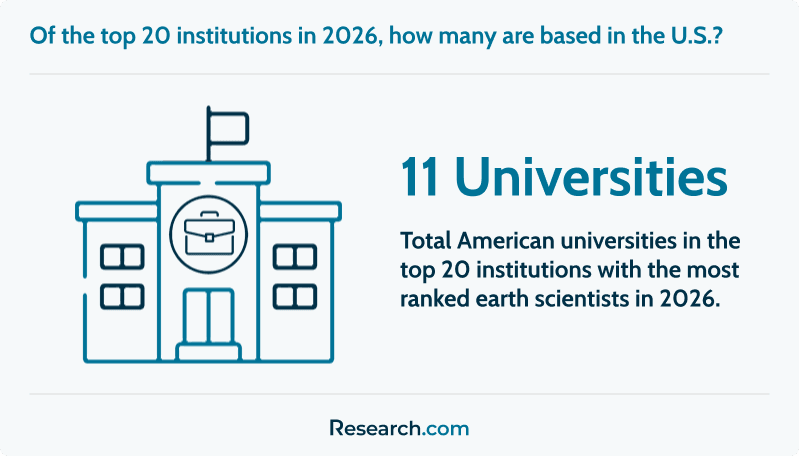
The top 20 continues to feature a strong presence from United States institutions, including Massachusetts Institute of Technology, University of California, Berkeley, and Woods Hole Oceanographic Institution. Institutions from China, the United Kingdom, Switzerland, France, and the Netherlands also maintain strong representation, reflecting the global reach of leading earth science research.
How online universities are expanding earth science research
The growth of online universities is creating new opportunities for earth science education and research. As flexible learning becomes more common, students from different regions can participate in research projects, access scientific resources, and connect with experts in the field.
A broader 2025 dataset from the National Council for State Authorization Reciprocity Agreements shows that more than 1.66 million students are enrolled in exclusively distance education programs across participating institutions, along with 473,548 students engaged in out-of-state learning placements, marking a 9.7% increase from the previous year. These placements increasingly include research-linked experiences such as internships, applied projects, and field-based academic training that are now supported through online and hybrid learning systems
Many online universities now offer earth science and environmental programs that support collaboration in areas such as climate science, geology, oceanography, and sustainability research. These programs help students develop technical and analytical skills while contributing to global scientific discussions. Online learning platforms also make it easier for researchers and institutions to share data, conduct virtual collaboration, and build international academic networks.
H-index ranking—leaders, averages, and distribution
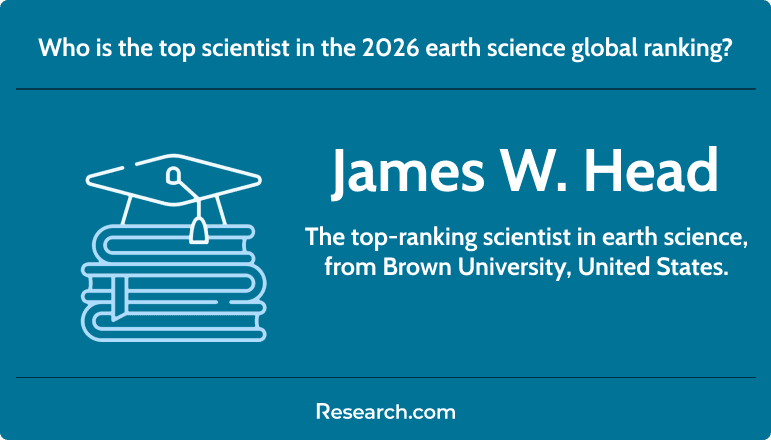
North America’s highest-ranked earth scientist is Professor James W. Head from the United States, who holds a discipline H-index of 154 and ranks 1st globally.
With a discipline H-index of 151, Professor Jean Poesen from Belgium leads Europe and places 2nd worldwide.
In Oceania, the top position belongs to Professor Simon A. Wilde of Australia, recording a discipline H-index of 146 and ranking 5th globally.
Asia is led by Professor Hai Cheng from China, whose discipline H-index reaches 144, placing him 6th in the world ranking.
Ranking 253rd globally, Professor M. Th. van Genuchten from Brazil stands as South America’s leading scientist with a discipline H-index of 88.
Africa’s top-ranked scientist is Professor Emmanuel John M. Carranza from South Africa, who records a discipline H-index of 82 and ranks 408th worldwide.
In the Middle East, Professor Zvi Ben-Avraham from Israel leads the region with a discipline H-index of 71 and ranks 833rd globally.
The average discipline H-index for the top 1% of scientists in the ranking is 147.0, compared to an overall average of 82.96 across the full top 1000 list.
The average number of discipline-specific publications among the top 1% reaches 1,081.38, while the overall average for all ranked scientists is 367.33 publications.
The top 1% of scientists average 85,108.62 discipline-specific citations, compared to an overall average of 26,695.5 citations across the entire ranking.
You can learn more about the methodology used to create this report here.
About Research.com
All research was coordinated by Imed Bouchrika, Ph.D., a computer scientist with a well-established record of collaboration on a number of international research projects with different partners from the academic community. His role was to make sure all data remained unbiased, accurate, and up-to-date.
Research.com is the number one research portal for science and educational rankings. Our mission is to make it easier for professors, research fellows, and students to progress with their research and find the top experts in a wide range of scientific disciplines. Research.com is also a leading educational platform that helps students find the best colleges, academic opportunities, and career paths.


