
2027 How to Become a Middle School Math Teacher in Montana: Requirements & Certification

Co-Founder and Chief Data Scientist
Becoming a middle school math teacher in Montana requires more than liking algebra or enjoying work with adolescents. You need the right degree, a state-approved preparation pathway, testing, supervised classroom experience, a Montana teaching license, and a clear understanding of where jobs and salaries are strongest. This guide is for future teachers, career changers, paraprofessionals, substitute teachers, and current educators who want to teach mathematics in grades typically served by middle schools in Montana.
The decision matters now because Montana districts continue to need qualified math educators, especially in communities where staffing can be difficult. At the same time, teacher preparation costs, licensure rules, student teaching demands, and cost-of-living differences across the state can affect whether this career path is financially and professionally sustainable for you. Below, you will learn the required steps, education options, licensing process, salary expectations, classroom realities, advancement paths, and practical ways to reduce risk before committing to a program.
Quick answer: how do you become a middle school math teacher in Montana?
To become a middle school math teacher in Montana, you generally need to earn a bachelor’s degree with appropriate education and mathematics preparation, complete a state-approved teacher preparation program, finish student teaching, pass required exams, complete fingerprinting and a background check, and apply for licensure through the Montana Office of Public Instruction. Candidates should confirm current requirements directly with the state before enrolling because licensure rules, testing expectations, and endorsement requirements can change.
Key Things You Should Know About Becoming a Middle School Math Teacher in Montana
- Montana has reported shortages of middle school math teachers in recent years, and rural districts often face the greatest hiring challenges. That can create opportunity, but location flexibility may matter.
- As of 2023, the average salary for middle school math teachers in Montana hovers around $54,000 annually. Actual pay can differ by district, contract schedule, experience, education level, and local cost of living.
- The employment outlook for middle school math teachers in Montana is described as promising, with projections indicating a growth rate of approximately 5% over the next decade. STEM priorities and retirements are key factors often cited in demand discussions.
- Montana’s cost of living is not uniform. Billings and Missoula can be more expensive than many smaller communities, while rural areas may offer lower housing costs but fewer local services or job options for family members.
- State investment in education has been described as increasing, which may support school resources over time. Still, resources vary by district, so candidates should evaluate individual school systems rather than relying on statewide generalizations.
- Education requirements for Montana middle school math teachers
- Certification and licensing steps in Montana
- Student teaching, internships, and classroom experience
- Montana math standards and curriculum expectations
- Job market, salary, and benefits
- Continuing education and professional development
- Classroom management and math teaching strategies
- Work-life balance for Montana middle school math teachers
- Related teaching paths in Montana
- Career growth and specializations
- Technology integration in math classrooms
- Legal and ethical responsibilities
- Using online education to advance your career
- Interdisciplinary collaboration in math instruction
- Elementary teaching experience and math foundations
- Cost-effective credential pathways
- Policy changes and classroom practice
- Financial aid and scholarships
- Alternative certification options
- Support resources for new teachers
- Special education strategies in math classrooms
- Transitioning from middle school to high school teaching
What are the steps to becoming a middle school math teacher in Montana?
The path is structured, but it is easier to manage when you separate it into education, testing, clinical experience, licensure, and job search decisions. The most important early step is choosing a program that aligns with Montana licensure expectations before you spend money or transfer credits.
| Step | What to do | Why it matters |
| 1. Choose the right degree path | Earn a bachelor’s degree in education or a related field with mathematics preparation. | Montana licensure depends on having appropriate academic preparation, not just general interest in math. |
| 2. Complete approved teacher preparation | Enroll in a state-approved teacher preparation program that includes pedagogy and supervised teaching. | Teacher preparation connects content knowledge with classroom practice and is a core licensure requirement. |
| 3. Build math content knowledge | Take coursework that strengthens number sense, algebraic reasoning, geometry, statistics, assessment, and middle-grade instruction. | Middle school teachers must explain concepts clearly, identify misconceptions, and adapt lessons for mixed skill levels. |
| 4. Complete student teaching | Teach under supervision in a real classroom and document performance expectations. | Student teaching is where candidates prove they can manage instruction, behavior, planning, and assessment. |
| 5. Pass required exams | Complete required assessments such as Praxis Core Academic Skills for Educators and the Praxis Subject Assessment in Mathematics, if required for your pathway. | Testing verifies baseline academic skills and subject-matter competency. |
| 6. Apply for licensure | Submit your application, transcripts, test scores, and required documentation to the Montana Office of Public Instruction. | You cannot work as a licensed teacher in Montana public schools without meeting state licensing rules. |
| 7. Complete background checks | Finish fingerprinting and background screening. | Schools must verify candidate suitability for working with minors. |
| 8. Apply strategically | Compare districts by salary schedule, mentoring, class size, commute, housing, and community fit. | Your first teaching job can shape your retention, confidence, and long-term career path. |
As part of planning, budget for licensure-related costs. The application fee for a standard teaching license in Montana has been described as approximately $100, though candidates should verify the current amount with the state before applying. New teachers should also explore loan forgiveness programs when they plan to work in eligible public schools or shortage areas.
What are the educational requirements for becoming a middle school math teacher in Montana?
Montana candidates usually begin with a bachelor’s degree that combines education coursework, mathematics preparation, and supervised teaching. A master’s degree can support advancement or salary movement in some districts, but it is not typically the first requirement for initial licensure.
- Bachelor’s degree: A degree in education, mathematics education, or a closely related field is the usual starting point. If you are beginning with only a high school diploma, an accredited bachelor’s program is the most direct route. Students comparing flexible options may also review accelerated online bachelor’s degree programs, but they should confirm that any program meets Montana teacher preparation requirements.
- Mathematics coursework: Candidates should expect college-level preparation in math content and in how middle school students learn mathematical ideas. Strong programs help future teachers diagnose errors, explain multiple solution methods, and connect math to real-world contexts.
- Education coursework: Teacher preparation normally includes lesson design, assessment, educational psychology, classroom management, adolescent development, inclusive instruction, and methods for teaching mathematics.
- State-approved teacher preparation: The program should include required clinical practice and student teaching. Before enrolling, ask the program directly whether it is approved for the license and endorsement you want in Montana.
- Accreditation: Accreditation affects licensure eligibility, transferability, financial aid, and employer confidence. Do not assume that every online or out-of-state program will satisfy Montana requirements.
- Subject-matter competency: Candidates may need to show competency through approved coursework, exams, or both. Montana middle school math teacher qualifications should be checked with the Montana Office of Public Instruction and the preparation program.
If you are comparing teaching requirements across states, be careful: requirements can differ widely. A resource on teacher induction programs in Arkansas can be useful for comparison, but it should not be used as a substitute for Montana licensure guidance.
What is the certification and licensing process for a middle school math teacher in Montana?
Certification is the formal process that allows you to teach in Montana public schools. The exact route depends on your education background, whether you completed a Montana-approved or out-of-state program, and whether you are pursuing a traditional or alternative pathway.
- Complete an eligible degree: Finish a bachelor’s degree in education or a related field with suitable mathematics preparation.
- Finish a teacher preparation program: Complete a state-approved program that includes pedagogy, adolescent learning, assessment, classroom practice, and math teaching methods.
- Pass required assessments: Candidates are commonly expected to complete relevant exams, including mathematics content assessments where applicable.
- Gather documents: Prepare transcripts, testing records, proof of student teaching, program completion verification, identification materials, and any required institutional recommendations.
- Submit the licensure application: Apply through the Montana Office of Public Instruction and follow all instructions for the license type and endorsement.
- Complete fingerprinting and background checks: This step is required to help protect student safety and confirm eligibility to work in schools.
- Pay required fees: Application, testing, transcript, background check, and program fees can add up, so candidates should build a full cost estimate before applying.
Teachers who later want to move into college teaching, administration, or education research may compare advanced options such as online doctorate in higher education leadership programs. That level of study is not required to begin teaching middle school math, but it may fit long-term leadership goals.
Teacher satisfaction should also be part of your decision. Overall job satisfaction among teachers has been described as dropping significantly from 81% in the 1970s to only 42% currently among those who feel the stress of the job is worth it. Treat this as a reminder to evaluate support, workload, salary, and school culture before accepting a position.

How important is teaching experience and what are the internship opportunities for middle school math teachers in Montana?
Teaching experience is essential because middle school math instruction is highly interactive. You are not only explaining procedures; you are helping students build confidence, manage frustration, work through errors, and connect abstract concepts to concrete situations. Classroom experience also helps candidates decide whether they prefer rural, suburban, or urban teaching environments.
- Student teaching: Montana candidates should expect supervised classroom practice as part of teacher preparation. Prior summaries have described certification requirements as including a minimum of 12 weeks of student teaching. Confirm current minimums with your preparation program and the Montana Office of Public Instruction.
- Internships and field placements: Candidates can often find opportunities through universities, school districts, career services offices, and educator networks. These placements help candidates observe classroom routines before taking full responsibility for instruction.
- Substitute teaching: Subbing can expose candidates to different grade levels, school cultures, and classroom management styles. It is especially useful for career changers who have not recently worked with adolescents.
- Tutoring: Math tutoring builds skill in explaining concepts one-on-one, diagnosing misunderstandings, and adjusting language for different learners.
- Paraprofessional work: Working as an instructional aide or paraprofessional can help candidates understand IEP support, small-group instruction, and classroom logistics.
| Experience option | Best for | What you learn |
| Student teaching | Licensure candidates | Full lesson planning, classroom management, grading, family communication, and professional expectations |
| Tutoring | Students building math teaching confidence | How to explain concepts, address gaps, and personalize instruction |
| Substitute teaching | Career changers and future applicants | How different schools operate and how students respond to routines |
| Paraprofessional roles | Candidates interested in inclusive classrooms | How to support diverse learners and collaborate with certified teachers |
| Volunteer programs | Early-stage students exploring teaching | Whether middle school learners and school schedules fit your personality |
What are the Montana standards and curriculum requirements for teaching middle school math?
Middle school math teachers in Montana must align instruction with state standards while adapting lessons to local communities and student needs. Standards guide what students should learn; teachers decide how to sequence, explain, assess, and reinforce those ideas.
- Montana Mathematics Content Standards: These standards describe the mathematical knowledge and skills students are expected to develop. Teachers use them to plan units, lessons, assessments, and intervention activities.
- Local curriculum decisions: Districts may select different instructional materials and pacing guides, so teachers should ask how closely curriculum maps are tied to state standards.
- Culturally responsive instruction: Montana education includes attention to local context and Indigenous perspectives. Math teachers can support this by using meaningful examples, community data, and respectful interdisciplinary connections.
- Problem solving and reasoning: Middle school math should go beyond memorized procedures. Students need to justify answers, compare strategies, interpret data, and apply concepts in unfamiliar situations.
- Assessment alignment: Teachers should use formative checks, quizzes, projects, and performance tasks that measure the same skills emphasized in standards.
Educators who want to influence curriculum at a broader level may later explore doctoral or leadership-oriented study. For a broader view of advanced education career options, see what you can do with a doctorate in education.
What is the job market like and what are the salary expectations for middle school math teachers in Montana?
The Montana job market for middle school math teachers is generally shaped by subject demand, district location, retirement patterns, student enrollment, and the difficulty of staffing rural schools. Math is often a priority area because it supports STEM readiness and long-term academic progress.
The average salary for a middle school math teacher in Montana is $63,148 as of August 27, 2024. Typical salaries for this position range from $51,283 to $78,517, as shown in the chart below.
Salary figures should be used as planning estimates rather than guarantees. Individual compensation can vary by district salary schedule, education level, years of experience, endorsements, local bargaining agreements, and whether the role includes extra duties such as coaching or department leadership.
| Location or salary measure | Figure cited | How to interpret it |
| Montana average cited for 2023 | Around $54,000 annually | A broad estimate useful for early career planning |
| Montana average as of August 27, 2024 | $63,148 | A later salary estimate for middle school math teachers in the state |
| Typical statewide range | $51,283 to $78,517 | A reminder that pay differs meaningfully across districts and experience levels |
| Belgrade | Around $57,739 | Local salary examples can help candidates compare district options |
| Absarokee | About $64,433 | Smaller communities may still offer competitive salaries depending on district schedules |
| Acton | $64,973 | Location-specific pay should be weighed against housing, commute, and benefits |
Urban areas such as Billings and Missoula may offer more school options but can also come with higher living costs and more competition for preferred positions. Rural districts may offer closer community relationships and stronger demand, but candidates should evaluate housing availability, distance from services, and professional support.
Benefits matter. Health insurance, retirement plans, paid leave, professional development support, and tuition assistance can make a lower salary more competitive. When comparing job offers, ask for the full salary schedule and benefits summary, not just the starting salary.
If you are considering additional education to strengthen communication, writing, or interdisciplinary teaching skills, you may also compare affordable online MFA programs, although those degrees are not a standard requirement for math teaching licensure.
What professional development and continuing education opportunities are available for middle school math teachers in Montana?
Professional development helps middle school math teachers keep their skills current, maintain licensure, and respond to changing student needs. Strong teachers continue learning after certification because math instruction, assessment tools, technology, and intervention practices evolve.
- State professional learning: The Montana Office of Public Instruction provides professional learning resources for educators, including opportunities that may support instructional practice and licensure renewal.
- District training: Many school systems offer professional development days focused on curriculum, assessment, student behavior, special education, technology, or local priorities.
- Math educator organizations: Professional groups can connect teachers with conferences, workshops, lesson ideas, mentoring, and peer support.
- Continuing education credits: Montana teachers should track required renewal hours or credits carefully and maintain documentation.
- Graduate study: A master’s degree or graduate certificate can support advancement, salary movement in some districts, or specialization in curriculum, leadership, special education, or instructional technology.
Teachers seeking advanced but affordable credentials can compare options such as budget-friendly online teaching master’s degrees, but they should confirm whether the program is accredited, accepted by their district, and relevant to their licensure or salary goals.
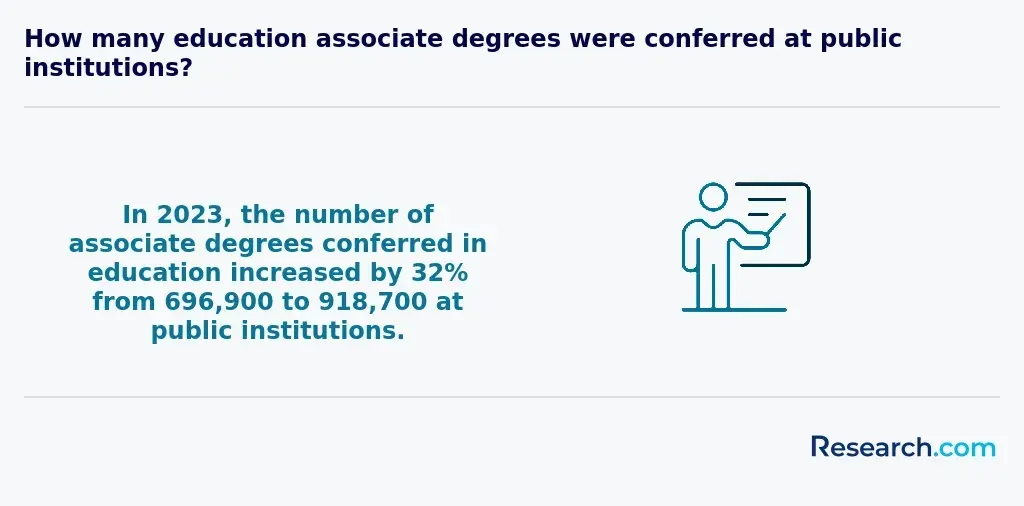
An Associate's degree in Education can also be an entry point for some education-related work before a bachelor’s degree. In 2023, the number of Associates' degrees in education conferred by public institutions was at 918,700, an increase of 32$ from 696,900, as shown below.
What are effective classroom management strategies and teaching methods for middle school math teachers in Montana?
Middle school math teaching works best when structure and curiosity are both present. Students at this age need predictable routines, clear expectations, and frequent opportunities to talk through ideas, make mistakes safely, and see why math matters.
- Set routines early: Establish how students enter class, start warm-ups, use materials, ask questions, work in groups, and submit assignments. Predictability reduces behavior problems.
- Teach math through explanation, not shortcuts: Show multiple solution paths and ask students to explain their reasoning. This builds conceptual understanding instead of memorization alone.
- Use local and practical examples: Budgeting, maps, agriculture, outdoor recreation, school events, and local data can make ratios, geometry, measurement, and statistics more meaningful.
- Differentiate instruction: Some students will need visual models, manipulatives, guided notes, small-group reteaching, or enrichment tasks. Plan for variation before the lesson starts.
- Check understanding frequently: Exit tickets, mini-whiteboards, quick quizzes, and short conferences help teachers identify confusion before it grows.
- Build academic confidence: Many middle school students decide whether they are “math people” during these years. Use feedback that focuses on strategy, effort, and revision.
- Use technology selectively: Digital tools should support thinking, practice, assessment, or collaboration. Technology should not replace teacher explanation or student reasoning.
| Common classroom challenge | Better teaching response | Why it works |
| Students give up quickly on word problems | Teach annotation, visual models, and problem-solving steps | Students learn how to enter a problem instead of waiting for a formula |
| Skill levels vary widely | Use tiered practice, small groups, and extension tasks | Students get support or challenge without holding back the entire class |
| Students memorize procedures without understanding | Ask students to compare methods and justify answers | Reasoning becomes visible and misconceptions surface earlier |
| Behavior disrupts instruction | Use clear routines, proximity, consistent consequences, and positive reinforcement | Students know what is expected and what happens next |
| Technology becomes distracting | Use tools with specific learning goals and time limits | Digital resources stay connected to instruction |
What is the work-life balance like for middle school math teachers in Montana?
Work-life balance depends heavily on the district, class load, planning time, administrative support, student needs, commute, and whether the teacher is new or experienced. New teachers often spend more time planning, grading, contacting families, and building classroom systems.
Montana’s community-centered school culture can be a major advantage, especially in smaller districts where teachers may know families well and receive strong local support. The trade-off is that teachers in small communities may also take on multiple roles, such as advising clubs, coaching, covering duties, or teaching several preparations.
- Protect planning time: Use templates for lesson plans, assessments, parent communication, and reteaching routines.
- Grade strategically: Not every practice problem needs a detailed grade. Use completion checks, targeted feedback, and self-correction when appropriate.
- Set communication boundaries: Clarify when you respond to emails and how families can contact you for urgent matters.
- Seek mentorship: A strong mentor can reduce stress by sharing pacing guides, classroom systems, and assessment ideas.
- Evaluate school culture before accepting an offer: Ask about planning time, class sizes, behavior support, curriculum resources, and first-year teacher mentoring.
Professional well-being is not separate from teaching quality. The importance of community support and workload management is also discussed in related state-specific guides, such as elementary school teacher requirements in New Mexico.
Are there other teaching career paths available in Montana for those interested in math education?
Yes. If you like math instruction but are unsure about middle school, Montana offers several education pathways that may still allow you to support mathematical thinking. Early childhood educators introduce number sense and patterns, elementary teachers build foundational math skills, high school teachers focus on more advanced content, and special education teachers help students access math through individualized supports.
| Path | When it may fit | Important consideration |
| Preschool teacher | You want to support early number sense, pattern recognition, and school readiness | Review how to become a preschool teacher in Montana before choosing a program |
| Elementary teacher | You prefer teaching multiple subjects and building core math foundations | You may need a broader elementary preparation pathway |
| Middle school math teacher | You enjoy early adolescence and pre-algebra, ratios, geometry, and data concepts | Classroom management and confidence-building are central |
| High school math teacher | You want deeper subject specialization and advanced math instruction | Endorsement and content expectations may differ |
| Special education teacher | You want to adapt instruction for students with disabilities | Specialized licensure preparation is usually required |
What are the career advancement opportunities and specializations for middle school math teachers in Montana?
Middle school math teachers can remain in the classroom while expanding their influence, or they can move into leadership, curriculum, coaching, or administrative roles. Advancement usually depends on experience, additional credentials, performance, district needs, and sometimes graduate education.
- Department leadership: Experienced teachers may coordinate math curriculum, mentor colleagues, analyze assessment results, and support instructional planning.
- Instructional coaching: Math coaches help teachers improve lessons, intervention strategies, assessment design, and student engagement.
- Special education or intervention specialization: Teachers can develop expertise in math interventions, inclusive practices, or support for students with learning differences.
- Technology integration: Teachers with strong digital instruction skills may lead schoolwide adoption of learning platforms, assessment tools, or blended learning models.
- Administrative roles: Teachers interested in broader school leadership may pursue administrative endorsements or advanced degrees in educational leadership.
- Curriculum and policy work: Experienced educators may contribute to district curriculum committees, assessment design, or state-level education conversations.
The National Center for Education Statistics found a strong correlation between educational attainment and teacher salaries in the United States. In 2020-2021, teachers with a bachelor's degree earned an average of $52,500 annually, while those with a master's degree earned $67,000. Educators holding an education specialist degree earned $70,500 on average, and those with a doctorate earned the most at $71,300, as shown in the graph below.
Advanced education can support earning potential, but candidates should compare tuition, time commitment, salary schedule movement, and personal goals before enrolling. A graduate degree is more valuable when it aligns with a real district need or career direction.
How can middle school math teachers effectively integrate technology into their classrooms?
Technology is most effective when it strengthens math thinking rather than simply adding screen time. Middle school math teachers can use digital whiteboards, graphing tools, adaptive practice platforms, formative assessment apps, and collaboration tools to make student thinking more visible.
- Use digital assessments to identify misconceptions quickly.
- Use graphing and geometry tools to let students manipulate mathematical models.
- Give students structured collaboration tasks instead of open-ended browsing.
- Choose tools that align with Montana standards and district privacy rules.
- Balance technology with paper-and-pencil reasoning, discussion, and teacher-led modeling.
Interdisciplinary online resources can also help teachers design richer examples. For instance, comparing historical data or timelines may connect math with social studies; educators exploring humanities-related study can review affordable online history degree programs for broader context.
What legal and ethical considerations must Montana middle school math teachers follow?
Montana middle school math teachers must follow licensing rules, school policies, student privacy expectations, mandatory reporting obligations, and professional ethics. These responsibilities are not optional; they are central to safe and lawful teaching.
- Valid license: Teachers must hold the appropriate Montana teaching license and endorsement for their assignment.
- Background checks: Fingerprinting and background screening are part of the licensure process and employment eligibility.
- Mandatory reporting: Teachers are responsible for reporting suspected child abuse or neglect according to Montana law and district procedures.
- Student privacy: Grades, disability information, discipline records, and family information must be handled confidentially.
- Equitable instruction: Math teachers must give all students meaningful access to instruction, including English learners, students with disabilities, gifted learners, and students who have experienced interrupted learning.
- Professional boundaries: Communication with students and families should follow district-approved channels and ethical expectations.
- Assessment integrity: Teachers must administer tests honestly, grade consistently, and avoid practices that misrepresent student learning.
How can online education advance your teaching career?
Accredited online programs can help teachers earn degrees, endorsements, graduate credits, or specialized training while continuing to work. Online education is especially useful for Montana educators who live far from campus-based programs or who need flexible scheduling.
Before enrolling, confirm accreditation, Montana licensure relevance, field placement requirements, tuition, transfer policies, and whether your district recognizes the credits for salary advancement. Teachers comparing options can start with Research.com’s guide to the best online colleges for teaching degrees.
How can interdisciplinary collaboration enhance classroom engagement for middle school math teachers in Montana?
Math becomes more engaging when students see it operating outside the math textbook. Collaboration with science, music, art, social studies, career and technical education, or physical education teachers can help students apply measurement, ratios, patterns, data, geometry, and problem solving in authentic contexts.
- Work with science teachers on data collection and graphing.
- Partner with music teachers to explore rhythm, fractions, ratios, and patterns.
- Connect with art teachers for symmetry, scale, tessellations, and geometry.
- Use social studies data for statistics, mapping, and proportional reasoning.
Teachers interested in cross-subject collaboration can review music teacher education requirements in Montana to better understand how another teaching specialty is prepared.
Should middle school math teachers consider gaining elementary classroom experience?
Elementary experience can be valuable for middle school math teachers because many middle-grade struggles begin with earlier gaps in number sense, fractions, place value, multiplication, and problem-solving confidence. Understanding how younger students first learn these concepts can improve intervention and reteaching at the middle school level.
This path is especially useful if you want to work in smaller districts, teach multiple grade levels, become an interventionist, or better support students who arrive below grade level. Candidates considering a broader credential should review how to become an elementary teacher in Montana.
What is the most cost-effective way to secure your teaching credential in Montana?
The lowest-cost pathway is not always the cheapest tuition on paper. The best value is the program that gets you licensed with the least wasted time, the fewest nontransferable credits, and the clearest path to employment.
- Choose an accredited program that aligns with Montana licensure requirements.
- Compare total cost, not just tuition: fees, testing, books, technology, travel, and lost wages during student teaching all matter.
- Ask whether prior credits or work experience can reduce your time to completion.
- Confirm field placement support before enrolling in an online program.
- Look for scholarships, district partnerships, and loan forgiveness eligibility.
- Avoid programs that cannot clearly explain Montana licensure outcomes.
For a focused comparison of lower-cost options, see Research.com’s guide to the cheapest way to get a teaching credential in Montana.
How are recent educational policy changes influencing classroom practices for middle school math teachers in Montana?
Policy changes can affect standards alignment, assessment expectations, instructional materials, data reporting, professional development, and district accountability. For teachers, the practical effect is usually seen in lesson pacing, intervention planning, documentation, and how schools measure student progress.
Middle school math teachers should monitor Montana Office of Public Instruction updates, district curriculum revisions, testing guidance, and professional learning opportunities. Teachers who want more subject specialization or a broader secondary role may also explore how to become a high school math teacher in Montana.
What financial aid and scholarship opportunities are available for middle school math teachers in Montana?
Future and current Montana teachers may be able to reduce costs through federal student aid, institutional scholarships, district tuition support, service-based loan forgiveness, grants, and workforce programs. Availability depends on the school, credential pathway, employment setting, and individual eligibility.
- Complete financial aid forms early if enrolling in a degree program.
- Ask colleges about scholarships for education majors, math education candidates, rural educators, and career changers.
- Check whether your district offers tuition reimbursement or professional development funding.
- Investigate loan forgiveness if you plan to work in eligible public schools or shortage areas.
- Compare funding structures across teaching areas; requirements for Montana English teacher certification, for example, may provide useful context when reviewing education programs.
Are alternative teaching certification pathways available in Montana?
Alternative certification may be available for candidates who already hold a degree or have professional experience but did not complete a traditional teacher education program. These pathways can be useful for career changers, but they are not shortcuts around competency, student safety, or classroom readiness.
Alternative routes often include condensed coursework, mentorship, supervised teaching, testing, and formal state approval. Before choosing this option, review eligibility carefully through teaching certificate requirements in Montana and confirm details with the Montana Office of Public Instruction.
What resources and support are available for new middle school math teachers in Montana?
New teachers need more than a license. They need mentoring, curriculum support, classroom management guidance, professional networks, and reliable state information. The first two years are often the hardest, so support should be part of your job search criteria.
- State guidance: The Montana Office of Public Instruction provides licensure, standards, professional learning, and educator resources.
- Math professional network: The Montana Council of Teachers of Mathematics connects math educators through resources, events, and professional community.
- District mentoring: Ask each employer whether first-year teachers are assigned mentors, common planning time, or induction support.
- Curriculum resources: Strong districts provide pacing guides, assessments, intervention materials, and access to approved instructional tools.
- Peer collaboration: Grade-level teams and professional learning communities can help new teachers avoid isolation and improve instruction faster.
- Behavior and student support teams: Counselors, special education staff, administrators, and interventionists are critical partners in middle school settings.
How can middle school math teachers integrate special education strategies effectively?
Inclusive math instruction helps students with disabilities access grade-level concepts while receiving supports matched to their needs. Teachers do not need to work alone; effective inclusion depends on collaboration with special education teachers, families, interventionists, and support staff.
- Read IEPs and accommodation plans carefully before instruction begins.
- Use visual models, manipulatives, worked examples, and structured notes.
- Break multistep tasks into smaller, teachable parts.
- Offer multiple ways for students to show understanding.
- Use formative assessment data to adjust grouping and interventions.
- Collaborate regularly with special education specialists.
- Maintain high expectations while providing appropriate supports.
Educators who want deeper preparation in inclusive instruction can review how to become a special education teacher in Montana.
What do graduates have to say about becoming a middle school math teacher in Montana?
- “Teaching middle school math in Montana has meant helping students move from uncertainty to confidence. The best moments happen when a student finally sees how a concept connects to everyday life. The professional community has also mattered; sharing lessons and strategies with other teachers makes the work more manageable.” — Sue
- “For me, this role is about more than equations. Middle school students are learning how to think, explain, revise, and persist. Smaller school communities can make it easier to know students well, and that personal connection changes how you teach.” — Johnny
- “The most rewarding part is watching a student understand something that once felt impossible. Montana’s collaborative teaching culture has helped me design better lessons, and the lifestyle outside of school is part of why I have stayed.” — Erica
Is transitioning to a high school teaching role a viable growth opportunity?
Yes, experienced middle school math teachers may find high school teaching to be a strong next step if they want deeper content specialization, advanced coursework, or a different student age group. The transition requires careful review of endorsement requirements, curriculum expectations, and the teacher’s comfort with advanced math topics.
Before making the move, compare the differences in student independence, course sequencing, graduation requirements, assessment pressures, and department structure. Educators exploring secondary teaching more broadly can also compare pathways such as becoming a high school history teacher in Montana to understand how secondary roles differ by subject.
Common mistakes to avoid before becoming a Montana middle school math teacher
| Mistake | Why it can hurt you | Better approach |
| Choosing a program before checking licensure alignment | You may complete credits that do not qualify you for the license you need. | Confirm Montana approval, accreditation, endorsement fit, and field placement requirements in writing. |
| Looking only at tuition | Testing, fees, travel, books, and unpaid student teaching can change the real cost. | Build a total-cost estimate before enrolling. |
| Assuming online programs automatically qualify | Some online or out-of-state programs may not meet Montana requirements. | Verify licensure outcomes directly with the program and the state. |
| Ignoring rural-versus-urban trade-offs | Salary, housing, commute, support, and job availability vary by location. | Compare district salary schedules and cost of living before applying. |
| Underestimating classroom management | Strong math knowledge alone does not guarantee effective teaching. | Seek field experience, mentoring, and training in adolescent behavior and routines. |
| Assuming salary outcomes are guaranteed | Pay depends on district schedules, credentials, experience, and bargaining agreements. | Review actual district contracts and benefits before accepting a role. |
Key Insights
- Montana middle school math teachers generally need a bachelor’s degree, approved teacher preparation, student teaching, required exams, a background check, and a state-issued license.
- Program choice is the biggest early decision. Accreditation and Montana licensure alignment should be verified before enrollment, especially for online or out-of-state options.
- Salary estimates vary. Figures cited include around $54,000 annually as of 2023 and $63,148 as of August 27, 2024, with a typical range of $51,283 to $78,517. Always compare actual district salary schedules.
- Location matters. Rural districts may have stronger need and community support, while urban areas such as Billings and Missoula may offer more openings but higher living costs.
- Student teaching and classroom experience are not formalities. They help candidates learn management, differentiation, assessment, and the realities of teaching adolescents.
- Middle school math teachers who want to advance can move into instructional coaching, curriculum leadership, special education, technology integration, administration, or high school teaching.
- The best financial decision is not always the lowest tuition. The most cost-effective pathway is the one that leads to Montana licensure with minimal wasted credits, strong placement support, and manageable total costs.
Related Articles for Nearby States
- 2027 How to Become a Middle School Math Teacher in Idaho: Requirements & Certification
- 2027 How to Become a Middle School Math Teacher in North Dakota: Requirements & Certification
- 2027 How to Become a Middle School Math Teacher in South Dakota: Requirements & Certification
- 2027 How to Become a Middle School Math Teacher in Washington: Requirements & Certification
- 2027 How to Become a Middle School Math Teacher in Oregon: Requirements & Certification
- 2027 How to Become a Middle School Math Teacher in Utah: Requirements & Certification
- 2027 How to Become a Middle School Math Teacher in Nebraska: Requirements & Certification
- 2027 How to Become a Middle School Math Teacher in Minnesota: Requirements & Certification
- 2027 How to Become a Middle School Math Teacher in Colorado: Requirements & Certification
- 2027 How to Become a Middle School Math Teacher in Nevada: Requirements & Certification
References:
- Bureau of Labor Statistics. (2023). Middle school teachers. Bureau of Labor Statistics.
- Bureau of Labor Statistics. (2023). Occupational employment and wages, May 2023: Middle school teachers. Bureau of Labor Statistics.
- Data USA. (2023). Education. Data USA.
- Data USA. (2023). Mathematics teacher education. Data USA.
- Montana Office of Public Instruction. (2024). Professional learning. Montana Office of Public Instruction.
- National Center for Education Statistics. (2023). The condition of education 2023. National Center for Education Statistics.
- Salary.com. (2024). Middle school math teacher salary in Montana. Salary.com.
Other Things You Should Know About Becoming a Middle School Math Teacher in Montana
To become a middle school math teacher in Montana, you must obtain a teaching license from the Montana Office of Public Instruction. This typically requires completing a bachelor's degree in education with a focus on mathematics, passing the required Praxis exams, and completing a student teaching internship.
Additionally, you may need to undergo a background check. It's essential to stay updated on any changes in certification requirements, as they can evolve.
The first step is to obtain a bachelor's degree in education with a focus on mathematics or a related field. Once completed, you must enroll in a teacher preparation program approved by the Montana Office of Public Instruction to gain required teaching skills.
In Montana, aspiring middle school math teachers must pass the Praxis II exam in Mathematics. This exam assesses specific teaching skills and content knowledge necessary for certification. Check with the Montana Office of Public Instruction for the most up-to-date exam requirements in 2027.
To obtain a middle school math teaching certification in Montana in 2027, one must complete a bachelor's degree in education with a focus on mathematics, pass the Praxis Subject Assessments, and complete a state-approved teacher preparation program. Background checks and obtaining a Class 5 provisional license are also necessary steps.


