
2027 What Does a Paleontologist Do: Responsibilities, Requirements, and Salary

Co-Founder and Chief Data Scientist
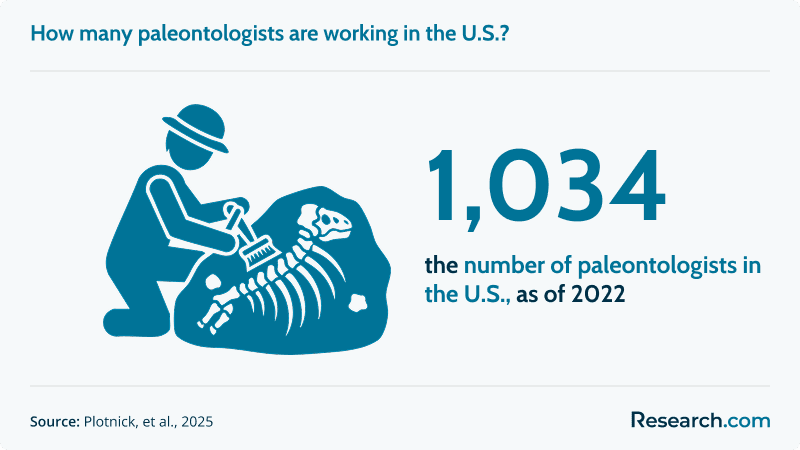
Becoming a paleontologist is a serious research career choice, not just a dream job for people who love fossils. The work can involve field expeditions, museum collections, laboratory analysis, teaching, grant writing, and years of graduate study. It is also a small profession: with only about 1,034 professional paleontologists in the entire U.S., students need a realistic plan as well as genuine enthusiasm for ancient life.
This guide explains what paleontologists actually do, where they work, how much they can earn, what skills matter most, and what education is usually required. It is designed for high school students, undergraduates, career changers, and anyone deciding whether paleontology is the right long-term path.
Key Things You Should Know About What a Paleontologist Does
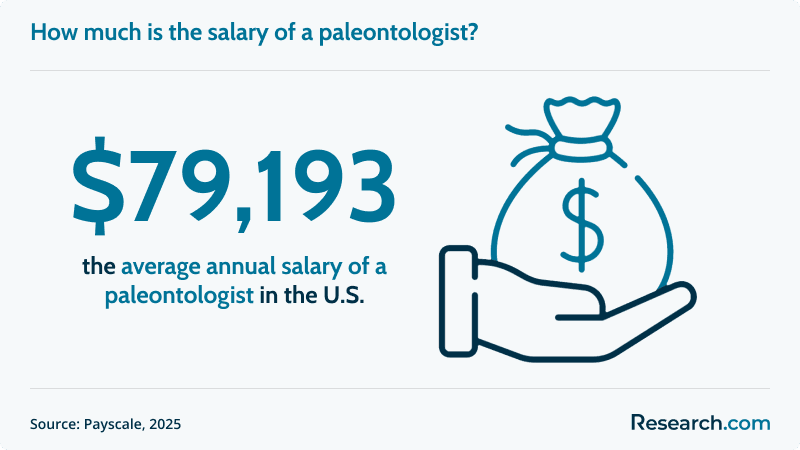
- The average salary for a paleontologist in the U.S. is approximately $79,193 per year.
- It is a highly specialized and small field, with only about 1,034 professional paleontologists working in the country.
- A Doctor of Philosophy (Ph.D.) is the standard educational requirement for most independent research and university positions.
- The work is not just fieldwork; it is a balance of excavating fossils, analyzing them in a lab, and academic duties like teaching and writing.
- Success in the field requires a strong foundation in geology and biology, as well as excellent data analysis and writing skills.
What is a paleontologist?
A paleontologist is a scientist who studies the history of life on Earth through fossils. Those fossils may include bones, shells, teeth, leaves, pollen, spores, footprints, burrows, and microscopic organisms preserved in rock. The goal is not simply to find impressive specimens, but to use fossil evidence to understand evolution, extinction, ancient climates, and past ecosystems.
Dinosaurs are the most familiar part of paleontology, but they represent only one branch of the field. Many paleontologists never work on dinosaurs at all. Some study ancient oceans, some focus on fossil plants, and others analyze microscopic fossils that help date rock layers or reconstruct environmental change.
Major areas within paleontology
- Vertebrate paleontology: The study of animals with backbones, including dinosaurs, ancient mammals, reptiles, fish, and amphibians.
- Invertebrate paleontology: The study of animals without backbones, such as trilobites, ammonites, corals, and mollusks.
- Paleobotany: The study of fossil plants, pollen, seeds, and forests to understand ancient landscapes and climates.
- Micropaleontology: The study of tiny fossils, often useful for dating rock layers and interpreting subsurface geology.
- Paleoecology: The study of how ancient organisms interacted with one another and with their environments.
In practice, paleontology sits at the intersection of geology and biology. Strong paleontologists understand both the organisms they study and the rocks that preserve them.
What does a paleontologist do during fieldwork?
Fieldwork is the part of paleontology most people picture first, but it is less about dramatic digging and more about careful scientific documentation. A field project usually begins before anyone picks up a tool. Paleontologists study geological maps, previous research, satellite imagery, and rock formations to identify areas likely to preserve fossils of the right age and type.
Once a promising site is located, the team surveys the area, records surface finds, maps the site, and determines whether excavation is justified. If fossils are collected, every specimen must be documented in context. Where the fossil was found, which rock layer contained it, its orientation, and its relationship to nearby fossils can be as scientifically important as the fossil itself.
Common fieldwork tasks
- Prospecting: Searching exposed rock layers for fossil material and identifying sites worth documenting or excavating.
- Mapping: Recording fossil locations, stratigraphic position, site boundaries, and surrounding geology.
- Excavation: Removing overlying sediment and rock with appropriate tools, from shovels and rock hammers to brushes and dental picks.
- Stabilization: Applying consolidants or protective materials when fossils are fragile.
- Jacket preparation: Wrapping larger specimens in plaster jackets so they can be transported safely to a lab.
- Field notes: Keeping accurate written, photographic, and spatial records so the find has scientific value after it leaves the ground.
The reality of field conditions
Fieldwork is often seasonal and physically demanding. Digs may take place in remote areas with heat, cold, wind, steep terrain, limited facilities, and long days of repetitive work. A successful field paleontologist needs patience, stamina, and respect for safety procedures, land access rules, and fossil collection regulations.
Practical land-reading skills also help. Understanding topography, drainage, soil exposure, erosion patterns, and rock layers can make fieldwork more effective. Even training from areas such as landscaping technology certification courses online can reinforce useful observation skills related to terrain and surface conditions.
For many paleontologists, fieldwork is rewarding because it connects scientific questions to real places. Still, it is only one part of the job. A fossil found in the field becomes meaningful only after it is prepared, analyzed, compared, and published.
What work happens in a paleontology lab?
The lab is where fossils are transformed from collected specimens into usable scientific evidence. A fossil may arrive from the field inside a plaster jacket, still surrounded by rock. Before researchers can study it closely, trained staff often spend weeks, months, or longer preparing it.
Fossil preparation is precise work. Preparators remove the surrounding rock matrix using small tools, microscopes, air scribes, adhesives, and stabilizing materials. The goal is to expose the fossil without damaging it or losing information. In some cases, preparation choices can affect what future researchers are able to study, so careful documentation matters.
What happens after preparation
- Identification: Researchers compare the fossil with known specimens to determine what organism it may represent.
- Measurement: Important structures are measured and described for analysis and publication.
- Imaging: CT scanners, photography, microscopy, and 3D modeling may be used to examine internal and external anatomy.
- Comparative anatomy: Fossils are compared with extinct and living organisms to understand relationships, function, and evolution.
- Data analysis: Measurements, locations, ages, and anatomical features are organized and analyzed to test research questions.
- Curation: Specimens are cataloged and stored so other researchers can verify and build on the work.
Why lab work matters
Fieldwork may produce the discovery, but lab work produces much of the science. A fossil’s shape, chemistry, age, microscopic structure, and geological context can reveal how an organism lived, how it moved, what environment it occupied, and how it relates to other species.
Modern paleontology labs are not just storage rooms. They may use digital reconstruction, chemical analysis, high-resolution imaging, statistical modeling, and biomechanical methods. Students who imagine paleontology as only outdoor excavation should understand that many professional hours are spent indoors, working with specimens, data, software, collections records, and scientific literature.
What are a paleontologist's other professional duties?
Professional paleontologists do much more than collect and study fossils. In universities, museums, agencies, and research organizations, the job often includes teaching, writing, management, public communication, and administrative work. These duties are not secondary; they are central to sustaining a research career.
- Securing funding: Research trips, lab equipment, imaging, student support, and specimen preparation can be expensive. Paleontologists often write grant proposals to organizations such as the National Science Foundation.
- Publishing research: Discoveries must be described, analyzed, peer-reviewed, and published so other scientists can evaluate and use the findings.
- Teaching: University paleontologists commonly teach geology, biology, evolution, stratigraphy, anatomy, or Earth history courses.
- Mentoring students: Faculty and museum researchers may supervise undergraduate projects, graduate theses, field assistants, and early-career researchers.
- Managing collections: Museum paleontologists may oversee fossil storage, cataloging, conservation, loans, and researcher access.
- Public outreach: Paleontologists often contribute to museum exhibits, public lectures, school programs, documentaries, interviews, and community events.
- Compliance and ethics: Work may involve permits, landowner permissions, public land regulations, repatriation issues, and responsible stewardship of scientifically important fossils.
The professional reality
For many academic paleontologists, writing is as important as field skill. Grant proposals, journal articles, course materials, exhibit text, and technical reports all require clarity and precision. A researcher who cannot communicate findings effectively may struggle to secure funding, publish work, or build a professional reputation.
This is why students should develop strong scientific writing early. Paleontology rewards curiosity, but it also requires documentation, argumentation, peer review, and collaboration.
What is the job outlook for paleontologists?
The job outlook for paleontologists is best described as limited and highly competitive. Paleontology is a small profession, and there are far more interested students than permanent research positions. As of the most recent data on the discipline, there were only about 1,034 professional paleontologists in the entire United States.
Many full-time positions are in universities, museums, government agencies, and specialized industry roles. Openings may depend on retirements, department budgets, grant funding, museum priorities, or agency needs. Because positions are limited, candidates often need advanced degrees, strong publication records, field or lab experience, and a clear research specialty.
Why competition is intense
Paleontology attracts people because it is intellectually exciting and culturally visible. That popularity creates what some career planners informally call the “Dinosaur Tax”: many talented applicants compete for a small number of jobs because the subject is so appealing.
This does not mean the career is impossible. It does mean students should plan strategically. The strongest candidates usually build experience early, work with active researchers, develop quantitative and technical skills, publish when possible, and remain open to adjacent careers in geology, biology, museums, education, environmental work, data analysis, or energy-related fields.
How to improve your odds
- Choose programs with active faculty: A department with paleontology researchers, collections, field projects, or relevant labs can provide better preparation.
- Gain research experience: Graduate admissions and job committees value evidence that you can contribute to real scientific work.
- Build technical depth: Skills in statistics, GIS, programming, imaging, anatomy, or stratigraphy can make you more competitive.
- Network professionally: Conferences, museum volunteering, field schools, and research assistantships can lead to mentors and opportunities.
- Stay flexible: Some people work in related roles rather than becoming tenure-track professors or museum curators.
How much can you earn as a paleontologist?
According to data from Payscale for 2027, the average annual base salary for a paleontologist in the U.S. is $79,193. That figure is a broad average, not a guaranteed starting salary. Actual pay can vary widely by employer, role, location, degree level, funding source, and experience.
Early-career researchers may spend time in postdoctoral positions or grant-funded roles before securing permanent employment. Senior faculty, established museum curators, and experienced specialists may earn more, especially when they hold leadership responsibilities or work at major institutions.
What affects paleontologist pay?
- Employer type: Universities, museums, government agencies, and private companies often use different salary structures.
- Career stage: Graduate students, postdoctoral researchers, assistant professors, tenured faculty, curators, and senior researchers are paid differently.
- Specialization: Technical areas such as micropaleontology, quantitative paleobiology, imaging, or applied geology may open different opportunities.
- Geographic location: Salaries may reflect regional cost of living and institutional budgets.
- Funding stability: Some positions are permanent, while others depend on grants, contracts, or project budgets.
A note on fossil sales
A common misconception is that paleontologists earn money by finding and selling valuable fossils. Professional paleontology is a scientific field, and scientifically important specimens are generally treated as part of the research record, not as personal commodities. Fossil collection and ownership can involve legal, ethical, and land-management rules, especially on public land or protected sites.
Students should evaluate paleontology as a research and education career, not as a path to income through fossil trading.
What skills do you need to succeed in paleontology?
Paleontology requires a mix of scientific knowledge, field judgment, technical ability, and communication skill. Passion helps sustain the long training path, but it is not enough by itself. The strongest candidates learn how to collect evidence carefully, analyze it rigorously, and explain its importance to both specialists and the public.
Hard skills
- Fieldwork and excavation techniques: Paleontologists need to locate fossil-bearing formations, use maps and GIS/GPS tools, excavate carefully, stabilize specimens, and maintain accurate field records.
- Geology and stratigraphy: Understanding rock layers, sedimentary environments, and geological time is essential for interpreting where fossils came from and what they mean.
- Comparative anatomy and taxonomy: Researchers must recognize anatomical structures, compare fossils with known organisms, and classify specimens using systematic methods.
- Data analysis and statistics: Tools such as R or Python can be useful for analyzing fossil measurements, evolutionary patterns, biodiversity, and ecological data.
- Fossil preparation and conservation: Cleaning, repairing, stabilizing, and preserving specimens requires patience, manual precision, and knowledge of materials.
- Scientific imaging and modeling: CT scanning, microscopy, photogrammetry, and 3D modeling are increasingly important in fossil research.
- Scientific literature review: Paleontologists must read deeply, evaluate prior research, and place new findings within the existing body of evidence.
Soft skills
- Analytical thinking: Fossil evidence is often incomplete, so researchers must draw careful conclusions without overstating what the data show.
- Attention to detail: Small anatomical differences, rock-layer changes, or labeling errors can affect scientific interpretation.
- Writing ability: Publications, grants, reports, and exhibit materials all depend on clear, accurate writing.
- Communication skills: Paleontologists often teach, present at conferences, speak to the public, or collaborate across disciplines.
- Collaboration: Field teams and research projects may include geologists, biologists, preparators, curators, students, land managers, and data specialists.
- Physical resilience: Fieldwork can involve hiking, lifting, heat, cold, dust, long travel, and repetitive manual work.
- Patience: Preparation, analysis, peer review, and career advancement can all move slowly.
Biomechanics can also be useful, especially when studying how extinct animals moved. Knowledge similar to what students may encounter in an online exercise science degree military personnel sometimes pursue can support the interpretation of movement, muscle attachment, posture, and physical function.
Foundational Knowledge: What to Major In
Most aspiring paleontologists begin with a strong undergraduate foundation in geology, biology, or a closely related science. Data shows that 46% of paleontologists majored in geology, which makes sense because fossils are preserved in rocks and must be interpreted in geological context.
Biology is also valuable, especially for students interested in evolution, anatomy, ecology, or organismal biology. Other backgrounds can be useful when paired with the right science coursework. Computer science can support modeling and data analysis. Chemistry can help with geochemistry and preservation. Fine arts can contribute to scientific illustration and visual reconstruction.
The best undergraduate path is usually the one that gives you strong grades, research experience, field or lab exposure, and the prerequisites needed for graduate study.
The chart below shows the most common majors for professionals in the field.
What education is required to become a paleontologist?
Becoming a professional paleontologist usually requires a long academic pathway. A bachelor’s degree can start the process, but most independent research, university faculty, and senior museum roles require graduate education. For many research careers, a Doctor of Philosophy (Ph.D.) is the expected qualification.
The standard route begins with a Bachelor of Science (B.S.) in geology, biology, or a related field. Students should use this stage to build a strong science foundation, complete lab and field courses, learn quantitative methods, and seek research or museum experience. A solid understanding of Earth systems is especially useful, which is why some students explore options such as the best online geography degree programs when building related academic preparation.
After the bachelor’s degree, many students pursue a Master of Science (M.S.) and then a Ph.D. Some programs may allow students to enter doctoral study directly after the bachelor’s degree, while others expect a master’s first. Program structure varies, so students should review admissions requirements, faculty research areas, funding packages, field opportunities, and graduate placement outcomes before applying.
Understanding Degree Requirements
- Bachelor’s degree: Provides foundational training in geology, biology, chemistry, physics, math, and scientific methods. It may qualify graduates for some assistant, education, or technician roles, but it is usually not enough for independent research leadership.
- Master’s degree: Can support roles such as collections manager, fossil preparator, research technician, museum educator, or applied specialist, depending on experience and employer needs.
- Ph.D.: Typically required for university faculty positions, principal investigator roles, and many curator or senior research positions. Doctoral training focuses on original research, publication, teaching, and professional specialization.
What to look for in a program
- Faculty fit: Your advisor’s expertise should match the type of fossils, methods, or questions you want to study.
- Research access: Strong programs may offer field sites, museum collections, labs, imaging tools, or data resources.
- Funding: Graduate funding can affect affordability and time to degree. Review assistantships, fellowships, tuition coverage, and fees carefully.
- Training breadth: Look for coursework in stratigraphy, evolution, anatomy, statistics, GIS, sedimentology, and scientific writing.
- Career outcomes: Ask where graduates work and whether the program prepares students for academic and nonacademic paths.
The chart below illustrates the common degree levels you'll find among people working in paleontology.
Where do paleontologists work?
Paleontologists work in universities, museums, government agencies, and selected private-sector roles. The right setting depends on whether you want to teach, conduct research, manage collections, support public education, or apply fossil data to geological problems.
- Universities and colleges: Many paleontologists work as professors in geology, biology, Earth science, or environmental science departments. Their duties may include research, teaching, student advising, grant writing, and service to the institution.
- Museums: Natural history museums employ curators, collections managers, preparators, exhibit specialists, educators, and researchers. Museum work may combine science, preservation, public outreach, and collection stewardship.
- Government agencies: Paleontologists may work with state geological surveys, the National Park Service, the Bureau of Land Management, or other public agencies that manage fossil resources, geological data, land use, or protected sites.
- Research institutes: Some scientists work in specialized centers focused on Earth history, evolution, climate, biodiversity, or museum-based research.
- Education and outreach organizations: Paleontology knowledge can support science communication, curriculum development, public programming, and informal education.
Opportunities in Private Industry
Private-sector roles are less common but can be important. The energy industry, for example, may employ micropaleontologists to analyze microscopic fossils in core samples. These fossils can help identify and correlate underground rock formations, including formations associated with oil and gas.
Applied roles often require strong geology, stratigraphy, data analysis, and reporting skills. A paleontologist who understands resource management and policy context may be better positioned for some industry-facing work. Related study, such as an energy policy degree online, can help students understand the broader systems surrounding energy, regulation, and resource decisions.
How work settings differ
- Academic roles: Best for those who want to teach, publish original research, and supervise students.
- Museum roles: Best for those interested in collections, exhibits, specimen care, public education, and research access.
- Government roles: Best for those interested in public lands, fossil resource management, geological surveys, and policy-related work.
- Industry roles: Best for those with applied geology, micropaleontology, stratigraphy, and technical reporting skills.
What are the different specializations in paleontology?
Paleontology is not a single-track career. Most professionals specialize by organism group, time period, method, environment, or research question. Specialization usually becomes more defined in graduate school, when students choose an advisor and develop an original research project.
- Vertebrate Paleontology: Focuses on animals with backbones, including dinosaurs, ancient mammals, reptiles, amphibians, and fish. This area often requires strong anatomy and evolutionary biology.
- Invertebrate Paleontology: Studies animals without backbones, including trilobites, ammonites, corals, brachiopods, and mollusks. These fossils are often important for understanding ancient oceans and dating rock layers.
- Paleobotany: Examines fossil plants, pollen, seeds, wood, leaves, and forests. Paleobotanists help reconstruct ancient vegetation, climate, and ecosystems.
- Micropaleontology: Focuses on microscopic fossils such as foraminifera and diatoms. This specialization can be especially useful in stratigraphy, paleoenvironmental reconstruction, and energy-related work.
- Paleoecology: Uses fossils and geological evidence to understand ancient ecosystems, food webs, habitats, climate conditions, and species interactions.
Other ways to specialize
- Trace fossils: Footprints, burrows, bite marks, nests, and other evidence of behavior.
- Taphonomy: The study of how organisms decay, are buried, fossilize, and become part of the rock record.
- Paleoclimatology: The use of fossil and geological evidence to study past climate conditions.
- Quantitative paleobiology: The use of statistics, databases, and computational methods to study evolution and biodiversity over time.
- Functional morphology: The study of how anatomical structures worked in extinct organisms.
Choosing Your Path
Your specialization should reflect both your interests and the opportunities available through mentors, collections, field sites, labs, and funding. A student fascinated by dinosaurs may discover that fossil mammals, marine invertebrates, pollen, or microfossils offer stronger research opportunities or clearer career pathways.
A broad science foundation keeps options open. Programs such as the best online natural sciences degree programs can help students build interdisciplinary preparation before narrowing into a paleontology specialization.
How do you get started on the path to becoming a paleontologist?
The best first step is to combine coursework with hands-on exposure. Paleontology is easier to evaluate when you have seen the work up close: museum collections, field camps, fossil preparation labs, research projects, and science communication programs all reveal different sides of the profession.
For Students in High School or Undergrad:
Your goal is to build the academic record and experience needed for future research opportunities and graduate school applications.
- Take the right science courses: Prioritize biology, geology, chemistry, physics, math, and statistics when available.
- Strengthen writing skills: Scientific writing, lab reports, and research papers are important preparation for future publication and grant work.
- Volunteer at a museum: Start with public-facing roles if necessary, then ask about collections, preparation labs, education programs, or research support.
- Look for field experience: University field schools, museum expeditions, and geology field camps can help you test whether you enjoy outdoor research conditions.
- Join science communities: School science clubs, rock and mineral societies, fossil clubs, and museum programs can connect you with mentors.
- Ask faculty about research: Undergraduates should seek lab assistantships, independent study projects, or summer research experiences.
- Learn basic tools: GIS, statistics, coding, photography, database work, and specimen documentation can make you more useful on research teams.
For Career-Changers or Adult Learners:
Your goal is to explore the field carefully before committing to a long degree path. Start by separating casual fossil interest from professional research work.
- Join an amateur society: Local paleontology, fossil, or rock clubs can provide field exposure and practical knowledge.
- Volunteer with a museum or university collection: Collections work can teach labeling, cataloging, handling, and preservation practices.
- Take introductory coursework: Community college or online courses in geology, biology, evolution, and Earth history can help you assess readiness.
- Talk to professionals: Ask paleontologists about their training, daily tasks, funding realities, job market, and alternative career paths.
- Evaluate finances and timeline: Graduate education can take years, so consider cost, funding, family responsibilities, and career goals before enrolling.
The Power of Community
Paleontology is built on collaboration. Professionals, students, preparators, curators, land managers, and experienced amateurs often work together. Getting involved in the community can help you find mentors, learn ethical collecting practices, hear about opportunities, and understand the realities of the field.
The most effective path is usually gradual: take relevant courses, volunteer, build technical skills, participate in field or lab work, and seek advice from people already doing the type of paleontology that interests you.
Here's What Paleontologists Have to Say About Their Careers
-
: "The factual thrill of uncovering a new fossil species—something literally unseen for millions of years—is indescribable, and it’s documented every time in a peer-reviewed paper. Knowing that my work directly contributes to the global scientific record on evolution and ancient climate change fills me with a deep sense of purpose and intellectual wonder.
Alice"
-
: "Fieldwork is physically demanding, involving rigorous hiking and excavation in remote locations, but the freedom and awe I feel working under vast, ancient skies are unmatched. I especially appreciate the high level of intellectual collaboration, frequently working with specialists from different scientific disciplines to piece together Earth's history.
Theodore"
-
: "While the job market can be competitive, specializing in micropaleontology means I contribute essential, quantifiable data on ancient environments to industries like energy and conservation. Using advanced laboratory tools to unlock the mysteries hidden in tiny rock samples gives me an immense, almost childlike satisfaction every day.
Ewan"
Key Findings
- Paleontology is a research-heavy science career. Fieldwork is important, but much of the job involves lab analysis, data interpretation, writing, teaching, collections work, and publication.
- The field is small and competitive. With only about 1,034 professional paleontologists in the entire United States, students should plan carefully and build strong academic and research credentials.
- Graduate education is usually necessary. A bachelor’s degree can start the pathway, but many independent research, faculty, and senior museum positions expect a Ph.D.
- Salary varies by role and employer. According to Payscale for 2027, the average annual base salary for a paleontologist in the U.S. is $79,193, but actual earnings depend on experience, specialization, location, and employer type.
- Useful skills go beyond fossil identification. Geology, anatomy, statistics, GIS, scientific writing, fossil preparation, imaging, and collaboration all matter.
- Specialization shapes opportunity. Vertebrate paleontology is well known, but areas such as micropaleontology, paleobotany, invertebrate paleontology, paleoecology, and quantitative paleobiology may offer different research and career paths.
- Hands-on experience is essential. Museum volunteering, field schools, lab work, amateur societies, and undergraduate research can help students decide whether paleontology fits their goals and temperament.
Other Things You Should Know About Becoming a Paleontologist
In 2027, aspiring paleontologists generally need a bachelor's degree in geology, biology, or a related field. Advancing in this field typically requires a master's degree or Ph.D., specializing in paleontology, to secure research or academic positions.
On U.S. federal public land, paleontologists usually need a permit from the land-managing agency, such as the Bureau of Land Management, National Park Service, or U.S. Forest Service. Collecting vertebrate fossils often requires an approved research proposal, site documentation, and curation of specimens in an authorized repository.
References
- Prospects.ac.uk. (n.d.). Palaeontologist job profile. Retrieved November 5, 2025, from https://www.prospects.ac.uk/job-profiles/palaeontologist
- U.S. Bureau of Labor Statistics. (2025, August 28). Geoscientists. Occupational Outlook Handbook. Retrieved November 5, 2025, from https://www.bls.gov/ooh/life-physical-and-social-science/geoscientists.htm
- Sam Noble Museum. (n.d.). What do paleontologists do? The University of Oklahoma. Retrieved November 5, 2025, from https://samnoblemuseum.ou.edu/understanding-the-past/what-do-paleontologists-do/
- Smithsonian National Museum of Natural History. (n.d.). Frequently Asked Questions. Department of Paleobiology. Retrieved November 5, 2025, from https://paleobiology.si.edu/about/faq.html
- Maidment, S. (n.d.). How to become a palaeontologist. Natural History Museum. Retrieved November 5, 2025, from https://www.nhm.ac.uk/discover/how-to-become-a-palaeontologist.html





