2027 Supply Chain Management and Logistics vs. Digital and Social Media Management for a Business Administration BS: Which Fits?
Audited and Verified:
Our Editorial and Data Verification Process
Research.com uses government datasets, official education statistics and primary institutional information to support its career and degree guides. Our review process checks factual accuracy, occupational definitions, source dates and the requirements associated with the credentials discussed.
How This Article Was Fact-Checked
Our editorial team verifies salary estimates, employment projections, education requirements and program information against original data providers and official organizations. Salary figures are checked against the relevant occupational definitions and reporting periods. Information about licensure, accreditation and required in-person training is reviewed separately.
Fact-checked and verified on:

Co-Founder and Chief Data Scientist
Choosing between these Business Administration BS concentrations means choosing the problems you want to solve: moving goods and managing suppliers, or reaching audiences and measuring digital campaigns. The distinction matters because employers look for different tools, work samples, and experience even when both concentrations share a business core.
This comparison is for students and working adults weighing an entry-level role or a career change. It explains what each pathway teaches, where it can lead, and what to verify before committing tuition and time.
Key Things You Should Know
- Choose supply chain management and logistics for purchasing, inventory, transportation, or operations work; choose digital and social media management for campaigns, audience research, content, and marketing measurement.
- U.S. Bureau of Labor Statistics projections for 2025-2035 show 18% employment growth for logisticians versus 7% for market research analysts, a relevant but imperfect proxy for digital marketing work.
- Neither concentration guarantees a specialist job. Compare required courses and applied projects, then check how the concentration affects your remaining credits, cost, and graduation date.
What are the differences between supply chain management and digital and social media management?
Supply chain management coordinates how an organization sources, makes, stores, and delivers goods or services. Logistics is the part concerned especially with movement, storage, and delivery. Digital and social media management plans and evaluates how an organization reaches people through digital channels; it may include content, paid campaigns, audience engagement, and performance analysis. Both use budgets, data, and cross-functional communication, but they optimize different outcomes.
The comparison below focuses on day-to-day decisions rather than concentration labels, which vary by school.
| Decision point | Supply chain and logistics | Digital and social media management |
| Typical question | How can we obtain and deliver what is needed reliably and at an acceptable cost? | How can we reach the right audience and learn whether our message works? |
| Common measures | Inventory levels, delivery times, supplier performance, and total costs | Qualified leads, conversions, engagement, campaign costs, and customer response |
| Frequent collaborators | Suppliers, purchasing, warehouses, transportation, finance, and operations | Customers, creative teams, sales, product staff, and marketing agencies |
| Important constraint | Physical capacity, lead times, and disruptions | Platform changes, advertising rules, privacy, and brand approval |
If your actual goal is coordinating schedules, budgets, and deliverables across many types of projects, neither concentration is an exact substitute for project management preparation. Compare the curriculum with affordable pathways to study project management before choosing based on a related-sounding job title.
Which Business Administration BS concentration fits your career goals?
Start with the work you have done and the role you want next. Experience in retail inventory, shipping, purchasing, manufacturing, or military logistics can make supply chain coursework immediately applicable. Experience in customer service, writing, sales, community engagement, or campaign support can provide a starting point for digital marketing. A substantial switch into either function usually requires more than the concentration name on a transcript.
Choose supply chain if you enjoy tracing bottlenecks, negotiating operational trade-offs, working with vendors, and testing whether a process performs reliably. Choose digital and social media if you want to research audiences, create and test messages, interpret campaign results, and balance creative work with measurement. If both appeal, examine whether electives let you study the other function without delaying graduation: an online seller, for example, needs both dependable fulfillment and effective customer acquisition.
The recommendation changes if your target employer asks for a specialized qualification. Aspiring HR professionals should compare understanding human resources degree levels rather than treating either concentration as HR preparation. Likewise, a student seeking deep transportation planning or advanced marketing analytics should compare the available concentration courses with a specialized bachelor's program.
What courses do these Business Administration BS concentrations include?
Both pathways typically sit on a business foundation that may include accounting, economics, finance, management, marketing, statistics, and information systems. A supply chain concentration may add procurement, inventory management, transportation, operations planning, and supply chain analytics. A digital and social media concentration may add consumer behavior, digital campaigns, content strategy, social media, marketing research, and web analytics. These are examples, not a standard curriculum: check the catalog for the actual required courses and prerequisites.
The strongest comparison is incremental learning: what you gain beyond the shared business core. Look for assignments that require a defensible decision, such as an inventory-policy analysis using permitted data or a campaign plan with defined audiences, measures, and privacy safeguards. Check whether the concentration is officially recorded, whether its courses run often enough to fit your schedule, and whether it adds credits beyond the degree minimum.
Statistics, accounting, or introductory marketing may need to precede advanced work. If you are transferring or returning to school, use business administration degree prerequisite planning as a starting point, then obtain the school's evaluation of which prior courses satisfy its specific requirements.
Supply chain work calls for spreadsheet analysis, demand and inventory reasoning, supplier communication, process mapping, and an understanding of cost versus service. Digital media work calls for clear writing, audience research, campaign setup, performance interpretation, and responsible handling of customer data. In either field, being able to explain an assumption or a disappointing result matters more than displaying a tool name alone.
Build evidence around the role you want. A prospective purchasing assistant might analyze a hypothetical supplier comparison with stated price and delivery assumptions. A prospective marketing coordinator might produce a sample campaign brief, content calendar, and measurement plan using public or invented data. Label simulated work clearly; never present it as an employer-approved project or measured business result.
Some students discover that their strongest interest is coordinating a project rather than owning supply or marketing decisions. If you have previous project-management coursework and are considering a different bachelor's pathway, compare its skill requirements and ask how your credits apply; project management bachelor's residency and transfer requirements can help frame that comparison. Accepted credits do not automatically satisfy a major or concentration.
Job titles overlap, so compare duties in actual postings. A supply chain graduate might seek logistics coordinator, inventory analyst assistant, purchasing assistant, or operations coordinator work. Tasks can include tracking orders, reconciling inventory information, contacting suppliers, and investigating delays. Logistician roles may also be accessible, but employers can require relevant experience or particular systems knowledge.
A digital and social media graduate might pursue marketing coordinator, social media coordinator, digital marketing assistant, or marketing research assistant roles. Tasks can include preparing approved content, setting up campaigns, reviewing audience data, and reporting results. A small employer may combine these duties with customer service or sales support. Neither pathway makes a new graduate a supply chain manager or marketing manager by default.
For a career change, search postings for your target title and note recurring tools, duties, and experience requirements. Then choose coursework and an internship, supervised assignment, or appropriately labeled portfolio sample that closes the most important gaps. If purchasing and logistics roles are the goal but tuition is a constraint, explore lower-cost supply chain completion routes alongside the general business degree; compare remaining required credits, not advertised price alone.
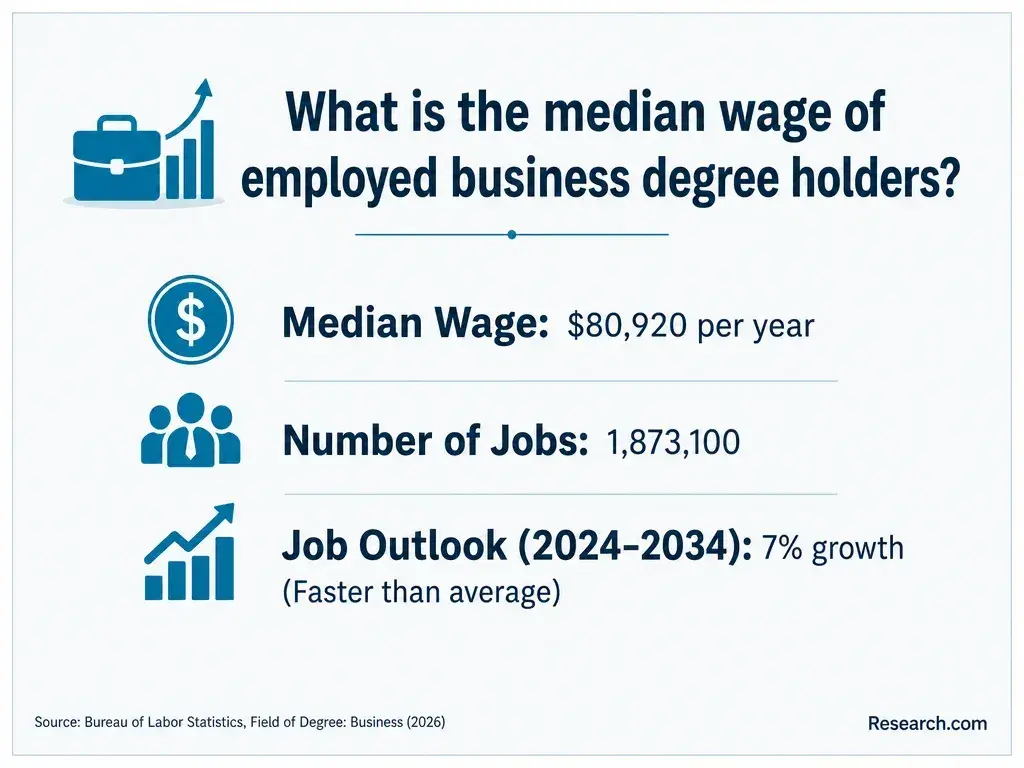
The closest broad federal benchmarks are logisticians for supply chain work and market research analysts for part of the digital marketing pathway. The second category is not a salary measure for every social media job. These Bureau of Labor Statistics figures describe all workers in each occupation, not starting pay or outcomes for a particular BS concentration.
Use the figures below to compare occupational markets, while remembering that experience, location, industry, and exact duties affect an individual offer.
| U.S. occupation | Median annual pay, May 2025 | Projected employment growth, 2025-2035 |
| Logistician | $82,320 | 18% |
| Market research analyst | $78,760 | 7% |
Logisticians have the higher projected growth in this comparison, but the figures cannot tell you which concentration will produce a better personal return. Estimate that return using your likely entry role, local openings, existing experience, and the cost of credits still required. When comparing a specialized degree with a business concentration, compare three-year-or-less supply chain degrees only after checking whether their transfer and scheduling assumptions apply to you.
There is no universal certification requirement for the entry-level roles described here. Employers may value a relevant credential, but they also assess experience, software ability, and evidence of sound decisions. Supply chain candidates may encounter voluntary credentials in purchasing, logistics, or supply chain operations; digital candidates may encounter platform or analytics training. Check each credential issuer's eligibility, examination, renewal, and fee rules before paying.
Choose training to close a documented hiring gap, not to collect badges. A platform certificate can show familiarity with an interface, while a well-explained project can show how you selected measures and interpreted results. Neither is equivalent to an academic concentration. If your target is project coordination instead, compare a focused credential with degree study and its full expenses; project management fees, books, and aid considerations illustrate costs that a tuition-only comparison can miss.
An online format can reduce commuting, but it does not necessarily make the concentration self-paced. Supply chain classes may use team simulations or scheduled presentations; digital media classes may require collaborative campaign work and deadlines tied to a shared project. Campus study can offer easier access to in-person teams and local employer events, but its class times and travel may be harder to combine with work.
Ask for sample course schedules in both concentrations. Confirm live attendance, group-meeting expectations, exam arrangements, required software, internship or campus visits, and how often advanced courses are offered. A working adult should also ask whether part-time enrollment changes the sequence or availability of required classes. US rankings of online business degree programs can generate candidates, but the current catalog and course schedule determine whether either concentration fits your week.
Admission may require secondary-school records for first-time students or college transcripts for transfer applicants; access to the business major can have separate prerequisites or academic-standing rules. Requirements vary by institution. For a returning student, the decisive question is not just how many credits transfer, but which satisfy general education, the business core, the chosen concentration, and any residency requirement.
Compare costs using a written degree audit and a term-by-term course plan. Include tuition for remaining credits, mandatory fees, books or software, potential travel, and any cost of reducing work hours. Ask whether switching concentrations adds prerequisites or courses and whether those courses are offered in the terms you need. Completion time follows from those answers and your enrollment pace, not a program's advertised fastest finish.
If speed matters, fast-track bachelor's degree options are worth comparing only after a school evaluates your credits and confirms the schedule. A shorter calendar plan may demand more weekly work or leave less room for paid employment.
How can you choose an accredited Business Administration program?
First, verify the institution's accreditation through the institution and its recognized accreditor. Then check whether any claimed AACSB, ACBSP, or IACBE business accreditation actually covers the school or program under consideration. Institutional and business-program accreditation are different; neither proves that a particular concentration has strong placement outcomes.
Next, request the current catalog, concentration requirements, course rotation, and - if you have prior study - an official credit evaluation. Ask career services what function-specific internships and recruiting support students can access, and request outcome figures with the population and time period clearly defined. A ranking can help identify schools, but ranked online business bachelor's completion routes cannot replace an individual degree audit or verification that your preferred concentration is offered.
The best choice is the accredited program that lets you complete relevant coursework and credible applied work at a manageable cost and pace. If neither concentration provides enough depth for your target role, compare a specialized degree or targeted training before enrolling.
Other Things You Should Know About Business Administration
Possibly. Ask whether the program permits a second concentration or electives in the other field, and whether either choice adds credits or delays required courses.
AI tools may assist with forecasting, content drafts, and analysis, but employers still need people to check data quality, interpret results, protect information, and make accountable decisions.
No arrangement is guaranteed. Some marketing tasks can be done remotely, while logistics work may require contact with facilities or shipments; actual requirements depend on the employer and role.
Not necessarily. For many early-career roles, relevant work and demonstrated functional skills are more immediate priorities. Consider graduate study when a specific advancement goal or employer requirement justifies it.
- Work Experience Education (WEE) - Career Technical Education (CA Dept of Education) https://www.cde.ca.gov/ci/ct/we/
- What Is a Bachelor's Degree in Supply Chain, Transportation and Logistics Management? | Bellevue University https://www.bellevue.edu/articles/what-is-a-bachelors-degree-in-supply-chain-transportation-and-logistics-management/
- BS in Business Administration (Supply Chain Management) | Sacramento State Catalog https://catalog.csus.edu/colleges/business-administration/marketing-and-supply-chain-management/bs-in-business-administration-supply-chain-management/
- CSU Supply Chain Management Concentration: Curriculum | CSU College of Business https://biz.colostate.edu/academics/undergraduate-programs/bsba/concentrations/supply-chain-management/curriculum
- Generative AI, the American worker, and the future of work | Brookings https://www.brookings.edu/articles/generative-ai-the-american-worker-and-the-future-of-work/
- Concentrations | Berkeley College https://berkeleycollege.edu/catalogs/undergraduate-2025-2026/academics-programs/management/concentrations/index.html
- Supply Chain Management Major - Rutgers Business School https://www.business.rutgers.edu/undergraduate-new-brunswick/supply-chain-management
- Student internships and employment opportunities after graduation: A field experiment - ScienceDirect https://www.sciencedirect.com/science/article/pii/S0272775721000601
- Business Administration with a Concentration in Logistics Management - Point University https://point.edu/academics/online/business-administration-in-logistics-management/
- Operations and Supply Chain Management Concentration | buffalo.edu https://catalogs.buffalo.edu/preview_program.php