2027 Statistical Learning Theory in an Online Data Science Master's: Courses, Projects, and Program Selection

Co-Founder and Chief Data Scientist
An online data science master's can teach you to fit models without teaching you why they generalize. If statistical learning theory is a priority, the decision is not simply whether a program lists machine learning. You need to examine prerequisites, course content, project evaluation, and whether the format lets you study the mathematics at the depth you want.
This guide helps prospective students distinguish substantive theory from a brief introduction and choose a program that fits their goals and constraints.
Key Things You Should Know
- Look for explicit treatment of generalization, overfitting, regularization, and model evaluation; a course called "machine learning" does not establish theoretical depth.
- The strongest evidence is a combination of detailed syllabi, mathematically demanding assignments, and projects that test models on genuinely unseen data.
- Compare the full cost and feasible study pace alongside curriculum. The U.S. median annual wage for data scientists was $120,230 in May 2025, but that occupation-wide figure does not predict a graduate's earnings.
What Is Statistical Learning Theory in an Online Data Science Master's?
Statistical learning theory studies when a model learned from a finite sample will perform well on new observations. In a master's program, that usually means connecting mathematical ideas, such as generalization, model complexity, regularization, and the bias-variance trade-off, to practical decisions about training and evaluating models.
Appropriate depth depends on your goal. A practitioner may need to recognize data leakage, select a defensible validation strategy, and explain why a more complex model is not necessarily better.
Someone aiming for research-intensive machine learning may also want derivations, probability-based arguments, and formal results about learning from data. A useful foundation includes calculus, linear algebra, probability, statistics, and enough programming to run experiments; individual courses may require different levels of preparation.
Do not confuse theory with a promise that every model will work reliably. Its value is in making assumptions and limitations visible, particularly when observations are not independent, a dataset shifts over time, or an impressive test score reflects a flawed evaluation design.
Which Courses Cover Statistical Learning Theory and Machine Learning?
The subject may appear in statistical learning, machine learning, advanced statistics, optimization, or computational learning courses. The distinction below helps you interpret catalog descriptions before asking for a current syllabus.
| Level of coverage | Typical evidence in coursework | Likely fit |
| Passing mention or single unit | Definitions of overfitting or bias-variance trade-offs within a broader survey | Basic awareness, not substantial preparation |
| Dedicated course | Repeated work on loss functions, regularization, generalization, validation, and model comparison | Students who need to justify modeling decisions |
| Advanced elective and substantial project | Mathematical derivations or proofs paired with experiments testing theoretical assumptions | Students seeking deeper ML or research preparation |
A title alone cannot establish which row applies. Examine learning objectives, prerequisites, assignment samples, and whether the course assesses explanations of why an approach works, not just code that produces a prediction. Also check whether an advanced elective runs regularly enough to fit your planned graduation date.
If your goal is primarily reporting, forecasting, and applied decision support rather than learning-theory depth, data analytics master's program options may be worth comparing before committing to a more theory-heavy curriculum.
What Projects Do Students Complete in Online Data Science Master's Programs?
Projects vary by course and program; an online master's may offer a capstone, a thesis, course projects, or some combination. For this subject, the most revealing project is not necessarily the one with the highest accuracy. It is one that makes a testable claim about generalization and evaluates it honestly.
For example, a student might compare regularization methods on a limited dataset, explain the expected trade-off, keep a final test set untouched during model selection, and report where the results depart from expectations.
A time-dependent problem calls for a split that respects time rather than a convenient random split. Clear documentation of assumptions, preprocessing, baselines, and uncertainty makes the work more useful to an employer or future research adviser.
Ask whether students can choose a question, receive feedback on experimental design, and present limitations rather than merely submit a model score. Projects involving sensitive data also need appropriate permissions and privacy safeguards.
If responsible use of models is a major interest, compare AI governance curriculum options for master's students separately; strong learning theory and strong governance training are related but not interchangeable.
What Are the Admission Requirements for an Online Data Science Master's?
Requirements differ by institution. Programs may assess an applicant's degree, transcripts, mathematics and statistics preparation, programming experience, recommendations, or other application materials. Do not assume that professional coding experience formally satisfies a stated probability prerequisite or that a nontechnical bachelor's degree automatically rules you out.
For a theory-focused path, compare your transcript and experience with the prerequisites for the specific courses you intend to take, not just the program's minimum admission criteria.
If your background is stronger in software than mathematics, probability and mathematical statistics may be the more important gaps. If it is stronger in statistics than computing, implementing and testing models may need attention.
Before paying an application fee, ask admissions or the relevant department whether prior coursework satisfies formal requirements, whether preparatory study can be completed after admission, and whether access to advanced electives depends on grades or additional prerequisites. Self-study can improve readiness without necessarily earning prerequisite credit.
How Long Does an Online Data Science Master's Take and Cost?
Duration depends on required credits, course availability, and how many courses you can take while meeting prerequisites. For a theory-focused student, the schedule of advanced electives matters as much as the program's advertised fastest completion path: an infrequently offered course can change your sequence.
Published tuition is not the same as the amount you will pay. Compare required credits and per-credit tuition or a clearly defined program price, then add mandatory fees, materials, computing needs, and any required travel.
Confirm whether tuition varies by residency or enrollment load and whether an employer will reimburse qualifying courses. Request the current official tuition schedule and a course-by-course plan before estimating a total; no single price or completion time applies across online programs.
If cost is the main constraint and your objective is machine learning rather than a degree specifically titled data science, compare lower-cost machine learning master's degrees. Check the current fee schedule and required courses yourself: a lower price is useful only if the program offers the theory and projects you need.
How Do Online and Campus Data Science Master's Programs Compare?
Delivery format does not, by itself, establish academic depth. Compare the same course objectives, assessments, faculty access, and project supervision across formats. An online program can suit a working student who needs geographic flexibility, while a campus program may better suit someone seeking regular in-person collaboration or access to particular campus research activities.
The operational details can determine whether a demanding theory course is realistic. Ask about live-session attendance, time zones, exam scheduling, group-work expectations, recorded instruction, and access to instructors during difficult mathematical assignments. An asynchronous lecture is not necessarily an asynchronous course if graded meetings or team projects occur at fixed times.
For a broader comparison of scheduling and support, see program selection for employed data science master's applicants. Give format substantial weight if work obligations could prevent you from completing the advanced courses that motivated the degree.
How Can You Verify Data Science Program Accreditation and Quality?
Verify the institution's current accreditation through its stated accreditor and an official accreditation directory; also check whether the program is authorized to enroll students where you live. Institutional accreditation does not certify that a particular machine learning course is rigorous, so treat it as one check rather than a substitute for curriculum review.
For academic quality, request recent syllabi for the courses you would actually take. Look for assessed work on generalization and evaluation, access to qualified instructors, a feasible elective rotation, and meaningful feedback on projects.
Be cautious when marketing highlights "AI" or "machine learning" but provides no course descriptions, assessment examples, or clear route into advanced study. If a school publishes outcomes, check which students are represented before treating them as evidence of what the program will do for you.
What Careers Can Statistical Learning Theory Graduates Pursue?
The training is relevant to data scientist and machine learning roles that involve model development, experimentation, and evaluation.
It can also strengthen work in applied research or analytics positions where someone must judge whether a model's apparent performance will hold up in practice. The degree title alone does not determine eligibility. Employers may weigh programming, domain experience, production systems, and demonstrated projects differently.
Choose deeper theory if you want to design evaluations, diagnose model failures, or read and apply technical research. If your target job centers on dashboards or routine reporting, that depth may be less valuable than data engineering, communication, or domain-specific analysis. A portfolio project that explains assumptions and failure cases can show how you would use the theory, rather than merely asserting that you studied it.
What Salary and Job Outlook Can Data Science Graduates Expect?
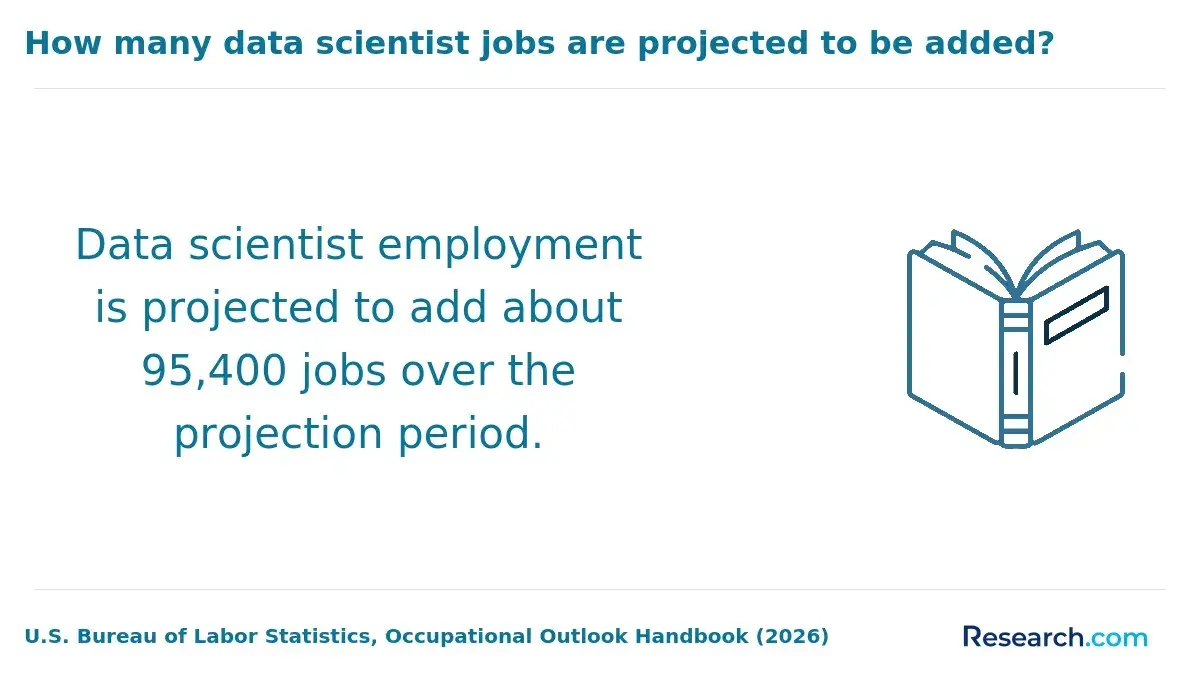
The U.S. Bureau of Labor Statistics reports a median annual wage of $120,230 for data scientists in May 2025 and projects 35% employment growth from 2025 to 2035. These figures describe an occupation, not the starting salary or employment probability of an online master's graduate. Prior experience, location, industry, responsibilities, and technical skills can materially change an individual outcome.
Use labor-market figures to judge whether the occupation merits investigation, not to calculate a guaranteed return on tuition. When comparing programs, ask for outcomes specific to online students and examine who responded, their experience before enrollment, and whether reported pay represents a salary level or an increase. For additional context on how roles and employers differ, see data science career earnings by industry.
Are Certifications or Licenses Required for Data Science Careers?
Data science roles generally do not have a universal professional license. Employers may value a certification tied to a particular platform, but it is not a substitute for being able to build, evaluate, and explain models. Requirements for a particular job can still vary by employer and industry, especially when work involves regulated or sensitive data.
If you are deciding between a certificate and a master's, identify the gap you need to close. A focused credential may suit someone who already has the mathematical foundation and needs a specific tool. A master's is more defensible when you need sustained graduate coursework, feedback on rigorous projects, and a broader foundation in statistical learning.
Other Things You Should Know About Data Science Programs
Some institutions make course previews or nondegree enrollment available, but access and any future credit are institution-specific. Ask whether you can review a syllabus or assignment and whether a completed course would count toward the master's before enrolling.
Not necessarily. Computing requirements depend on the assignments and any cloud or remote resources the program provides. Ask for required software, hardware specifications, and potential computing charges before buying equipment.
It can provide evidence of research ability, particularly if you define a question, justify methods, and discuss limitations with a faculty adviser. Check whether the online program offers a thesis and appropriate supervision; a thesis does not guarantee doctoral admission.
Follow the course's academic-integrity rules, which may differ across assignments. Even when tools are permitted, you should be able to verify the code, explain the mathematics, and account for any tool use the instructor requires you to disclose.
References
- A high-bias, low-variance introduction to Machine Learning for physicists - PMC https://pmc.ncbi.nlm.nih.gov/articles/PMC6688775/
- M.S. in Data Science, Online | virginia.edu https://datascience.virginia.edu/degrees/msds-online
- Master's in Data Science | utexas.edu https://cdso.utexas.edu/msds
- Lesson 2: Statistical Learning and Model Selection | STAT 897D https://online.stat.psu.edu/stat857/node/207/
- Online Master's in Data Science and Analytics | OU Online https://online.ou.edu/program/ms-in-data-science-and-analytics/
- Master of Science (M.S.) in Applied Data Science - UGA Online https://online.uga.edu/degrees-certificates/master-of-science-in-applied-data-science/
- Statistics Data Science Curriculum | stanford.edu https://statistics.stanford.edu/academic-programs/graduate-programs/statistics-data-science-curriculum
- Courses | Master of Science in Data Science | University of Connecticut https://masters.datascience.uconn.edu/courses/
- Online Master of Data Science Degree Program | MDS@Rice https://csweb.rice.edu/academics/graduate-programs/online-mds
- Online Master's in Data Science (MSDS) | Northwestern University https://sps.northwestern.edu/masters/data-science/