2027 UT Austin MSDS vs. Harvard Extension Data Science and AI ALM: Cost, Curriculum, Admissions, and Format

Co-Founder and Chief Data Scientist
UT Austin's online Master of Science in Data Science (MSDS) and Harvard Extension School's Data Science and AI master's take different approaches to cost, admission, and study format. UT Austin offers a lower-priced, fully online technical degree; Harvard Extension offers an earn-your-way-in admissions path but requires some campus study. If you're choosing between them, the decisive questions are whether you can meet each program's preparation requirements, attend campus when needed, and justify the full cost - not which university name sounds more compelling.
Key Things You Should Know
- UT Austin advertises $10,000 in program tuition for its 10-course online MSDS; confirm fees and the price applicable to your enrollment before comparing final costs.
- Harvard Extension's Data Science and AI degree is a Master of Liberal Arts (ALM) in Extension Studies, not an MSDS. Its course-by-course tuition and campus-related expenses make a personalized cost estimate essential.
- Choose UT Austin if a fully online format and lower published tuition drive your decision. Consider Harvard Extension if its admission-course pathway and curriculum suit you and you can accommodate campus attendance.
How do UT Austin MSDS and Harvard Extension's Data Science and AI ALM compare?
Both are graduate-level routes into data science, but their degree titles, admissions processes, and attendance requirements are not interchangeable. This comparison highlights the distinctions most likely to change your choice.
| Decision factor | UT Austin MSDS | Harvard Extension Data Science and AI ALM |
| Credential | Master of Science in Data Science | Master of Liberal Arts in Extension Studies, field of Data Science and AI |
| Academic structure | 10-course, 30-credit program | 12-course, 48-credit program |
| Admission route | Apply to the degree program | Qualify through specified admission courses, then apply |
| Attendance | Fully online | Primarily online, with an on-campus requirement |
| Published price structure | Advertised total program tuition | Tuition charged by course; total depends on the applicable rates and expenses |
Neither the shorter curriculum nor the degree title establishes which program teaches a particular topic more deeply. Compare required courses, available electives, and projects against the work you want to do. If neither curriculum matches your goals, low-cost online AI degree programs offer a useful third comparison rather than a reason to force a choice between these two.
Which program costs less: UT Austin MSDS or Harvard Extension's ALM?
UT Austin is the lower-priced option on published tuition. Its advertised MSDS tuition is $10,000 for the program. Harvard Extension charges by course, so compare the tuition for every required course at the rate you expect to pay; do not compare a single Harvard course with UT Austin's entire degree.
The cost components below show what belongs in a like-for-like estimate. Published tuition is a starting point, not necessarily the amount you will spend to graduate.
| Cost component | UT Austin MSDS | Harvard Extension ALM |
| Tuition basis | Advertised $10,000 program tuition | Applicable per-course tuition multiplied across required courses |
| Additional academic costs | Check current fees, materials, and payment terms | Check current fees, materials, and admission-course charges |
| Travel and lodging | No campus attendance required for the degree | Budget for the on-campus requirement if you do not live nearby |
| Financing | Interest may increase the amount repaid | Interest may increase the amount repaid |
Ask both schools for a current, degree-completion cost estimate before committing. Include employer reimbursement and any aid for which you actually qualify. The guide to explore financial aid for graduate data science degrees can help you organize those questions, but aid availability and eligibility must be confirmed with each school.
What are the curriculum differences between UT Austin MSDS and Harvard Extension's ALM?
UT Austin's MSDS is a compact, prescribed technical curriculum built around data science methods, including statistics, machine learning, and computing. Harvard Extension's longer Data Science and AI ALM combines required work with course choices; its distinguishing feature for some students is the opportunity to shape study around particular data science or AI interests.
For a machine-learning role, inspect how far each program goes beyond introductory model training: look for evaluation, statistical reasoning, programming, and substantial applied work. For an AI systems or infrastructure role, check whether the courses available during your enrollment cover data pipelines and deployment - not merely AI in their titles. AI and data engineering graduate study options provide a comparison point if those skills are central to your goal.
Project work matters, but verify its form. Review current syllabi and degree requirements to determine whether you will complete an individual portfolio project, a team project, or a required culminating experience. A course description alone does not establish how much hands-on work you will produce.
What are the admission requirements for each data science master's program?
UT Austin uses a degree-application process and expects preparation for graduate-level quantitative and computing coursework. Check its current admissions page for the required application materials, deadlines, and stated background expectations; professional interest in data science is not a substitute for the preparation needed to succeed in the courses.
Harvard Extension uses an earn-your-way-in route: prospective students complete designated admission courses at the required standard before applying to the ALM. Taking a course is not, by itself, admission to the degree. Check the current list of qualifying courses, grade rules, application eligibility, and deadlines before enrolling in a course you expect to count.
The practical difference is when you must demonstrate readiness. If your record does not clearly show recent programming and statistics work, Harvard's course-based route may let you establish it through graded study. If you already have that preparation, compare the time and expense of admission courses with UT Austin's direct application process. Neither route guarantees admission.
How do the online formats and scheduling options compare?
UT Austin's MSDS is designed to be completed online, without a campus residency. That makes it the simpler logistical choice if travel, caregiving, or an unpredictable work schedule rules out in-person study. Online, however, does not mean deadline-free; check course calendars and assessment rules before planning your weekly workload.
Harvard Extension offers substantial online study but has an on-campus component. Its suitability depends on the specific courses you plan to take, when they are offered, and whether you can attend the required campus study. Before enrolling, ask which current options satisfy that requirement and whether their dates fit your work and travel constraints. Do not assume that a course advertised online fulfills a campus requirement.
How long does each data science master's program take to complete?
UT Austin requires 10 courses, while Harvard Extension's ALM requires 12. That difference describes academic volume, not a guaranteed difference in calendar time. Your pace will depend on course load, scheduling, prerequisites, and - in Harvard's case - the timing of admission and campus coursework.
Build a term-by-term plan before comparing completion dates. Ask each program which required courses run every term, how many courses working students commonly take, and whether there is a maximum completion period. If your main constraint is finishing technical graduate study within a fixed budget, cost-conscious online ML master's study may also be worth comparing; a lower course count is useful only when the schedule lets you make steady progress.
What careers can each data science master's program prepare you for?
Either program can support preparation for data scientist or machine-learning-focused analytical work when its courses build the skills an employer seeks. UT Austin may be the clearer fit if you want a defined technical MSDS curriculum. Harvard Extension may be more attractive if its available course choices let you concentrate on the methods or applications relevant to your intended role.
Match the curriculum to actual job descriptions rather than the degree label. Data scientist postings may call for statistical modeling and communication; machine learning engineering roles may place more weight on software development and deployment. For either path, projects that show your own code, evaluation decisions, and explanation of results will make your skills easier to assess. A degree does not replace relevant experience or guarantee a role change.
How do salary expectations and job prospects compare for graduates?
There is no sound basis here for claiming that graduates of one of these programs earn more than graduates of the other. A useful national benchmark is the U.S. Bureau of Labor Statistics median annual wage of $120,230 for data scientists in May 2025. That is a wage for employed people in the occupation - not an entry-level offer, a program-specific outcome, or a salary increase caused by either degree.
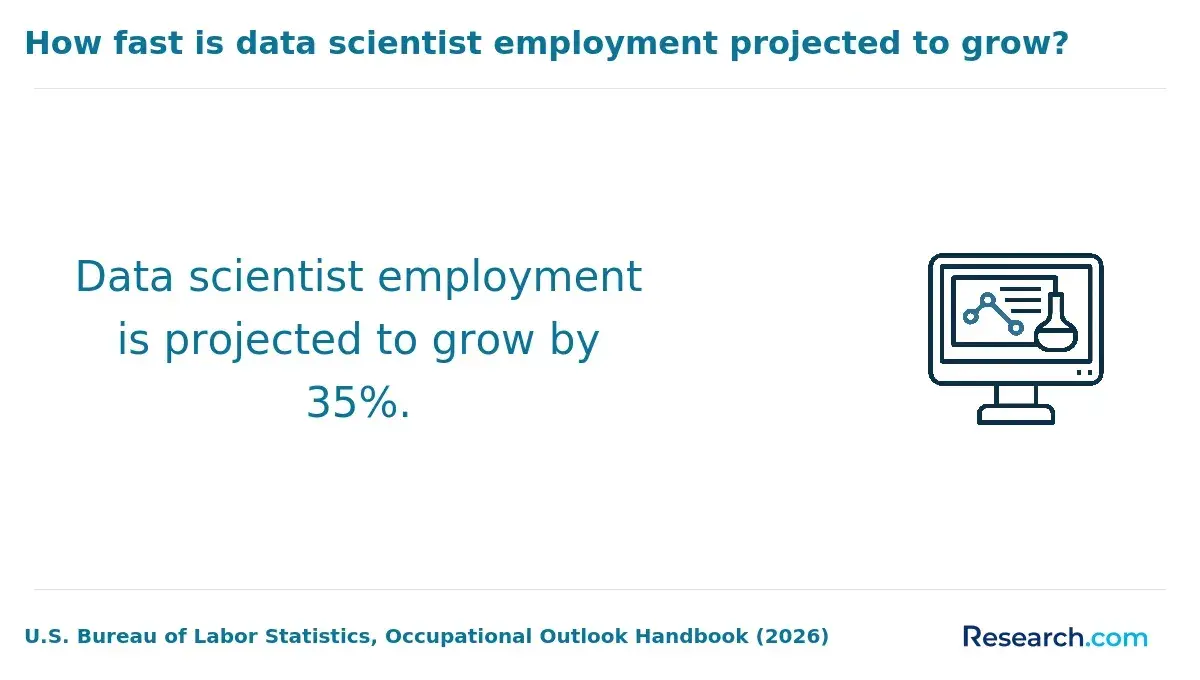
The BLS projects 35% employment growth for data scientists from 2025 to 2035. That indicates demand across the occupation, but it does not measure an individual graduate's chance of being hired. For a personal return-on-investment estimate, compare your likely target roles and local pay with your current earnings, then subtract tuition, travel, financing costs, and any income you would give up while studying.
Are either program's degrees accredited or professionally recognized?
UT Austin and Harvard University are institutionally accredited universities. That is different from claiming that either data science degree has a separate, profession-specific accreditation. Data science jobs generally do not depend on holding a professional license tied to one of these degree titles.
Describe the credentials precisely when assessing employer recognition: UT Austin awards an MSDS; Harvard Extension awards a Master of Liberal Arts in Extension Studies with a Data Science and AI field. Do not present the latter as a Harvard College degree or as an MSDS. If an employer's tuition policy requires a particular credential type, ask whether it covers the exact degree before you enroll.
Which program is better for your data science career goals?
Choose UT Austin if lower published tuition, a fully online schedule, and a defined technical MSDS are your leading requirements. Consider Harvard Extension if you value its admission-course pathway and course choices enough to accept per-course pricing and the campus obligation. Neither is a universal winner: the better investment is the one whose required work you can complete and whose projects support the roles you intend to seek.
Before paying an application fee or enrolling in an admission course, make your decision against the same checklist for both programs:
- Price every required course and fee, then add realistic travel and financing costs.
- Map required courses and available projects to skills in your target job descriptions.
- Confirm admission-course rules, campus attendance, course availability, and a feasible completion schedule directly with the schools.
- Check how each exact degree title fits your employer's reimbursement policy and your own career plans.
If neither option satisfies your cost and curriculum requirements, compare affordable paths to an AI master's qualification rather than relying on a hoped-for salary gain to justify a poor fit. The most costly mistake is treating advertised tuition or institutional reputation as a substitute for checking the degree you will actually complete.
Other Things You Should Know About Data Science
Not necessarily. Employers vary in their education requirements. Relevant experience and demonstrable skills may qualify you for some roles; a master's is most useful when it fills a specific knowledge gap or helps you compete for roles that value graduate study.
Yes, if you have not used it for data analysis. Being able to write, debug, and explain basic analysis code will help you judge your readiness. Self-study can build skill, but it does not automatically satisfy a school's formal admissions rules.
Only if your employer permits it and you protect confidential information. A public portfolio can instead use an appropriately licensed dataset to demonstrate the same modeling and communication skills.
Not by itself. Compare AI engineering postings with your experience in software development, data systems, model evaluation, and deployment. Choose coursework and projects that address the gaps for the specific jobs you want.
References
- Master's in Data Science | utexas.edu https://cdso.utexas.edu/msds
- Choosing Specialization Tracks in Computer Science | South Dakota Mines https://www.sdsmt.edu/academics/academic-departments/electrical-engineering-and-computer-science/choosing-specialization-tracks-in-computer-science.html
- Graduate Admissions Process | Computer Science | The University of Iowa https://cs.uiowa.edu/graduate/admissions
- Performance-based Admissions Track (PAT) - Gies Online https://giesonline.illinois.edu/explore-programs/performance-based-admissions-track
- What Is an Artificial Intelligence Degree? | American Public University https://www.apu.apus.edu/area-of-study/intelligence/resources/what-is-an-artificial-intelligence-degree/
- Data Science and Artificial Intelligence Master's Degree Program | Harvard Extension School https://extension.harvard.edu/academics/programs/data-science-artificial-intelligence-graduate-program/
- What's the Difference Between Asynchronous and Synchronous Learning? | Ohio State Online https://online.osu.edu/content-hub/blogs/whats-the-difference-between-asynchronous-and-synchronous-learning/