2027 Edge AI in an Online Data Science Master's: Courses, Projects, and Program Selection

Co-Founder and Chief Data Scientist
An online data science master's can teach machine learning without preparing you to run models on devices with limited memory, power, or connectivity. If edge AI is your goal, the deciding factors are technical depth, access to hardware, and the freedom to complete a deployment-focused project.
This guide helps prospective students distinguish a passing mention of edge AI from a program that supports meaningful practice - and decide whether an online data science degree is the right route.
Key Things You Should Know
- Look for a path from machine learning fundamentals to model compression, on-device inference, and performance testing; an "AI" course title alone does not establish edge AI depth.
- Prioritize a project that measures accuracy alongside device-level latency, memory use, and power use or a defensible proxy for it.
- Check project supervision, hardware access, and total cost before enrolling; the U.S. Bureau of Labor Statistics projects 35% growth in data scientist employment from 2025 to 2035, but that forecast does not predict demand for a particular edge AI job.
What Is Edge AI in an Online Data Science Master's Program?
Edge AI means running AI inference - or, in some cases, adapting models - close to where data is generated, such as on a sensor, camera, phone, or industrial device. Instead of sending every observation to a remote server, a system processes some data locally. That can help when connectivity, response time, bandwidth, or data-handling constraints matter, but local processing introduces limits on compute, memory, and power.
In a data science master's, edge AI is usually best understood as an application of machine learning, not a separate degree requirement. The relevant question is whether students can move beyond training a model on a powerful computer to making it work reliably on a specified device. That distinction matters if your target work involves deployed products rather than analysis alone.
What Courses Teach Edge AI in an Online Data Science Master's?
Useful preparation combines statistical modeling with systems skills. Course titles vary, so compare syllabi, assignments, and elective availability rather than looking only for a class called "edge AI." The table shows what each course area could contribute to a deployment-focused path.
| Course area | Edge AI contribution | Evidence of substantive coverage |
| Machine learning and deep learning | Model selection, training, and evaluation | Students assess performance on data that represents deployment conditions |
| Computer vision or signal processing | Methods for camera, audio, or sensor data | Assignments address noisy or changing real-world inputs |
| Embedded systems or mobile computing | Device constraints and local execution | Students run code on specified hardware or a realistic device environment |
| Machine learning systems or MLOps | Packaging, monitoring, and updating models | Work covers deployment and failure handling, not just training |
| Optimization or efficient AI | Smaller, faster models | Students compare methods such as quantization or pruning against accuracy and resource limits |
A single lecture can establish awareness; a dedicated course can build technique; an advanced elective plus a supervised deployment project offers stronger evidence of practical depth. If embedded-systems electives sit outside the data science department, ask whether online students may actually enroll in them and count them toward the degree.
What Projects Build Practical Edge AI and Data Science Skills?
A strong project defines a device, a real use case, and measurable constraints before choosing a model. For example, a student might build a sensor-based anomaly detector for equipment with intermittent connectivity or an image classifier for a small camera device. The value lies in documenting the trade-off between predictive performance and what the device can support - not merely showing that a model runs.
These project elements make the work useful both for learning and for a portfolio:
- Problem and data: Explain who uses the output, how representative data is obtained, and how privacy or permission limits its use.
- Baseline and deployment: Compare a simple baseline with the chosen model, then demonstrate inference on the intended hardware or a clearly identified substitute.
- Evaluation: Report accuracy or task-appropriate error alongside measured latency, model size, and memory use; measure power use when equipment permits.
- Reproducibility and failure analysis: Document software versions, test conditions, unexpected inputs, and what happens when the network or device fails.
Before relying on a capstone for this work, confirm that the program permits your topic, offers an appropriate supervisor, and allows the hardware and data you plan to use. A project without device-level testing may still demonstrate data science skills, but it is weaker evidence of edge AI implementation.
How Do Online and Campus-Based Edge AI Master's Programs Compare?
Online study can suit a working professional who can test models on accessible hardware at home or at work. Campus study may be more useful when a project requires a specialized lab, shared devices, or frequent in-person collaboration. Neither format establishes technical depth by itself: compare the same course access, project rules, supervision, and equipment arrangements in each program.
Ask an online program whether devices are shipped, purchased by students, accessed remotely, or replaced by simulations. Also ask whether required labs or presentations have scheduled attendance and whether campus visits are mandatory. A campus program's lab advantage matters less if your intended project uses readily available hardware and strong remote supervision.
If format flexibility is essential but a data science curriculum lacks device-focused work, affordable online study in artificial intelligence offers another category to compare. Apply the same deployment and hardware criteria rather than assuming an AI degree covers edge systems.
What Are the Admission Requirements for an Online Data Science Master's?
Requirements vary by institution. Programs may assess prior coursework, programming ability, mathematics and statistics preparation, professional experience, recommendations, or a statement of purpose. Edge AI interests do not necessarily change the formal admissions rules, but gaps in Python, linear algebra, probability, or software development can make advanced deployment work harder.
Compare the published prerequisites with your transcript and work samples. If you have modeling experience but little systems experience, ask whether introductory computing electives are available before the capstone. If your mathematical foundation needs work, distinguish courses that strengthen your application from courses the school formally accepts as satisfying a prerequisite. AI master's programs with preparatory coursework may be worth comparing, but confirm how any foundation courses affect admission, credit, cost, and time to completion.
How Much Does an Online Edge AI Data Science Master's Cost?
There is no defensible single price for an "edge AI data science master's": schools price degrees differently, and edge AI may be an elective or project topic rather than a named program. Request a program-specific estimate for the number of credits you expect to take. The figures to collect are:
- Published tuition for the full required credit load, including any rate differences that apply to your residency or enrollment status.
- Mandatory university, technology, and course fees.
- Required hardware, software, and materials, plus any travel for in-person activities.
- Additional tuition or fees if prerequisites, foundation courses, or a longer study plan are necessary.
Compare total estimated cost, not one school's tuition-only figure against another school's tuition plus fees. Ask whether your employer provides education assistance and whether aid applies to your planned enrollment level. For a broader cost comparison with AI-focused alternatives, see budget planning for an online AI master's; treat any earnings figure as context, not a return promised by a degree.
How Long Does an Online Data Science Master's With Edge AI Take?
Completion time depends on required credits, course availability, enrollment pace, and whether your proposed project needs prerequisites or approvals. A catalog's advertised timeline may assume a particular course load; it may not describe the path for a student taking an embedded-systems elective offered infrequently.
Map the sequence backward from the project: identify when you can take machine learning, a relevant systems or efficient-AI course, and the capstone. Ask whether electives run online every term, whether prerequisites can be taken concurrently, and what happens if a project requires an additional term. This is particularly important if you will study part time while working.
What Jobs Can Graduates Get With Edge AI and Data Science Skills?
Potential targets include data scientist roles involving deployed models, machine learning engineer positions, applied AI work in connected products, and computer vision or sensor-analytics roles. Titles alone are unreliable: one "data scientist" role may focus on experimentation, while another expects production software and device testing. Employers set their own requirements, and a master's degree does not guarantee entry into a specialized role.
Read job descriptions for the actual work: model development, deployment, embedded programming, monitoring, and collaboration with hardware engineers. If the roles you want emphasize firmware or low-level optimization, a data science degree without substantial systems coursework may be a weaker fit than a computing-focused alternative. For the wider employment context, compare data science programs aligned with data career demand against the edge-specific skills in your target postings.
What Salary and Job Outlook Can Data Science Graduates Expect?
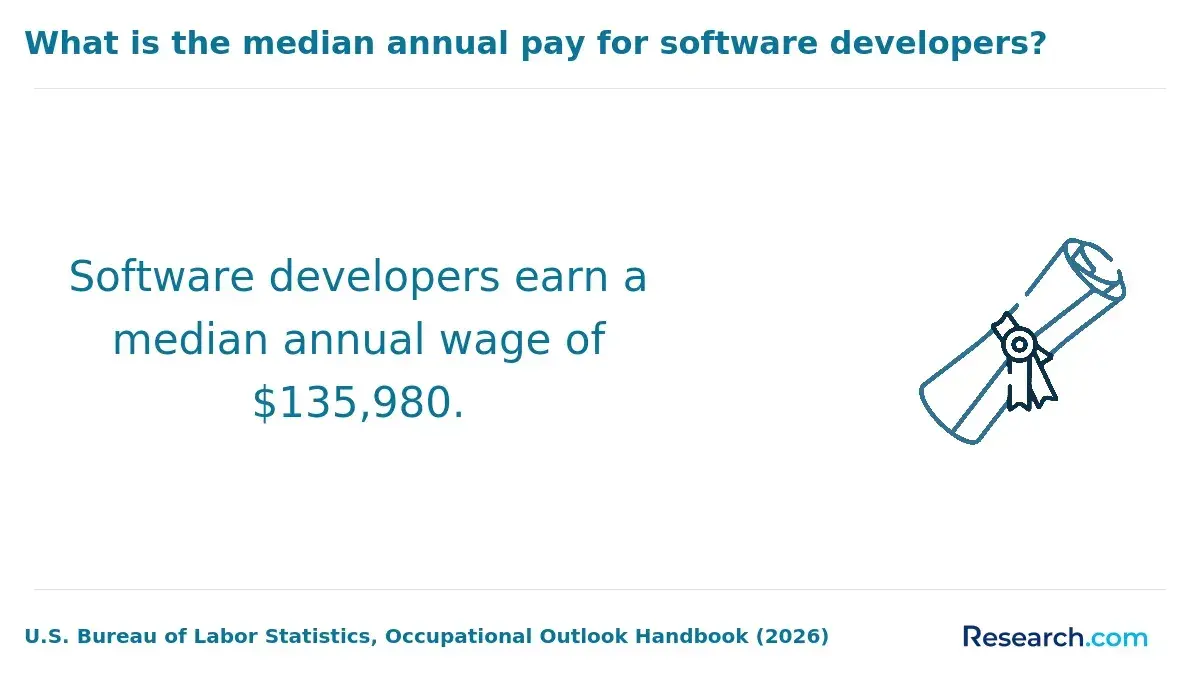
The U.S. Bureau of Labor Statistics reports a $120,230 median annual wage for data scientists in May 2025. That occupational figure includes workers with different education and experience levels; it is not an expected starting salary or an edge AI pay estimate. BLS also projects strong growth in data scientist employment from 2025 to 2035, but its occupation-level outlook cannot show how many openings require on-device AI skills.
For a personal career decision, compare jobs you could pursue now with jobs for which a specific program would make you a stronger applicant. Factor in your experience, location, portfolio, and the role's engineering requirements. Do not calculate a degree's likely payoff by assuming you will earn the occupational median immediately after graduation.
How Do You Choose an Accredited Online Edge AI Master's Program?
Start by confirming the institution's current accreditation through its published accreditation information and the recognized accreditor's listing. Accreditation applies to the institution or, where relevant, a specified program; it does not certify that an edge AI pathway exists. If you will study from another state, confirm that the school can enroll you there and disclose any required in-person activity.
Then use a short, evidence-based comparison. These checks address the most common mistake: choosing a promising program description without verifying that you can complete the courses and project you actually want.
- Request current syllabi and identify whether edge AI is a mention, a course unit, a dedicated elective, or a substantial project opportunity.
- Confirm online access to prerequisites, electives, supervision, and any required hardware or remote lab.
- Ask for the rules governing capstone topics, data use, and device-based evaluation.
- Compare full estimated cost and a course-by-course completion plan under the same enrollment assumptions.
- Check accreditation and enrollment eligibility directly, then ask the financial aid office what assistance applies to your plan.
If financing will influence your choice, understanding aid for data science graduate programs can help you prepare questions for each school. Choose a data science master's when its modeling foundation and verified deployment opportunities match your target work; favor a more systems-focused program when device engineering is the central skill you need to acquire.
Other Things You Should Know About Data Science
Usually, your first step is to ask how the program handles hardware. Do not buy a device until you know which platforms its courses support and whether equipment is supplied or remotely accessible.
Only if your employer permits it and the program's data-use rules allow it. Otherwise, use approved public, simulated, or properly de-identified data; workplace access does not automatically grant permission to publish results.
Yes. Training, evaluation, and version control transfer well. You will still need to learn how device constraints change model selection, testing, and deployment.
Often you can describe the problem, your methods, permitted aggregate results, and your contribution without releasing restricted code or data. Check employer, course, and project agreements before publishing anything.
References
- Edge Machine Learning for AI-Enabled IoT Devices: A Review | nih.gov https://pmc.ncbi.nlm.nih.gov/articles/PMC7273223/
- Professional Certificate in Tiny Machine Learning (TinyML) | harvard.edu https://harvardonline.harvard.edu/program/professional-certificate-in-tiny-machine-learning-tinyml
- Khoury College: A leader in AI innovation and education | Khoury College of Computer Sciences https://www.khoury.northeastern.edu/ai/
- Analytics: Data Science & AI (Online) - Rutgers MBS https://mbs.rutgers.edu/academic-programs/analytics-data-science-ai-online
- Master's in Data Science - Pace University Online https://online.pace.edu/graduate-programs/ms-in-data-science/
- Edge artificial intelligence: Past advances, current paradigms, and emerging horizons - ScienceDirect https://www.sciencedirect.com/science/article/pii/S0952197626019196
- Master's in Artificial Intelligence - Computer Science https://cdso.utexas.edu/msai
- Data Science and Artificial Intelligence Master's Degree Program | Harvard Extension School https://extension.harvard.edu/academics/programs/data-science-artificial-intelligence-graduate-program/
- Applied Data Science and AI: Master's Degree | du.edu https://ritchieschool.du.edu/academics-education/gr-programs/ms-online-applied-data-science-and-artificial-intelligence
- Master of Data Science | pitt.edu https://www.sci.pitt.edu/academics/masters-degrees/data-science