2027 PhD in Nursing Programs for Nurses in South Dakota: BSN, MSN, and DNP Entry Routes and Research Fit
Audited and Verified:
Our Editorial and Data Verification Process
Research.com uses government datasets, official education statistics and primary institutional information to support its career and degree guides. Our review process checks factual accuracy, occupational definitions, source dates and the requirements associated with the credentials discussed.
How This Article Was Fact-Checked
Our editorial team verifies salary estimates, employment projections, education requirements and program information against original data providers and official organizations. Salary figures are checked against the relevant occupational definitions and reporting periods. Information about licensure, accreditation and required in-person training is reviewed separately.
Fact-checked and verified on:

Co-Founder and Chief Data Scientist
A South Dakota nurse considering a PhD must answer two questions before applying: Which programs will admit someone with their current degree, and which can support the research they want to conduct? Those answers matter more than a program's proximity or online label. This guide compares BSN, MSN, and DNP entry routes, explains how to evaluate programs available to South Dakota residents, and shows what to ask about faculty mentorship, funding, and dissertation feasibility. It is for licensed nurses aiming to produce nursing research - not simply to earn another clinical credential.
Key Things You Should Know
- BSN-, MSN-, and DNP-prepared nurses may have different PhD entry options; prior graduate coursework does not automatically shorten a dissertation.
- A nursing PhD centers on original research. A DNP generally centers on advanced practice or practice improvement, and neither degree title alone grants APRN authority.
- For South Dakota residents, verify three separate facts before applying: the PhD is accepting students, the institution is accredited, and a suitable faculty mentor has capacity.
What are PhD in nursing programs in South Dakota?
A nursing PhD is a research doctorate that prepares nurses to formulate questions, conduct rigorous studies, and contribute new knowledge to nursing practice, education, or health systems. The defining work is typically a dissertation. It is not an initial RN program or, by itself, an advanced practice specialty track.
"In South Dakota" can mean a PhD offered by a South Dakota institution or a program elsewhere that admits a nurse living in the state. South Dakota State University is a logical institution to investigate for nursing doctoral study, but applicants should confirm its currently offered degree, entry routes, application cycle, and faculty availability directly with the university rather than assume a nursing doctorate listed elsewhere is a PhD.
Nurses whose main goal is leading an evidence-based change in their own organization should compare the PhD with advanced nursing leadership doctorates online. A DNP project and a PhD dissertation can address the same care problem, but they ask different questions and require different forms of scholarly work.
What entry routes are available for BSN, MSN, and DNP nurses?
Entry route determines how much graduate preparation a nurse may need before advanced research work. It does not determine whether an applicant's proposed question has a feasible method, data source, and mentor. The comparison below describes common routes, not guaranteed offerings at any South Dakota school.
| Starting credential | Potential route | Key question for the program |
| BSN and RN license | Direct BSN-to-PhD admission, if offered | Which graduate-level methods and nursing theory courses are built into the route? |
| MSN and RN license | Post-master's PhD admission | Which previous courses satisfy doctoral requirements, if any? |
| DNP and RN license | PhD admission with individual review of prior doctoral work | What research preparation is still required despite the DNP? |
A DNP project may demonstrate strong evidence-appraisal and implementation skills, but it does not automatically replace PhD research methods, examinations, or a dissertation. Likewise, an MSN in an APRN specialty and an MSN in education may provide different preparation for the same research proposal.
An RN whose highest nursing qualification is an associate degree generally needs additional academic preparation before these PhD routes. Comparing ADN-to-MSN bridge length and requirements can help identify a possible intermediate step, but the eventual PhD program must decide whether the resulting degree meets its admissions rules.
Which South Dakota nursing PhD programs are accredited?
Do not infer a PhD's accreditation status from the accreditation of a school's BSN, MSN, or DNP. Institutional accreditation applies to the university; nursing program accreditation has a defined scope that must be checked for the particular degree. State board approval for an initial-licensure nursing program addresses a different question again.
For each South Dakota institution under consideration, confirm that the PhD is currently offered and verify the university's institutional accreditation in the accreditor's directory. Then check the nursing accreditor's listing for the exact degrees covered. If the PhD is not among them, ask the university to explain how the research doctorate is reviewed and governed; do not describe it as CCNE- or ACEN-accredited based solely on another nursing degree's listing.
This distinction also matters earlier in a nurse's education. Someone reviewing RN-to-BSN project-based learning options should check that program's own accreditation and requirements, rather than carry an accreditation claim forward to a later PhD.
Expect a review of academic preparation and research potential, not just clinical seniority. Requirements vary by institution and entry route, so obtain the requirements for the specific intake and ask whether admission is contingent on a faculty match.
A useful application file typically includes transcripts; evidence of any required RN license; a statement describing a focused research interest; recommendations that can speak to scholarly ability; and a writing sample, résumé, or interview if requested. The program may also specify prior statistics coursework, minimum grades, English-language documentation, or a test policy. None of these should be assumed universal.
The strongest statement links a nursing problem to a researchable question. For example, rather than promising to "improve rural health," an applicant might identify a population, an outcome worth measuring, and a plausible source of data - while acknowledging that access and ethics review remain unresolved. Nurses considering a practice doctorate instead can use comparing DNP eligibility requirements as a separate exercise; DNP admissions criteria should not be substituted for PhD criteria.
Delivery format affects access to mentors, research teams, and data - not merely commuting. A South Dakota nurse can potentially study with an out-of-state program while remaining employed locally, but "online" may still include live meetings, scheduled research work, residencies, or travel.
| Format | Potential advantage | Constraint to verify |
| Primarily online | May allow residence and employment in South Dakota | Live sessions, campus visits, advising frequency, and permission to enroll from South Dakota |
| Campus-based | More routine access to in-person seminars and research teams | Relocation, commuting, and compatibility with an RN work schedule |
| Hybrid | Combines remote work with planned in-person contact | Actual travel dates, duration, and costs |
Ask how often students meet their adviser, how remote students join research groups, and whether a proposed dissertation depends on data available only near campus. Online doctoral research should not be judged by the standards of online and hybrid LPN program comparisons: a PhD has research and supervision requirements, not initial bedside-training requirements.
PhD study commonly combines nursing theory, research design, quantitative and qualitative methods, statistics, ethics, and dissertation work. Particular courses and examination milestones depend on the program. Coursework should equip the student to defend a question, select defensible measures and methods, interpret uncertainty, and report limitations - not simply use a statistical software package.
For a South Dakota applicant, a research theme such as rural access, chronic disease management, workforce issues, or community health is useful only when a potential adviser has relevant expertise and the project has a realistic population and data pathway. Access to an employer's records or a community partner cannot be assumed. The university and any participating organization must determine permissions, privacy safeguards, and whether ethics or institutional review board review is required.
A clinical interest does not automatically require a PhD. A nurse whose goal is to change specialty practice rather than study it may find short-format online PMHNP study more relevant - but only after checking the certificate's prior-degree, supervised-clinical, certification, and state requirements.
Time to completion depends on entry route, enrollment intensity, course sequencing, examinations, adviser availability, and dissertation progress. A BSN entrant may need more graduate coursework than an MSN entrant. A DNP entrant should not budget for an automatically abbreviated PhD: the receiving program must evaluate prior work, and original research still takes time.
Published tuition alone is a poor comparison. Request a written estimate covering required credits and fees, expected enrollment through dissertation completion, residency travel, research expenses, and any continuing-enrollment charges. Then distinguish a guaranteed stipend or tuition award from an assistantship that depends on work, annual renewal, or available funding. Reduced work hours can be a larger household cost than a tuition difference.
If the intended return is advanced clinical practice rather than a research career, compare the total cost of a PhD with lower-tuition advanced practice nursing programs that actually prepare students for the desired population focus. A cheaper degree is not a saving if it does not qualify the nurse for the intended role.
A nursing PhD is most directly relevant to research-intensive faculty positions, investigator roles, research leadership, and jobs designing or evaluating nursing and health-services studies. Some graduates also work in policy or health-system research. Hiring still depends on publications, methodological skills, funding experience, teaching record, and the needs of a particular employer; the degree alone does not secure a faculty appointment or grant.
For nurses who chiefly want to teach clinically, lead a unit, or expand direct patient care, a PhD may be more education than the position requires. Check actual job postings before committing to years of dissertation work. An APRN seeking a new patient population, for example, should investigate planning a shorter post-master's FNP pathway rather than assume doctoral research changes their certification or practice authority.
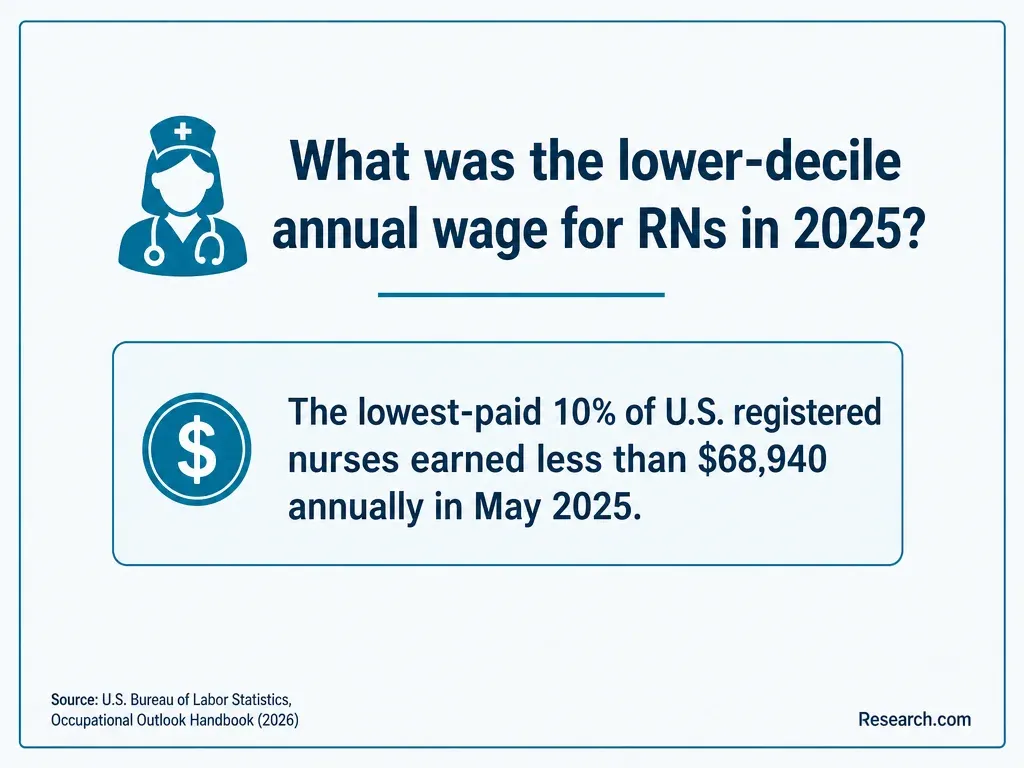
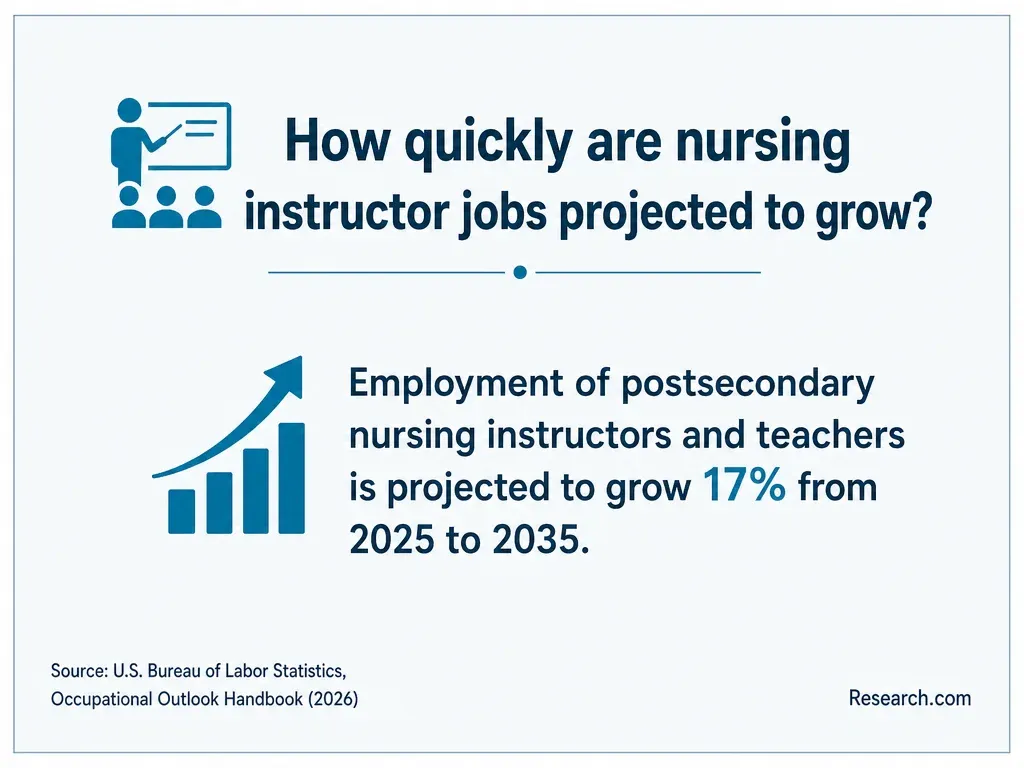
There is no single reliable "nursing PhD salary." A faculty member, clinical researcher, and practicing APRN are counted under different occupations and paid for different duties. The U.S. Bureau of Labor Statistics reports occupation-wide wages and projections, not earnings attributable to a PhD. For an academic goal, examine its postsecondary nursing instructors and teachers data; for a clinical goal, examine the relevant nursing occupation instead. Neither figure predicts an individual offer.
Use the most recently published BLS wage reference year and projection period when comparing roles, then check South Dakota or target-employer postings for required qualifications, contract length, research expectations, and pay. In particular, do not use nurse practitioner pay as the expected return on a research doctorate. A nurse attracted primarily by an FNP role can compare shorter family NP training pathways, while verifying that any program meets the applicable educational and certification requirements.
How do nurses choose the right nursing PhD program in South Dakota?
Start with the research and the intended job, then compare South Dakota-based and eligible out-of-state programs on equal terms. A nearby program without a suitable, available adviser may be a worse fit than a more distant program with strong supervision and workable travel requirements.
Before applying, use the following sequence to resolve the uncertainties most likely to derail a doctorate:
- Confirm that the exact PhD and your BSN, MSN, or DNP entry route are open for your intended term.
- Identify faculty whose current work fits your question, and ask whether they expect to take a student.
- Discuss feasible data access, methodological training, research ethics, and dissertation milestones with the program.
- Verify institutional accreditation, enrollment eligibility from South Dakota, attendance requirements, and the full funding offer in writing.
- Speak with current students about advising availability, research opportunities, and the time they can realistically devote to study.
Keep the qualification being compared in view. Exploring condensed LPN-to-RN study schedules may be useful to someone still pursuing initial RN preparation, but it is not an alternative entry route into a research doctorate. For an experienced RN ready for PhD study, adviser fit and a feasible dissertation should drive the final choice.
Other Things You Should Know About Nursing
Possibly, but employment does not grant research access. Obtain required employer permissions and university guidance on privacy, data handling, and ethics review before collecting or analyzing records.
No general rule requires that. The program must approve the question and methods, and the student must have legitimate access to the proposed population or data.
It may help generate a research question, but the PhD program decides what constitutes original dissertation work. Existing project results do not automatically satisfy that requirement.
Ask the program how students are reassigned and whether another qualified faculty member can support the topic and methods. Adviser continuity is worth discussing before enrollment.
- Research Your Options: U.S. Online Learning | EducationUSA https://educationusa.state.gov/your-5-steps-us-study/research-your-options/online-learning
- DNP Preparation of Primary Care Nurse Practitioners and Clinical Outcomes for Patients with Chronic Conditions | nih.gov https://pmc.ncbi.nlm.nih.gov/articles/PMC10683711/
- Graduate Nursing Practice | University of South Dakota https://www.usd.edu/Academics/Graduate-Programs/Nursing-Practice
- Career Outcomes for Epidemiology Students | umich.edu https://sph.umich.edu/epid/career-outcomes.html
- Nursing (Ph.D.) | Academic Program | South Dakota State University https://www.sdstate.edu/programs/graduate/nursing-phd
- DNP vs PhD in Nursing: Which Is Better for Me? | UCF Online https://www.ucf.edu/online/nursing-degrees/news/dnp-vs-phd-in-nursing-which-is-better-for-me/
- PhD Student Funding Opportunities | Frances Payne Bolton School of Nursing | Case Western Reserve University https://case.edu/nursing/admissions/financial-aid/phd-funding
- BSN to Ph.D. in Nursing | UAMS College of Nursing https://nursing.uams.edu/programs/phd/bsn-to-phd/