2027 PhD in Nursing Programs for Nurses in Montana: BSN, MSN, and DNP Entry Routes and Research Fit
Audited and Verified:
Our Editorial and Data Verification Process
Research.com uses government datasets, official education statistics and primary institutional information to support its career and degree guides. Our review process checks factual accuracy, occupational definitions, source dates and the requirements associated with the credentials discussed.
How This Article Was Fact-Checked
Our editorial team verifies salary estimates, employment projections, education requirements and program information against original data providers and official organizations. Salary figures are checked against the relevant occupational definitions and reporting periods. Information about licensure, accreditation and required in-person training is reviewed separately.
Fact-checked and verified on:

Co-Founder and Chief Data Scientist
For a Montana nurse considering doctoral study, the first decision is not which school has the shortest program. It is whether the goal requires a research doctorate, a practice doctorate, or no doctorate at all. That choice determines which faculty, clinical placements, funding, and career outcomes matter.
This guide compares PhD and DNP routes for BSN-, MSN-, and DNP-prepared nurses, identifies what to verify about Montana-based and online options, and shows how to assess whether a proposed research or practice project is feasible.
Key Things You Should Know
- A PhD prepares nurses to conduct original research; a DNP centers advanced practice and the application of evidence. Neither degree title alone qualifies a graduate for an NP license.
- BSN-to-DNP, post-master's DNP, and DNP-to-PhD are distinct routes. Compare the credential awarded, population focus, supervised experiences, and scholarly work before comparing speed.
- Before enrolling, verify 4 essentials: the exact program and its accreditation, Montana enrollment eligibility, required travel or placements, and a faculty or project fit you can realistically sustain.
What PhD and doctoral nursing programs are available for nurses in Montana?
Montana State University in Bozeman is a starting point for nurses seeking an in-state DNP. Its offerings and specialty tracks should be checked in the catalog for the intended entry term; do not assume that every advertised graduate nursing option admits both BSN- and MSN-prepared nurses.
A Montana-based nursing PhD should likewise be confirmed in a current university catalog rather than inferred from an institution's other doctoral degrees. If no suitable in-state research program or supervisor is available, a PhD that enrolls Montana residents from another state may be the better fit.
The distinction is consequential: a DNP's practice-focused scholarly work is not interchangeable with a PhD dissertation. Conversely, an aspiring advanced practice nurse should not select a PhD expecting it to provide a clinical population-focus track.
Nurses comparing DNP schedules can use accelerated Doctor of Nursing Practice programs as a starting list, then confirm each school's actual entry route, required hours, and Montana eligibility.
How do BSN, MSN, and DNP entry routes differ for Montana nurses?
Start with the role you want and the degree you already hold. The routes below can lead to different credentials and should not be treated as interchangeable shortcuts.
| Starting point | Possible route | Best fit and main limitation |
| BSN and RN license | BSN-to-DNP | Fits an eligible nurse seeking a specified DNP track; verify whether it includes APRN preparation and required supervised care. |
| MSN and RN license | Post-master's DNP | Fits practice leadership or an eligible advanced practice goal; prior graduate hours may require a school-approved gap review. |
| BSN or MSN | PhD in nursing, where admitted | Fits original research and scholarly careers; prior degree requirements and faculty fit vary by program. |
| DNP | PhD, where admitted | Fits a clinician seeking formal research training; a DNP project does not automatically replace dissertation requirements. |
For an RN whose highest nursing credential is an associate degree, ADN-to-MSN program planning may clarify the steps before doctoral admission. An MSN or PhD is not automatically necessary for a nurse whose actual goal is an NP role; compare eligible clinical tracks first.
What accreditation should Montana nurses verify when choosing a doctoral program?
Check institutional accreditation and the accreditation of the exact nursing program separately. Institutional accreditation applies to the university; nursing accreditation, where applicable, applies to a defined program and accreditor scope.
For a DNP, confirm the program's status with its stated nursing accreditor, such as CCNE or ACEN. For a PhD, ask which accreditation or institutional quality-review processes apply rather than assuming a DNP listing covers the PhD.
Accreditation is not the same as permission to enroll from Montana, approval of a clinical site, or eligibility for professional certification. Request written confirmation for the intended term and specialty. Even when reviewing family NP programs organized by duration, verify accreditation and certification eligibility directly with the school and relevant credentialing body; a short advertised timeline cannot establish either.
Montana nurses may be able to complete much of a doctorate remotely, but online does not mean entirely from home. DNP tracks can involve scheduled live classes, campus intensives, supervised clinical care, or an approved practice-project site.
A research PhD can require residencies, meetings with an advisor, teaching or assistantship duties, and secure access to data. Requirements differ by program and enrollment term.
Ask who obtains placements, whether a proposed Montana site is eligible, how often travel is required, and whether project or dissertation work can continue if a site withdraws. Nurses balancing employment and caregiving should also ask when synchronous sessions and on-site obligations occur.
Comparisons with BSN completion pathways with alternative practice experiences illustrate why the word "online" says little about a doctoral program's supervised-work requirements.
DNP coursework commonly develops evidence appraisal, population health, systems leadership, quality improvement, and methods for evaluating practice change. An APRN-focused track also requires its specified clinical and population-focus preparation.
PhD study instead emphasizes research design, theory, statistics or qualitative methods, ethics, and a dissertation that makes an original scholarly contribution. Confirm each program's actual curriculum rather than assuming identical course sequences.
For Montana-focused work, rural access, behavioral health, chronic disease, Indigenous health partnerships, and care delivery across long distances can be meaningful areas of inquiry. A topic is not yet a viable dissertation or DNP project, though: identify an available advisor, an answerable question, feasible data, organizational permission, and the required privacy and ethics review.
The institution determines whether work is research, quality improvement, or another approved activity. If the goal is specifically psychiatric NP practice rather than research, time-efficient PMHNP certificate pathways may be a more direct option for an eligible graduate nurse.
BSN-to-DNP applicants should expect the school to review their nursing degree, RN license, academic record, clinical background, references, and fit for the chosen track.
A post-master's applicant may also need transcripts, syllabi, certification details, and documentation of supervised graduate hours so the program can determine remaining competencies. Minimum grades, experience expectations, interviews, and application materials are school- and track-specific.
An MSN in education or leadership does not by itself establish eligibility for a post-master's NP track. Likewise, an existing APRN changing population focus may need additional formal coursework and direct-care experiences. Ask the receiving program for a written review of what prior study counts.
For an already-qualified graduate nurse seeking only family NP preparation, post-master's FNP certificate completion timelines may be worth comparing with a full DNP.
Time to completion depends on entry degree, specialty, enrollment pace, placement availability, and the time needed to finish a project or dissertation. A post-master's DNP may involve less coursework than a BSN-to-DNP, but prior credits and hours count only after the receiving school evaluates them. A PhD's research milestones can make its completion date less predictable than a course schedule suggests.
No single tuition figure reliably describes doctoral study in Montana. Build a written estimate from the school's current charges and your expected pace, using these cost categories so a lower advertised tuition rate does not obscure the total commitment:
- Tuition, mandatory fees, and any continuing-enrollment or dissertation charges.
- Travel and lodging for campus visits, clinical placements, or research.
- Books, technology, screening, certification, and other track-specific expenses.
- Reduced work hours, plus any assistantship terms or employer-reimbursement conditions.
Request separate estimates for the expected and delayed-completion scenarios. If NP preparation is the goal, psychiatric NP program affordability comparisons can help frame alternatives, but a lower-cost MSN or certificate and a DNP must be compared against the same intended role.
A DNP can support advanced clinical practice when its track supplies the required preparation, or roles in practice leadership, improvement, and nursing education.
A PhD is a stronger match for nurses who want to design studies, seek research funding, publish original findings, and pursue research-intensive faculty positions. Hiring decisions still depend on experience, scholarly output, teaching ability, organizational needs, and any required license or certification.
The doctorate is not always the most direct career step. An RN seeking a particular NP role may find that an eligible MSN track provides the required preparation; shorter MSN routes to psychiatric NP preparation offer one comparison point. Choose a doctorate when its additional research or practice-leadership work serves a defined goal, not solely because it is the highest degree.
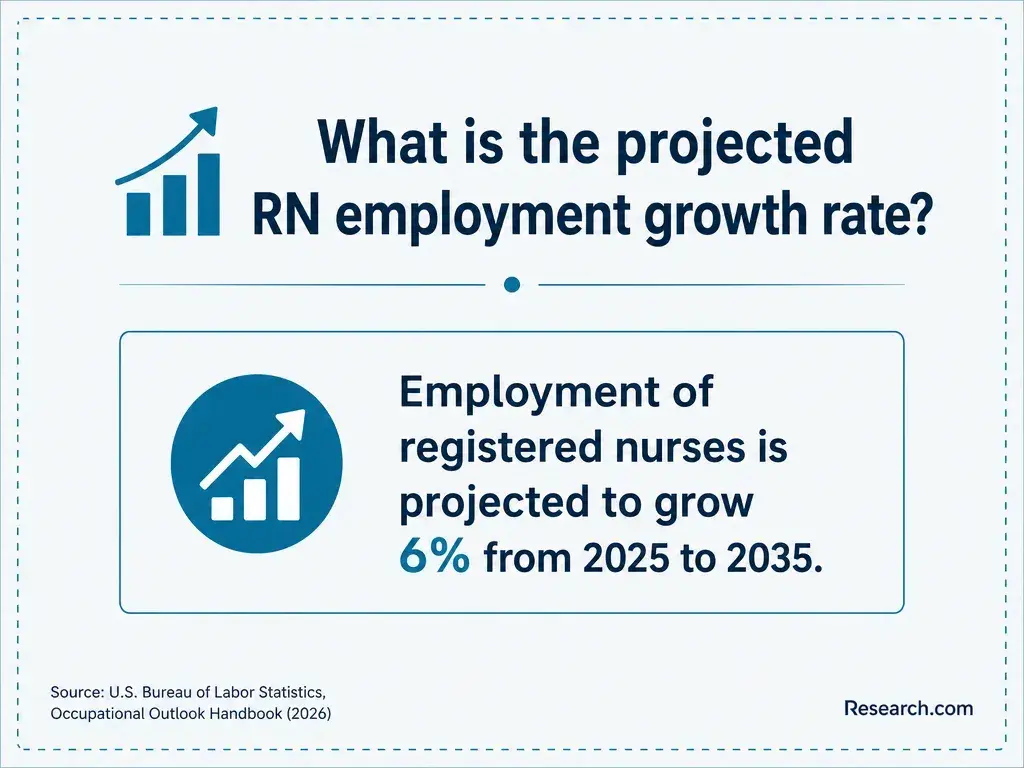
There is no single "doctoral-prepared nurse" salary in Montana. Pay depends on the occupation, duties, employer, experience, location, and whether the nurse practices as an RN, a licensed APRN, an educator, or a researcher. Likewise, an occupational employment projection is not a forecast of vacancies for DNP or PhD graduates in a particular Montana community.
For a useful comparison, identify the exact role first, then consult the most recent U.S. Bureau of Labor Statistics wage and outlook figures for that occupation alongside Montana job postings and employer pay ranges. Treat national medians as occupation-wide context, not a starting offer or a return promised by a doctorate.
A BSN-prepared nurse weighing earnings against education costs should also compare budget-conscious graduate nursing options for BSN nurses before assuming the doctoral route is financially necessary.
What Montana licensure and certification requirements apply after doctoral nursing study?
A nursing doctorate does not issue or renew an RN license. Nurses must maintain the license required for their work. For a new APRN role, confirm the Montana Board of Nursing's applicable licensing requirements, the accepted national certification for the specific role and population focus, and any employer credentialing requirements. A non-APRN DNP or PhD does not confer NP authority.
Graduates of out-of-state or online programs should confirm Montana eligibility before enrolling, including whether their clinical education and program track support the intended certification and license application.
When comparing cost comparisons across online NP pathways, exclude options that cannot confirm the necessary Montana placement and professional-eligibility conditions, regardless of price.
Other Things You Should Know About Nursing Programs
Not universally. A program may value publications, but it may instead assess research interests, methods preparation, writing, and fit with available faculty.
Prior work can help shape a research question, but the PhD program decides whether any work counts toward its requirements. Do not assume a practice project replaces original dissertation research.
Yes, if the program encourages it. Ask whether the faculty member is accepting students and whether your question, methods, and likely data access align; a conversation is not an admission or supervision commitment.
Only with the necessary employer permission, privacy safeguards, and institutional review or determination. Employment does not automatically grant research access to patient or organizational data.
- Examination | ky.gov https://kbn.ky.gov/Registered-Nurse/Pages/rn-examination.aspx
- Barrier for BSN students to pursue a PhD in nursing... - PMC https://pmc.ncbi.nlm.nih.gov/articles/PMC8678190/
- Health Workforce Shortage Areas | hrsa.gov https://data.hrsa.gov/topics/health-workforce/shortage-areas
- Graduate Student Financial Support | University of Montana https://www.umt.edu/sociology//graduate/financial-support.php
- D.N.P. to Ph.D. in Nursing | Nova Southeastern University https://nursing.nova.edu/degrees/doctoral/dnp-phd.html
- DNP vs. Ph.D.: What's The Difference? | Boundless Learning Online Learning Services https://onlinedegrees.bradley.edu/blog/dnp-vs-phd
- BSN to DNP vs. MSN to DNP: Which Pathway Works for You? | Herzing University https://www.herzing.edu/blog/bsn-dnp-vs-msn-dnp-which-pathway-works-you
- DNP vs. Ph.D. in Nursing: Key Differences, Careers and Focus | STU https://online.stu.edu/degrees/healthcare/dnp/dnp-vs-phd/
- DNP vs. PhD in Nursing: Which Terminal Degree Fits Your Goals? | Arkansas State University Online https://degree.astate.edu/online-programs/healthcare/dnp/general-practice/dnp-vs-phd-nursing/