2027 Paying for an Online Ed.D. in Leadership and Learning in Organizations: A Family Budget Built Around Part-Time Study
Audited and Verified:
Our Editorial and Data Verification Process
Research.com uses government datasets, official education statistics and primary institutional information to support its career and degree guides. Our review process checks factual accuracy, occupational definitions, source dates and the requirements associated with the credentials discussed.
How This Article Was Fact-Checked
Our editorial team verifies salary estimates, employment projections, education requirements and program information against original data providers and official organizations. Salary figures are checked against the relevant occupational definitions and reporting periods. Information about licensure, accreditation and required in-person training is reviewed separately.
Fact-checked and verified on:

Co-Founder and Chief Data Scientist
A part-time online Ed.D. can fit around a job without fitting neatly around a family budget. Tuition bills arrive by term, while childcare, travel, and time away from work may vary throughout the program. For working parents considering Leadership and Learning in Organizations, the decision is not simply whether the degree is affordable on paper. It is whether the household can sustain the payments and weekly commitments through completion. This guide shows you how to price the full commitment, test a realistic study schedule, and decide when employer support or a less costly alternative changes the answer.
Key Things You Should Know
- Budget by term, not just by advertised tuition: include required fees, materials, childcare, convening travel, and any earnings you would forgo.
- Part-time enrollment spreads charges across more terms but may add continuation costs; obtain the program's course sequence and billing rules before comparing options.
- Do not budget around a presumed promotion: the U.S. Bureau of Labor Statistics reports a $133,000 median annual salary for training and development managers in 2025, not an expected salary for Ed.D. graduates.
What is an online Ed.D. in Leadership and Learning in Organizations?
It is a practice-oriented doctorate focused on how people learn and how leaders improve organizations. Depending on the university, students may study adult learning, leadership, organizational change, and applied research, then complete a capstone or dissertation specified by the program. "Online" describes where much of the instruction occurs; it does not establish that classes are self-paced or that campus visits are unnecessary.
The degree can suit a parent who already leads training, organizational improvement, or cross-functional work and wants deeper methods for evaluating it. It is less direct if the immediate goal is a single technical skill or an entry-level career change. Compare the exact curriculum and award name - not just similar-sounding titles - when using Ed.D. concentration planning for doctoral applicants.
How much does an online Ed.D. in Leadership and Learning in Organizations cost?
There is no reliable universal price. A school may charge by credit, term, or program, and the advertised figure may exclude fees or required travel. Request a written estimate based on your proposed part-time sequence, including the final project stage. For initial comparisons, organizational leadership doctorate tuition comparisons can help identify programs to investigate, but each school's current bill and degree requirements control your budget.
The following categories show what belongs in a household estimate and why a tuition-only comparison can mislead.
| Cost category | What to confirm | Family-budget effect |
| Tuition and required fees | Billing basis, required credits, annual changes, and continuation charges | Determines the amount and timing of school payments |
| Materials and technology | Required books, software, equipment, and connectivity | Can create expenses outside the tuition bill |
| Campus convenings | Required attendance, dates, travel, lodging, and meals | May require advance savings and caregiving coverage |
| Care and employment | Extra childcare, reduced hours, unpaid leave, or missed shifts | Changes household cash flow even when the school does not charge for it |
| Applied project | Any required travel, data access, or project-related expenses | May arise late in the degree, subject to program and employer rules |
Ask whether aid and any scholarship continue during reduced-credit or project-only terms. Do not assume a professional doctorate receives PhD-style funding, or that stretching the program over more terms leaves its total cost unchanged.
How can families budget for part-time online Ed.D. study?
Build a term-by-term cash-flow plan alongside a weekly care plan. For each term, enter confirmed school charges and expected household expenses, subtract only funding you are eligible to receive, and identify when each payment or reimbursement arrives. A family that can afford the total cost may still struggle with a tuition bill due before employer reimbursement.
Use these steps to stress-test the plan before paying a deposit:
- Get the program's part-time course map, payment calendar, required meeting times, convening dates, and projected completion requirements in writing.
- Price care for live classes, group meetings, independent study, and any travel; assign a backup caregiver for predictable schedule conflicts.
- Check employer assistance for annual limits, eligible courses, grade rules, payment timing, continued-employment conditions, and repayment obligations.
- Set aside a reserve for a delayed course, extra project term, job change, or family interruption; ask the school how a leave would affect tuition and aid.
- Compare the resulting term payments with what the household can spare without relying on an unconfirmed raise, scholarship, or promotion.
Employer help is valuable only to the extent that its terms work for your family. Discuss a formal written agreement rather than treating a manager's encouragement as guaranteed funding. Guidance on employer tuition support for higher education leadership study can help frame that conversation, although your employer's policy is decisive.
If the plan works only when every term goes perfectly, consider delaying enrollment, studying more slowly where permitted, or choosing a targeted certificate or employer leadership program instead.
An online Ed.D. can be awarded by an institution with recognized institutional accreditation, but accreditation must be checked for the specific university. Confirm the institution's current status with its accreditor and ask the program whether any additional recognition applies to the degree. Institutional accreditation does not, by itself, establish eligibility for a regulated school leadership role.
Employer recognition is a separate question. For a parent weighing substantial household expense, examine postings and speak with hiring managers in the target sector: do they value a practice-oriented doctorate, demonstrated leadership results, a particular license, or some combination? A credible degree may strengthen an experienced candidate's work without substituting for the experience a role requires.
Relevant study may connect adult learning and leadership theory with needs assessment, organizational change, program evaluation, and qualitative or quantitative inquiry. Those subjects matter financially when you can apply them to responsibilities you already hold: a workplace learning project may make study more useful than coursework disconnected from your job. Course titles alone, however, do not show how deeply a program teaches a skill.
Ask to see the required sequence, live and group-work expectations, and the rules for its capstone or dissertation. A workplace project may need employer permission, faculty approval, and appropriate privacy or research review. Do not budget on being able to use restricted employee or learner data - or on completing the project during paid work hours - without authorization.
Requirements vary. Programs may ask for a completed graduate degree, transcripts, professional experience, recommendations, a statement of purpose, and evidence that the applicant can undertake doctoral work. Some may specify grades, interviews, or research preparation. Ask the admissions office which conditions apply to your entry term rather than assuming an education master's or a particular job title is universally required.
Prior graduate credits deserve a financial check: credits that establish admission eligibility do not necessarily transfer into Ed.D. requirements or reduce tuition. If you hold an education specialist degree, review education specialist graduates considering a doctorate, then request an official, program-specific credit evaluation before counting on savings.
The answer depends on the required course sequence, how often courses run, enrollment limits, and the time allowed for the final project. "Part-time" may reduce the number of courses taken at once while increasing the number of billed terms. A family should request a sample schedule through graduation, not just a stated minimum completion time.
Test that schedule against school holidays, work peaks, and caregiving. Confirm whether live attendance and campus convenings are mandatory, when group projects occur, and what happens if you pause or change employers during applied research. If a longer path substantially raises the estimated bill, compare budget-conscious Ed.D. degree options using each program's actual part-time policies.
Depending on prior experience, graduates may pursue greater responsibility in learning and development, organizational development, workforce programs, consulting, or education administration. A training manager may use applied evaluation to improve development programs; a nonprofit leader may use organizational inquiry to guide staff learning. Neither move follows automatically from earning the degree.
For a family budget, the strongest case is often a defined role or organizational problem that requires deeper capability and for which the employer recognizes doctoral study. Compare job requirements with your current experience. If the main gap is facilitation, instructional design, or managing a larger team, supervised work and focused training may be faster and cheaper than a doctorate.
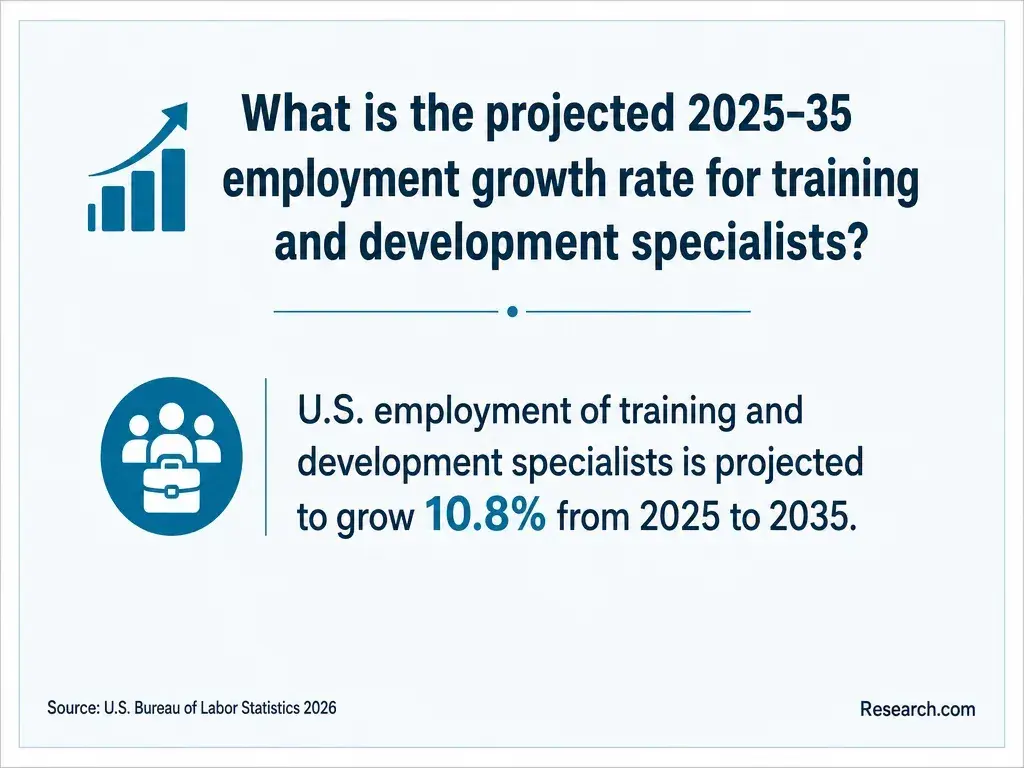
There is no single Ed.D. graduate salary. Pay depends on occupation, sector, location, responsibility, and experience. The U.S. Bureau of Labor Statistics reports a 2025 median annual salary of $133,000 for training and development managers, with employment projected to grow 6.4% from 2025 to 2035. That occupational median includes people with different educational backgrounds; it is neither an entry salary nor evidence of a doctorate-related pay increase.
For a useful household calculation, compare your current compensation with pay ranges for roles you could realistically qualify for after study. Count an expected increase only if it is supported by an actual employer policy, offer, or credible advancement path - not by a broad occupational median.
Do Ed.D. graduates need licenses or certifications for leadership careers?
Many organizational learning and development roles do not require a state-issued license, though employers may prefer particular experience or certifications. School principal and other regulated education roles are different: requirements depend on the state and position, and a broadly focused organizational leadership Ed.D. should not be treated as a licensure program.
If licensure is central to your planned return on the degree, obtain the program's licensure disclosure and confirm eligibility with the relevant state authority before committing household funds. If a professional certification is the actual hiring requirement, compare that route's time and cost with doctoral study.
Other Things You Should Know About EdD Leadership
Keep enough accessible savings to handle the household emergencies you normally plan for. If tuition would eliminate that cushion, consider delaying enrollment or finding a less costly route rather than assuming future aid will fill the gap.
Some employers can; others reimburse employees after grades are posted. Ask payroll or benefits staff which arrangement applies and when you would owe the university.
Review any tuition-assistance repayment clause and ask the program whether the change affects an approved workplace project. A new employer's willingness to provide data access or study time is not automatic.
Only if the program and organization permit it. Ask about ownership and confidentiality, then prepare a redacted account of your methods and responsibilities rather than sharing restricted records or identifiable results.
- 7 Options if You Didn't Receive Enough Financial Aid | studentaid.gov https://studentaid.gov/articles/financial-aid-not-enough/
- An essential guide to building an emergency fund | consumerfinance.gov https://www.consumerfinance.gov/an-essential-guide-to-building-an-emergency-fund/
- Employer-offered educational assistance programs can help pay for college | Internal Revenue Service https://www.irs.gov/newsroom/employer-offered-educational-assistance-programs-can-help-pay-for-college
- Childcare Costs, Reduced Work, and Financial Strain | commerce.gov https://www.commerce.gov/news/blog/2024/06/childcare-costs-reduced-work-and-financial-strain-new-estimates-low-income
- Cost of Attendance (Budget) | 2025-2026 Federal Student Aid Handbook https://fsapartners.ed.gov/knowledge-center/fsa-handbook/2025-2026/vol3/ch2-cost-attendance-budget
- Tuition and Estimated Costs | erau.edu https://erau.edu/admissions/tuition-and-costs
- Cost of Attendance | Tuition & Finance | GCU Blog https://www.gcu.edu/tuition/cost-attendance
- and Ask For - Employer Tuition Reimbursement Benefits | Harvard Extension School https://extension.harvard.edu/blog/how-to-use-and-ask-for-employer-tuition-reimbursement-benefits/
- How Should I Complete My Master's Degree? | Walden University https://www.waldenu.edu/online-masters-programs/resource/full-time-vs-part-time-how-should-i-complete-my-masters-degree
- Online Ed.D. in Organizational Leadership | UMass Global https://www.umassglobal.edu/academic-programs/doctor-education-organizational-leadership