2027 Online RN-to-MSN and ADN-to-MSN Programs for Nurses in Kansas: Entry Routes, Costs, and Practicum
Audited and Verified:
Our Editorial and Data Verification Process
Research.com uses government datasets, official education statistics and primary institutional information to support its career and degree guides. Our review process checks factual accuracy, occupational definitions, source dates and the requirements associated with the credentials discussed.
How This Article Was Fact-Checked
Our editorial team verifies salary estimates, employment projections, education requirements and program information against original data providers and official organizations. Salary figures are checked against the relevant occupational definitions and reporting periods. Information about licensure, accreditation and required in-person training is reviewed separately.
Fact-checked and verified on:

Co-Founder and Chief Data Scientist
An online MSN can let a Kansas RN advance without leaving work, but the entry route matters as much as the specialty. Some programs accept associate-prepared nurses directly into a bridge; others require a BSN first. "Online" may still mean scheduled classes, campus visits, and supervised practice at an approved site. This guide helps licensed nurses compare those routes, check whether a program supports their intended role in Kansas, and estimate the time, cost, and placement work involved before applying.
Key Things You Should Know
- An ADN-to-MSN bridge accepts an eligible RN without a BSN; an RN-to-BSN followed by an MSN is a separate route and may award two degrees rather than one.
- Check three distinct requirements before enrolling: institutional accreditation, nursing-program accreditation, and whether the school can enroll you and support required practice in Kansas.
- Online coursework does not eliminate supervised practicum requirements; ask who secures the site and preceptor, what hours are required, and whether your workplace qualifies.
What are online RN-to-MSN and ADN-to-MSN programs in Kansas?
These are postlicensure pathways: they build on an existing RN license rather than prepare a non-nurse for the NCLEX-RN. "RN-to-MSN" describes the progression from RN preparation to a master's degree. "ADN-to-MSN" specifies that an associate-degree nurse can enter without first earning a BSN. Schools use the labels differently, so the admission credential and degrees awarded matter more than the program name.
The routes below differ most in where bachelor's-level work occurs and whether a BSN is awarded along the way.
| Route | Starting point | What to confirm |
| Direct ADN-to-MSN bridge | Licensed RN with an associate degree or qualifying diploma | Bridge courses, any bachelor's award, and entry into the chosen MSN track |
| RN-to-BSN, then MSN | Licensed RN without a BSN | Separate admissions decisions, transfer credits, and total cost of both degrees |
| BSN-to-MSN | Licensed RN with a BSN | Specialty prerequisites and graduate admission requirements |
For Kansas residents, the school need not be physically in Kansas, but it must be able to enroll them and arrange required practice there. If you do not yet hold an RN license, start with entry-level nursing degree comparisons, not a postlicensure bridge.
Which Kansas RN-to-MSN and ADN-to-MSN programs are properly accredited?
No school should be treated as a confirmed, currently available ADN-to-MSN option solely because it advertises an online MSN or an RN-to-BSN program. Kansas nurses can investigate graduate nursing offerings at institutions such as the University of Kansas Medical Center, Wichita State University, and Fort Hays State University, but must check the current catalog for an explicit entry route from their credential, the intended MSN specialty, and Kansas enrollment eligibility. An RN-to-BSN plus a separate MSN is not automatically a direct bridge.
Verify institutional accreditation through the institution's accreditor and nursing-program accreditation through the applicable CCNE or ACEN directory. Check that the accreditation covers the relevant nursing degree; a school-wide accreditation claim alone does not establish that. Then obtain written confirmation from the program that it accepts Kansas students, permits the proposed clinical location, and prepares graduates for any intended certification or regulated role. State board approval associated with initial RN education, graduate-program accreditation, and authorization for a particular student's placement answer different questions.
An ADN-to-MSN bridge program guide can help identify routes to investigate, but the school, accreditor, and relevant regulator must confirm the status of the exact track and entry term.
What are the admission requirements for Kansas online RN-to-MSN programs?
Most postlicensure routes require an eligible, unencumbered RN license, transcripts from an approved nursing program, and satisfactory undergraduate academic work. Schools may also require a minimum GPA, statistics or other prerequisites, recommendations, a résumé, a statement of goals, or relevant RN experience. An APRN track may impose additional specialty-specific requirements. Admission to the university does not necessarily guarantee entry into the nursing major or preferred MSN track.
Ask admissions to evaluate your transcripts against the specific bridge curriculum: an ADN, nursing diploma, prior non-nursing bachelor's degree, and previous graduate credits may be treated differently. Request a written degree audit showing which credits actually satisfy requirements, not merely which credits transfer. Also ask about background checks, immunizations, and site requirements that could affect clinical eligibility after academic admission.
Do not assume a prelicensure TEAS or HESI policy applies to licensed-RN graduate admission. If entrance testing is a concern, comparing nursing school acceptance requirements may help frame your questions, but obtain the current requirements directly from each MSN program.
An ADN-to-MSN pathway typically places bachelor's-level nursing or general-education coursework before graduate courses, or integrates it into a prescribed bridge sequence. Do not assume it awards a BSN: some routes lead to the MSN without a separate bachelor's credential. That distinction matters if an employer requires a BSN specifically or if you later apply to a program with bachelor's-degree prerequisites.
Compare a direct bridge with RN-to-BSN followed by MSN using the complete degree audit. A bridge may avoid duplicate applications or coursework, while a separate BSN offers a recognized stopping point if graduate study is delayed. The better route depends on accepted credits, specialty availability, employer tuition rules, and whether you can maintain the sequence while working. Prior RN employment may strengthen an application, but it does not automatically replace required courses or supervised graduate hours.
Most licensed-RN graduate bridges do not use the same entrance exams as initial RN programs. If you are also weighing a return to prelicensure education, exploring nursing admission without these entrance exams addresses that different admissions decision.
Bridge coursework fills gaps between associate-level preparation and graduate study. Depending on the school, it may cover population health, nursing research, evidence appraisal, leadership, and professional practice. MSN coursework then follows the selected role: education programs emphasize teaching and learner assessment; leadership programs address operations and improvement; APRN programs require population-focused advanced clinical preparation.
The specialty is a consequential choice. A nurse educator or administration MSN is not interchangeable with a family or psychiatric-mental health nurse practitioner program. NP preparation involves its own advanced assessment, pathophysiology, pharmacology, and supervised patient-care requirements. If you already hold a graduate nursing degree and want a different advanced practice focus, short-format online PMHNP study concerns certificate routes, not a substitute for assessing an initial ADN-to-MSN curriculum.
Online classes do not make practice hours virtual. APRN tracks require supervised experiences with the relevant patient population; non-APRN tracks may require an approved teaching, leadership, or other applied practicum. The program sets its educational requirements, approves sites and preceptors, and evaluates student work. A site and preceptor must also agree to participate, and the experience must satisfy applicable certification and regulatory rules.
Before paying a deposit, get written answers about who finds the site, who negotiates affiliation agreements, when approval must occur, whether Kansas placements are supported, and what happens if a placement falls through. Ask about daytime hours, campus visits, simulation, and whether a current employer can serve as a site. Employment alone does not turn work hours into approved practicum hours; faculty oversight, objectives, supervision, and documentation still matter.
Placement policies can decide whether an NP route is feasible for a working nurse. For a relevant comparison, see planning family NP study around clinical placement policies, then confirm what the particular school actually guarantees.
There is no reliable single completion time for Kansas nurses. A direct bridge adds undergraduate-level work before or alongside the MSN; an RN-to-BSN followed by a separate MSN adds another degree sequence and potentially another admission cycle. Transfer-credit decisions, part-time enrollment, specialty course schedules, and placement availability can all change the finish date.
Ask for a term-by-term plan based on your transcripts and intended track. Check whether required courses run every term, how long you may pause enrollment, and whether a delayed practicum postpones graduation. If comparing accelerated specialties, planning a faster MSN-PMHNP pathway is useful only if its clinical schedule and entry requirements remain workable for you.
A defensible price comparison requires a school-specific quote; a per-credit tuition rate alone is not the cost of an ADN-to-MSN. No single Kansas price applies across bridge, MSN, and specialty tracks. Request the total number of credits you must take, the charge per credit, mandatory fees, and the term-by-term billing schedule. Do not count a possible credit waiver until it appears in a written evaluation.
The following cost categories help expose differences that a tuition-only comparison misses.
| Cost category | What to include in your estimate |
| Academic charges | Bridge and graduate tuition, program fees, technology, books, and continued-enrollment charges |
| Practice expenses | Screenings, immunizations, travel, parking, lodging, and any required campus attendance |
| Career-entry expenses | Applicable certification examination, license application, and credentialing fees |
| Household impact | Reduced work hours, childcare, and employer-reimbursement conditions |
Compare the net cost of a bridge with RN-to-BSN plus MSN, including any employer assistance that applies to one stage but not another. A later DNP is a separate investment; admission-focused nursing practice doctorate comparisons address a different credential and should not be folded into an MSN price quote.
An RN-to-MSN student must maintain the RN license required by the program and clinical sites. Graduation from an MSN does not itself grant a new license or certification. For a non-APRN education or leadership role, the relevant requirements depend on the employer and position; the MSN does not expand the RN's legal scope of practice.
For a Kansas NP role, verify that the specific population-focused track meets the eligibility rules of its national certifying organization and Kansas Board of Nursing requirements for advanced practice authorization. Certification examination eligibility, passing the examination, state authorization, and employer credentialing are distinct steps. A graduate of a non-APRN MSN cannot rely on that degree alone to practice as an NP.
Already-certified APRNs considering another population focus should request a formal review of prior courses and supervised experiences. FNP certificate routes for changing advanced practice focus may be more direct than a second MSN, but previous hours do not automatically satisfy new-track requirements.
What careers, salaries, and job outlooks follow a Kansas MSN?
An MSN's career value depends on the track and the nurse's experience. Education graduates may pursue staff-development or teaching positions; leadership graduates may seek management or quality roles; appropriately prepared and authorized NP graduates may pursue advanced clinical positions. An MSN alone does not guarantee promotion, an APRN job, or a pay increase. Some faculty and senior leadership positions require additional qualifications or substantial experience.
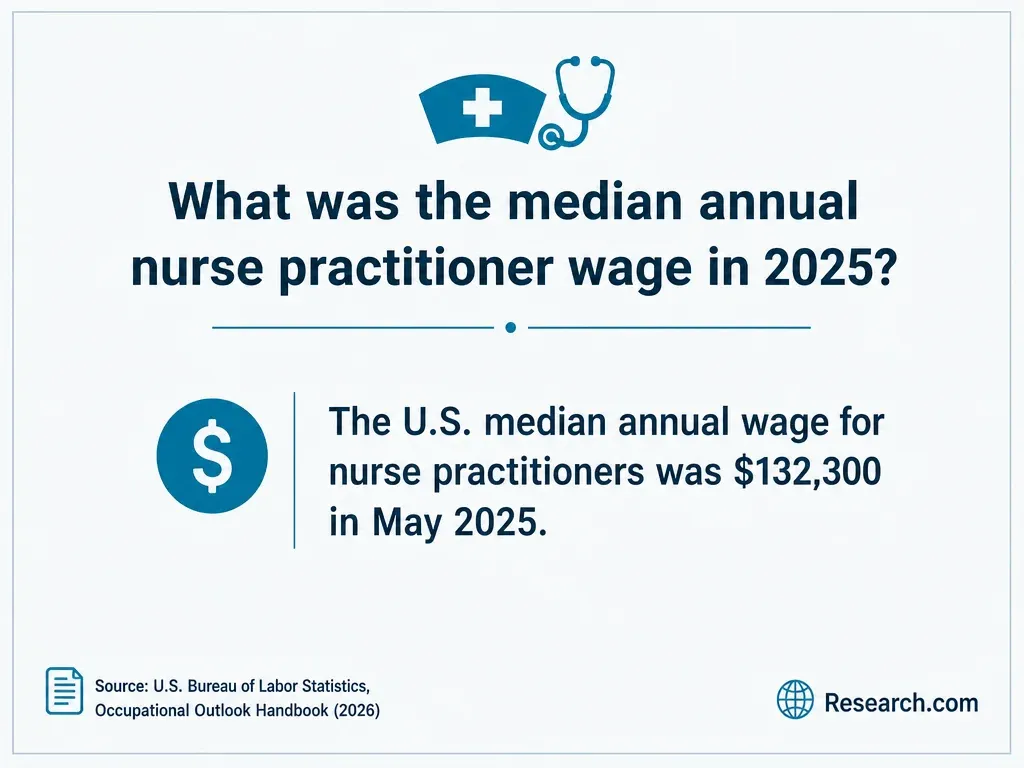
For salary comparisons, use the U.S. Bureau of Labor Statistics occupation matching the intended job - such as registered nurse, nurse practitioner, or nursing instructor - and check its latest wage reference year and projection period. Those occupation-wide figures are not Kansas MSN-graduate starting salaries: specialty, setting, geography, schedule, and experience affect offers. Compare actual Kansas postings and employer pay ranges with the program's full cost and the income you might forgo during practicum terms.
If the target position requires a practice doctorate, compare that next step only after establishing whether an MSN meets your immediate goal. Online DNP timelines for working nurses provide a separate planning reference, not evidence that every MSN graduate needs a DNP.
Other Things You Should Know About Nursing
Possibly, but confirm live-class times, course load, practicum shifts, and any campus attendance. A program's online label does not promise evening or weekend clinical hours.
Not by itself. The school must accept Kansas residents and permit the required Kansas practice experiences; ask for confirmation for your entry term and track.
Ask the program before enrolling. Shared courses may apply, but specialty seats, prerequisites, supervised hours, and graduation timing can differ.
Request a written degree audit, term plan, total-cost estimate, placement policy, and confirmation of the credential for which your chosen track prepares graduates.
- Accreditation in the U.S. | ed.gov http://www.ed.gov/laws-and-policy/higher-education-laws-and-policy/college-accreditation/accreditation-in-the-us
- RN-to-MSN: Registered Nurse to Master of Science in Nursing | University of Maryland School of Nursing https://www.nursing.umaryland.edu/academics/grad/registered-nurse-to-masters/
- Online RN to BSN Clinical Requirements | MDC Online https://online.mdc.edu/blog/online-rn-to-bsn-clinical-requirements/
- Master of Science in Nursing | kumc.edu https://www.kumc.edu/school-of-nursing/academics/master-of-science-in-nursing.html
- Clinical Information - Nursing Students - UW-Madison https://students.nursing.wisc.edu/clinical-information/
- Online RN to MSN Program | Wilkes University Online https://onlinenursingdegrees.wilkes.edu/programs/rn-msn-online
- Clinical Policies | Research College of Nursing https://researchcollege.edu/student-services/clinical-policies/
- KU Graduate Tuition & Fees | Estimate Your Costs https://gradapply.ku.edu/afford/cost
- Online RN to MSN Bridge Programs - Master of Nursing | Aspen University https://www.aspen.edu/nursing/rn-msn/
- Direct Entry MSN Programs: A Path to Nursing Without a BSN | Alverno MSN https://msn.alverno.edu/articles/direct-entry-msn-explained