2027 Women's Health NP Program Guide for Nurses in Pennsylvania: MSN Options and Clinical Planning
Audited and Verified:
Our Editorial and Data Verification Process
Research.com uses government datasets, official education statistics and primary institutional information to support its career and degree guides. Our review process checks factual accuracy, occupational definitions, source dates and the requirements associated with the credentials discussed.
How This Article Was Fact-Checked
Our editorial team verifies salary estimates, employment projections, education requirements and program information against original data providers and official organizations. Salary figures are checked against the relevant occupational definitions and reporting periods. Information about licensure, accreditation and required in-person training is reviewed separately.
Fact-checked and verified on:

Co-Founder and Chief Data Scientist
For a Pennsylvania RN considering women's health advanced practice, the hardest part of choosing an MSN is often not the coursework - it is confirming that the specialty track leads toward WHNP certification and that its clinical placements are feasible. Programs differ in delivery, preceptor arrangements, and the populations students can see. This guide explains the Pennsylvania options worth investigating, how to plan supervised clinical experiences, and what to check before committing tuition or changing your work schedule. It also separates graduation from the certification and state authorization needed to practice.
Key Things You Should Know
- A WHNP MSN is a postlicensure advanced practice track, not an initial RN program; confirm that the specific track prepares graduates for the National Certification Corporation's WHNP-BC examination.
- Investigate the University of Pennsylvania and Drexel University as Pennsylvania-based MSN leads, but verify each school's current WHNP admissions status, format, clinical hours, and eligibility for your intended entry term.
- Plan placements before enrolling: online coursework does not remove supervised clinical requirements, and Pennsylvania practice requires state CRNP authorization in addition to national certification.
What Is a Women's Health Nurse Practitioner Program in Pennsylvania?
A women's health nurse practitioner (WHNP) MSN prepares an already-licensed RN for advanced assessment, diagnosis, management, and prevention within women's health and gender-related care. The track combines graduate nursing courses with supervised patient-care experiences. It differs from a general MSN in education or leadership: those degrees do not, by themselves, provide WHNP preparation.
The intended outcome matters more than the degree label. An applicant seeking gynecologic and reproductive health practice should confirm WHNP-specific coursework, clinical experiences, and eligibility for the National Certification Corporation (NCC) WHNP-BC exam. An applicant seeking initial RN licensure needs a different route; non-nursing bachelor's to direct-entry MSN options address a separate starting point and should not be mistaken for an RN-to-WHNP track.
What Are the Requirements to Become a Women's Health Nurse Practitioner in Pennsylvania?
The usual sequence is to hold an RN license, complete an appropriate graduate WHNP track, meet NCC's examination requirements, earn WHNP-BC certification, and obtain Pennsylvania certified registered nurse practitioner (CRNP) authorization for the applicable specialty. Requirements for prescriptive authority are a further consideration. Confirm current applications and practice conditions with the Pennsylvania State Board of Nursing before making employment plans.
Neither experience in an OB-GYN unit nor an MSN in another concentration automatically replaces WHNP education and supervised clinical preparation. Pennsylvania's CRNP practice rules, including applicable physician-collaboration requirements, also need separate review; national certification is not permission to practice independently of state rules. Nurses who do not yet hold an RN license should first compare RN-qualifying routes, rather than assume that shorter practical nursing study pathways lead directly to NP eligibility.
Which Pennsylvania MSN Programs Offer Women's Health Nurse Practitioner Preparation?
Two Pennsylvania institutions to investigate are the University of Pennsylvania and Drexel University. Treat them as a shortlist, not a promise that a track is accepting students in every term: specialty availability, degree awards, delivery arrangements, and clinical policies can change. Request the catalog and admissions requirements for your intended entry term before applying.
This comparison identifies the decision each school must help you resolve; it does not assume that similarly named tracks have identical requirements.
| Institution to investigate | WHNP MSN decision to verify | Clinical-planning question |
| University of Pennsylvania | Confirm the current women's health/gender-related NP MSN track, entry options, and required attendance. | Which sites and patient encounters can the program arrange or approve for your location? |
| Drexel University | Confirm whether its women's health/gender-related NP MSN is accepting your entry cohort and how courses are delivered. | Who finds preceptors, and what happens if a proposed site cannot be approved? |
Ask each school for its exact specialty-track curriculum, nursing program accreditation information, certification-eligibility statement, state enrollment eligibility, and clinical-placement policy in writing. An ADN-prepared RN should also check whether a BSN or an approved bridge is required; ADN-prepared RN graduate study options do not necessarily include a WHNP track.
Delivery format changes where and when you study, not whether you need approved direct-care experiences. A mostly online track may reduce routine travel while retaining live classes, campus visits, scheduled assessments, and in-person clinical shifts. A campus-based track may make face-to-face instruction easier to access but can create a substantial commute.
The comparison is most useful when based on your actual work hours, location, and available clinical sites rather than an "online" label.
| Planning factor | Mostly online or hybrid track | More campus-based track |
| Academic schedule | May combine asynchronous work with required live sessions or visits | More predictable on-site attendance, but potentially less travel flexibility |
| Clinical learning | Still requires approved in-person sites and preceptors | Also requires approved placements; proximity to campus does not guarantee one |
| Best fit to test | Can you secure sites near home while meeting required session times? | Can you commute without losing access to suitable clinical shifts? |
Request a written breakdown of placement responsibilities and geographic restrictions. Guidance on family NP placement policies before enrollment offers useful questions to ask, but an FNP site or preceptor is not automatically suitable for WHNP clinical objectives.
Expect graduate work in advanced health assessment, pathophysiology, and pharmacology, alongside WHNP-focused study in gynecologic and reproductive health, health promotion, and management across the relevant lifespan. The exact sequence, credit load, and clinical-hour requirement belong to the individual program and must support its stated certification pathway.
Clinical planning is more specific than finding any outpatient practice. Ask whether proposed rotations can provide the required mix of preventive visits, gynecologic concerns, contraception and reproductive care, pregnancy-related care where required, and age-group exposure. The school must approve the site and qualified preceptor, oversee learning, and document accepted hours and competencies. An existing nursing job, simulation activity, or self-arranged shadowing does not automatically count.
This is a key distinction from comparing no-traditional-clinical RN-to-BSN options: a WHNP track prepares for a new advanced practice role and requires supervised specialty preparation. Ask the program what contingency it offers if a proposed preceptor withdraws midterm.
Applicants generally need an RN license and academic preparation acceptable to the school. Programs may also review a BSN or approved bridge credential, GPA, prerequisite courses, nursing experience, recommendations, a statement of purpose, and clinical-site eligibility. Requirements are school- and cohort-specific; admission to a university is not necessarily admission to its WHNP track.
Before applying, obtain a written answer to any entry-status issue that could delay you:
- If you have an ADN or a bachelor's degree outside nursing, ask which bridge credits and prerequisites must be completed before WHNP coursework.
- If you already hold an MSN or NP credential, provide syllabi and supervised-hour records for a formal program review; do not assume prior clinical hours will transfer.
- If you live outside Pennsylvania, ask whether the school can enroll you, approve local clinical sites, and support the certification and licensing route you intend to use.
An applicant without an RN license needs an initial-licensure program first. ABSN programs with flexible admission requirements may be worth comparing for that earlier step, but admission to an ABSN does not reserve a later WHNP place.
There is no reliable single Pennsylvania WHNP MSN price or completion time: credits, enrollment pace, prerequisite or bridge work, fees, and clinical scheduling vary. Ask each school for a term-by-term plan and an itemized estimate for your entry term. A shorter advertised academic sequence may still take longer if required clinical courses are offered only in certain terms or a placement is delayed.
Use the following costs to build a comparable budget; tuition alone will understate what you may pay.
- Program tuition and mandatory university, technology, and clinical-course fees.
- Books or digital materials, screening and health-clearance costs, travel to clinical sites or campus, and any required lodging.
- Certification and Pennsylvania application costs, plus earnings lost if clinical shifts require reduced RN work hours.
Compare total costs under the same credit and time assumptions, and check employer tuition assistance rules before relying on reimbursement. Lower-cost online NP degree options can provide a tuition benchmark, but only a program with the right WHNP track, clinical support, and eligibility should remain on your shortlist.
Graduation, certification, and state authorization are separate milestones. NCC administers the Women's Health Care Nurse Practitioner certification examination and awards WHNP-BC to candidates who meet its requirements and pass. Pennsylvania's State Board of Nursing determines CRNP authorization and any separate prescriptive authority under its current rules; employers may impose additional credentialing and onboarding requirements.
Before your final term, compare your program's graduation documentation with NCC's current eligibility instructions and Pennsylvania's current CRNP and prescribing applications. If you are already an APRN, ask the school and regulators how a new population focus will be documented rather than assuming your existing credential covers women's health practice. Conversely, post-master's FNP certificate completion timelines concern a different certification pathway; an FNP certificate is not a WHNP credential.
WHNPs may work in OB-GYN practices, reproductive-health clinics, ambulatory specialty services, and other settings that provide care within their education, certification, state-authorized scope, and employer privileges. Actual duties depend on the patient population and practice: a position focused on preventive gynecology may offer a different caseload and schedule from one integrated with obstetric services.
Evaluate job descriptions for the patients served, expected procedures, physician-collaboration arrangements, prescribing needs, orientation, and access to consultation. WHNP preparation is not nurse-midwifery preparation and does not itself establish competence or authority to manage labor and birth as a midwife. If your intended work instead centers on psychiatric assessment and treatment, time-efficient PMHNP certificate pathways address another population focus, with their own education and credentialing requirements.
What Salary and Job Outlook Can Pennsylvania Women's Health NPs Expect?
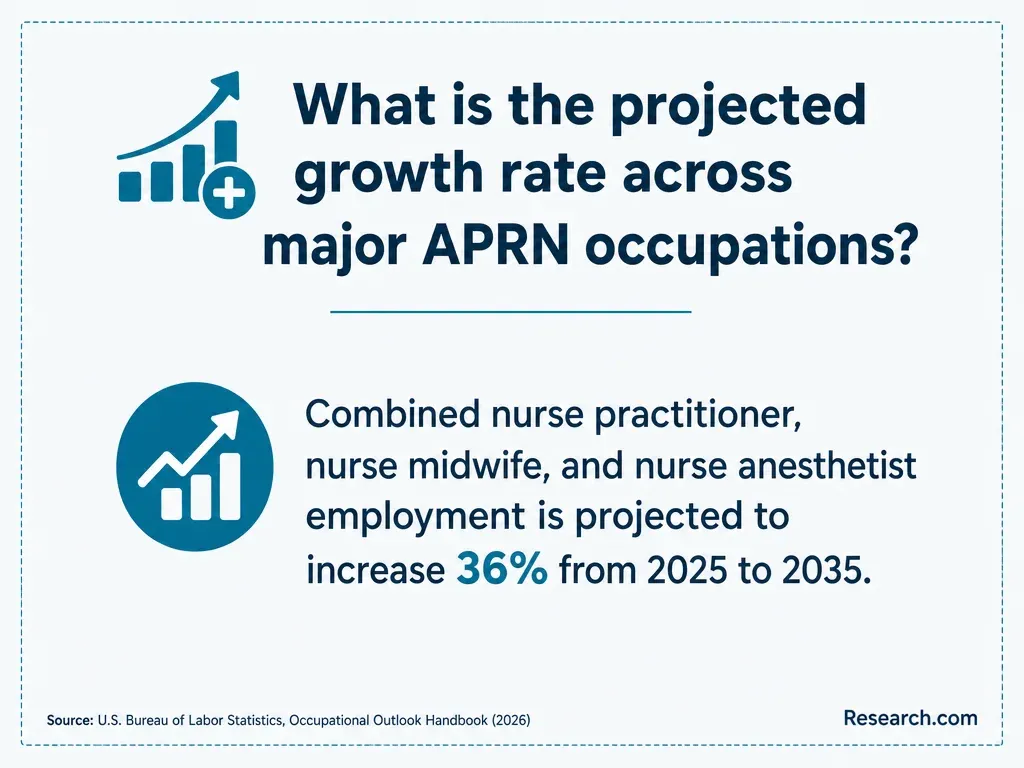
The U.S. Bureau of Labor Statistics reports nurse practitioner employment and wages as an occupation, not WHNP salaries as a separate specialty. Its national NP figures can indicate broader demand, but they cannot predict a Pennsylvania WHNP offer or show how many openings specifically require WHNP-BC. Pay can differ by employer, region, experience, schedule, patient volume, and scope of duties.
For a useful local comparison, review Pennsylvania postings that explicitly accept WHNPs and compare their salary ranges with benefits, call obligations, collaboration arrangements, and clinical support. Then weigh plausible earnings against the program's full cost and any reduced RN income during training. A compressed alternative, such as comparing 12-month family NP programs, is not a shortcut to WHNP certification; it makes financial sense to compare it only if its different population focus fits the work you actually want.
Other Things You Should Know About Nursing
Care is guided by a patient's anatomy, health needs, the clinician's preparation, and applicable scope - not identity alone. Ask programs how they teach inclusive, clinically appropriate gender-related care.
Not automatically. The patient's location can trigger that state's licensing and practice requirements. Check the destination state's rules and employer policy before providing care.
No. Nurse-midwifery has its own educational preparation, certification, and state authorization requirements.
Not solely because you have an MSN. Consider a DNP for a specific practice or leadership goal, and verify whether a particular employer or position requires it.
- Cost of Attendance (Budget) | 2025-2026 Federal Student Aid Handbook https://fsapartners.ed.gov/knowledge-center/fsa-handbook/2025-2026/vol3/ch2-cost-attendance-budget
- Nursing Education Programs | Department of State https://www.pa.gov/agencies/dos/department-and-offices/bpoa/boards-commissions/nursing/nursing-education-programs
- Women's Health/Gender-Related - Penn Nursing https://www.nursing.upenn.edu/womens-health-gender-related/
- Purdue Global Nursing Students: Tips to Find a Clinical Placement https://www.purdueglobal.edu/blog/nursing/how-to-find-clinical-placement/
- Clinical Rotations FAQ - Online Nursing Programs https://online.nursing.georgetown.edu/academics/family-nurse-practitioner-fnp/admitted/clinical-placement-faq/
- MSN Women's Health/Gender Related Nurse Practitioner | Drexel University Online https://www.online.drexel.edu/online-degrees/nursing-degrees/womenshealthnp/index.aspx
- WHNP Programs: What You Need to Know | keiseruniversity.edu https://www.keiseruniversity.edu/articles/whnp-programs-what-to-know/
- Women's Health Nurse Practitioner | Admissions | SUNY Downstate https://www.downstate.edu/education-training/college-of-nursing/admissions/womens-health-np/index.html
- Graduate Clinical Placements | Master of Science in Nursing Handbook 2025-2026 https://u.osu.edu/msnursinghandbook2025/clinical-requirements/specialty-clinical-locations-and-travel/
- CCNE Accreditation | aacnnursing.org https://www.aacnnursing.org/ccne-accreditation